
A single accident with an underinsured driver can leave you facing thousands of dollars in unpaid medical bills and lost income. California law allows you to protect yourself with underinsured motorist coverage, but many drivers don’t understand how it works or whether they have adequate protection.
At Schaar & Silva LLP, we’ve helped accident victims recover compensation when at-fault drivers didn’t carry enough insurance. This guide walks you through what underinsured motorist coverage California actually covers, when you need it, and how to file a claim that gets results.
What Underinsured Motorist Coverage Actually Covers
How Underinsured Motorist Coverage Works
Underinsured motorist coverage pays the difference when an at-fault driver’s insurance falls short of your actual damages. If another driver causes a crash and their liability policy maxes out at $30,000, but your medical bills, lost wages, and pain and suffering total $75,000, your underinsured motorist coverage fills the $45,000 gap-up to your policy limit. California law requires insurers to offer this coverage with every auto policy, and the default limit must match your liability coverage unless you sign a written waiver. As of January 1, 2025, California raised minimum underinsured motorist limits to $30,000 per person and $60,000 per accident through Senate Bill 1107, a significant change that reflects the state’s recognition of the protection gap.
Why the Numbers Matter in California
The Insurance Research Council reported that about 18.0% of drivers nationwide were underinsured in 2023, and when combined with uninsured drivers, roughly one in three U.S. drivers lacked adequate coverage. In California specifically, the uninsured rate hit 20.4% in 2023 according to the Insurance Research Council, ranking the state 8th highest nationally-meaning the odds of hitting an underinsured or uninsured driver are uncomfortably high.
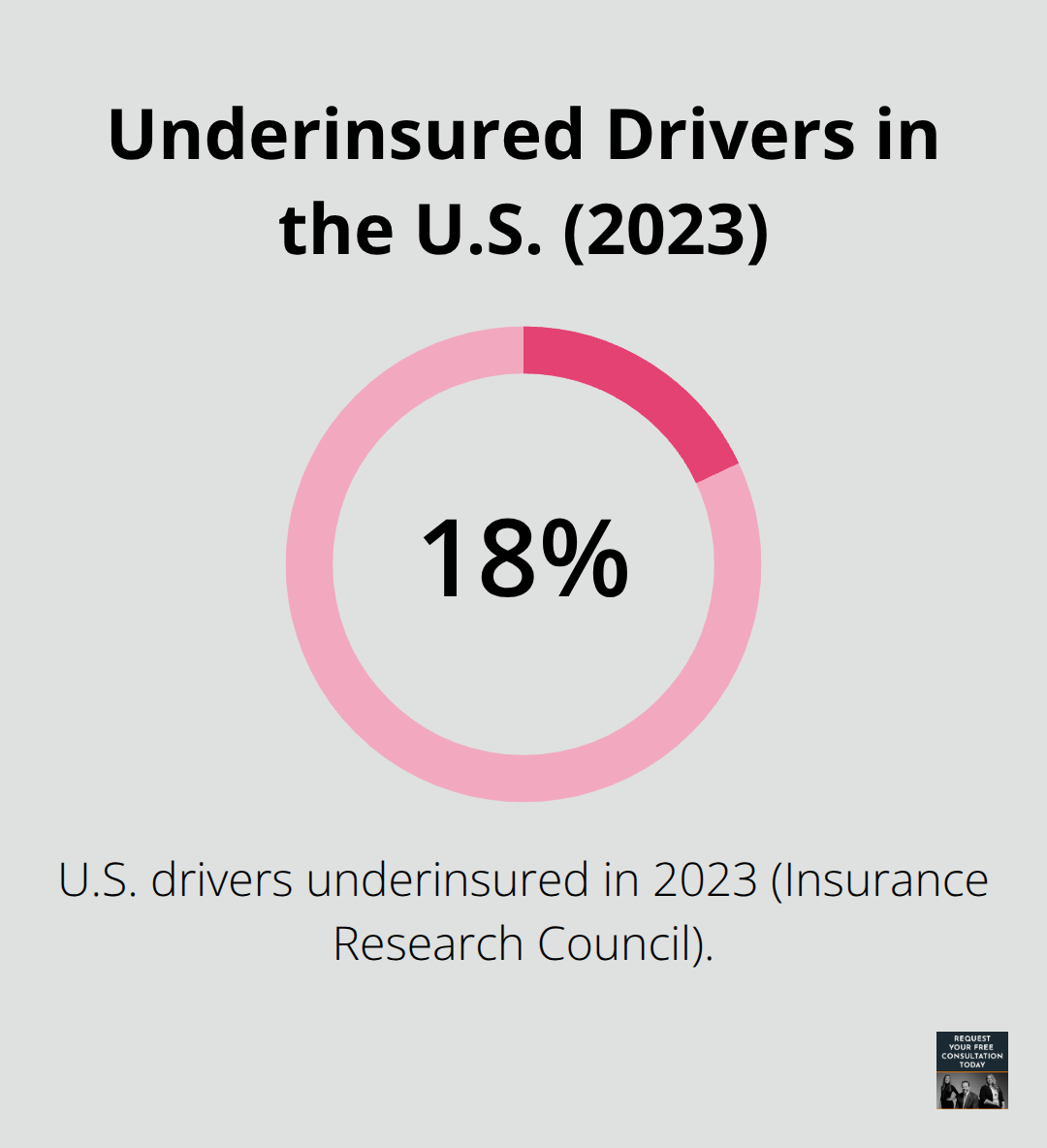
These statistics underscore why California’s 2025 minimum increase matters: more drivers on the road carry insufficient coverage, and you need protection that actually covers your losses.
Underinsured vs. Uninsured Motorist Coverage
The distinction between underinsured and uninsured motorist coverage matters for your recovery strategy. Uninsured motorist coverage applies when the at-fault driver carries zero insurance or is unidentified in a hit-and-run; it covers your medical expenses, lost wages, and pain and suffering up to your policy limit. Underinsured motorist coverage activates only after the at-fault driver’s liability insurance is exhausted, then supplements up to your UIM limit.
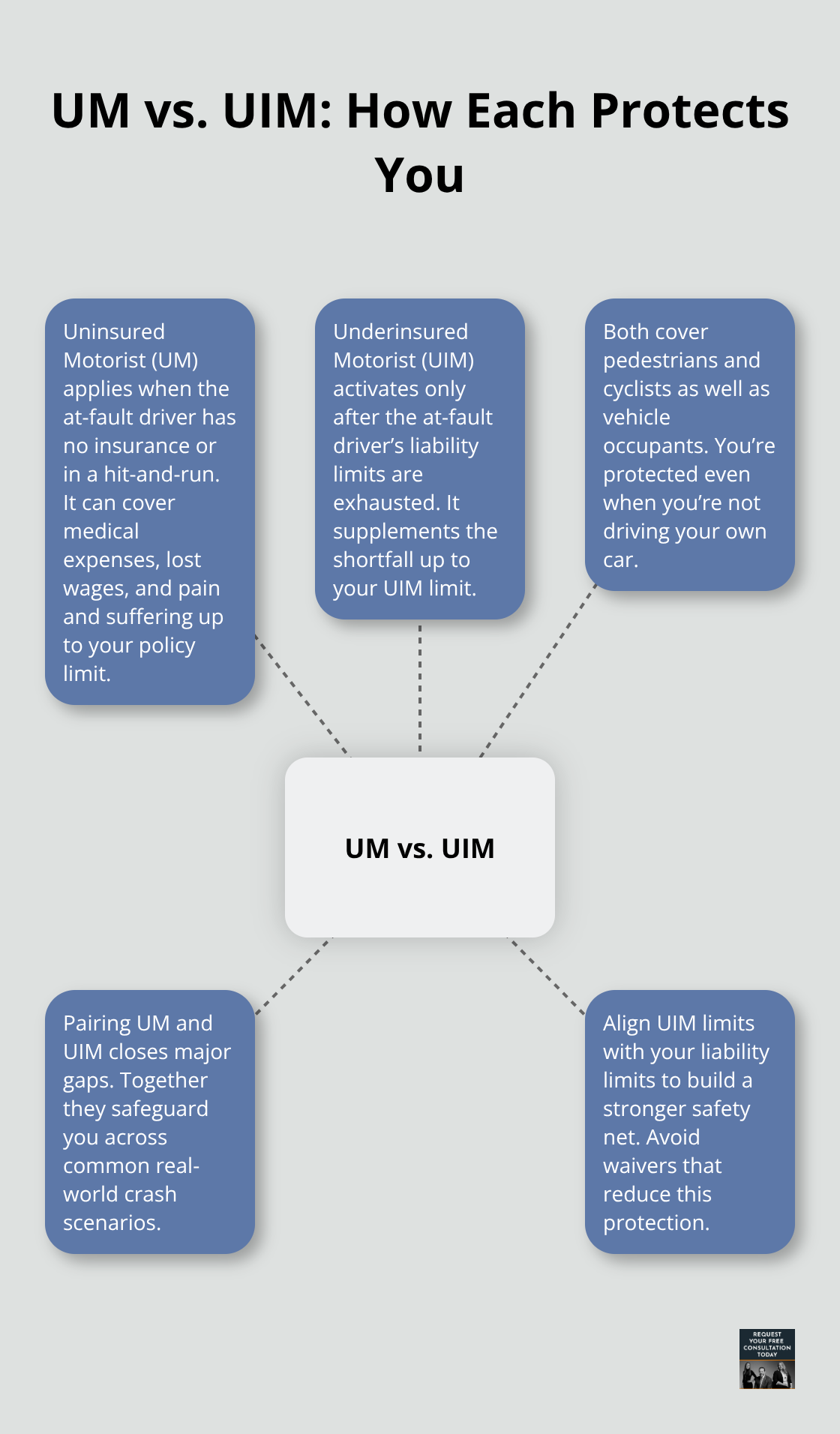
If you’re a pedestrian or cyclist struck by an uninsured or underinsured driver, both coverages protect you even though you weren’t driving a vehicle.
Real Injury Costs Exceed Current Minimums
Traumatic brain injuries can exceed $1,000,000 in lifetime care expenses, far outpacing California’s previous minimum limits. The new 2025 minimums represent progress, but serious injuries still often exceed even the higher thresholds. When you compare your current policy, request explicit underinsured motorist limits from your insurer and confirm no improper waiver exists; aligning your UIM coverage with your liability limits creates a safety net that actually protects your assets and future income. Understanding what your coverage actually pays becomes critical when you face medical bills that dwarf the at-fault driver’s insurance limits.
When Underinsured Drivers Leave You Exposed
The Coverage Gap That Costs You Money
Most accident victims assume the at-fault driver’s insurance will cover their losses. That assumption collapses fast when you face a driver whose liability limits don’t match the actual cost of your injuries. California’s minimum liability coverage sits at $15,000 per person and $30,000 per accident, yet a single hospitalization for a serious injury can exceed $50,000 before you add lost wages, ongoing physical therapy, or pain and suffering damages. The Insurance Research Council found that 18.0% of drivers nationwide were underinsured in 2023, meaning roughly one in five vehicles on the road carry insufficient coverage to protect you.
In California, where the uninsured rate hit 20.4% that same year, the combination of underinsured and uninsured drivers creates a genuine financial threat. Your underinsured motorist coverage activates the moment the at-fault driver’s liability insurance maxes out while your damages continue climbing. If you’re hit by a driver carrying only the state minimum and your medical bills reach $45,000, your underinsured motorist coverage bridges that gap up to your policy limit, protecting your savings and future earnings from being seized to cover unpaid expenses.
Lost Income and Medical Costs Pile Up Fast
The practical reality hits hardest when you’re dealing with lost income alongside medical expenses. A construction worker sidelined for three months loses thousands in wages that the at-fault driver’s $30,000 liability policy won’t cover. A small business owner dealing with a brain injury faces months of cognitive recovery and lost productivity that no at-fault driver’s insurance adequately compensates. Underinsured motorist coverage pays these losses directly to you, bypassing the at-fault driver’s insufficient insurance entirely.
Pedestrians and Cyclists Face the Highest Risk
Pedestrians and cyclists face heightened exposure to underinsured drivers since they have no vehicle protection and often sustain severe injuries. A cyclist hit by a delivery driver carrying minimum coverage faces permanent disability costs that can reach $500,000 or more in lifetime care, yet the at-fault driver’s $15,000 liability limit leaves a devastating gap. Your underinsured motorist coverage fills that gap, which is why California’s 2025 increase to $30,000 per person and $60,000 per accident represents meaningful progress, though serious injuries still frequently exceed even these higher thresholds.
Coverage Extends Beyond Your Own Vehicle
Many drivers overlook that underinsured motorist coverage extends to you as a pedestrian or passenger in another vehicle, not just when you’re driving your own car. This protection applies every time you’re on the road, whether you’re walking to work, riding your bike, or sitting in someone else’s car. When an underinsured driver strikes you in any of these scenarios, your own policy steps in to cover the gap between the at-fault driver’s insufficient limits and your actual damages. Understanding this breadth of protection matters because it means you carry financial safeguards in situations where you have no control over the other driver’s coverage level.
How to File Your Underinsured Motorist Claim
Act Quickly After the Accident
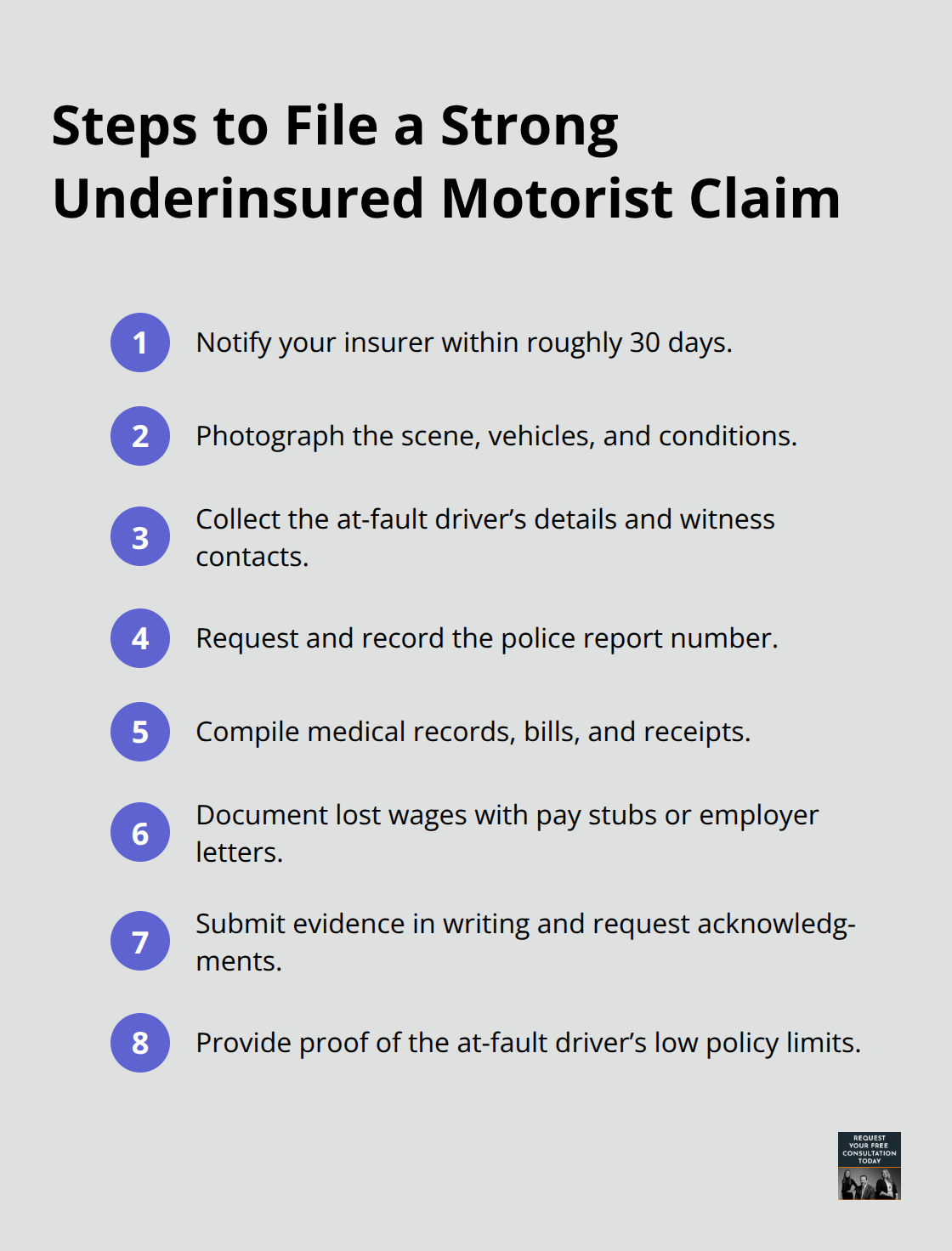
You have roughly 30 days to notify your insurance company of your intent to file an underinsured motorist claim, though California policies vary on exact deadlines. Start immediately at the accident scene by photographing the damage to all vehicles, the road conditions, traffic signals, and the other driver’s license plate and vehicle. Write down the at-fault driver’s name, phone number, address, insurance company, and policy number. Collect contact information from all witnesses and request a police report number, which becomes critical evidence for your claim. Do not give a recorded statement to any insurance adjuster before consulting with legal representation, as adjusters often have conflicting interests that can weaken your case.
Gather Medical and Financial Documentation
Collect medical records from your initial hospital visit and any follow-up treatment immediately after the accident. Document lost wages with pay stubs or employer statements that show income you missed during recovery. Photograph any visible injuries and keep receipts for medications, transportation to medical appointments, and out-of-pocket expenses related to your recovery. This documentation creates the foundation for proving your damages exceed the at-fault driver’s liability limits.
For serious injuries like traumatic brain injuries or spinal cord damage, medical evidence showing lifetime care costs becomes your most powerful tool, since these expenses frequently reach six figures and far exceed even California’s new minimum coverage limits.
Report the Claim to Your Insurance Company
Provide only factual information to your claims adjuster and avoid speculation about fault or injury severity. Submit your police report, medical records, and proof of the at-fault driver’s insufficient coverage limits in writing. Request a written acknowledgment that your company received each document. The at-fault driver’s policy information is essential here: you need proof they carry only $15,000 or $30,000 in liability coverage while your damages exceed that amount. This evidence directly establishes that their insurance falls short and your underinsured motorist coverage must activate.
Work with Legal Representation to Maximize Recovery
Insurance companies have teams of adjusters trained to minimize what they pay, and you need an advocate who understands how to present your damages comprehensively. An attorney can negotiate with your own insurance company on your behalf, request independent medical evaluations to strengthen your claim, and file suit if the insurer refuses fair compensation. At Schaar & Silva LLP, we serve Santa Cruz County and can help direct you to medical lien services that facilitate payment of your bills until your case is resolved. We also assist in evaluating property damage and connect you with specialists who can offer psychological support during your recovery. The goal is straightforward: prove your actual damages, demonstrate the at-fault driver’s coverage is insufficient, and recover the full gap up to your own underinsured motorist policy limit.
Final Thoughts
Underinsured motorist coverage California protects your financial future when an at-fault driver’s insurance falls short of your actual damages. With one in five California drivers uninsured and 18% nationwide underinsured, you face a genuine risk of hitting someone whose liability limits won’t cover your medical bills, lost wages, or pain and suffering. The state’s 2025 increase to $30,000 per person and $60,000 per accident represents progress, but serious injuries routinely exceed even these higher thresholds, making robust coverage essential.
Pull your declarations page today and verify your underinsured motorist limits match your liability coverage. If you carry only the state minimum, raise your limits to $100,000 per person or higher-the premium increase is often modest compared to the protection you gain. Confirm in writing that you haven’t signed a waiver reducing your coverage, and ask your insurer explicitly about any exclusions that might apply to your situation.
If you’ve been in an accident with an underinsured driver, we at Schaar & Silva LLP serve Santa Cruz County and understand how insurance companies minimize payouts when your damages exceed the at-fault driver’s limits. Contact our team to handle the legal details while you focus on healing, and we’ll negotiate with your own insurer to recover the full gap between the at-fault driver’s insufficient coverage and your actual losses.
