

After a car accident, getting a fair auto injury settlement requires knowing what you’re entitled to and how to navigate the claims process. Many people in Santa Cruz County, Sacramento, and Oakland leave money on the table simply because they don’t understand the steps involved.
We at Schaar & Silva LLP have helped countless accident victims recover the compensation they deserve. This guide walks you through the entire settlement process, from documenting your injuries to negotiating with insurance companies.
What Damages Can You Actually Recover?
An auto injury claim covers far more than just your immediate medical bills. Medical expenses form the foundation, but settlement calculations include lost wages from time away from work, ongoing treatment costs, and permanent physical limitations that affect your earning capacity. If your injuries require long-term care or therapy, those future costs belong in your claim. The Insurance Research Council found that represented claimants recover approximately 3.5 times more than those without legal help, largely because attorneys understand how to quantify all recoverable losses, not just the obvious ones. Many accident victims in Sacramento and Oakland underestimate what they’re entitled to because they focus only on bills paid so far, missing future medical needs entirely.
Documentation Determines Your Settlement Value
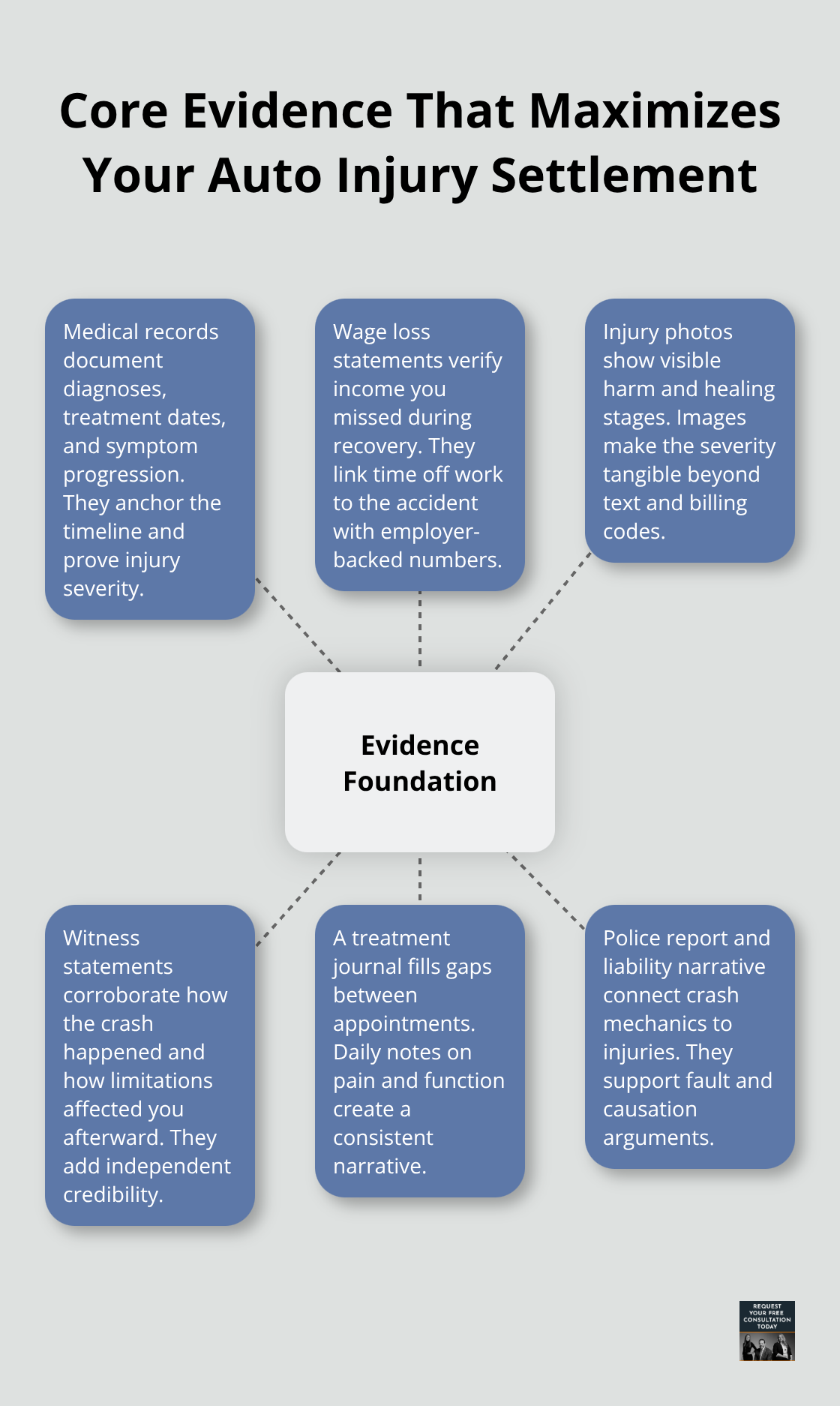
Medical records create the strongest evidence because they show treatment dates, diagnoses, and ongoing symptoms recorded by healthcare providers. Wage loss statements from your employer verify income lost during recovery, and these numbers carry weight with insurance adjusters. Photographs of your injuries taken immediately after the accident and throughout recovery demonstrate severity in ways descriptions cannot. Witness statements from people at the scene or those who observed your limitations afterward add credibility to your claim.
Most people make a critical mistake by waiting until settlement negotiations to gather this evidence, when memory fades and documentation becomes harder to retrieve. Start collecting everything the week after your accident, before details blur.
Treatment Gaps Undermine Your Credibility
Gaps in medical treatment are the single biggest credibility killer in settlement negotiations. If you stop seeing doctors for three months, then resume treatment, adjusters interpret the gap as proof your injuries weren’t serious enough to warrant continued care. Insurance companies use these gaps to argue your damages are lower than claimed. Consistent treatment throughout your recovery period, even for routine follow-ups, strengthens your position dramatically. A detailed journal documenting your pain levels, limitations, and how injuries affect daily activities fills gaps between medical appointments and provides narrative evidence that complements clinical records. The longer you maintain treatment and documentation until reaching maximum medical improvement, the higher your settlement typically becomes because you’ve proven the full scope and duration of your condition. This foundation of evidence positions you well as you move into active settlement negotiations.
How to Negotiate and Know When to Settle
Negotiating your settlement requires a completely different mindset than filing your claim. Most people view settlement as a single conversation, but it’s actually a series of strategic moves that determine whether you recover fairly or leave thousands on the table. The Insurance Research Council data showing represented claimants recover 3.5 times more than unrepresented ones reflects this reality: the difference between accepting the first offer and negotiating properly can easily amount to tens of thousands of dollars.
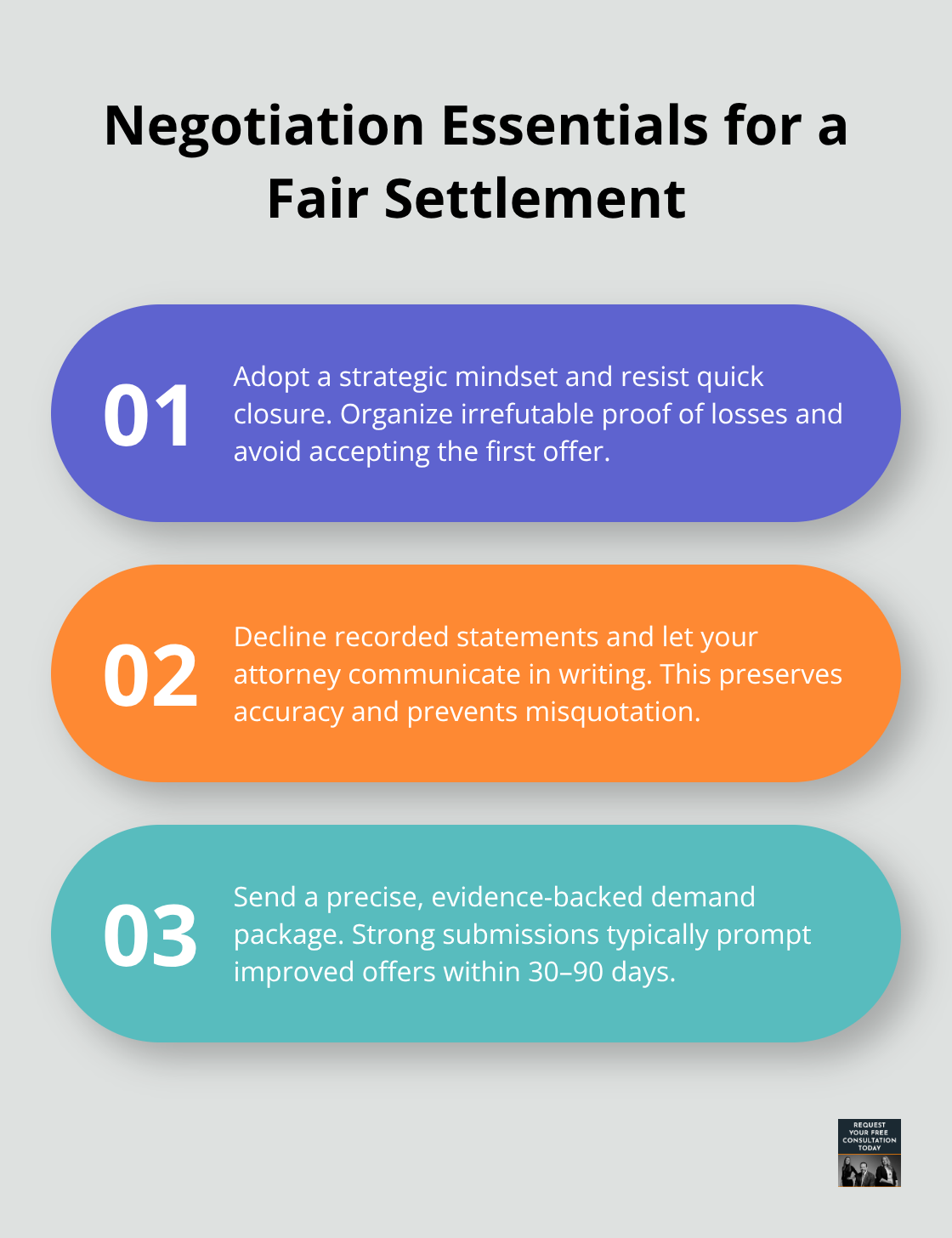
Your job during negotiation is to present organized, irrefutable evidence of your losses while staying calm and strategic about timing. Insurance adjusters count on you being impatient, eager to close your case, or unfamiliar with what your claim is actually worth. Don’t give them that advantage. The strength of your position depends entirely on the foundation you’ve already built-the medical records, wage statements, photographs, and treatment journal from the weeks after your accident. Without this documentation, you have nothing but your word, which adjusters will discount aggressively.
Refuse Recorded Statements Without Your Attorney
Adjusters will call and ask for a recorded statement about the accident, your injuries, and your treatment. They frame it as routine, but they’re actually gathering ammunition to undermine your claim later. Anything you say can be twisted, taken out of context, or used to suggest your injuries are less severe than documented. If you slip and say you’re feeling better on one particular day, the adjuster will cite that comment months later when you’re claiming ongoing pain. Your attorney can communicate your position in writing instead, which creates a permanent record you control. Adjusters will push back, suggesting you’re being uncooperative, but don’t fall for it. Your silence protects your settlement value far more than any recorded conversation ever will.
Prepare a Demand Package With Precision
After you reach maximum medical improvement-the point where your condition stabilizes and further treatment won’t significantly improve your condition-your attorney prepares a comprehensive demand package. This document walks the adjuster through every element of your damages with supporting evidence. It includes your complete medical records organized chronologically, all bills and receipts, wage loss documentation from your employer, photographs of injuries at various stages of healing, witness statements, the police report, and a detailed narrative explaining how the accident happened and why the other party is liable. Each piece of evidence serves a specific purpose: medical records establish injury severity and duration, bills prove costs, wage statements quantify income loss, and photographs make the injury real in a way numbers cannot. The demand package typically runs 50–100 pages because thoroughness matters. Adjusters treat thin, poorly organized demands as weak claims and respond with lowball offers. A solid demand package backed by evidence forces them to take your case seriously and justify any rejection with specifics rather than vague denials. Most California settlements that don’t require litigation resolve within 30–90 days after a strong demand package arrives.
Establish Your Walk-Away Number Before Negotiations Start
Establish your absolute minimum settlement amount before the adjuster makes any offer. This number should reflect your documented damages plus a reasonable multiplier for pain and suffering-typically 1.5 to 3 times your medical bills for moderate injuries, higher for severe cases. If your medical bills total $25,000 and you lost $8,000 in wages, your documented losses are $33,000. A multiplier of 2 would put your floor at roughly $66,000, though your actual value may be higher depending on injury severity and permanence. Write this number down and don’t negotiate below it unless truly extraordinary circumstances emerge. Adjusters will make an initial offer well below your floor, hoping you’ll accept out of frustration or financial pressure. This is where most people fail-they accept offers that cover only their bills and lost wages, leaving pain and suffering entirely uncompensated. Your walk-away number keeps you disciplined when the pressure mounts. If the adjuster refuses to meet your floor after multiple rounds of negotiation, filing a lawsuit often accelerates settlement because it signals you’re serious and adds costs and uncertainty to the insurer’s position. The next chapter covers what happens when settlement negotiations stall and litigation becomes your path forward.
Mistakes That Tank Your Settlement Before Negotiation Even Starts
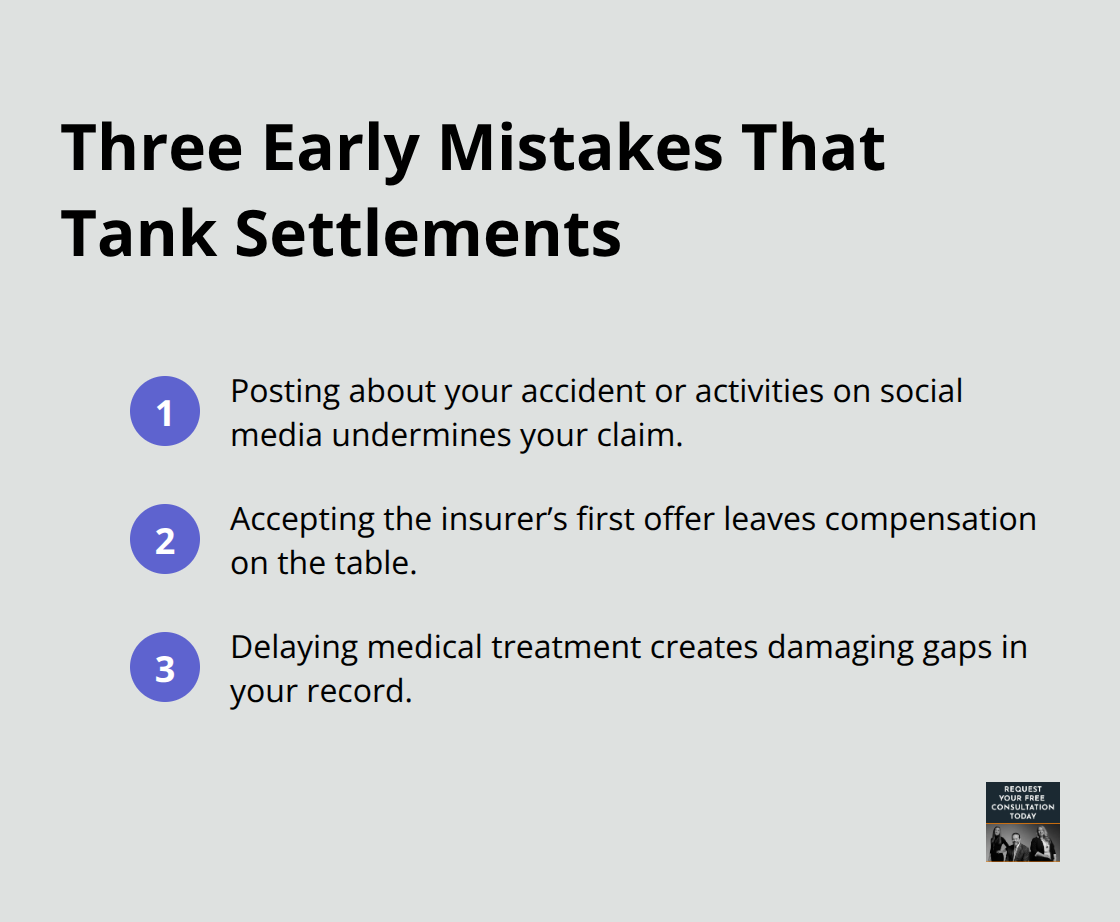
The decisions you make in the first two weeks after your accident determine whether you recover fairly or sabotage your claim before serious negotiations begin. Most people don’t realize that insurance adjusters actively monitor your actions during this critical window and look for reasons to minimize payouts. Your behavior during these early days creates evidence that adjusters will use against you throughout the settlement process.
Social Media Posts Destroy Your Credibility
Social media posts about your accident create a permanent record that adjusters will use against you relentlessly. If you post that you’re heading to the gym, hiking, or doing yard work while claiming significant injuries, adjusters will screenshot those posts and cite them in settlement discussions as proof your injuries are exaggerated. Even innocent comments like feeling better on a particular day get weaponized to suggest your overall condition is less severe than your medical records indicate.
Adjusters don’t care about context or the full picture-they extract single statements and use them to justify lower offers. The safest approach is to avoid posting anything about your accident, your injuries, or your recovery timeline on any social platform. This includes Facebook, Instagram, TikTok, and even private messages that might be shared. One careless post can easily reduce your settlement by thousands of dollars, so the math is simple: don’t post anything.
Rejecting Lowball First Offers Strengthens Your Position
Accepting the first settlement offer without negotiation is equally damaging because adjusters deliberately lowball initial offers to test whether you understand your claim’s actual value. Insurance companies know that unrepresented claimants typically accept first offers because they lack leverage and confidence in negotiation. Your initial offer will be substantially below what your documented damages support, sometimes covering only medical bills with little to nothing for lost wages or pain and suffering.
The adjuster will present this lowball number as final and use language suggesting it’s a generous offer or that further negotiation is unlikely. This is a negotiating tactic, not reality. Pushing back with your demand package and documented evidence almost always results in a higher offer within 30 to 60 days. The difference between accepting the first offer and negotiating properly can amount to tens of thousands of dollars.
Immediate Medical Treatment Prevents Credibility Gaps
Failing to seek immediate medical treatment after your accident creates the third major mistake by establishing a gap in your injury record that adjusters exploit ruthlessly. If you delay treatment for days or weeks after the crash, adjusters argue the injuries weren’t serious enough to warrant immediate care. This gap becomes evidence they cite to justify lower settlement offers because the narrative they construct is that truly serious injuries prompt immediate medical attention.
You need to see a doctor within 48 hours of your accident, even if you feel relatively fine, because adrenaline masks pain and some injuries like whiplash don’t manifest immediately. Your medical records must show continuous treatment from shortly after the accident through maximum medical improvement, with no unexplained gaps that adjusters can weaponize. Consistent treatment throughout your recovery period, even for routine follow-ups, strengthens your position dramatically and prevents adjusters from using silence against you.
Final Thoughts
Your auto injury settlement depends entirely on the foundation you build in the weeks immediately following your accident. The steps outlined in this guide-documenting injuries thoroughly, maintaining consistent medical treatment, preserving evidence, refusing recorded statements, and preparing a detailed demand package-separate claimants who recover fairly from those who leave thousands on the table. The Insurance Research Council data is clear: represented claimants recover approximately 3.5 times more than unrepresented ones, and that difference reflects the strategic approach outlined here.
Most people underestimate what their claim is worth because they focus only on immediate medical bills and lost wages, missing the pain and suffering damages that typically comprise the largest portion of any settlement. Your walk-away number, established before negotiations begin, keeps you disciplined when adjusters pressure you to accept lowball offers. Social media silence protects your credibility, consistent treatment throughout your recovery strengthens your position, and a comprehensive demand package forces adjusters to justify their positions with specifics rather than vague denials.
We at Schaar & Silva LLP understand that navigating an auto injury settlement while recovering from your injuries is overwhelming. Our team handles the legal complexities so you can focus on healing, and we assist with medical bill management through lien services, evaluate property damage claims fairly, and connect you with psychological support when emotional trauma accompanies physical injury. Contact us for a free consultation to discuss your case and learn how we can support your recovery in Santa Cruz County and surrounding areas.
