

Soft tissue injuries from car accidents can sideline you for months, rack up medical bills, and leave you uncertain about fair compensation. Insurance companies often undervalue these claims because soft tissue damage doesn’t show up on X-rays the way broken bones do.
We at Schaar & Silva LLP have helped countless accident victims in Santa Cruz County, Sacramento, and Oakland recover the damages they deserve. This guide walks you through how settlements work, what strengthens your claim, and when to push back against lowball offers.
What Soft Tissue Injuries Actually Are
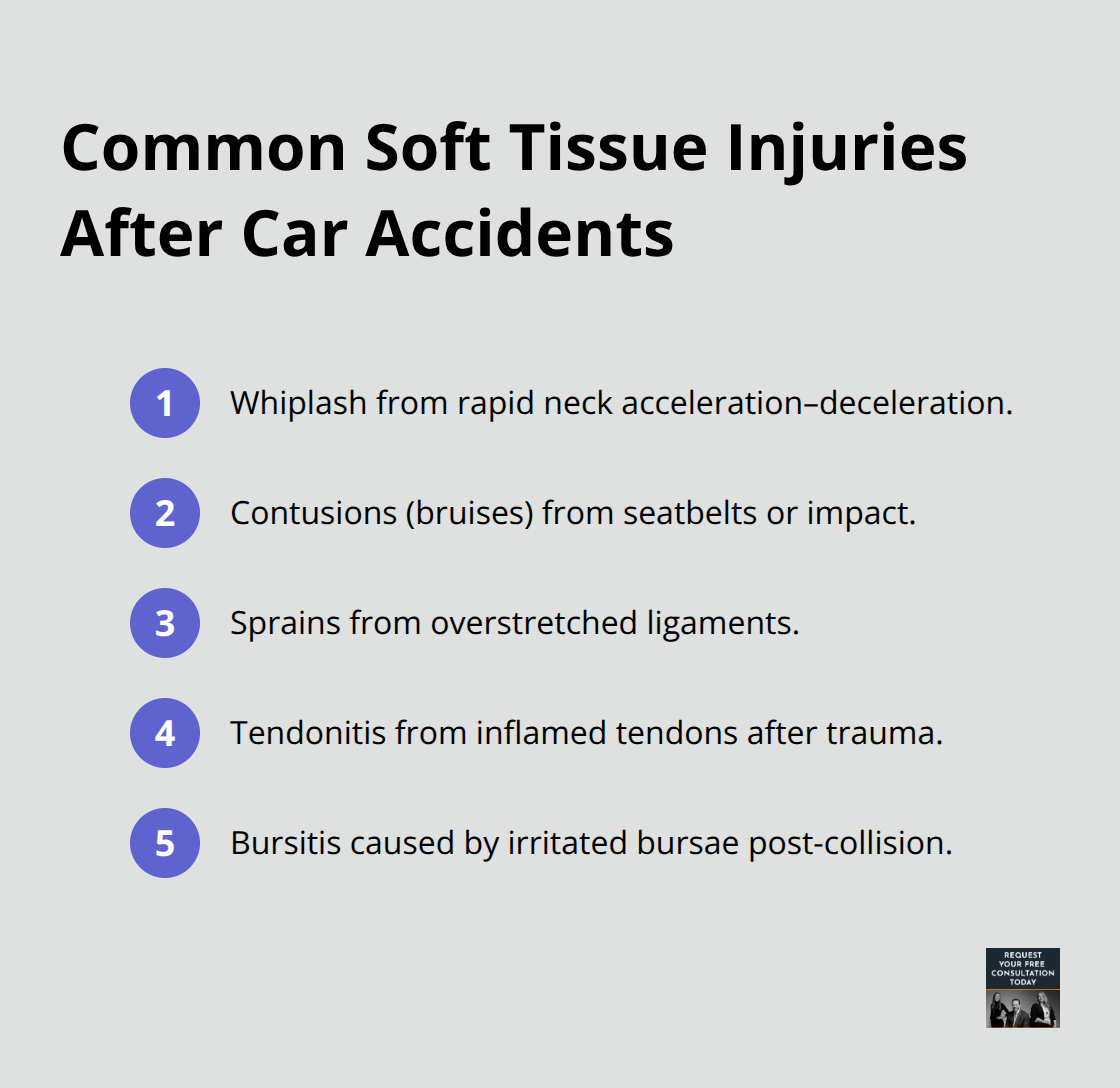
Soft tissue injuries involve damage to tendons, ligaments, and muscles that result from trauma during a car accident. These injuries don’t require broken bones or visible fractures-they stem from the violent forces that your body absorbs during impact. Whiplash stands as the most common soft tissue injury we see in Santa Cruz County, Sacramento, and Oakland, occurring when your neck snaps forward and backward during a rear-end collision. Contusions (bruises), sprains, tendonitis, and bursitis round out the typical soft tissue injuries that follow auto accidents. The challenge is that these injuries feel severe and limit your daily activities, yet they leave no trace on X-rays, which is exactly why insurance companies use them as justification to lowball settlements.
Why Insurance Companies Undervalue Your Claim
Insurance adjusters treat soft tissue claims with skepticism because no objective medical test definitively proves you’re injured. A broken femur shows up on imaging; whiplash does not. This gap between what you feel and what doctors can measure on film creates an opening for insurers to argue your pain is exaggerated or temporary.
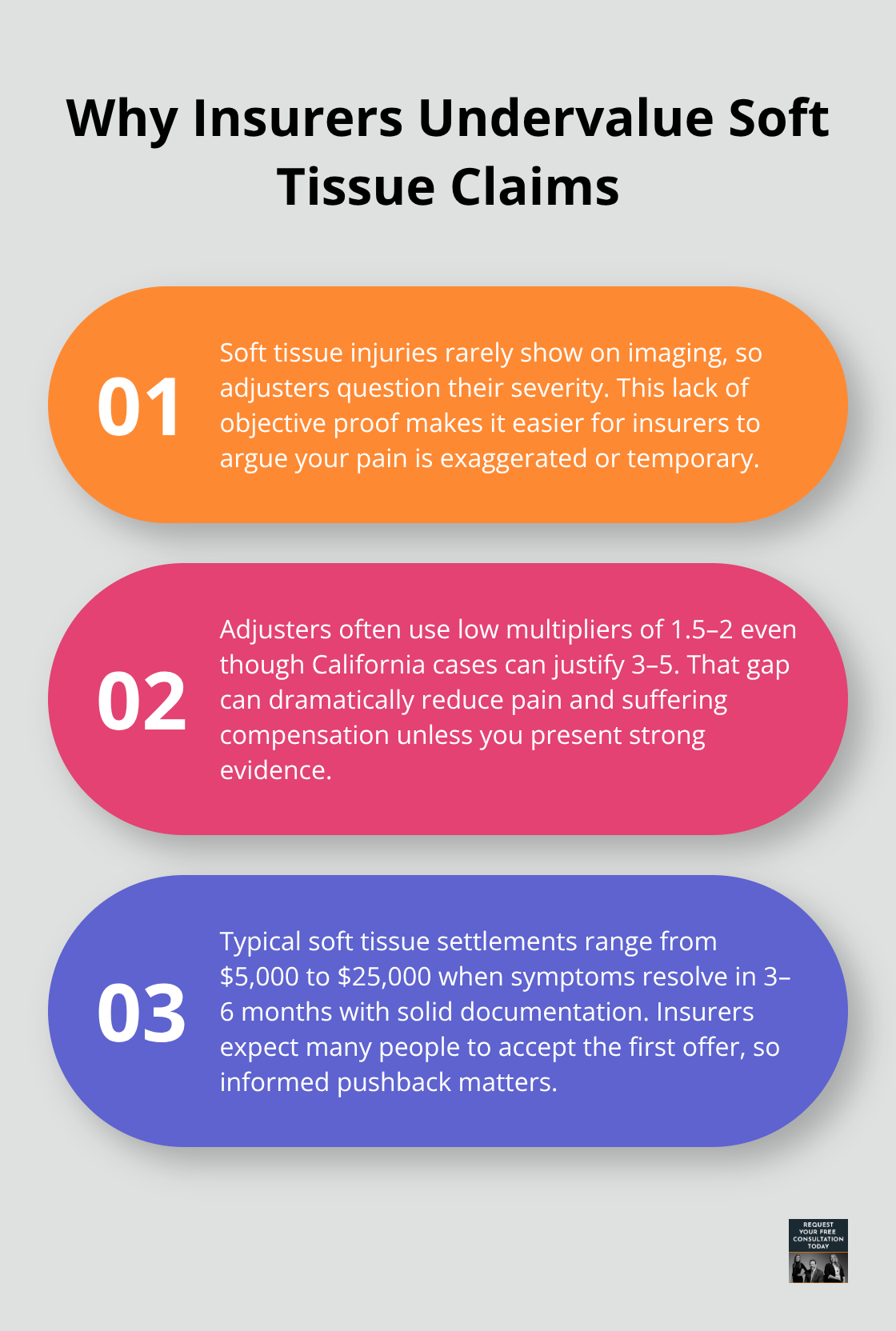
Many adjusters apply a multiplier of just 1.5 to 2 times your medical bills for soft tissue cases, even though California law permits multipliers of 3 to 5 for more serious injuries. The reality is that soft tissue injuries often settle between $5,000 and $25,000 when symptoms resolve within three to six months, but this figure assumes you’ve documented everything meticulously and pushed back against the initial offer. Insurance companies count on accident victims accepting their first settlement without understanding that pain and suffering damages often exceed medical bills and lost wages by two to five times in California cases.
How Documentation Changes the Settlement Equation
Medical records serve as your strongest weapon against undervaluation. Consistent treatment notes showing ongoing pain, restricted range of motion, and functional limitations give adjusters concrete reasons to increase their offer. A detailed daily pain journal that tracks your symptoms, medication use, and activities you cannot perform transforms abstract suffering into quantifiable evidence. Photographs of visible injuries like bruising or swelling, combined with witness statements about how the accident affected your work and family life, further strengthen your position. When you present this evidence early in settlement negotiations, insurers recognize that a jury would likely award substantially more than their initial offer, which shifts their calculation toward a fair settlement rather than a lowball figure.
The strength of your documentation directly determines how aggressively you can negotiate with the insurance company-and whether you should move forward with settlement discussions or prepare for trial.
How Soft Tissue Damages Get Calculated
Medical Records Form Your Foundation
Medical records form the foundation of any damage calculation, and their completeness determines whether you receive a fair settlement or a fraction of what you deserve. Insurance companies use settlement software like Colossus, which analyzes thousands of data points from past cases to generate target settlement ranges based on your injury profile, medical expenses, and treatment duration. Your medical bills alone rarely tell the full story because California law permits non-economic damages for pain and suffering that often exceed medical costs by two to five times.
Understanding the Multiplier Method
The multiplier method applies a factor of 1.5 to 5 times your total medical expenses depending on injury severity. A rear-end collision causing neck strain with $3,500 in medical bills, for example, might yield around $10,500 total with approximately $7,000 allocated to pain and suffering. A simple fracture like a broken wrist without surgery commonly settles between $15,000 and $40,000 when physical therapy needs and time off work are factored in.
Adjusters increase multipliers when you present evidence of daily life disruption through photos, family testimony documenting how you cannot perform household tasks, and reports quantifying functional impairment. Conversely, gaps in treatment records or evidence that medical care seems excessive can lower the multiplier substantially, which is why consistency matters more than the total number of visits.
The Per Diem Approach
The per diem approach offers an alternative calculation method where a daily dollar value gets assigned to your suffering and multiplied by the number of pain days, often based on your actual daily earnings or a comparable figure. This method works particularly well when you can demonstrate clear, documented pain across a specific timeframe.
How Credibility Impacts Your Settlement
Your credibility and pre-existing conditions significantly impact whether a jury or adjuster accepts your pain and suffering claim. Detailed daily pain journals that track symptoms, medication use, and activities you cannot perform transform abstract suffering into documented evidence that strengthens your negotiating position. When you maintain consistent medical records and present credible testimony about your functional limitations, adjusters recognize that a jury would likely award substantially more than their initial offer.
Moving Forward With Your Claim
Insurance companies count on accident victims accepting their first settlement without understanding how settlement calculations actually work. Once you understand the multiplier method, the per diem approach, and how documentation influences these calculations, you can evaluate whether an offer reflects what a jury would likely award at trial-or whether you should push back and demand fair compensation.
Negotiating Your Soft Tissue Settlement
Document Your Injuries From Day One
Start your documentation the moment the accident happens, not weeks later when memory fades and injuries feel routine. Photograph visible injuries at the accident scene, at home over the following days as bruising develops, and throughout your recovery as swelling changes. Capture your medication bottles with dates visible, your medical appointment cards, and any physical therapy equipment you use.
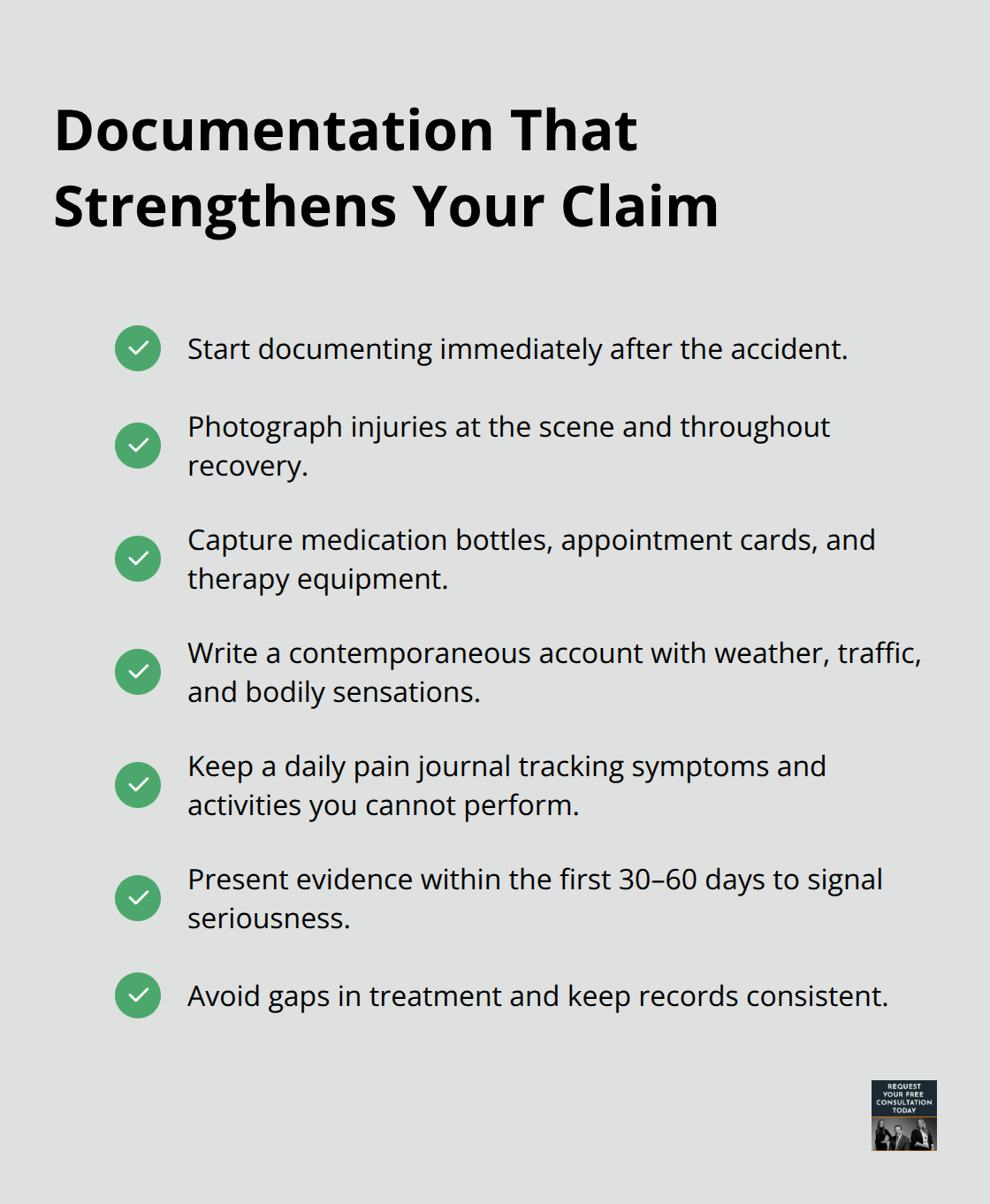
Write down the date, time, and specific details of your accident immediately while everything is fresh-weather conditions, traffic patterns, road hazards, and exactly what you felt in your body at impact. This contemporaneous account carries far more weight with insurance adjusters than a statement you reconstruct months later.
Insurance companies use settlement software that flags gaps in medical treatment and inconsistencies in your account, so the more granular and timely your documentation, the harder it becomes for adjusters to discount your claim. A detailed daily pain journal that tracks your symptoms, medications, sleep disruption, and activities you cannot perform transforms abstract suffering into quantifiable evidence that settlement software recognizes as credible. When you present this evidence within the first 30 to 60 days after your accident, adjusters see that you took your injury seriously from the start, which increases their settlement offer substantially compared to claims built from scattered records months later.
Guide Your Medical Providers Toward Strong Documentation
Your medical providers are not your settlement advocates, so you must actively guide them toward documenting the elements that strengthen your claim. Before each appointment, write down your functional limitations-which household tasks you cannot perform, how your injury affects your work, whether you need help with daily activities-and share this list with your doctor so it gets incorporated into their notes. Ask your medical provider to document your range of motion restrictions, any visible swelling or bruising, and your pain level on a scale of one to ten at each visit.
Request that they note whether your symptoms are improving, stable, or worsening, because consistent or worsening symptoms support higher multipliers in settlement calculations. When your treatment concludes, ask for a detailed summary letter that outlines your diagnosis, treatment dates, the functional impact of your injury, and the prognosis for full recovery. This summary letter gives adjusters a clear narrative that connects your medical expenses to your actual suffering. If your doctor recommends ongoing treatment or monitoring, ensure those recommendations appear in your medical records because gaps in treatment often trigger adjuster skepticism, whereas documented recommendations for continued care justify higher settlement demands.
Time Your Settlement Negotiations Strategically
Settlement negotiations typically begin within 30 to 90 days after you report your claim, so your documentation strategy must be aggressive during these first months. Insurance adjusters expect accident victims to accept their first offer without understanding how settlement calculations actually work. Once you present comprehensive documentation (medical records, daily pain journals, photographs, and functional impact statements), adjusters recognize that a jury would likely award substantially more than their initial offer, which shifts their calculation toward fair compensation rather than a lowball figure.
Final Thoughts
Soft tissue settlement California cases succeed when you act decisively from the moment your accident happens. Photograph injuries as they develop, maintain detailed daily pain journals, and guide your medical providers toward documenting the functional limitations that matter most in settlement calculations. When you present this evidence within the first 30 to 90 days, adjusters recognize that a jury would likely award substantially more than their initial offer, which shifts negotiations toward fair compensation rather than a fraction of what you deserve.
We at Schaar & Silva LLP help accident victims in Santa Cruz County, Sacramento, and Oakland navigate this process from start to finish. Our team evaluates your claim, connects you with medical lien services, and ensures that your documentation reflects the true impact of your injury on your life. We understand that soft tissue injuries disrupt your daily activities in ways that medical bills alone cannot capture, which is why we focus on building claims that reflect your actual suffering and functional losses.
Contact Schaar & Silva LLP for a free consultation to discuss your accident and understand what fair compensation looks like in your situation. We handle the legal complexities while you focus on recovery.
