

After a car accident, insurance companies often lowball their initial settlement offers. At Schaar & Silva LLP, we’ve seen countless people accept far less than their injury settlement in California is actually worth.
The difference between a low offer and a fair payout comes down to knowing how insurers calculate damages and what tactics actually work in negotiations. This guide walks you through the strategies that move the needle.
What Goes Into Your Settlement Amount
Medical Expenses Drive Your Baseline
Insurance companies use a formula that stacks three main categories of damages to reach a settlement figure. The first is economic damages-the actual out-of-pocket costs you’ve incurred. Medical bills from emergency care, imaging, surgery, physical therapy, and ongoing treatment are tallied up.
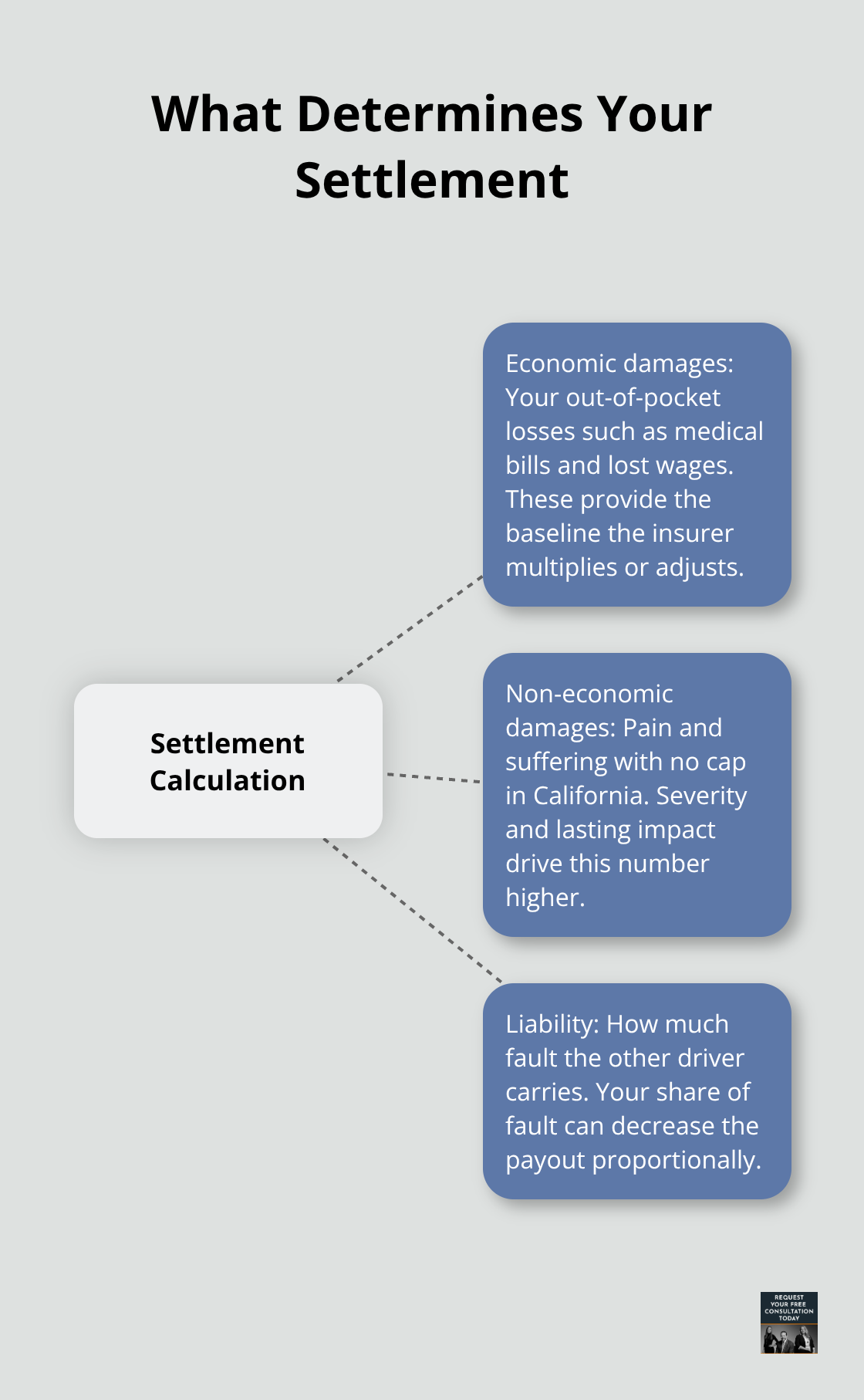
If you missed work, those lost wages get added too. The second category is non-economic damages, primarily pain and suffering, which California allows without any cap. The third is liability-how much fault the other driver carries. These three elements determine what insurers believe they owe you, and understanding how each one works gives you leverage in negotiations.
Medical costs form the foundation of your settlement calculation, and insurers know this. A herniated disc from a rear-end collision might generate $15,000 to $50,000 in medical expenses alone, depending on whether you need surgery or just conservative care. If you required surgery, costs can easily exceed $100,000 when you factor in hospital stays, anesthesia, surgeon fees, and post-operative rehabilitation.
Why Immediate Care Matters
Seeking immediate medical attention after your accident matters so much because delays of even a few days give insurers ammunition to claim your injuries weren’t serious. You must maintain continuous treatment records without gaps; missed appointments or long pauses between visits signal to adjusters that your condition is improving faster than your claims suggest, which tanks your settlement value. Objective medical evidence strengthens everything: MRI scans showing a herniated disc, CT reports documenting fractures, and surgical records proving you needed intervention make it nearly impossible for insurers to minimize your claim.
Lost Wages and Future Earning Capacity
Lost wages follow a similar principle. You should document your income with tax returns from the prior two years, recent pay stubs, and a letter from your employer confirming the dates you missed work and your hourly rate or salary. If your injury causes permanent disability that reduces your future earning capacity, you may need a vocational economist to calculate what you’ll lose over your remaining work years.
Pain and Suffering Multipliers
Pain and suffering is where settlements often expand dramatically. California imposes no cap on non-economic damages, meaning a severe brain injury or permanent spinal cord damage can justify a six-figure or even seven-figure award. Insurers typically use a multiplier method-taking your economic damages and multiplying by 1.5 to 5 times that amount depending on severity. A moderate whiplash case with $20,000 in medical bills and $5,000 in lost wages might generate a pain-and-suffering multiplier of 2 to 3 times, pushing your total claim toward $50,000 to $75,000. Severe cases with traumatic brain injury can see multipliers of 4 to 5 times or higher.
Documentation transforms this calculation. You should maintain journals describing daily pain, take photos of visible injuries, collect medical notes recording your complaints, and gather testimony about how the injury disrupted your life. All of this feeds into how insurers and juries assess what your suffering is actually worth. With this foundation in place, you’re ready to understand what tactics actually move insurers toward fair offers rather than lowball numbers.
How to Negotiate With Insurance Companies
Build Your Case Before Talking Money
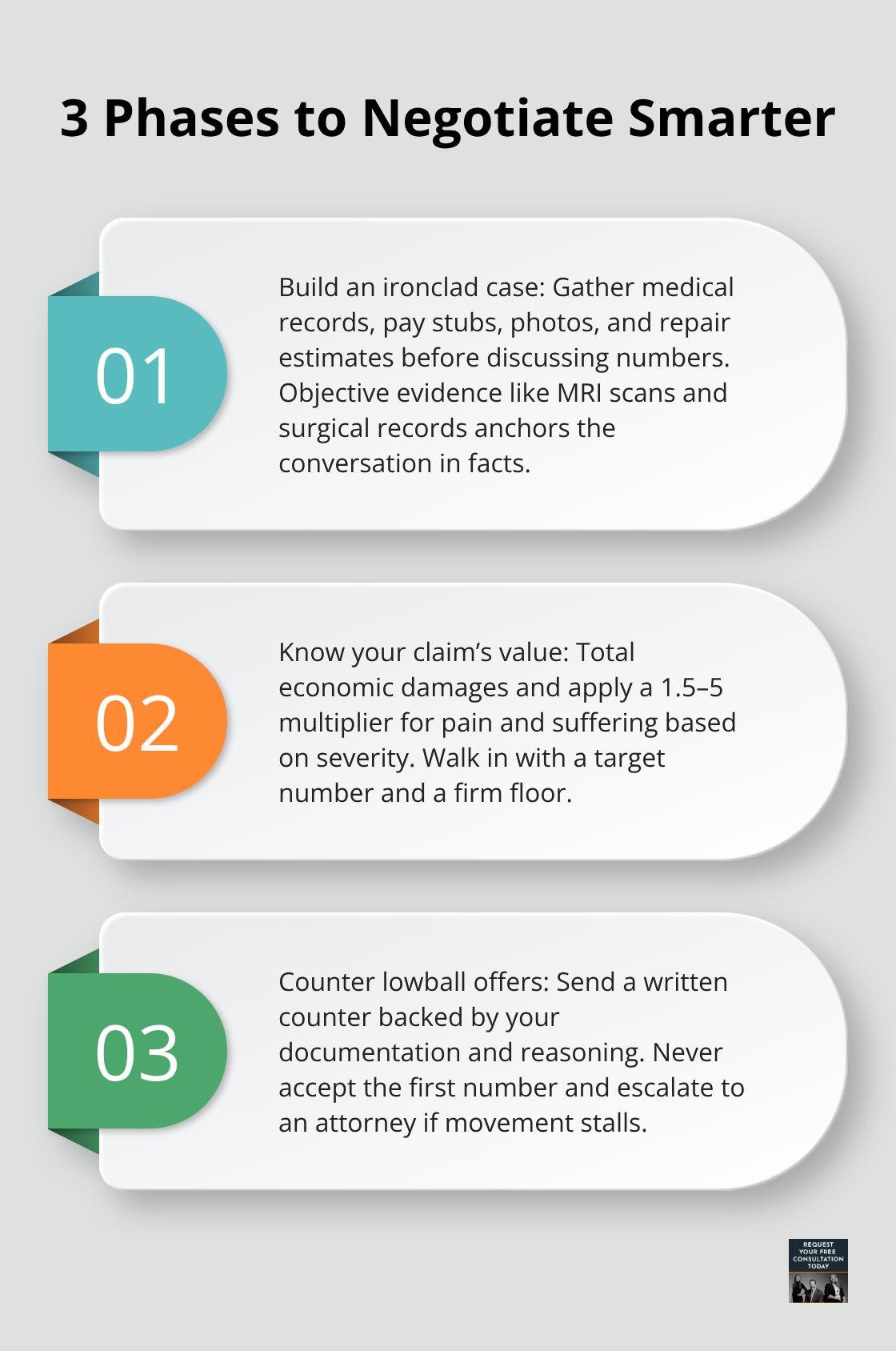
Negotiating with insurers requires three distinct phases: building an ironclad case before you talk money, knowing exactly what your claim is worth, and responding strategically when the lowball offer arrives. Insurance adjusters are trained to settle quickly and cheaply, which means your job is to make their job harder by being prepared.
The first mistake people make is picking up the phone and discussing their case without documentation in hand.
You need medical records showing treatment dates and diagnoses, pay stubs proving lost wages, photos of injuries at different stages of healing, and repair estimates for vehicle damage. Objective medical evidence matters most because insurers cannot dispute an MRI showing a herniated disc or surgical records documenting that you needed an operation. When you hand an adjuster this stack of evidence, you shift the conversation from what they think your claim is worth to what the evidence actually proves it is worth.
A 2026 settlement analysis shows that moderate whiplash injuries with solid medical documentation average $15,000 to $75,000, while cases lacking clear medical support often settle for $5,000 to $10,000. That gap exists because documentation removes the adjuster’s ability to claim your injury was minor or that you recovered faster than your medical records show.
Calculate Your Claim’s True Value
Understanding your claim’s true value before negotiation starts is non-negotiable. Add up your economic damages: medical bills, lost wages, and any future medical care a life care plan documents. Then apply a multiplier to account for pain and suffering, typically 1.5 to 5 times your economic damages depending on injury severity.
A case with $30,000 in medical bills and $8,000 in lost wages totals $38,000 in economic damages; multiplied by 2.5 for a moderate injury, your claim is worth roughly $95,000. When the insurer’s first offer comes in at $35,000, you know exactly how far apart you are. Insurance companies use a formula-based approach to value claims, and understanding their math gives you leverage during negotiations.
Counter Low Offers With Evidence and Strategy
Respond with a written counter-offer backed by your documentation and a brief explanation of why your valuation is correct. Never accept the first number; insurers expect negotiation and build lowball offers into their opening position. If the adjuster refuses to move significantly, that signals they are not negotiating in good faith, and escalating to an attorney becomes the logical next step.
Rejecting early offers also protects you because once you sign a release, you cannot claim additional damages for injuries that develop later or medical costs that exceed your estimate. An attorney can handle these negotiations and knows which adjusters respond to pressure and which ones need a demand letter before they take a case seriously.
Pitfalls That Tank Your Settlement Value
The Cost of Accepting Early Offers
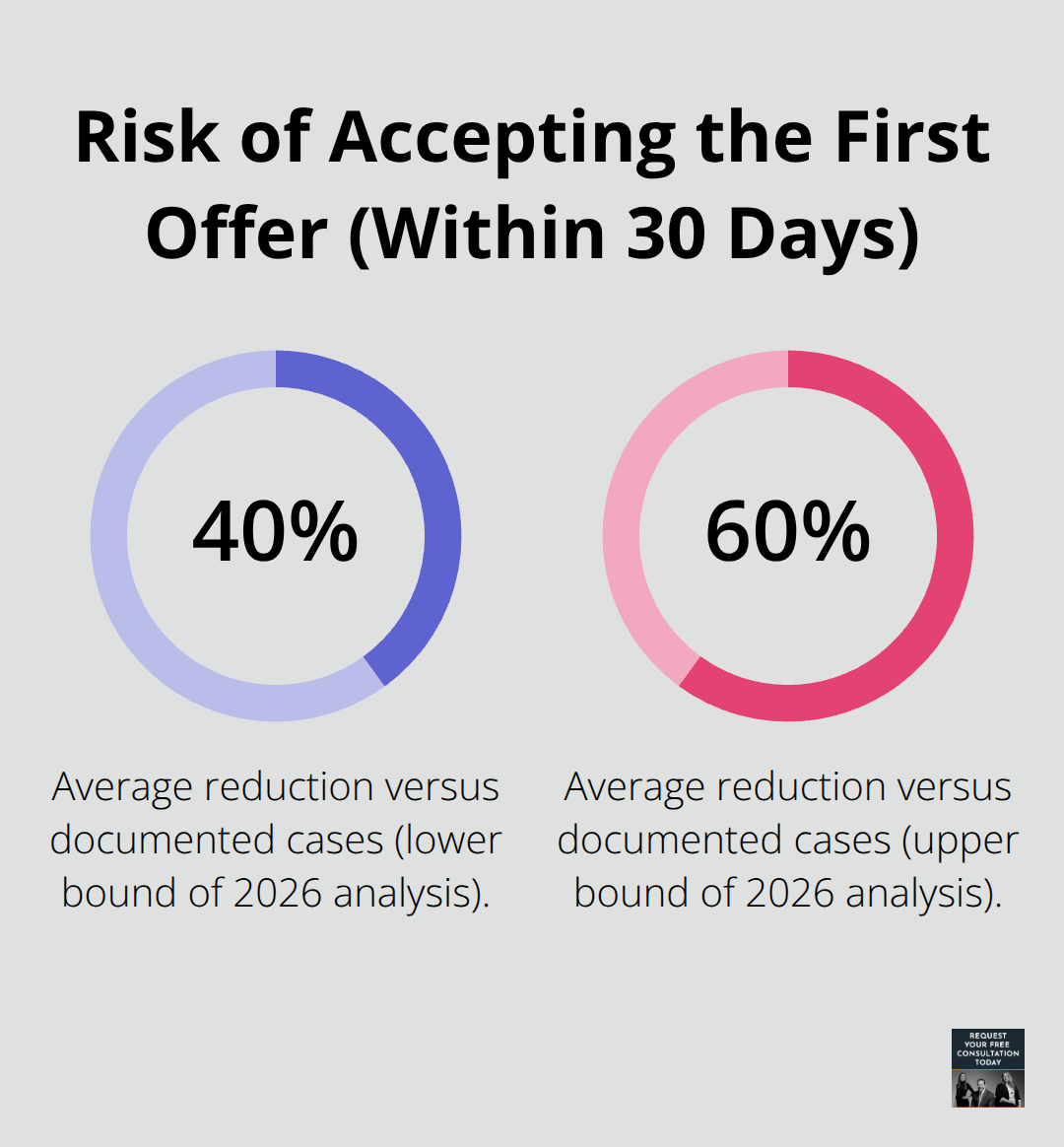
The gap between what your claim is actually worth and what you end up accepting often comes down to three critical mistakes that happen after the accident. The first mistake is accepting the insurer’s initial offer without understanding your claim’s true value. Insurance companies know that injured people are desperate, in pain, and financially stressed, so they deliberately lowball their opening number. A 2026 settlement analysis shows that people who accept the first offer within 30 days of an accident receive settlements averaging 40 to 60 percent below what documented cases ultimately recover. If your claim is worth $95,000 based on medical evidence and lost wages, accepting a $35,000 first offer means you’ve left $60,000 on the table.
The insurer counts on you not knowing this math.
Once you sign a release, you cannot go back and claim additional damages if your injuries worsen or medical costs exceed your estimate. Waiting until you reach maximum medical improvement-meaning your condition has stabilized and your doctors confirm no further improvement is expected-protects you from this trap. This typically takes three to six months for moderate injuries and six to twelve months for serious cases.
Social Media Exposure Destroys Your Credibility
The second mistake is posting about your accident on social media or discussing details with friends and family who might share information online. Insurance companies actively monitor social media, and a single photo or comment can destroy your credibility. If you post that you’re feeling better, went to the gym, or attended a social event, adjusters will screenshot that content and use it to argue your injuries are less severe than your medical records claim. They’re looking for any inconsistency between what you tell them and what your online activity suggests. One careless Instagram post can reduce your settlement by tens of thousands of dollars because it gives the insurer grounds to question whether your pain and suffering claims are legitimate.
Documentation Gaps Undermine Your Case
The third mistake is failing to document your injuries and recovery thoroughly. Medical records are your evidence, but they’re only as strong as the detail they contain. If you skip appointments or go weeks without treatment, adjusters will argue that your injury resolved faster than you claim. If you don’t mention pain or limitations to your doctor, those gaps become ammunition in settlement negotiations. You need to maintain a continuous treatment record without breaks, describe your daily symptoms and functional limitations at each visit, and keep a personal journal documenting how the injury affects your work, sleep, and activities.
Photos of visible injuries at different healing stages, receipts for all medical expenses, and written statements from your employer about missed work all build an undeniable case. When you hand an adjuster this documentation, you eliminate their ability to minimize your claim based on guesswork. The difference between a scattered record and a thorough one often equals the difference between a $25,000 settlement and a $75,000 settlement for the same injury type.
Final Thoughts
Maximizing your injury settlement in California requires three concrete actions: build solid documentation before negotiating, calculate what your claim actually costs, and wait until maximum medical improvement before accepting any offer. Insurance adjusters negotiate settlements daily while you likely handle this once in your lifetime, which means an attorney levels the playing field by managing evidence and knowing which adjusters respond to pressure. We at Schaar & Silva LLP help people throughout Santa Cruz County recover fair compensation by handling the legal details while you focus on healing, and we offer a free consultation to discuss your case and learn what your injury settlement in California is actually worth.
The mistakes that tank settlements are entirely preventable: don’t accept the first offer, don’t post on social media, and don’t let gaps appear in your medical treatment. A moderate whiplash case with solid documentation settles for $50,000 to $75,000, while the same injury without documentation often settles for $10,000 to $15,000 because insurers exploit what you don’t know. That gap exists because evidence shifts power away from adjusters and toward facts.
You pay nothing unless we recover compensation for you, which means accessing experienced representation costs you nothing upfront. Contact us to discuss your case and understand what your claim is worth based on your specific injuries and medical records.
