

Truck crash settlements rarely favor those who walk in unprepared. Insurance companies count on injured people accepting their first offer, which is typically far below what the claim is actually worth.
We at Schaar & Silva LLP have seen countless cases in Santa Cruz County, Sacramento, and Oakland where victims left money on the table simply because they didn’t know how to negotiate. This guide walks you through the tactics that actually work.
Who Pays in a Truck Crash and What You Can Recover
Multiple Liable Parties Increase Your Recovery
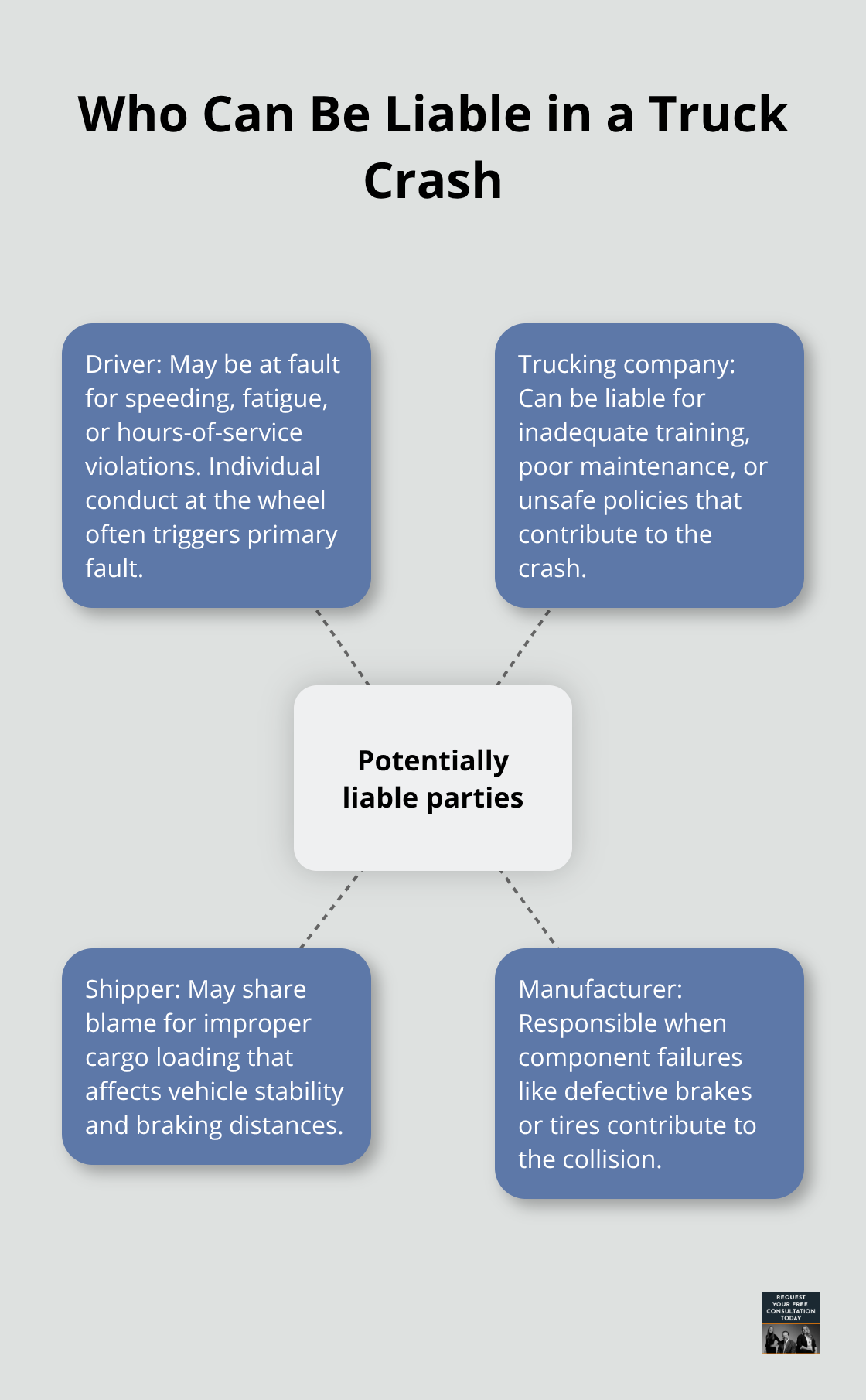
Truck crashes differ fundamentally from car accidents because multiple parties often share liability. A fully loaded tractor-trailer weighs up to 80,000 pounds, and at highway speeds the momentum creates devastating damage. When that happens, you must identify everyone responsible. The driver may be at fault for speeding or fatigue, but the trucking company could be liable for inadequate training or poor maintenance. The shipper might share blame for improper cargo loading. The manufacturer could be responsible if brakes or tires failed. This matters because each liable party carries insurance, and identifying all of them directly increases your total recovery.
Federal Violations Establish Negligence Per Se
Federal Motor Carrier Safety Administration (FMCSA) violations strengthen your position significantly. Hours-of-service violations, inadequate vehicle inspections, or failure to maintain brakes and tires aren’t just safety issues-they establish negligence per se, meaning the law presumes liability without requiring you to prove carelessness. Courts in Santa Cruz County, Sacramento, and Oakland recognize these federal standards, and violations tip the negotiation heavily in your favor. When you preserve evidence early, you’ll find driver logs, black box data, maintenance records, and inspection failures. These documents become your leverage. Trucking companies defend aggressively to avoid higher insurance premiums, so they’ll push back hard unless you present undeniable proof of violations.
Economic Damages: The Measurable Losses
Damages in truck crashes fall into two categories: economic and non-economic. Economic damages are straightforward-medical bills, surgeries, hospital stays, ongoing therapy, lost wages, and property damage. If you’re permanently disabled, future earning capacity matters enormously. A 35-year-old earning $60,000 annually who can no longer work has far greater damages than someone with minor injuries. You’ll need medical professionals to project these costs, not guesses.
Non-Economic Damages and Catastrophic Injuries
Non-economic damages cover pain and suffering, emotional distress, and impact on daily life. Catastrophic injuries like traumatic brain injury, spinal cord damage, or amputation can justify settlement values exceeding $1.2 million because future care costs are staggering. Severity drives settlement value more than any other factor. Minor injuries typically settle within three to six months at lower amounts. Severe injuries require time to reach Maximum Medical Improvement (MMI), the point where doctors determine your permanent condition.
The Cost of Settling Too Early
Settling before MMI almost always results in undercompensation because future medical expenses remain unknown. Catastrophic cases may take 12 to 24 months to reach MMI. Insurance adjusters understand this and will pressure you to accept early offers while you’re still hospitalized. Resist that pressure. A spinal fracture victim who accepts $85,000 during acute treatment leaves over $1.1 million on the table. Your damages compound over time as you understand the full scope of permanent disability, which is why the next section covers the specific tactics that prevent you from accepting inadequate offers in the first place.
How to Build a Stronger Negotiating Position
The moment you file a claim, the insurance adjuster calculates what they think they can get away with offering. That number bears little relationship to what your case is actually worth. To shift the balance, you need evidence so solid that the insurer knows fighting you costs more than settling fairly. Start collecting documents immediately after the crash. Within 30 days, critical data disappears-black box recordings overwrite, surveillance footage gets deleted, and witness memories fade. Obtain the truck’s maintenance records, driver logs, and inspection reports. Request the driver’s qualification file from the trucking company, which reveals safety violations and prior incidents. Pull the 911 call recording and dispatch records. Photograph the crash scene if you haven’t already, and collect written statements from witnesses before they become unavailable. When you present this evidence package to the insurer, you’re not making a request-you’re demonstrating that liability is provable and defense costs will be substantial. Insurance companies respond to leverage, not emotion.
Medical Documentation Determines Your Settlement Ceiling
Your medical records form the foundation of damages calculation, and completeness directly impacts your settlement number. Obtain every medical report, imaging study, surgical note, and therapy record from day one through Maximum Medical Improvement. If your doctor projects ongoing treatment for two years, include those projected costs with medical justification. The insurer will scrutinize this documentation, so accuracy matters more than volume. A spinal fracture with MRI confirmation, surgical intervention, and a physician’s prognosis for permanent mobility restrictions carries far more weight than vague pain complaints. Document lost wages with pay stubs, employer statements, and tax returns covering at least two years prior to the crash. If you’re self-employed, provide business tax returns and profit-and-loss statements. Economic damages must be quantifiable. When you present your demand, include a detailed damages schedule showing each medical bill, each lost paycheck, and each projected future cost with supporting documentation. Insurers negotiate seriously only when they see numbers backed by records they cannot dispute.
Evidence Preservation Within the Critical 30-Day Window
The first month after a truck crash determines what evidence survives. Black box data overwrites within 30 days on most vehicles, and surveillance footage from nearby businesses disappears just as quickly. Contact the trucking company immediately and send a spoliation letter-a formal written demand that they preserve all evidence related to the crash. This letter creates a legal obligation to retain driver logs, maintenance records, inspection reports, and vehicle data. Failure to preserve evidence after receiving this letter strengthens your position if the case goes to trial. Photograph the crash scene from multiple angles, including vehicle damage, road conditions, and traffic signals. Collect contact information from every witness and obtain written statements within days, not weeks. Request dispatch records, which show communication between the driver and the company. Pull the driver’s qualification file, which reveals prior safety violations, training records, and any history of accidents. These documents combined with FMCSA violation records create an evidence package that makes the insurer’s defense substantially more expensive.
Countering Lowball Offers With Strategic Demands
The first offer from an insurance company is rarely within 50 percent of fair value, especially in catastrophic cases. Do not counter immediately. Instead, respond with a written demand letter that matches or exceeds your calculated damages, supported by the evidence you’ve gathered.

If liability is clear and you have FMCSA violations on record, your demand should be aggressive. The insurer expects pushback and prices their opening offer accordingly. When they respond with a counteroffer, analyze what changed-did they concede liability, acknowledge injury severity, or simply add a small increment to their initial position? Small increments signal they’re anchoring low and testing your resolve. Reject inadequate counters in writing, restate your damages with any new evidence, and set a deadline for their next response. Most settlements in California truck cases occur between months 9 and 18 after the crash, once medical treatment nears completion and both sides understand the full scope of damages. Settling before that window typically means accepting less than your case justifies.
When Negotiation Stalls, Litigation Applies Pressure
If the insurer stalls or refuses to negotiate meaningfully, filing a lawsuit often accelerates settlement discussions because litigation triggers discovery obligations and attorney fee exposure that insurers want to avoid. The threat of trial costs and depositions shifts the insurer’s calculation from “How low can we go?” to “What will this cost us to defend?” A trial-ready approach-one where your attorney demonstrates preparation and willingness to proceed-pressures insurers to raise their offers substantially. In Los Angeles County and surrounding areas, the timeline from filing to verdict typically runs 18 to 30 months, but the discovery process itself often forces settlement before trial. Insurers know that defending a catastrophic injury case with clear FMCSA violations will be expensive and risky. Your next step depends on whether the insurer’s negotiating position has genuinely shifted or whether they continue to undervalue your claim.
Mistakes That Cost You Money in Settlement Negotiations
The gap between what truck crash victims accept and what they should receive comes down to three critical errors, and each one is preventable. The first mistake is treating the insurance company’s opening offer as a negotiating starting point rather than what it actually is: a lowball anchor designed to test your resolve. Insurance companies systematically underestimate claims during active medical treatment. Your response to that first offer determines everything that follows. Do not accept it. Do not treat it as a baseline. Instead, respond with a written demand that reflects your actual damages based on medical documentation, lost wages, and future care costs. If the insurer offers $150,000 for a spinal fracture case with projected lifetime care costs of $800,000, that offer is not a negotiation-it’s an insult designed to pressure you while you’re vulnerable. Reject it firmly and in writing, with supporting evidence. The insurer expects this. What they don’t expect is someone who walks in prepared.
Social Media Destroys Your Credibility and Settlement Value
Posting about your crash, your injuries, or your case on social media is one of the fastest ways to hand the insurance company ammunition to reduce your settlement. Defense adjusters and attorneys routinely monitor social media accounts of claimants, and anything you post can be used against you. A photograph showing you at a family gathering while claiming you cannot work will be presented to a jury. A comment about feeling better contradicts your medical records. Insurance companies employ investigators who screenshot posts, compile them, and present them to demonstrate that your injuries are less severe than you claim. This happens constantly in truck crash cases. The practical solution is simple: do not post anything related to your case, your injuries, or your recovery on any platform. Do not discuss settlement amounts, negotiations, or communications with your attorney. Do not share medical updates. Do not post photographs that could be misinterpreted. This restriction applies throughout your entire case, from the day of the crash until settlement is finalized and funds are received. The statute of limitations in California gives you two years to file a personal injury claim under California Code of Civil Procedure Section 335.1, but your settlement value can be destroyed in two minutes through a careless social media post.
The Statute of Limitations and Evidence Preservation Windows
Missing filing deadlines or failing to document all damages costs you far more than any negotiation mistake. California’s two-year statute of limitations is firm-if you don’t file within that window, your claim disappears entirely. For government entities involved in the crash, you must file a Government Claims Act notice within six months, or you lose the right to sue. The delayed-discovery rule applies to injuries that don’t manifest immediately, meaning the clock may start when you discover the injury rather than when the crash occurred, but this protection is not guaranteed. Do not rely on it. File protective lawsuits before the deadline if there’s any uncertainty.
Evidence Preservation Within 30 Days
The second deadline issue involves evidence preservation. Black box data, surveillance footage, and driver logs disappear within 30 days if not preserved. Once that window closes, the evidence is gone permanently, and no amount of negotiation recovers it. A spoliation letter must be sent immediately to the trucking company, the vehicle owner, and any business that may have surveillance footage.
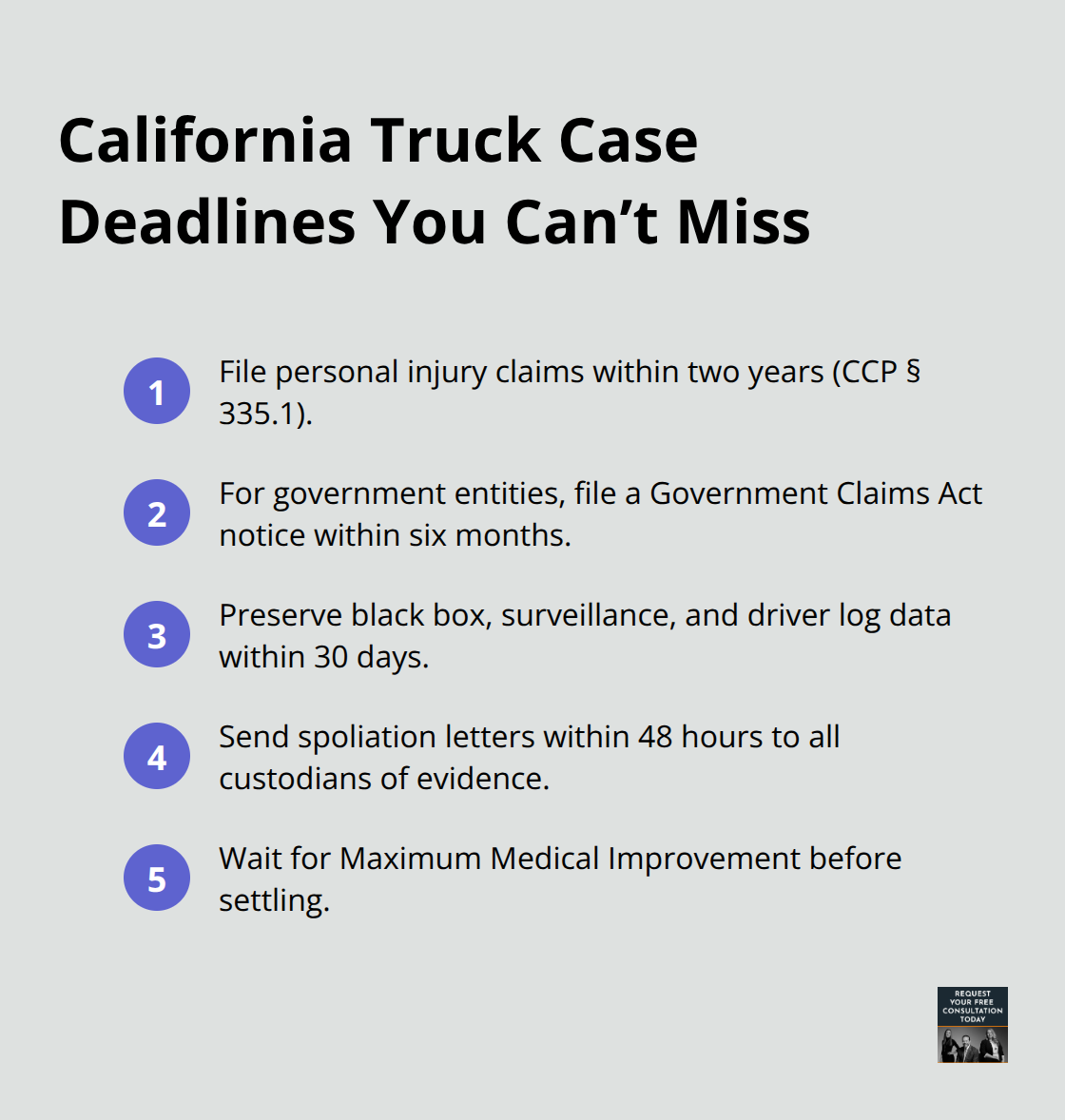
This letter creates a legal obligation to preserve evidence, and failure to comply after receiving it strengthens your position if litigation becomes necessary. Send this letter within 48 hours of the crash to maximize your chances of recovering critical data.
Medical Treatment Timing and Maximum Medical Improvement
Medical treatment deadlines matter significantly. Settling before reaching Maximum Medical Improvement almost guarantees undercompensation because future costs remain unknown. If your doctor projects two years of ongoing physical therapy, do not accept a settlement offer in month three of treatment. Wait until treatment nears completion and medical professionals can accurately project permanent limitations and future expenses. These three deadlines-statute of limitations, evidence preservation window, and MMI timing-are non-negotiable. Missing any of them eliminates recovery or substantially reduces it.
Final Thoughts
Truck crash settlement negotiations reward those who act fast and refuse inadequate offers. Insurance companies deploy teams of adjusters and attorneys trained to minimize payouts, so you need representation that matches that firepower. We at Schaar & Silva LLP understand trucking liability, FMCSA violations, and how to present evidence that makes defense costs prohibitive for insurers in Santa Cruz County, Sacramento, and Oakland.
The difference between accepting an inadequate settlement and receiving fair compensation comes down to having someone in your corner who navigates the legal complexities while you focus on recovery. Our team handles medical bill navigation, property damage evaluation, and connects you with support services that address both your physical and emotional recovery. Contact Schaar & Silva LLP to discuss your truck crash settlement case and learn how we protect your rights.
Moving forward after a truck crash means taking action immediately, preserving evidence, documenting everything, and refusing to settle until you understand the full scope of your damages. That approach protects you and your family when the stakes are highest.
