

Truck accidents cause serious injuries and financial hardship for victims across Santa Cruz County, Sacramento, and Oakland. Understanding truck crash litigation helps you protect your rights and recover the compensation you deserve.
At Schaar & Silva LLP, we guide clients through every stage of their claims, from gathering evidence to negotiating settlements. This guide covers the key aspects of truck accident cases so you know what to expect.
What Causes Truck Accidents and Who’s Liable
The Devastating Impact of Truck Crashes
Truck accidents in Northern California inflict serious injuries and financial hardship that differ dramatically from standard car crashes. A semi-truck weighing 80,000 pounds creates forces that smaller vehicles cannot withstand. The National Highway Traffic Safety Administration reported nearly 6,000 deaths in large-truck crashes in 2022, with the majority of victims being occupants of passenger vehicles. Understanding what caused your crash matters because it determines who pays for your injuries and how much compensation you can recover.
Driver Fatigue and Hours-of-Service Violations
Driver fatigue remains one of the most preventable causes of truck accidents in this region. Federal hours-of-service regulations limit drivers to 11 hours of driving per 14-hour duty period, yet violations occur regularly on I-5 and Highway 99 where tight delivery schedules pressure drivers to exceed safe limits. When a driver operates beyond these legal thresholds, both the driver and the trucking company become liable through what’s called vicarious liability. Electronic logging device records show exactly when drivers were operating and when they violated rest requirements-this evidence strengthens your case significantly. Fatigue impairs reaction time and concentration in ways comparable to intoxication, making high-speed crashes inevitable when a fatigued driver encounters traffic or road hazards. If the company failed to enforce hours-of-service rules or ignored complaints about driver fatigue, that negligence becomes actionable evidence in your claim.
Mechanical Failures and Maintenance Negligence
Mechanical failures cause crashes that trucking companies should have prevented through proper maintenance. Brake failures, tire blowouts, and steering problems result from deferred maintenance and inadequate inspections rather than random defects. Federal regulations require carriers to maintain detailed maintenance records and conduct regular safety inspections, yet many companies prioritize cost-cutting over safety. Maintenance records reveal whether the company neglected required repairs or ignored known defects-this documentation proves negligence. Overloaded or improperly secured cargo shifts weight distribution and increases stopping distances, turning a routine maneuver into a rollover or jackknife crash. Improper loading practices often fall to third-party loaders, which means additional defendants and additional insurance policies available to compensate you. The weight and distribution of cargo directly affects how an 80,000-pound truck handles on grades common to Northern California highways, making this factor critical to establishing negligence and identifying all parties responsible for your injuries.
What Compensation Can You Recover
Medical Expenses and Long-Term Care Costs
Truck accident injuries create financial losses that extend far beyond immediate medical bills. Medical expenses in truck crashes typically include emergency room treatment, surgery, hospitalization, physical therapy, and ongoing specialist care. If your injuries require long-term treatment, future medical costs become part of your claim-this includes anticipated surgeries, medications, home care assistance, and medical equipment. You must document every medical expense meticulously because insurers will scrutinize these costs, and gaps in your records weaken your position. Often, victims face exorbitant medical bills that accumulate during recovery. Medical lien services can facilitate payment of your bills until your case resolves, allowing you to focus on healing rather than immediate payment obligations.
Lost Wages and Loss of Earning Capacity
Lost wages cover income you missed during recovery, but loss of earning capacity matters more in serious truck crash cases. If your injuries permanently reduce your ability to work or force you into lower-paying employment, you can recover the difference between what you earned before the crash and what you will earn going forward. You should calculate this by examining your pre-crash income, your current earning capacity, and your expected working years until retirement. This category of damages often exceeds immediate wage loss because it accounts for decades of reduced earning potential. An 80,000-pound truck crash can inflict permanent disabilities that eliminate entire career paths, making lifetime earning capacity calculations essential to fair compensation.
Pain and Suffering and Emotional Distress
Pain and suffering damages compensate for physical pain, emotional distress, and reduced quality of life resulting from your injuries. California law recognizes that severe injuries cause psychological harm-anxiety, depression, PTSD, and loss of enjoyment in activities you once performed. Juries award pain and suffering based on injury severity, treatment duration, and long-term prognosis rather than a fixed formula. You should gather comprehensive medical records showing treatment progression and maintain a detailed journal documenting daily pain and limitations. Preserve evidence of activities you can no longer perform because this documentation strengthens your claim substantially. When a truck crash causes permanent disfigurement, amputation, or spinal cord injury, pain and suffering awards increase substantially because courts recognize the lifetime impact of these conditions. Emotional trauma frequently goes underestimated in settlements, yet psychological support and documented mental health treatment demonstrate the real harm you suffered.
Why Early Settlement Offers Fall Short
Insurers offer initial settlements before your full medical picture emerges, and accepting early means forgoing compensation for long-term consequences you have not yet experienced. The claims process moves at different speeds depending on injury severity and treatment length, but rushing to settle leaves money on the table.
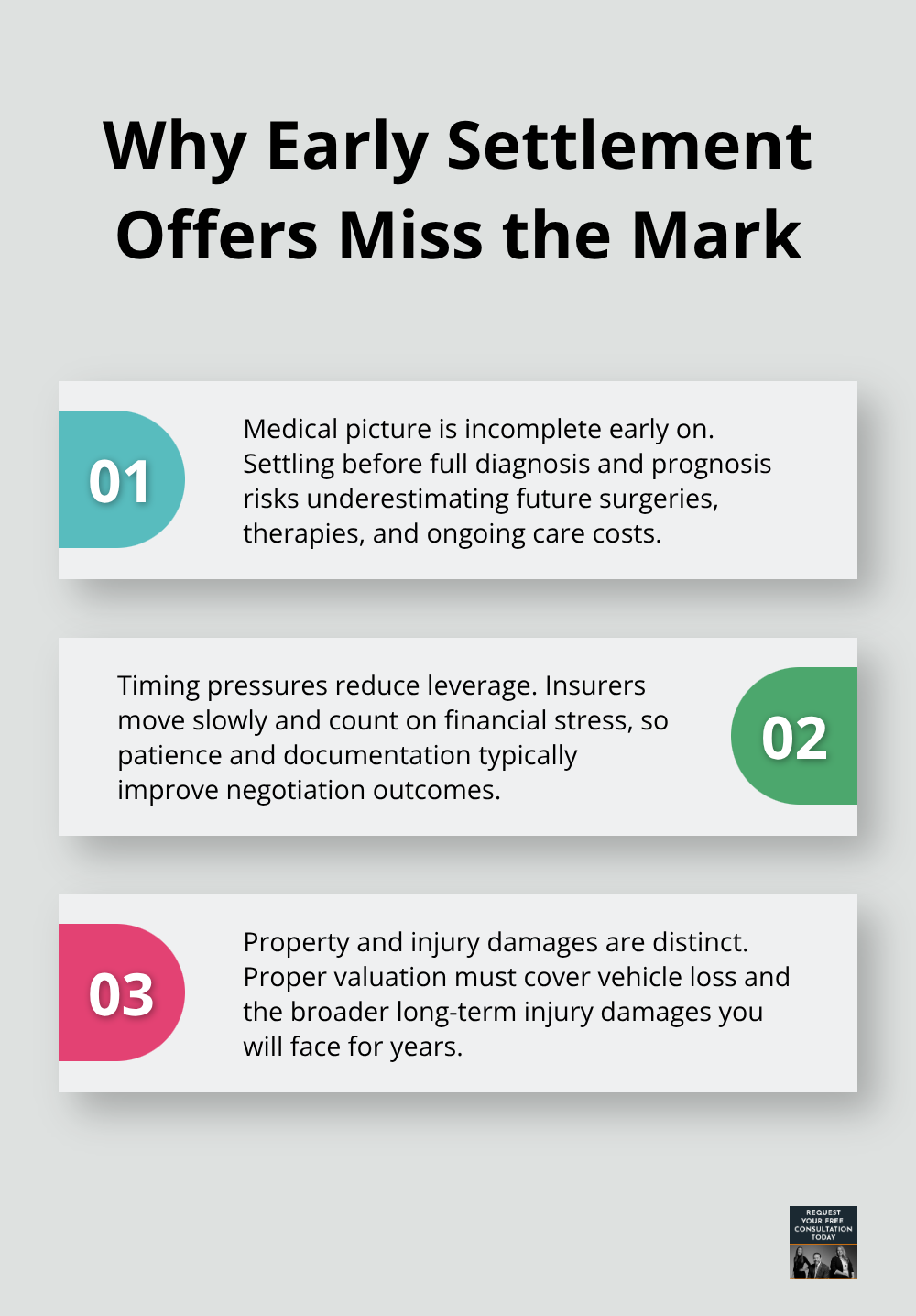
Property damage claims require fair valuation of your vehicle loss, and settlement negotiations should account for both vehicle repair or replacement costs and the broader injury damages you will face for years ahead.
How to Move Through Your Truck Accident Claim
Act Immediately After the Crash
The truck accident claims process unfolds in stages, and timing matters enormously. California law gives you two years to file a personal injury claim from the injury date under California Code of Civil Procedure 335.1, but waiting until month 23 guarantees problems. Early action preserves evidence that disappears fast-electronic logging device data, maintenance records, and witness memories fade or vanish within weeks. You should photograph the scene from multiple angles, collect driver and company information, get witness contact details, and preserve your vehicle as-is until inspection occurs. Medical records become your foundation because they establish injury causation and severity. Start treatment immediately even if you feel fine, since delayed care weakens your damage claims substantially.
Organize Your Medical and Financial Records
Maintain organized records of every medical bill, treatment note, prescription, and transportation cost related to your injuries. Insurance adjusters will request these records repeatedly, and gaps signal weakness they exploit in settlement negotiations. You must track repair estimates or replacement value documentation carefully for property damage claims. The entire process typically takes months to years depending on injury severity and the complexity of liability disputes involving multiple parties like the driver, trucking company, and maintenance providers.
Navigate Insurance Company Communications
Insurance companies move slowly by design, hoping you’ll accept inadequate offers out of financial desperation. When the at-fault driver’s insurer contacts you, do not discuss fault details or sign anything without legal guidance. The trucking company’s commercial policy typically carries higher limits than personal auto insurance, which means better recovery potential if you navigate claims correctly. Settlement negotiations require understanding what your case is actually worth, which depends on documented medical expenses, lost income calculations, and realistic pain and suffering valuations.
Evaluate Settlement Offers Against Your Damages
The insurer’s initial offer often falls short of your actual damages. If you reject an insufficient settlement, you have the option to file a personal injury lawsuit and prepare for trial. Most cases settle before trial, but the credible threat of litigation forces insurers to offer fair compensation. Property damage claims require fair vehicle valuation separate from your injury damages, so accurate documentation strengthens your negotiating position substantially.
Final Thoughts
Truck crash litigation differs fundamentally from standard car accident claims because of the size and weight involved, the regulatory framework governing trucking operations, and the multiple parties who may bear responsibility. Your case likely involves the driver, the trucking company, maintenance providers, and cargo loaders-each with separate insurance policies and legal obligations. The evidence that matters most includes electronic logging device records proving hours-of-service violations, maintenance documentation showing negligent upkeep, and medical records establishing injury severity and causation.
California’s two-year statute of limitations for personal injury claims creates urgency that many victims underestimate. Waiting months to pursue your claim allows evidence to vanish and witness memories to fade, which weakens your position substantially. The claims process moves at different speeds depending on injury complexity, but early legal involvement preserves your rights and prevents insurers from devaluing your case through delay tactics.
We at Schaar & Silva LLP guide clients through truck crash litigation by handling the legal complexities while you focus on recovery. Contact us for a free case evaluation to understand what your case is worth and what compensation you can realistically recover.
