

Truck accidents in California cause severe injuries and financial losses that demand immediate action. At Schaar & Silva LLP, we help victims understand their rights and pursue fair truck crash settlements.
This guide walks you through each stage of the process, from the accident scene to settlement negotiations or trial.
What to Do Immediately After a Truck Accident
The first hours after a truck accident determine how much compensation you recover. Most people focus on their injuries and forget to preserve critical evidence that insurers will later use against them. At the accident scene, photograph everything from multiple angles: the truck’s position, tire marks, road conditions, traffic signals, and all vehicle damage. Capture the license plate, the truck’s company name, and any visible company logos. Collect the names, phone numbers, and addresses of at least three independent witnesses who saw the crash happen, not just people who arrived afterward. According to the Judicial Council of California, the statute of limitations gives you two years to file a personal injury lawsuit, but evidence deteriorates fast.
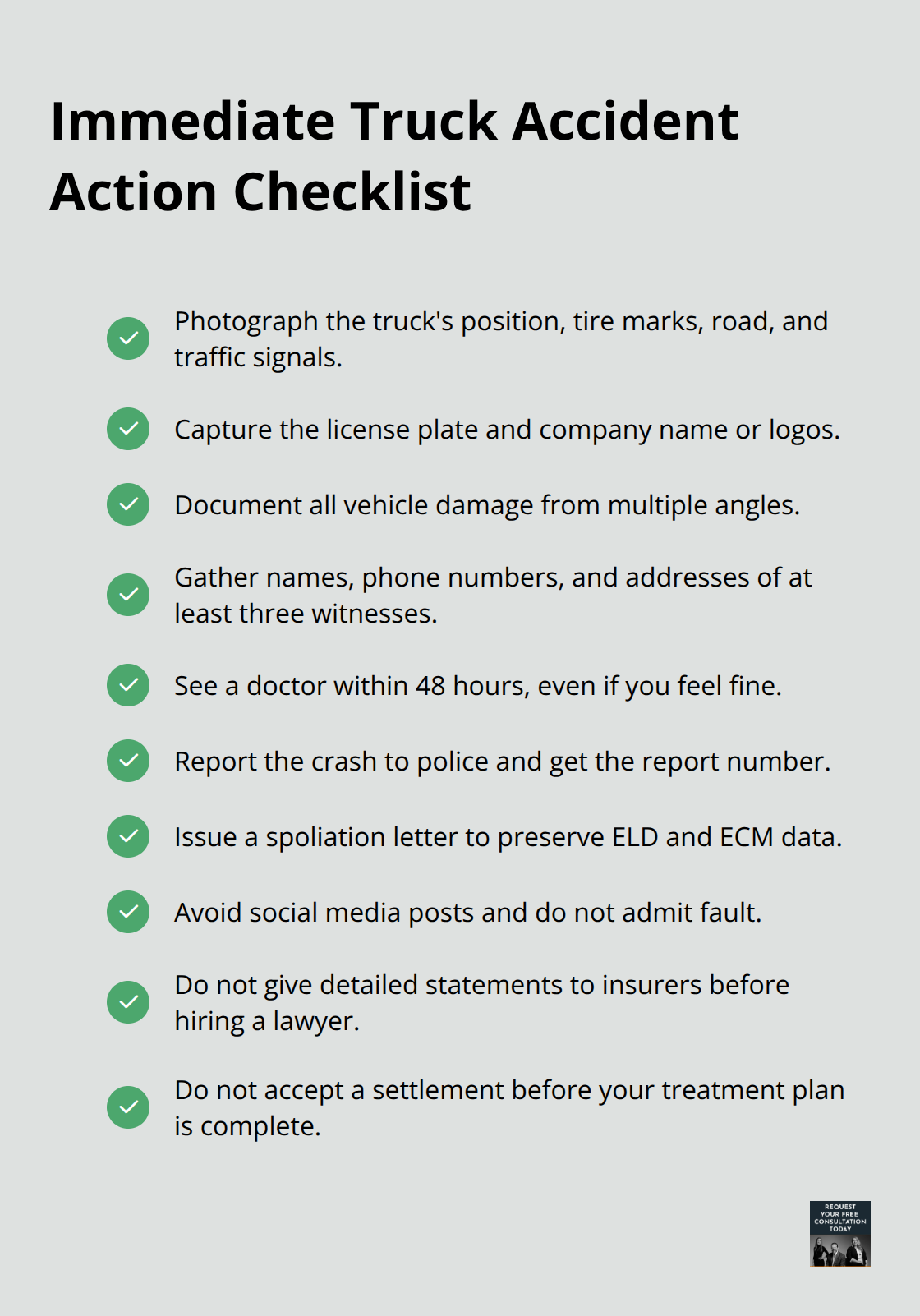
Electronic logging device data, dashcam footage, and maintenance records can be overwritten or destroyed within weeks. Issue a spoliation letter immediately to lock down ELD and ECM data before the trucking company can claim it was accidentally lost. Do not post anything about the accident on social media, do not admit fault at the scene, and do not accept any settlement offer before your medical treatment plan is complete.
Seek Treatment and Report the Incident
Medical records form the foundation of your settlement value. See a doctor within 48 hours even if you feel fine, because many serious injuries like traumatic brain injury or internal bleeding show up days later. Keep every medical receipt, prescription record, and treatment note organized in a single folder. Report the crash to police immediately and obtain the official police report number. California law requires you to report accidents to your insurance company within a reasonable time, but do not volunteer detailed statements to the adjuster until you have legal counsel. Gather your auto insurance policy and the truck driver’s insurance information. Note the truck’s commercial carrier name and the motor carrier number, which you can verify through the Federal Motor Carrier Safety Administration database.
Contact a Legal Team Before Insurance Calls
Insurers contact victims within hours of a crash and use recorded statements against you later. A lawyer can handle these communications and prevent you from accidentally reducing your claim value. Insurance adjusters ask leading questions designed to establish comparative fault under California’s pure comparative negligence rule, which means even 30 percent of the blame cuts your recovery by 30 percent. Trucking insurers perform internal valuations that account for available policy limits, FMCSA violations, and punitive damages exposure. An attorney who understands FMCSA regulations (hours-of-service violations, drug testing failures, vehicle maintenance requirements) can identify violations that support higher settlements. The median settlement for California truck cases falls between $250,000 and $500,000, but your actual range depends on eight specific factors: total available insurance coverage, regulatory violations, liability strength, injury severity, medical documentation, economic damages, non-economic damages, and venue.
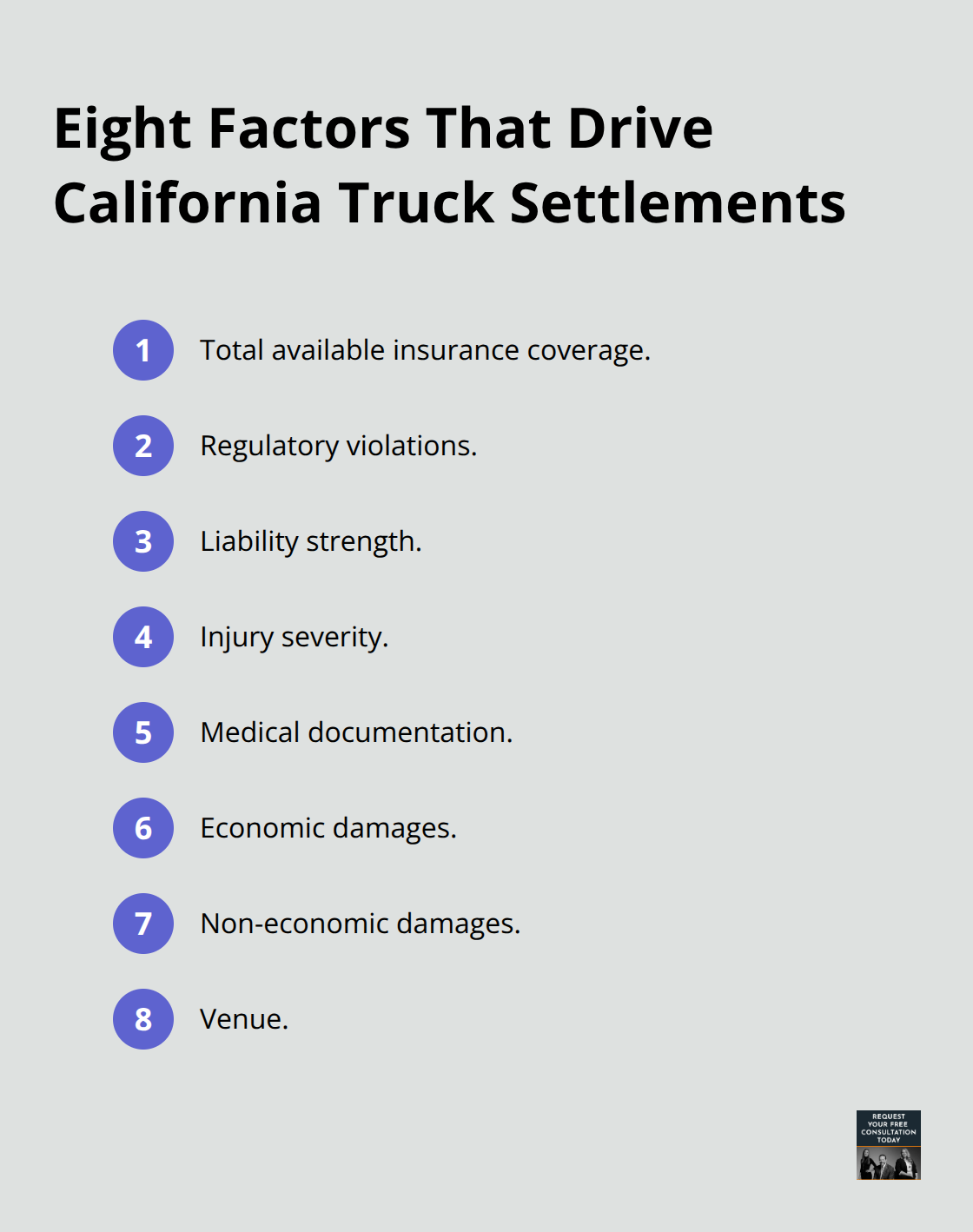
Understanding these factors helps you evaluate whether a settlement offer reflects your case’s true value.
Why Truck Accidents Create Larger Settlements Than Car Crashes
Truck accidents generate substantially higher settlements than passenger vehicle collisions because of three structural realities that compound injury severity and available compensation. An 80,000-pound commercial truck creates catastrophic injuries that a 4,000-pound car cannot match, which means medical costs, lifetime care needs, and pain-and-suffering awards climb dramatically. Interstate motor carriers carry minimum liability coverage of $750,000 to $5,000,000 under federal law, compared to California’s standard $15,000 per-person auto liability limit. This coverage gap alone explains why the median truck settlement in California reaches $250,000 to $500,000, while typical car accident settlements fall far below that range. Multiple defendants in truck crashes create stacked insurance layers: the driver’s employer, the truck owner, the trailer lessor, cargo loaders, maintenance contractors, and sometimes the broker or shipper all carry separate policies that stack on top of each other. A single catastrophic injury case might access primary coverage, excess coverage, umbrella policies, and cargo coverage simultaneously, multiplying the total available recovery pool.
How FMCSA Violations Push Settlement Value Higher
Federal Motor Carrier Safety Administration violations transform a negligence claim into a per-se negligence case, which means the violation itself proves the truck driver or company acted recklessly without requiring additional proof. Hours-of-service violations under 49 CFR Part 395 show the driver operated while fatigued, which courts treat as automatic negligence. Drug and alcohol testing failures under 49 CFR Part 382 establish impairment without dispute. Negligent hiring or training under 49 CFR Part 391 means the carrier knowingly employed an unqualified or unsafe driver. Vehicle maintenance failures under 49 CFR Part 396 prove the company ignored brake, tire, or steering defects that caused the crash. Electronic logging device tampering under 49 CFR Part 395 shows the driver or company falsified records to hide hours violations. These violations support punitive damages in California, which have no statutory cap in truck cases. A case involving a fatigued driver with hours-of-service violations and poor maintenance records generates exponentially higher settlement pressure than a simple negligence claim.
Comparative Fault Reduces Your Recovery Dollar-for-Dollar
California’s pure comparative negligence rule under Civil Code Section 1714 means even minor comparative fault decimates your settlement. If a jury or insurance adjuster assigns you 30 percent of the blame for a $1,000,000 case, your recovery drops to $700,000 automatically. Trucking insurers weaponize this rule by arguing the victim contributed to the crash through lane position, speed, or failure to avoid the truck. Accident reconstruction experts, electronic logging device data, dashcam footage, and witness statements become critical to allocate fault accurately. A case with clear liability evidence (the truck ran a red light, crossed the center line, or caused a rear-end collision) commands premium settlement value because comparative fault exposure is minimal. A case where liability is ambiguous or the victim’s actions are remotely questionable invites aggressive comparative fault arguments that reduce compensation by 20 to 40 percent. Insurance adjusters use comparative fault strategically in settlement negotiations to lower their initial offer and pressure victims into accepting reduced amounts.
Evidence Strength Determines Your Settlement Outcome
The strength of your evidence directly correlates to settlement value, which is why early evidence preservation protects your claim’s financial outcome. Spoliation letters lock down electronic logging device and ECM data before the trucking company can claim it was accidentally lost. Dashcam footage, accident reconstruction reports, and witness statements establish liability without ambiguity. Medical records that document causation between the truck crash and your injuries eliminate gaps that insurers exploit to reduce damages. Property damage assessments and repair estimates quantify economic losses that support higher settlement demands. Photographs from the accident scene, traffic signal timing data, and road condition reports all reinforce liability and comparative fault arguments in your favor. The more evidence you preserve immediately after the crash, the stronger your negotiating position becomes when settlement discussions begin.
How Settlement Negotiations Work in Truck Accident Cases
Settlement negotiations in California truck crashes follow a structured timeline with predictable milestones, and understanding this process prevents you from accepting inadequate offers early. Most truck accident cases resolve within 12 to 36 months, with catastrophic injuries or wrongful death cases taking longer due to uncertain future medical costs and lifetime care needs. The process begins when your attorney sends a demand letter to the trucking company’s insurance carrier, which includes your medical records, economic damages calculation, and non-economic damages estimate.
The Insurance Valuation Process
Insurers perform a multi-step internal valuation that determines their settlement authority. They verify coverage across all policy layers (primary, excess, umbrella, cargo, and UM/UIM), assess liability using FMCSA violation analysis and accident reconstruction, calculate past and future medical expenses and lost wages, estimate pain and suffering using multipliers between 1x and 5x your economic damages, and analyze punitive damages exposure. A realistic demand letter for a moderate injury case ranges from $300,000 to $750,000, while severe permanent injury cases demand $750,000 to $5,000,000 or higher.
Initial Offers and Counter-Proposals
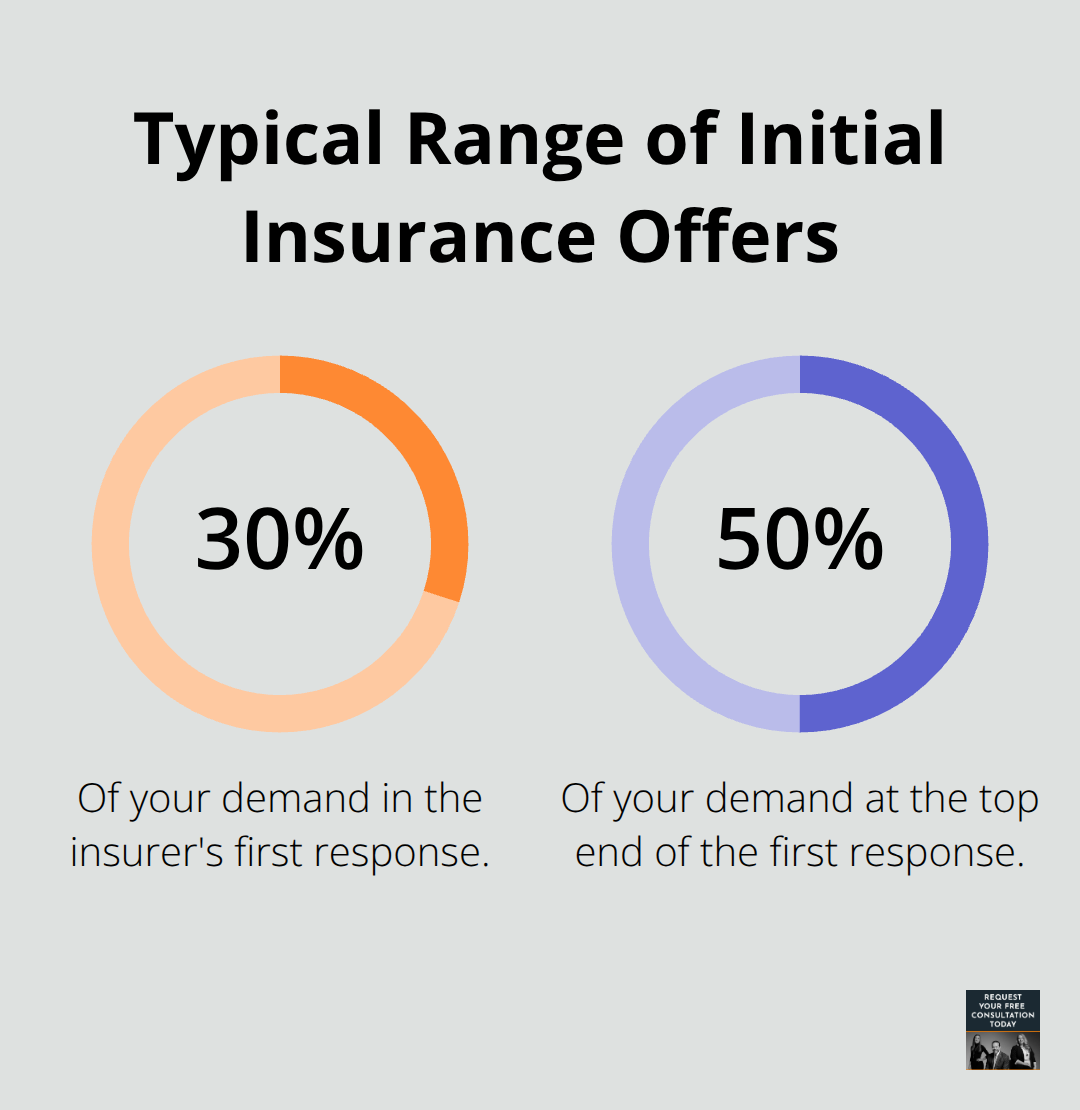
The insurance adjuster’s first response typically offers 30 to 50 percent of your demand, which is a negotiating position, not a final offer. Reject lowball initial offers without hesitation and counter with a detailed settlement proposal that justifies your damages through medical evidence, wage loss documentation, and life-care plans for catastrophic injuries.
Most cases settle after two to four rounds of negotiation, with settlement conferences occurring 6 to 12 months after the demand letter. If the insurer refuses to move significantly or denies clear liability, your attorney files a lawsuit and enters the discovery phase.
Discovery Changes Settlement Dynamics
Discovery and litigation dramatically change settlement dynamics because insurers recognize that trial costs, jury risk, and public verdict exposure exceed their settlement reserves. During discovery, your attorney obtains the truck driver’s personnel file, hiring records, training documents, and disciplinary history through interrogatories and document requests. You also obtain the electronic logging device data showing hours violations, maintenance records proving negligent upkeep, and the driver’s drug and alcohol testing results. Depositions lock witnesses into sworn testimony before trial, which forces the insurance company to confront the strength of your evidence. A deposition of the truck driver admitting fatigue or distraction, combined with ELD data proving hours violations, creates massive settlement pressure because the insurer cannot credibly argue liability at trial.
Settlement Pressure During Litigation
Discovery typically takes 6 to 12 months, and settlement negotiations intensify during this phase as both sides evaluate trial risk more realistically. Insurance carriers often increase settlement offers by 50 to 100 percent once discovery reveals damaging evidence. Many cases settle at or near trial date as jury selection approaches, because jurors in Los Angeles County, Orange County, and Sacramento tend to award higher verdicts in truck cases with clear liability and severe injuries. If settlement negotiations stall despite strong evidence, proceeding to trial forces the insurer to justify their position before a jury, which almost always results in higher verdicts than their final settlement offer. Trial outcomes for catastrophic injury cases in California frequently exceed $3,000,000, and wrongful death verdicts reach $5,000,000 to $85,000,000 depending on the victim’s age and earning potential.
Final Thoughts
Truck crash settlement California cases demand immediate action, thorough evidence preservation, and strategic legal guidance to maximize your recovery. Insurance carriers exploit gaps in evidence, comparative fault arguments, and victim confusion about deadlines to reduce their payouts. You now understand that truck accidents generate substantially higher settlements than car crashes because of catastrophic injuries, larger policy limits, and multiple defendants with stacked coverage layers.
FMCSA violations transform negligence claims into per-se negligence cases that support punitive damages without caps in California. Comparative fault can reduce your recovery dollar-for-dollar, which is why liability evidence strength determines your settlement outcome. The eight factors that drive real compensation-total available insurance coverage, regulatory violations, liability strength, injury severity, medical documentation, economic damages, non-economic damages, and venue-control whether you receive fair compensation or accept a fraction of what your case is worth.
We at Schaar & Silva LLP help truck accident victims in Santa Cruz County, Sacramento, and Oakland understand their rights and pursue fair settlements. Contact us today to discuss your case and learn how much your truck crash settlement California claim is actually worth based on the factors that drive real compensation.
