
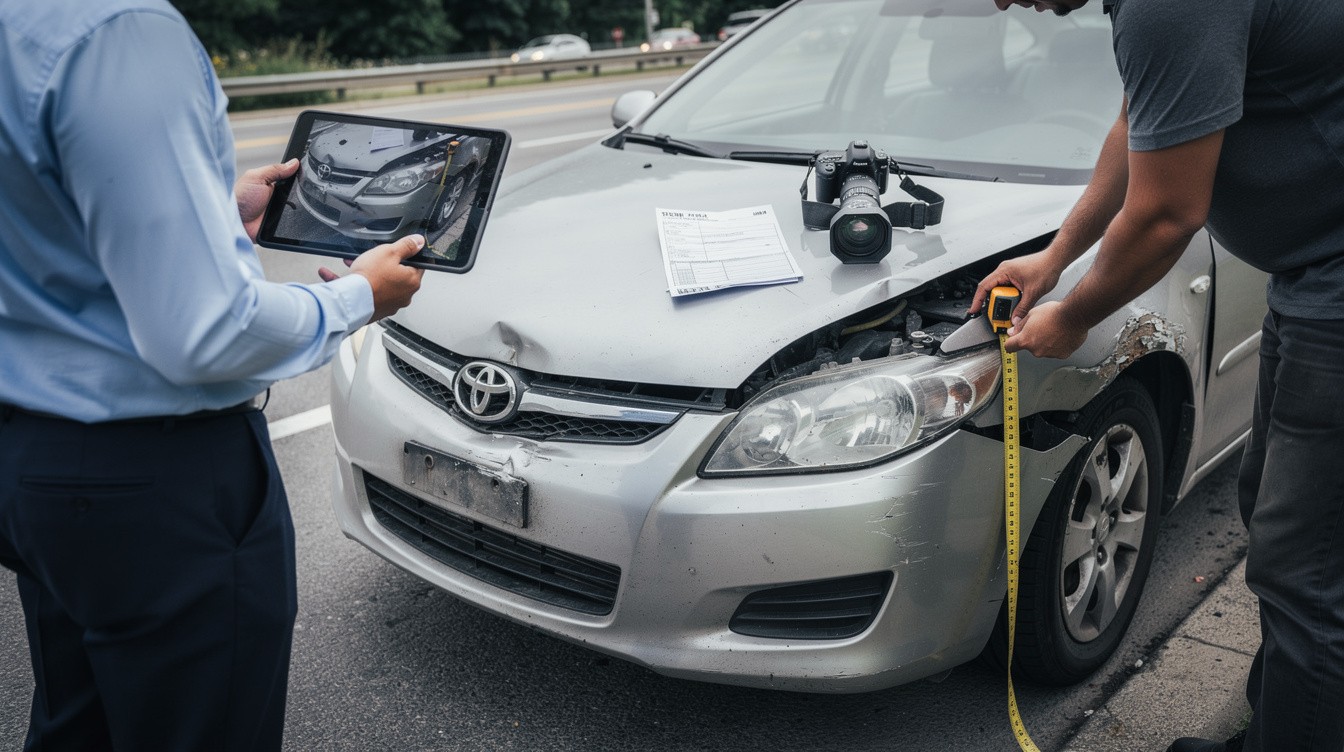
After a vehicle accident, insurance companies often undervalue property damage claims. Understanding how property damage valuation works puts you in a stronger position to fight for fair compensation.
We at Schaar & Silva LLP have helped countless accident victims in Santa Cruz County, Sacramento, and Oakland recover the full value of their damaged vehicles. This guide walks you through the process step by step.
How Insurance Companies Value Your Damaged Vehicle
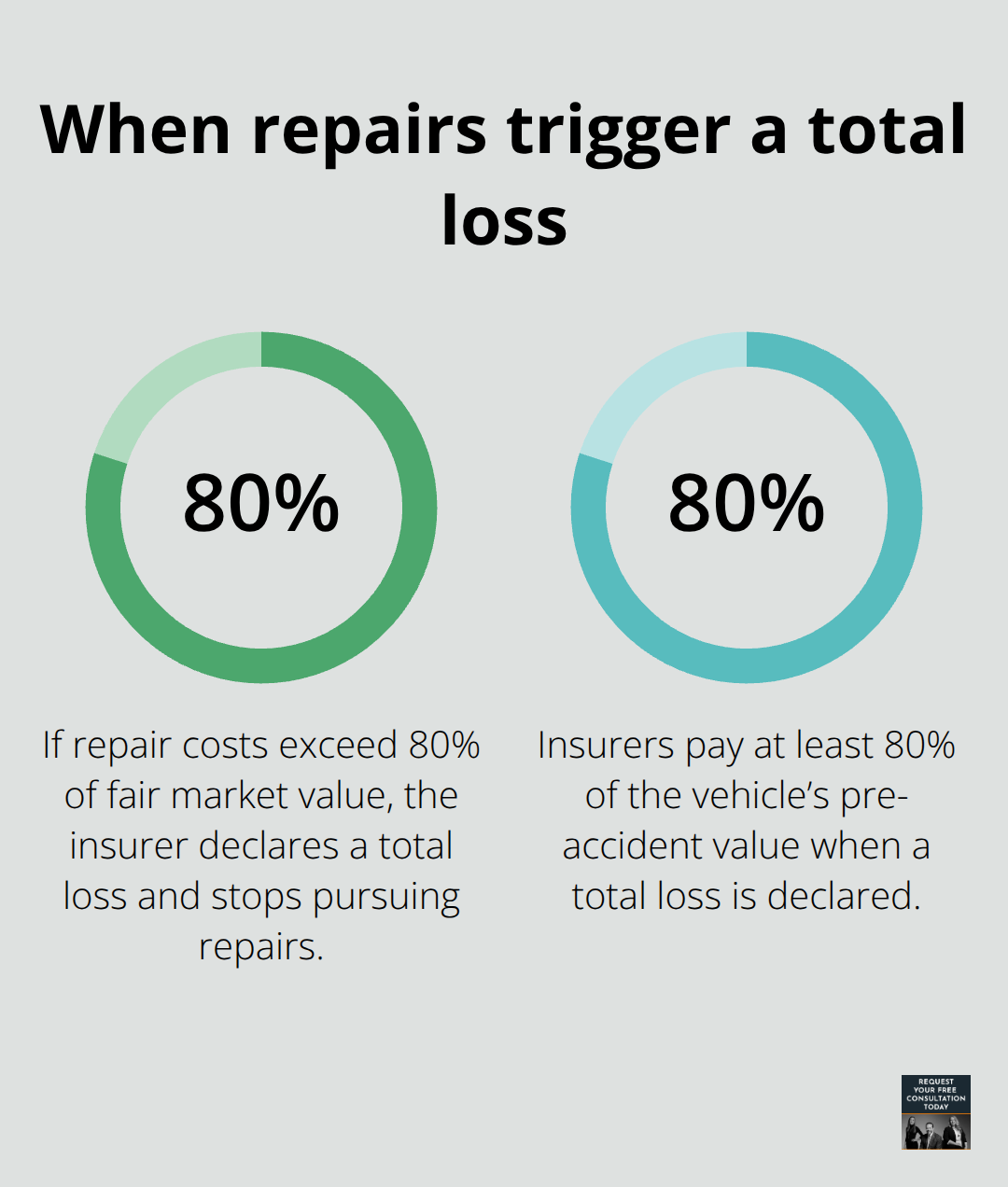
Insurance adjusters use a specific formula to determine what your vehicle is worth after an accident, and understanding this process prevents you from accepting artificially low offers. The adjuster establishes your car’s fair market value-what it could have sold for one day before the crash, adjusted for location, age, mileage, and condition. They then subtract repair costs or, if repairs exceed 80% of that fair market value, they declare your car a total loss and pay you at least 80% of the pre-accident value. This is where many accident victims lose money: they don’t challenge the valuation method the insurer chooses, and different methods produce vastly different results.
Use resources like Kelley Blue Book or NADA Guides to independently calculate your vehicle’s value before accepting any offer. Include documentation of recent maintenance (oil changes, brake work, new transmission) and any aftermarket upgrades (custom rims, stereo systems, lift kits) because these directly increase your claim amount. Get everything in writing from the adjuster, and if they call a form standard, verify its contents in writing to avoid misunderstandings that lower your payout.
Repair Costs Versus Total Loss Thresholds
When repair estimates arrive, the insurer must reimburse for repairs using parts that are similar in kind and condition to the damaged ones-not necessarily original manufacturer parts, but equivalent quality. If you disagree with the insurer’s repair estimate, obtain multiple estimates (two to three) from different body shops and present them to the adjuster; this creates negotiating leverage. The critical threshold is 80% of fair market value: if repairs cost $16,000 and your car’s fair market value is $20,000, the insurer treats it as a total loss rather than repairing it.
After a total loss declaration, you can choose to keep the vehicle and receive its salvage value, or sell it to the insurer. Track any personal property inside the vehicle at the time of the crash-cell phones, GPS units, work equipment, groceries, luggage-because these items should be repaired or replaced as part of your claim, and they often add thousands to your recovery.
Diminished Value Claims Most Accident Victims Ignore
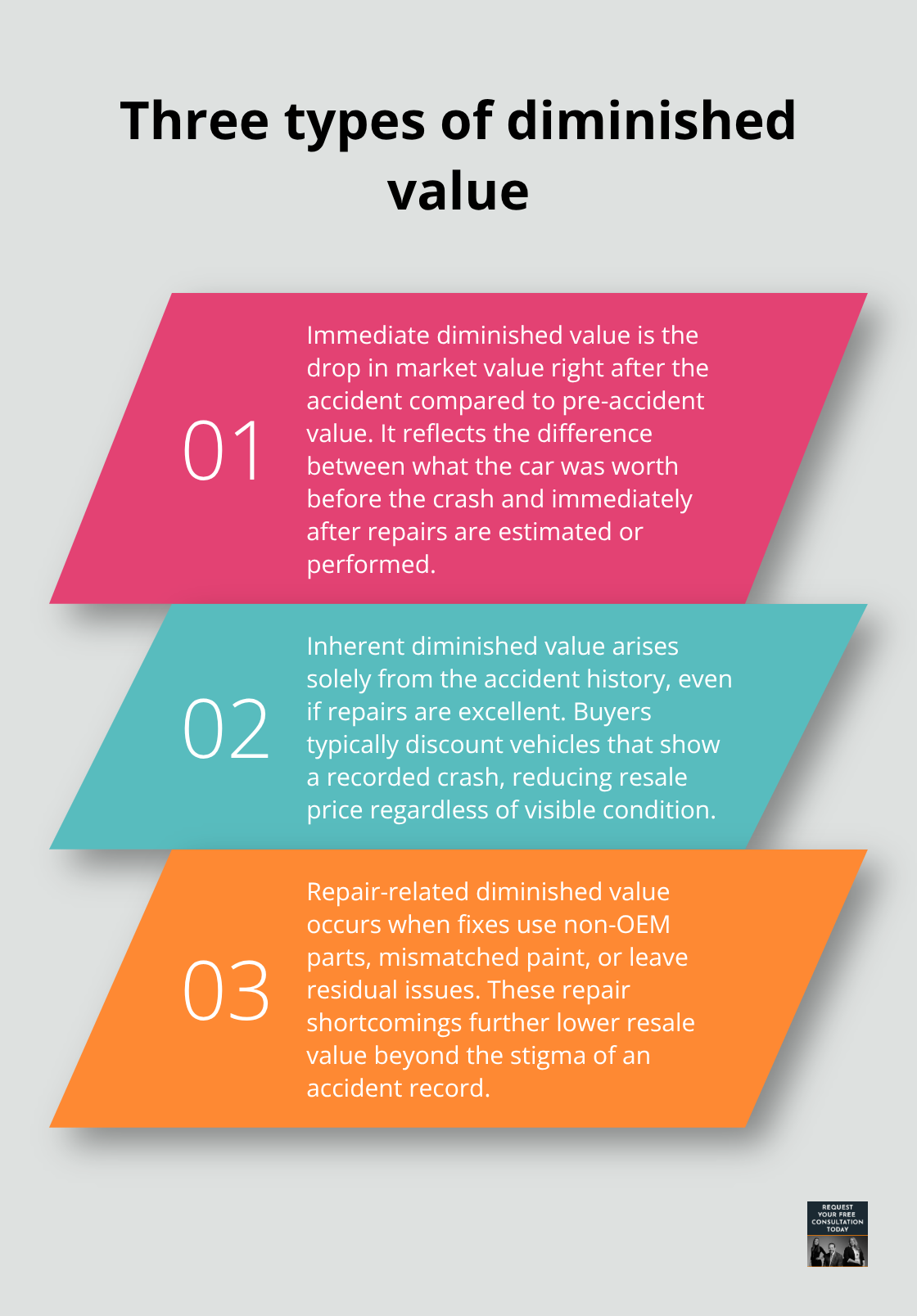
Even after your car is repaired, it loses resale value simply because it has an accident history. This loss is called diminished value, and it persists regardless of repair quality. Three types exist: immediate diminished value (the drop in market value when comparing pre-accident to post-repair value), inherent diminished value (the loss caused by accident history alone), and repair-related diminished value (when repairs use non-original parts or mismatched paint).
Newer vehicles, luxury cars, and high-value vehicles experience substantial diminished value claims. Most accident victims never pursue this because insurers don’t volunteer the information, but you have the right to claim it. Document everything-repair receipts, rental car costs while repairs happen, towing fees, fuel costs in your tank-because these out-of-pocket expenses strengthen your total claim value and demonstrate the full financial impact of the accident.
Understanding these valuation methods positions you to challenge low offers, but negotiating with adjusters requires strategy and documentation that many victims struggle to assemble alone.
What Evidence Matters Most for Your Property Damage Claim
Photographs and Video Documentation
Building a strong property damage claim starts with evidence that proves the accident happened, what was damaged, and how much it costs to repair or replace. Insurance adjusters won’t increase their offers without documentation that challenges their initial valuation, so you must gather the right materials before you negotiate. Photographs taken immediately after the accident carry the most weight because they show damage in its original state, before any repairs or cleanup. You should take photos from multiple angles of your vehicle’s exterior damage, the interior if personal property was damaged, and the overall accident scene including road conditions and other vehicles involved. If possible, capture images of the at-fault driver’s vehicle and their license plate. Video footage from nearby traffic cameras, dashcams, or surveillance systems strengthens your claim significantly because it documents the accident sequence and prevents the other party from disputing liability. Many adjusters will accept video evidence without requesting additional corroboration, which accelerates the claims process.
Police Reports and Official Records
Police reports create an official record that insurers must acknowledge, and in California the statute of limitations for property damage claims is generally 3 years from the date of damage according to the California Courts Self Help Guide, so you should obtain this report immediately to protect your timeline. You must request the police report number at the accident scene and follow up within days to verify the report is filed accurately; if errors exist, request a correction before submitting it to your insurer. This official documentation prevents adjusters from questioning whether the accident actually occurred and establishes a clear timeline for your claim.
Repair Estimates and Comparative Analysis
Repair estimates from body shops are where most accident victims make critical mistakes by accepting the insurer’s estimate without comparison. You should obtain two to three written estimates from different shops and present all of them to the adjuster; this demonstrates that the insurer’s estimate may be low and creates leverage for negotiation. Each estimate must itemize parts, labor, and timeline separately so you can identify where valuations differ. The insurer must reimburse for repairs using parts that are similar in kind and condition to the damaged ones, so your estimates should specify whether they include original manufacturer parts or equivalent aftermarket components.
Documentation of Personal Property and Out-of-Pocket Costs
Medical records matter less for pure property damage claims but become essential if you also sustained personal injury; you should keep documentation of any treatment related to the accident because insurers sometimes link vehicle damage severity to injury claims. Receipts for rental car costs, towing fees, and fuel in your tank at the time of the accident must all be submitted because these out-of-pocket expenses are recoverable and often overlooked. Documentation of aftermarket upgrades like custom rims, stereo systems, or lift kits must include proof of purchase and installation to justify higher claim values. Without receipts, insurers use estimated market value, so a documented paper trail directly increases your payout.
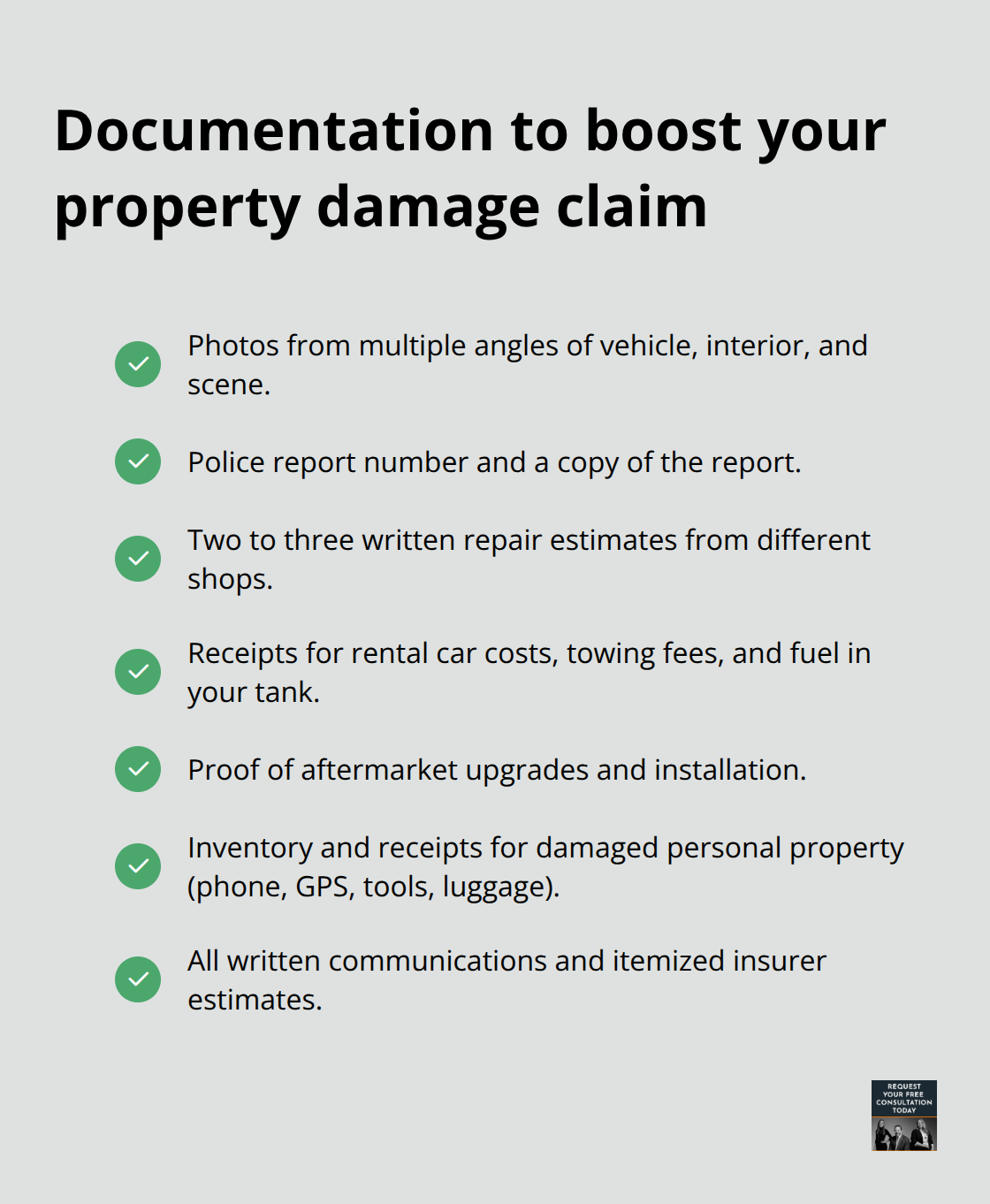
You should also track any personal property inside the vehicle at the time of the crash-cell phones, GPS units, work equipment, groceries, luggage-because these items should be repaired or replaced as part of your claim.
Written Communication and Record-Keeping
You must write down the adjuster’s name, date, and content of every conversation, and request all offers in writing; verbal promises carry no weight if disputes arise later. Each written estimate, receipt, and communication creates a paper trail that strengthens your negotiating position and prevents adjusters from later claiming they never received certain documents. When you present multiple estimates, photographs, and receipts to your adjuster, you shift the burden back to the insurance company to justify why their valuation differs from your documented evidence. This foundation of evidence is what allows you to challenge low settlement offers effectively and move into the negotiation phase with confidence.
Turning Your Evidence Into Negotiating Power
Present Your Documentation Strategically
Your documented evidence means nothing until you use it strategically against the insurance company’s initial offer. Most accident victims in Santa Cruz County, Sacramento, and Oakland accept the first settlement proposal within weeks of their accident, which is precisely when they have the least information and the most emotional pressure. Insurers count on this speed; they know that victims who wait longer tend to gather more evidence, obtain multiple estimates, and understand their claim’s true value.
The moment you receive an initial offer, your response determines whether you recover fair compensation or accept artificially low money. Do not respond immediately. Instead, spend the next two weeks compiling everything you gathered: your photographs, police report, multiple repair estimates, documentation of personal property damage, receipts for rental car costs and towing fees, and any evidence of aftermarket upgrades. Present all of this material to your adjuster in writing, with a cover letter that calmly identifies specific discrepancies between their estimate and yours.
If their repair estimate is $8,500 but you have estimates from two other shops at $10,200 and $9,800, state this plainly and ask which parts or labor rates they used that differ from industry standards. Insurers frequently use lower labor rates or exclude certain repairs to reduce their payout, and when you force them to justify these choices in writing, they often increase their offer without further negotiation.
Understand Your Adjuster’s Limitations and Incentives
Your adjuster is not your advocate; they work for the insurance company and face pressure to close claims quickly and cheaply. Some adjusters operate in bad faith, deliberately undervaluing claims knowing most victims won’t fight back. Others simply follow company guidelines that systematically undervalue certain vehicle types or damage patterns. Regardless, your job is to make their job harder by requiring written justification for every decision they make.
When they call with a settlement offer, write down the exact amount and ask them to email it with a detailed breakdown showing how they calculated fair market value, what repair costs they included, and whether they considered diminished value. Many adjusters will admit they did not include diminished value because their company does not automatically add it, which opens the door for you to submit a separate diminished value claim with supporting evidence.
Recognize When Diminished Value Claims Add Substantial Value
For vehicles newer than 2015 or with fair market values above $25,000, diminished value claims often exceed $3,000 to $8,000, depending on the damage severity and repair quality. If your adjuster refuses to increase their offer after you present multiple estimates and detailed documentation, you have reached the point where legal representation becomes financially smart rather than optional.
An attorney will obtain independent vehicle valuations, hire engineers to assess structural damage that affects future safety and resale value, and negotiate directly with the insurance company’s legal team rather than the adjuster. This shift in dynamics frequently results in substantially higher settlements because insurance companies treat attorney-represented claims differently than unrepresented victims. If your claim exceeds $15,000 in total damages or involves a luxury vehicle, newer model, or significant diminished value, consulting with an attorney costs nothing and typically results in recovery that far exceeds any legal fees involved.
We at Schaar & Silva LLP help accident victims in Santa Cruz County evaluate whether their property damage claim is being fairly valued and whether pursuing additional recovery through legal channels makes financial sense. Some claims are straightforward and settle quickly; others involve disputed liability, multiple at-fault parties, or significant diminished value that requires legal pressure to recover.
Final Thoughts
Property damage valuation after a vehicle accident requires you to move beyond accepting the first offer from your insurance company. You now understand how adjusters calculate fair market value, why repair estimates vary significantly, and how diminished value claims add thousands to your recovery. The evidence you gather in the days following your accident determines whether you recover fair compensation or settle for artificially low money.
Start by documenting everything: photographs from multiple angles, police reports, multiple repair estimates, receipts for rental costs and towing, and proof of any aftermarket upgrades or personal property damage. Present this material to your adjuster in writing and force them to justify discrepancies between their valuation and yours. If they refuse to increase their offer after you provide detailed documentation, you have reached the point where legal representation becomes financially smart rather than optional.
In Santa Cruz County, Sacramento, and Oakland, many accident victims leave thousands on the table by failing to pursue diminished value claims or by accepting quick settlements before understanding their claim’s true value. We at Schaar & Silva LLP help accident victims evaluate whether their property damage valuation reflects fair compensation and whether pursuing additional recovery makes financial sense. If your claim exceeds $15,000 in total damages, involves a luxury or newer vehicle, or includes significant diminished value, contact us for a free evaluation to understand whether your settlement offer reflects the true value of your loss.
