
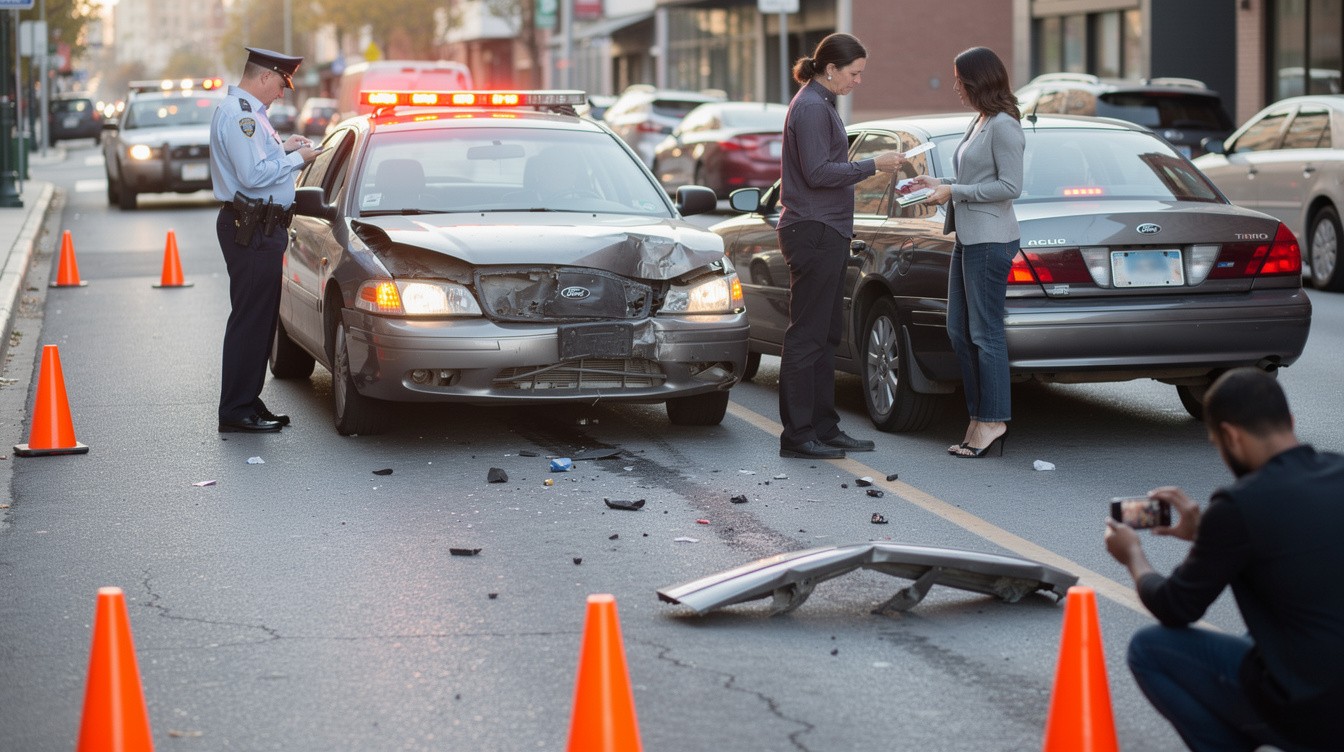
A rear-end collision in California often leaves the driver who was hit wondering who pays for the damage. The good news is that California law makes it relatively straightforward to establish fault in these cases.
We at Schaar & Silva LLP have helped countless accident victims recover the compensation they deserve. This guide walks you through how fault works, what evidence matters, and how to calculate your damages.
Who Is Liable in a Rear-End Collision
The Legal Presumption Against the Following Driver
California Vehicle Code Section 21703 creates a legal presumption that the driver who hits the car in front bears responsibility for the collision. This presumption exists because every driver has a duty to maintain a safe following distance. The logic is straightforward: if you stay far enough behind the car ahead, you can stop in time if they brake suddenly. When you hit them from behind, the law assumes you failed to keep that safe distance. This presumption carries significant weight in court, but it is not absolute.
When the Front Driver Bears Liability
The driver in front can sometimes shift liability back to you if they acted recklessly. Slamming on the brakes without legitimate cause or reversing unexpectedly into traffic can make the front driver liable for the collision. Non-functioning brake lights on the lead vehicle also tip the scales toward the front driver’s liability because you had no warning they were braking. Understanding this starting point matters because it means you begin from a position of strength if you were hit from behind.
How California’s Comparative Negligence Rule Works
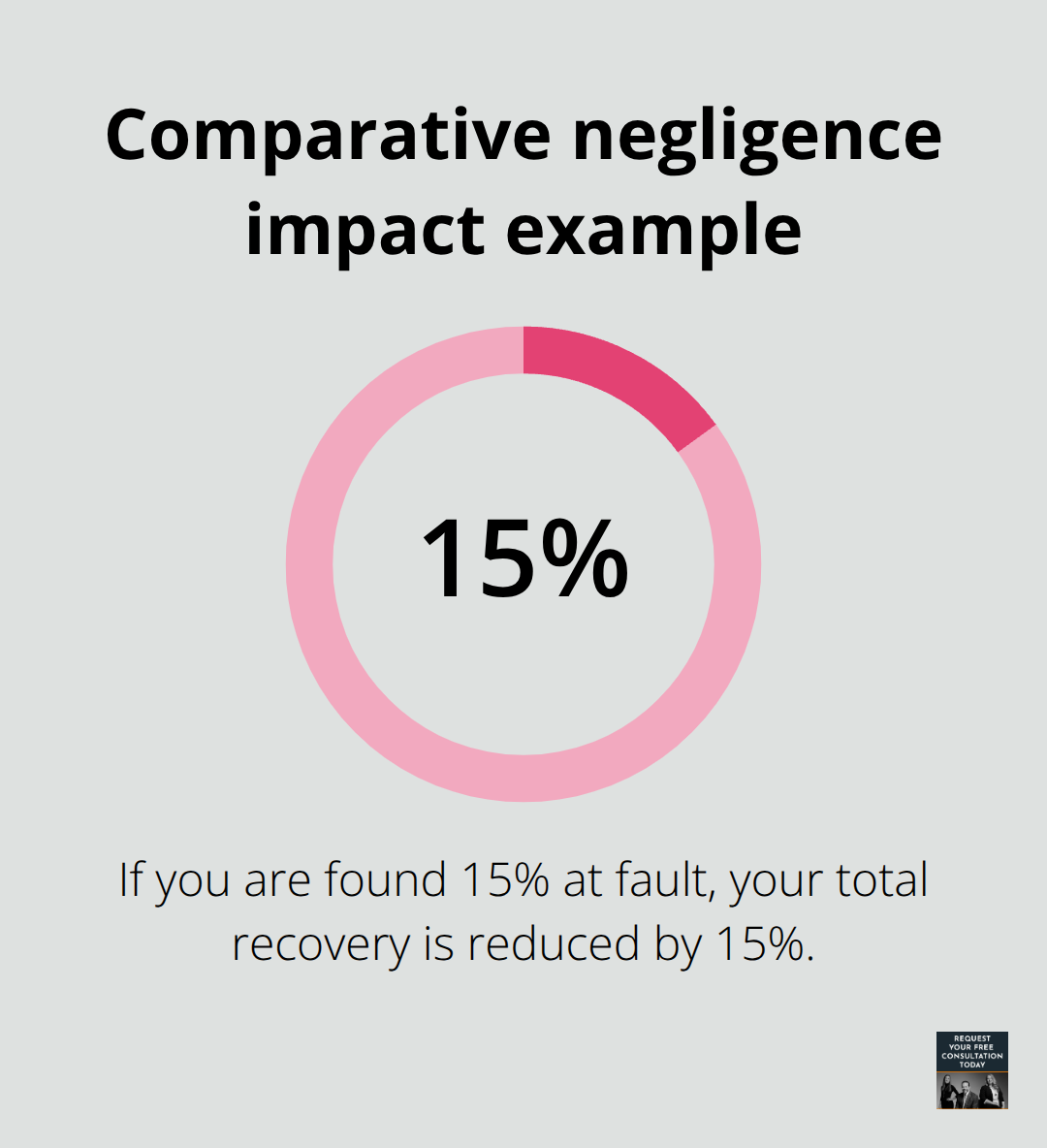
California follows pure comparative negligence, which means fault can be divided between drivers based on the actual evidence. If you were partially at fault, your damages get reduced by your percentage of responsibility. For example, if you were texting while driving and a rear-end collision occurred, a court might find you 15% at fault, which would reduce your recovery by 15%.
Rear-end collisions are far more common than most people realize, making understanding these rules essential for protecting your claim.
Evidence That Overcomes Presumptions
To overcome the presumption against the following driver or to prove shared fault, you need concrete evidence. Police reports from the accident scene carry significant weight because officers document road conditions, vehicle damage patterns, and witness observations. Photographs of vehicle damage, skid marks, and the accident scene help accident reconstruction experts establish the sequence of events. Witness statements matter tremendously because neutral observers can describe what they saw without bias. Medical records documenting injuries you sustained create a direct link between the collision and your damages.
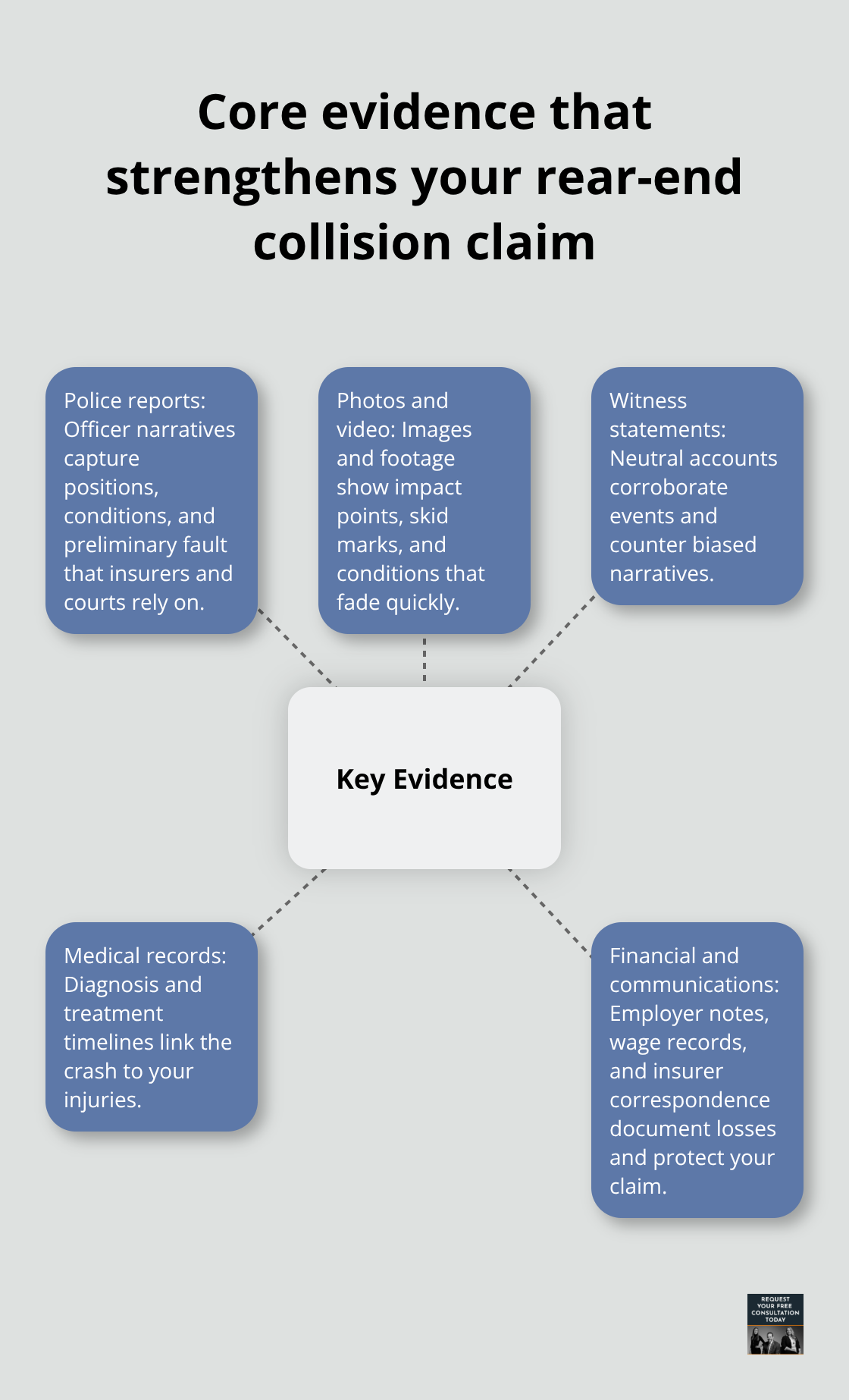
The stronger your evidence collection, the harder it becomes for an insurance company to minimize what they owe you.
What you collect at the scene directly impacts how much compensation you ultimately recover, which is why the next section focuses on the specific steps you should take immediately after a collision.
What Evidence Matters Most After a Rear-End Collision
Act Immediately at the Scene
The first 24 hours after a rear-end collision determine whether your claim succeeds or stalls. Call 911 immediately, even if injuries seem minor. Police officers document the scene in ways that become invaluable later. The officer’s report includes vehicle positions, road conditions, traffic signals, and preliminary fault assessment. Request the police report number at the scene and follow up within days to obtain the full report, as some departments require formal requests.
Photograph and Video Evidence
Photographs taken at the scene carry enormous weight because they show damage patterns, vehicle alignment, and environmental factors that fade from memory. Take photos of both vehicles from multiple angles, focus on the point of impact, and capture skid marks if visible. Document road conditions, weather, and any traffic signs that affected visibility or stopping ability. Video footage from nearby businesses, traffic cameras, or dashcams provides objective proof of how the collision occurred. Contact nearby stores, gas stations, or restaurants within 48 hours to ask about security footage, as many businesses overwrite recordings after a week. If you had a dashcam running, preserve that footage immediately by uploading it to cloud storage or an external drive.
Collect Witness Information
Witness statements carry substantial credibility because neutral observers have no stake in the outcome. Collect names, phone numbers, and email addresses from anyone who saw the collision, and ask them to write down what they observed while details are fresh. Insurance adjusters weight eyewitness accounts heavily when multiple witnesses corroborate the same facts.
Document Your Injuries and Medical Treatment
Medical records become your proof that injuries resulted directly from the collision, not from a pre-existing condition. Seek medical attention within 48 hours even if you feel fine, because some injuries like whiplash and traumatic brain injury develop over days. Keep every medical receipt, prescription, physical therapy invoice, and doctor’s note in a dedicated folder. If you delay treatment, insurers argue that injuries were minor or unrelated to the accident, which reduces settlement value significantly.
Preserve Financial and Communication Records
Document lost wages by obtaining written statements from your employer showing dates you missed work and hourly rate. Preserve all communications with the other driver and their insurance company without admitting fault or accepting blame for the collision. Your own statements can be used against you later, which is why you should contact an attorney before speaking with any insurance adjuster about your case. The evidence you preserve now directly shapes the damages you can recover, making the next step-understanding what compensation California law allows-essential to your recovery.
What Compensation Can You Recover
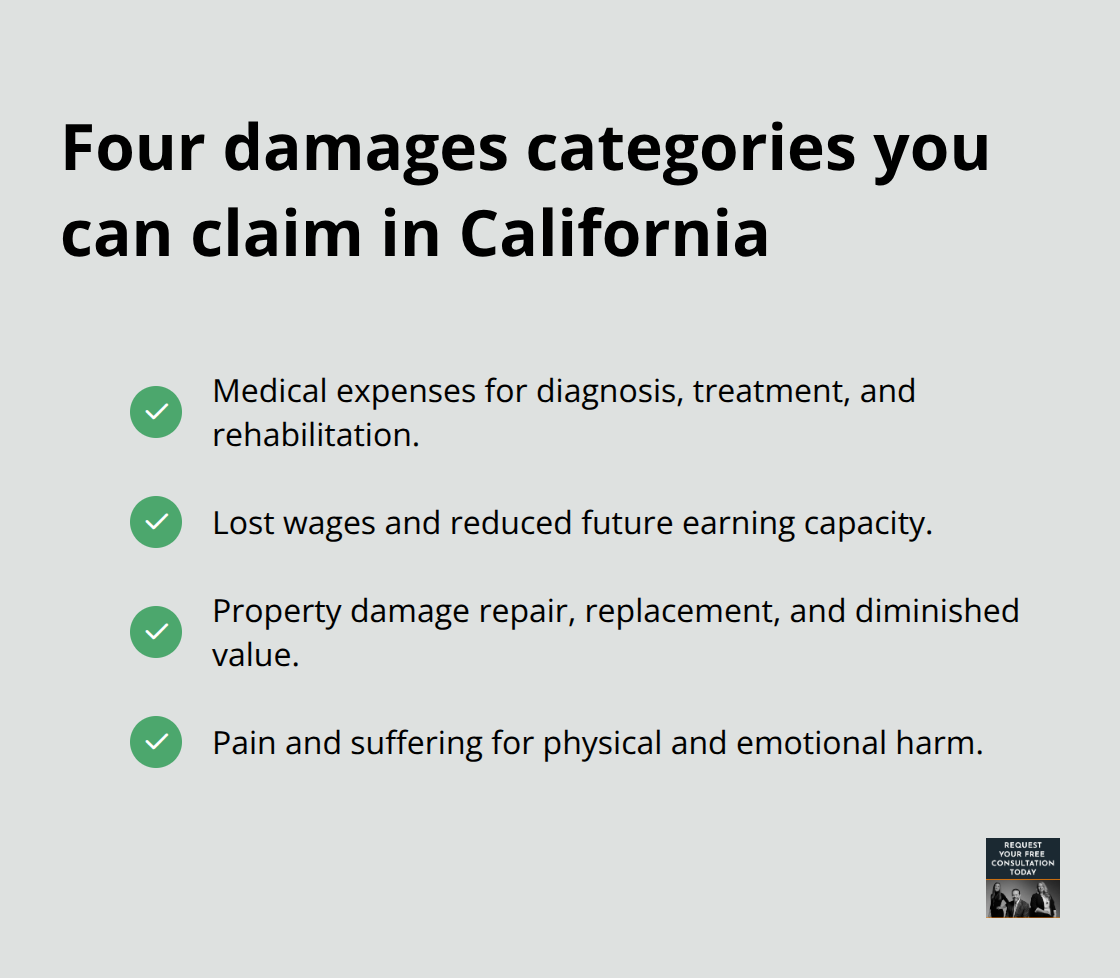
California law allows you to recover four main categories of damages after a rear-end collision, and understanding what falls into each category directly affects how much money you should demand from the insurance company.
Medical Expenses and Treatment Costs
Medical expenses represent the foundation of your claim because they document the physical harm you sustained. This includes emergency room visits, hospital stays, surgery, diagnostic imaging like MRI or CT scans, physical therapy, prescription medications, and ongoing treatment. Mayo Clinic research shows that whiplash and neck injuries are among the most common injuries in rear-end collisions, often requiring months of physical therapy. Most accident victims make a critical mistake by settling too quickly before they understand their full medical picture. Injuries like traumatic brain injury can take weeks to manifest, so you should wait at least 6 to 12 weeks after the collision before accepting any settlement offer. Keep receipts for every medical expense, including travel to appointments and medical devices like neck braces or orthopedic pillows.
Lost Wages and Reduced Earning Capacity
Lost wages cover income you stopped earning while recovering from your injuries and includes salary, hourly wages, bonuses, and commissions. Request written documentation from your employer showing the exact dates you missed work and your regular compensation rate. If your injury reduces your future earning capacity because you cannot return to your previous job or must work reduced hours, that loss qualifies as damages too.
A forensic economist can calculate the lifetime impact of reduced earnings, which becomes particularly important if you suffered permanent disability.
Property Damage Valuation
Property damage compensation covers the cost to repair or replace your vehicle, and here is where most people leave money on the table. Get repair estimates from at least two independent body shops, not just the insurance company’s preferred vendor. If your vehicle is a total loss, research its fair market value using NADA Guides or Kelley Blue Book rather than accepting the insurer’s initial valuation. Many accident victims ignore the diminished value of their repaired vehicle, which can be 10 to 20 percent of the pre-accident value in California.
Pain and Suffering Damages
Pain and suffering damages compensate for your physical discomfort, emotional distress, and reduced quality of life. Insurance adjusters typically apply multipliers of 1.5 to 3 times your medical expenses when calculating pain and suffering, though this varies based on injury severity and jurisdiction. Counties like Los Angeles, San Francisco, and Santa Clara historically award higher pain and suffering damages than rural counties, so your location matters significantly. Document your pain and suffering by keeping a daily journal describing your symptoms, limitations, and emotional impact. The Insurance Information Institute reports that rear-end collisions accounted for 7.2 percent of all fatal crashes in the United States in 2017, underscoring how serious these collisions can be.
Connecting Damages to Your Collision
When you have suffered a significant injury, the strength of your claim depends on presenting evidence that connects each damage category to the collision itself. Medical records establish causation for injuries, pay stubs prove lost wages, repair estimates substantiate property damage, and your testimony combined with medical documentation supports pain and suffering claims. We at Schaar & Silva LLP help accident victims in Santa Cruz County evaluate the full scope of their damages and negotiate aggressively with insurers who consistently undervalue claims.
Final Thoughts
A rear-end collision in California succeeds when you present evidence that connects each damage category to the collision itself, leaving no room for the insurance adjuster to argue your injuries were minor or unrelated. Medical expenses alone tell only part of the story-lost wages, property damage, and pain and suffering often represent the largest portions of your recovery, yet many accident victims settle before calculating these amounts accurately. The damages you recover depend directly on how thoroughly you document your injuries and losses from the moment the collision occurs.
We at Schaar & Silva LLP help accident victims throughout Santa Cruz County, Sacramento, and Oakland navigate this process from start to finish. Our team assists with medical bill management, evaluates property damage claims to guarantee fair valuation, and connects you with support when emotional trauma follows your accident. We handle the legal complexities while you focus on recovery.
Contact Schaar & Silva LLP for a free case evaluation and bring your police report, photographs, medical records, and any documentation of lost wages. We review your evidence, explain your rights under California law, and discuss how much your claim is worth based on comparable cases and jury verdicts in your county.
