
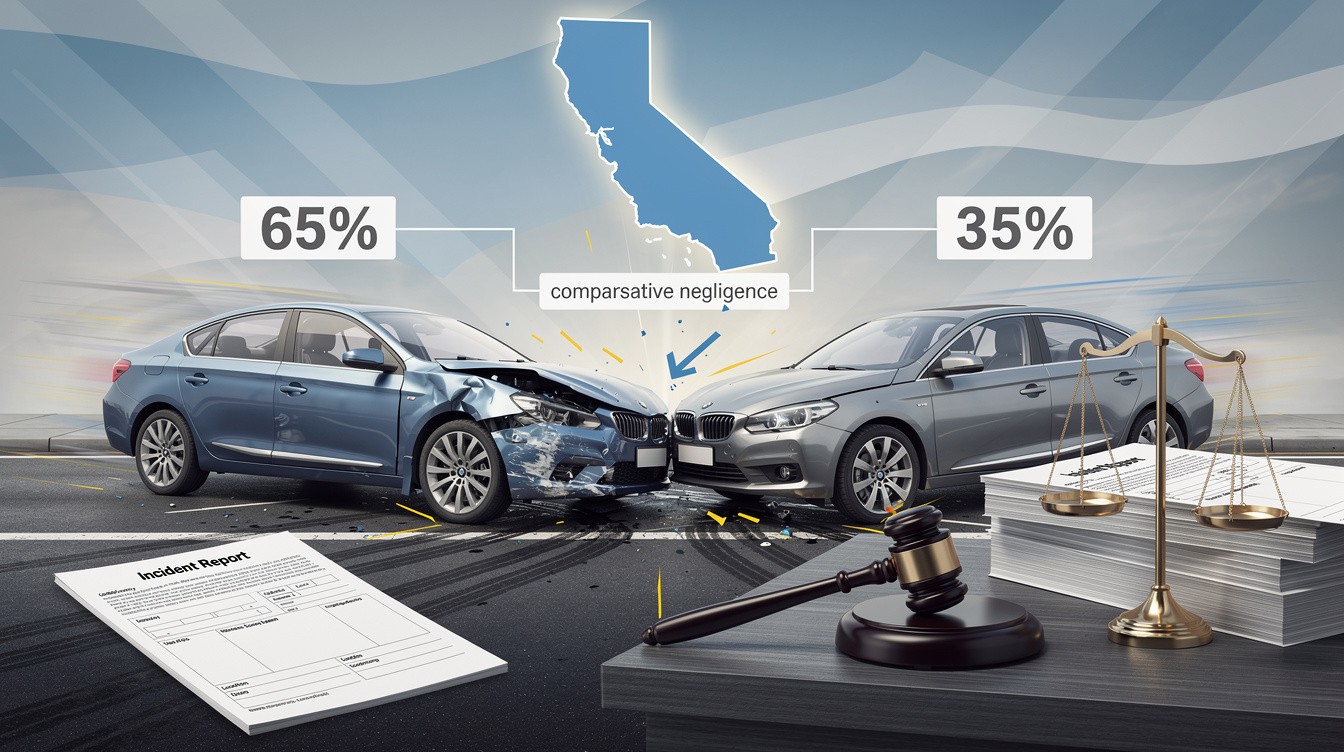
California comparative negligence rules determine how much compensation you can recover after an auto accident, even if you’re partially at fault. Most people don’t realize that being 49% responsible doesn’t automatically disqualify you from receiving damages.
At Schaar & Silva LLP, we’ve helped countless accident victims navigate these complex fault determinations. Understanding how California’s system works can make a significant difference in your case outcome.
How Fault Gets Determined in California
California’s pure comparative negligence rule under Civil Code § 1714 allows you to recover damages even if you caused part of the accident. There’s no 51% bar that blocks recovery-that’s a key distinction from many other states. Instead, your compensation gets reduced by your own percentage of fault. If you’re found 30% at fault in a $100,000 claim, you receive $70,000. The system allocates costs based on actual responsibility, not an arbitrary threshold. Insurance adjusters know this rule well, and they use it aggressively to minimize what they pay you. They’ll push for a higher fault percentage on your side because every percentage point they assign reduces their payout dollar-for-dollar. This is why understanding how fault gets calculated matters enormously-it directly affects your bottom line.
Evidence, Not Guesswork, Determines Fault
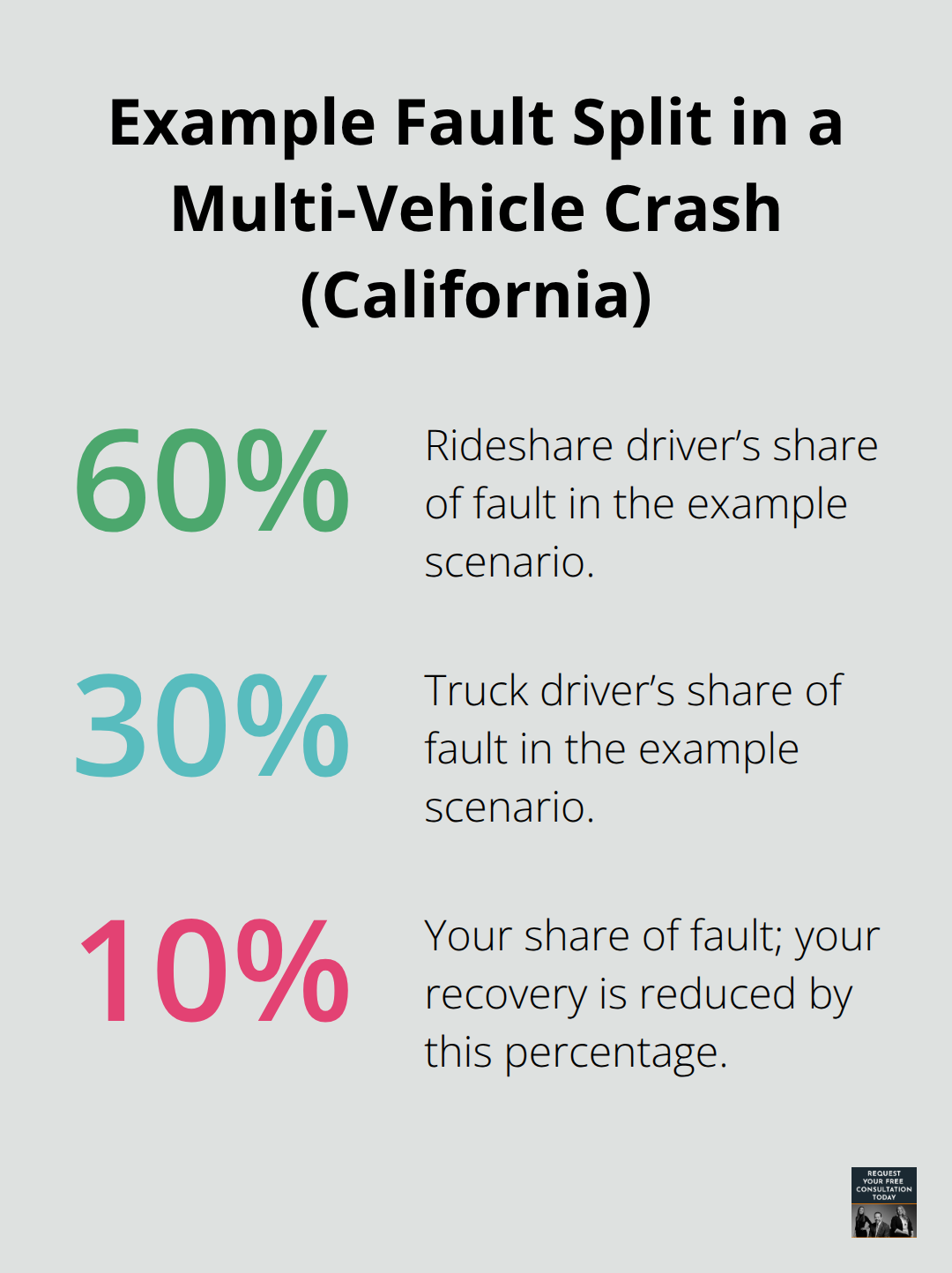
Police reports provide initial documentation, but they don’t determine final fault. Adjusters investigate using accident reports, witness statements, photographs, dashcam footage, and vehicle damage patterns. In multi-vehicle accidents, fault splits across all parties involved. For example, if a rideshare driver bears 60% responsibility, a truck driver 30%, and you 10%, your damages get reduced by 10% while economic damages remain jointly and severally liable under Proposition 51. Accident reconstruction specialists strengthen fault arguments when liability remains unclear-their objective analysis of speed, impact angles, and road conditions carries weight in negotiations and at trial.
Preserve Evidence Immediately After an Accident
You must photograph vehicle positions and damage right away. Collect witness contact information before people leave the scene. Obtain the police report within days, not weeks. These steps create a factual record that counters aggressive adjuster tactics later. The sooner you document what happened, the harder it becomes for insurance companies to assign you unwarranted blame.
Insurance Companies Deploy Aggressive Tactics to Shift Blame
Adjusters request recorded statements early, hoping you’ll admit fault or contradict yourself later. Don’t give one without legal guidance-anything you say can be used against you. They monitor social media for posts that suggest you’re less injured than claimed. They also dispute medical necessity, arguing that certain treatments weren’t needed to recover. Gaps in your medical treatment hurt your case; if you delay seeking care or skip appointments, adjusters claim your injuries weren’t serious. Continuous treatment through maximum medical improvement (the point where your condition stabilizes) strengthens your position on both injury severity and fault allocation.
How Treatment Decisions Impact Fault Assignment
Your medical choices directly influence how adjusters calculate fault. When you maintain consistent treatment with documented medical providers, you establish that your injuries were real and required ongoing care. Conversely, treatment gaps give adjusters ammunition to argue your injuries were minor or exaggerated. This connection between medical behavior and fault determination means that staying on a continuous care path protects both your health recovery and your legal position. Understanding this link helps you make informed decisions about your treatment plan as your case moves forward.
How Negligence Affects Your Auto Accident Claim
When multiple parties contribute to an accident, California’s system does not simply split blame down the middle. Instead, each party’s percentage of fault gets determined through specific evidence about who violated traffic laws, who failed to exercise reasonable care, and whose actions directly caused the crash.
Fault Percentages Shift Based on Evidence
In a rear-end collision, the trailing driver typically bears the majority of fault because California Vehicle Code Section 21703 requires maintaining safe following distance. However, if the front driver suddenly braked without lights or brake fluid leaked onto the roadway, fault percentages shift. Insurance adjusters calculate fault by examining police reports, witness statements, vehicle damage patterns, and dashcam footage. They assign percentages that total 100% across all parties, then reduce your recovery by your assigned percentage.
The critical point: adjusters intentionally inflate your fault percentage to lower their payout. A driver found 25% at fault on a $200,000 claim receives $150,000, not $200,000. This means their error costs you $50,000 directly. Adjusters know most accident victims won’t fight back, so they start with aggressive fault assignments hoping you’ll accept the first offer.
Multi-Party Accidents Complicate Fault Assignment
Multi-party accidents multiply this problem because adjusters can blame you, other drivers, road conditions, or vehicle defects simultaneously. Under Proposition 51, economic damages remain jointly and severally liable, meaning you can collect full medical bills from any defendant, but non-economic damages split according to each party’s fault percentage. If a rideshare driver, a truck driver, and you share responsibility in proportions of 50%, 35%, and 15%, the rideshare company and truck company must cover all your medical bills together, but pain and suffering damages split 50/35/15.
Common Accident Scenarios and Shared Blame
Left-turn collisions frequently involve shared blame when the turning driver claims the oncoming traffic was speeding while the oncoming driver claims inadequate signal time. Lane-change accidents pit your positioning against the other driver’s mirror-checking responsibility. Parking lot collisions often involve comparative negligence when one driver was backing while another was speeding through tight spaces. Intersection accidents with traffic light disputes become fact-intensive because adjusters challenge whether you entered on green or yellow.
Pedestrian cases introduce comparative negligence arguments about jaywalking or distracted walking, even though California Vehicle Code Section 21950 prioritizes driver duty to avoid hitting pedestrians. Motorcycle accidents invite helmet-defense arguments where adjusters claim your injuries would have been prevented if you wore a helmet, though they must prove this connection specifically. Adjusters also deploy the seatbelt defense in similar fashion, claiming injuries would have been reduced by restraint use. These defenses only work if adjusters prove the specific injury would have been prevented, not that you were generally less safe.
Document Safety Practices and Gather Evidence Early
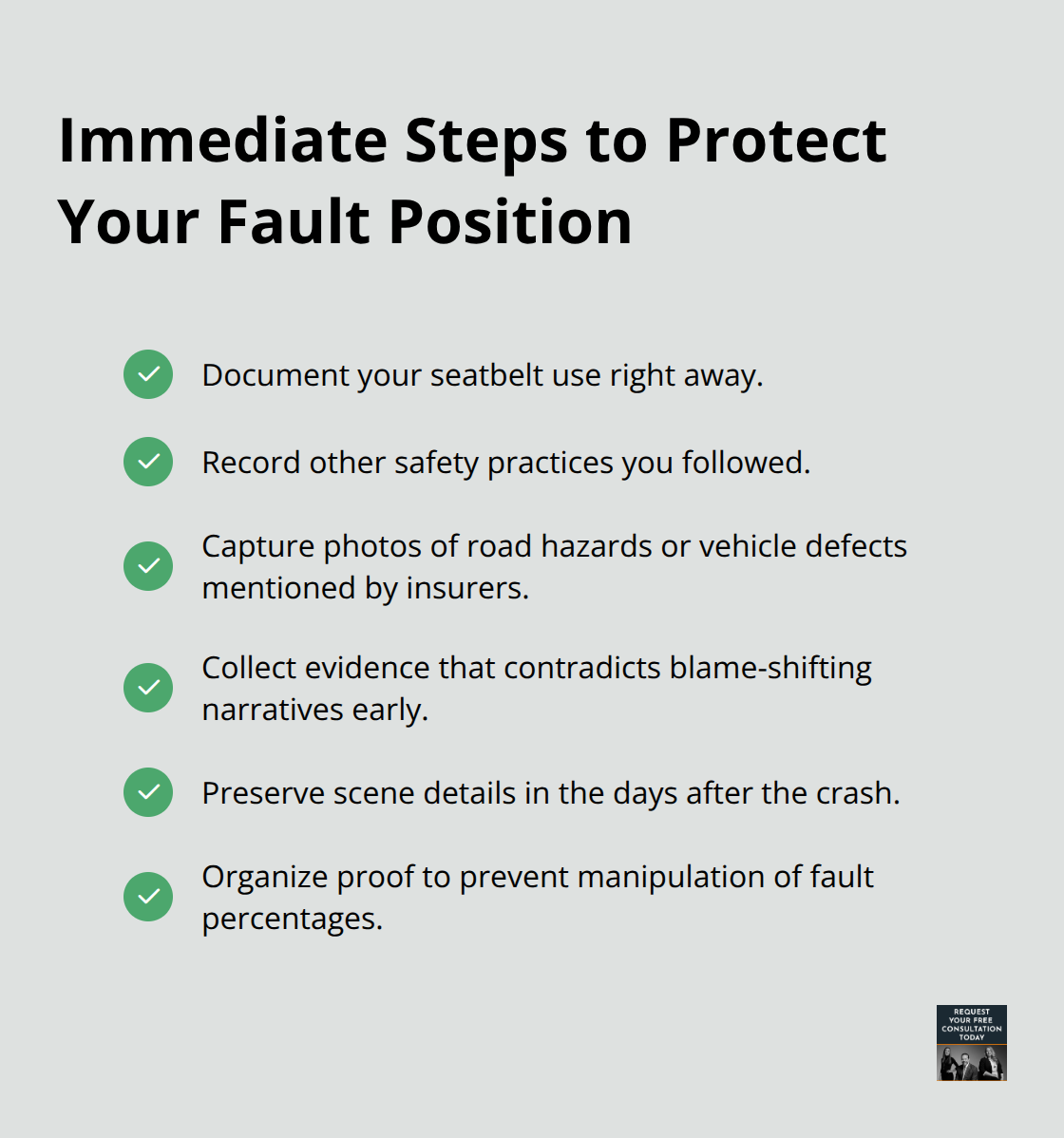
Document your seatbelt use and safety practices immediately because adjusters will argue the opposite if you don’t. Insurance companies also shift blame to vehicle defects or road conditions when it benefits their position, claiming brake failure or pothole damage caused the crash rather than driver error. Gathering contradictory evidence early prevents adjusters from constructing false narratives later. The evidence you collect at the scene and in the days following your accident directly determines whether adjusters can successfully manipulate fault percentages in their favor.
Building Your Evidence Foundation
Adjusters count on accident victims to miss critical evidence or fail to document what happened. The first hours after a crash determine whether you have a strong factual record or whether adjusters can construct a false narrative about fault. Photograph vehicle positions, road conditions, traffic signals, and all visible damage from multiple angles immediately after the crash-these images contradict adjuster claims that your vehicle was in a dangerous position or that impact patterns suggest different fault percentages. Collect witness contact information before people disperse because memories fade within days and adjusters deliberately contact witnesses first to obtain statements favorable to the at-fault driver.
Obtain and Verify Official Documentation
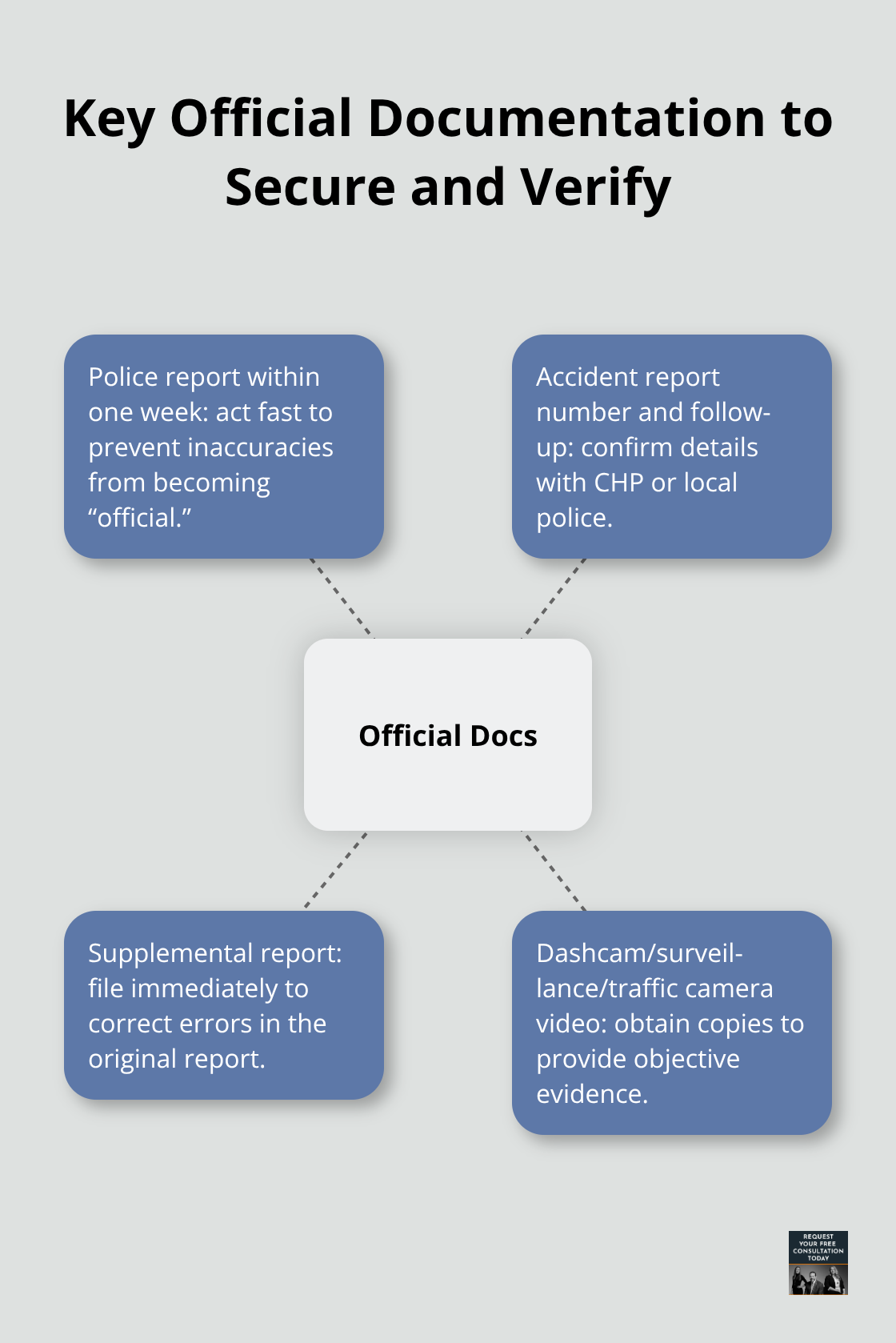
Obtain the police report within one week because delays allow time for inaccuracies to calcify into official documentation. Request the accident report number at the scene, then follow up with the California Highway Patrol or local police department to verify the report contains accurate information about traffic violations, road hazards, and witness statements. If the report contains errors, file a supplemental report immediately. Dashcam footage, surveillance video from nearby businesses, or traffic camera recordings provide objective evidence that contradicts adjuster theories about how the crash occurred.
Establish Injury Timeline Through Medical Records
Medical records from your first treatment session establish injury dates and severity, making it harder for adjusters to argue your injuries developed later or resulted from pre-existing conditions unrelated to the accident. Medical documentation carries enormous weight in fault determination because treatment decisions signal injury seriousness to adjusters and judges alike. Obtain detailed records from every medical provider you see, including diagnostic imaging results, specialist evaluations, and treatment notes that explain why ongoing care was medically necessary.
Maintain Continuous Treatment Records
Gaps in treatment give adjusters ammunition to claim your injuries weren’t serious or that you’ve recovered despite claiming ongoing harm. Maintain continuous care through maximum medical improvement (the point where your condition stabilizes and further treatment produces minimal improvement)-this demonstrates commitment to recovery and prevents adjusters from questioning your credibility. Property damage valuations also matter because vehicle damage patterns reveal impact force and collision angles that either support or contradict fault theories.
Document Property Damage and Economic Losses
Obtain repair estimates from multiple mechanics and preserve photos of the damage before repairs begin. Insurance adjusters sometimes underestimate property damage to suggest lower impact speeds, implying less severe injuries or different fault dynamics. Photograph all medical bills, receipts, and lost wage documentation because these economic damages require concrete proof rather than estimates or assumptions. Adjusters frequently challenge medical necessity and lost wage calculations, so contemporaneous documentation prevents disputes months later when memories fade and supporting evidence becomes harder to locate.
Final Thoughts
California comparative negligence rules allow you to recover compensation even when you share fault for an accident, unlike many states that use an all-or-nothing approach. The evidence you collect immediately after your crash determines whether adjusters can manipulate fault percentages in their favor, so police reports, photographs, witness statements, and medical records create a factual record that prevents false narratives. Continuous medical treatment through maximum medical improvement strengthens both your injury claim and your fault position because it demonstrates that your injuries required ongoing care.
Insurance companies deploy aggressive tactics specifically designed to shift blame onto you through recorded statements, social media monitoring, and challenges to medical necessity. Understanding these tactics helps you avoid the traps adjusters set, and legal representation matters enormously because adjusters negotiate differently when they know you have an attorney. We at Schaar & Silva LLP have recovered over five billion dollars for clients by fighting aggressive fault assignments and demanding fair settlements.
Contact us for a free case review to understand how California comparative negligence rules affect your specific situation and what your case is actually worth.
