
After a car accident, figuring out what your claim is worth feels overwhelming. The settlement amount depends on several factors, from medical bills to lost income, and understanding these variables helps you know what to expect.
At Schaar & Silva LLP, we’ve helped many Santa Cruz County residents navigate auto accident personal injury settlement amounts. This guide breaks down the real numbers and shows you what similar cases have recovered.
What Really Drives Your Settlement Amount
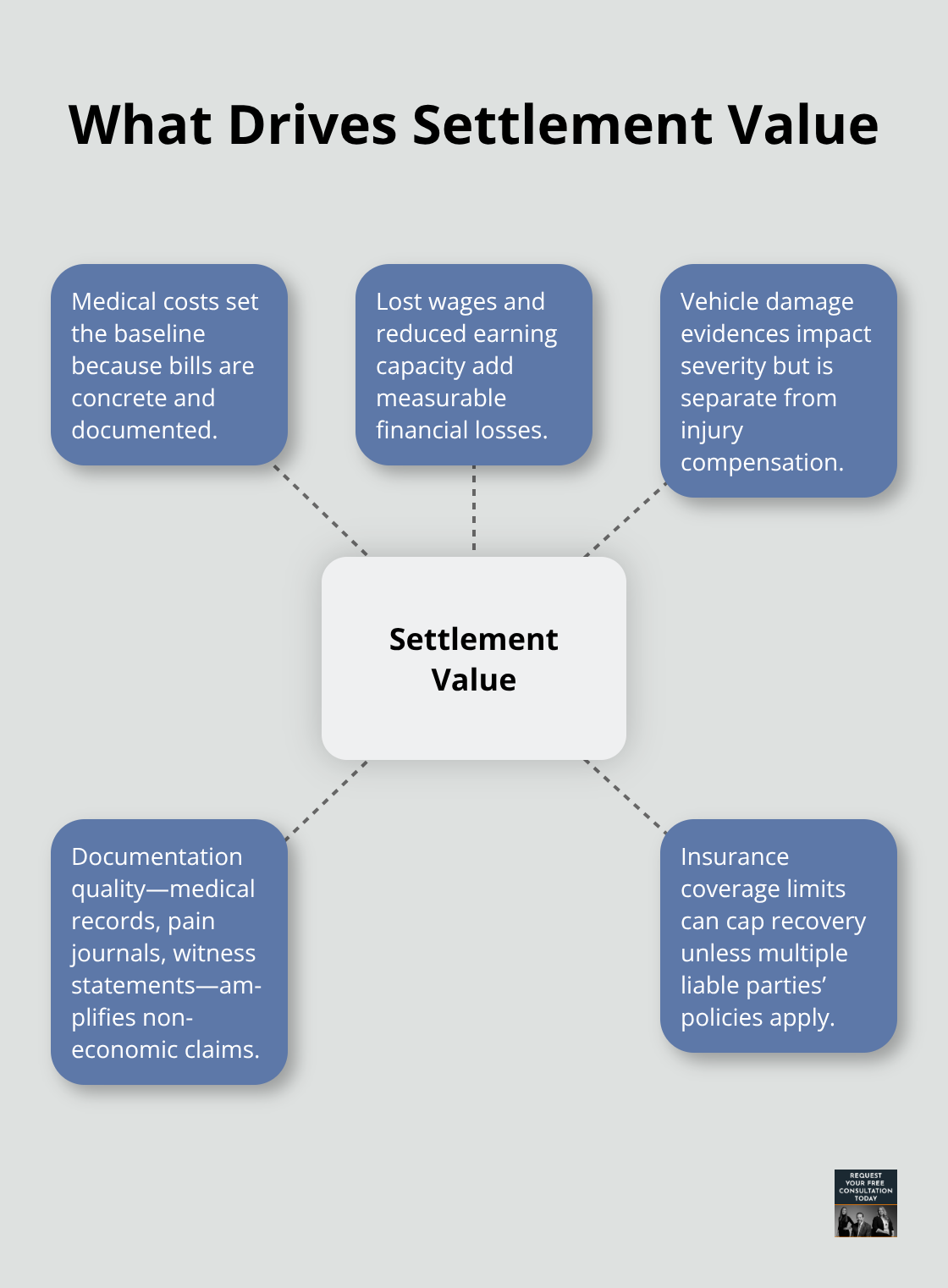
Injury severity and medical costs form the foundation of what your claim is worth. If you spent $57,000 on hospitalization after your accident, that number anchors your settlement floor. Medical expenses in serious cases climb fast-emergency room visits, imaging scans, surgical procedures, and ongoing physical therapy all add up. Insurance companies and defendants start their calculations here because medical bills are concrete and documented. However, medical costs alone don’t determine your final settlement. A person with $20,000 in medical bills might recover $70,000 or more when pain and suffering damages are factored in using a multiplier method, where non-economic damages roughly equal medical expenses multiplied by a factor between 1 and 5. The multiplier climbs higher for severe injuries that disrupt your life long-term.
Medical Costs Shape Your Baseline
Your medical records become your evidence. Hospitals document everything-admission dates, procedures, medications, follow-up appointments. This paper trail shows the accident’s true impact on your body. Broken bones, spinal injuries, and head trauma typically justify higher multipliers because recovery is lengthy and painful. Minor whiplash cases settle around $12,000 to $30,000 because the medical treatment costs less and recovery happens faster. Catastrophic injuries that require ongoing care or permanent disability push settlements into six or seven figures. You must maintain detailed records from day one after your accident.
Lost Wages and Earning Capacity
Lost wages matter equally. If your accident sidelined you for three months and you earn $4,000 monthly, you’re out $12,000 in income alone. Some injuries prevent you from returning to your previous job entirely, creating a loss of earning capacity that extends far beyond your immediate time away from work. You should track every missed paycheck, every reduction in hours, and every job you couldn’t take because of your injuries. This financial loss is straightforward to prove and defendants rarely challenge it.
Vehicle Damage Reveals Impact Force
Vehicle damage correlates with injury severity. A rear-end collision that totals your car suggests higher impact forces and more serious injuries than a minor fender-bender. Insurance adjusters photograph your vehicle damage and use it as evidence about accident intensity. If your truck required $15,000 in repairs or was declared a total loss, that damage report strengthens your injury claim. However, property damage and personal injury are separate components of your settlement. You recover for vehicle repair or replacement value independently from your medical and pain-and-suffering damages.
In Santa Cruz County, vehicle damage claims follow standard market valuations-what similar vehicles sell for in your area determines your recovery amount. You should keep repair estimates, photos of the damage, and the final repair invoice organized in one file. These documents move your claim forward faster and eliminate back-and-forth with insurance companies. Understanding how medical costs, lost wages, and vehicle damage interact sets the stage for recognizing what types of damages you can actually claim in your case.
What Damages Can You Actually Recover
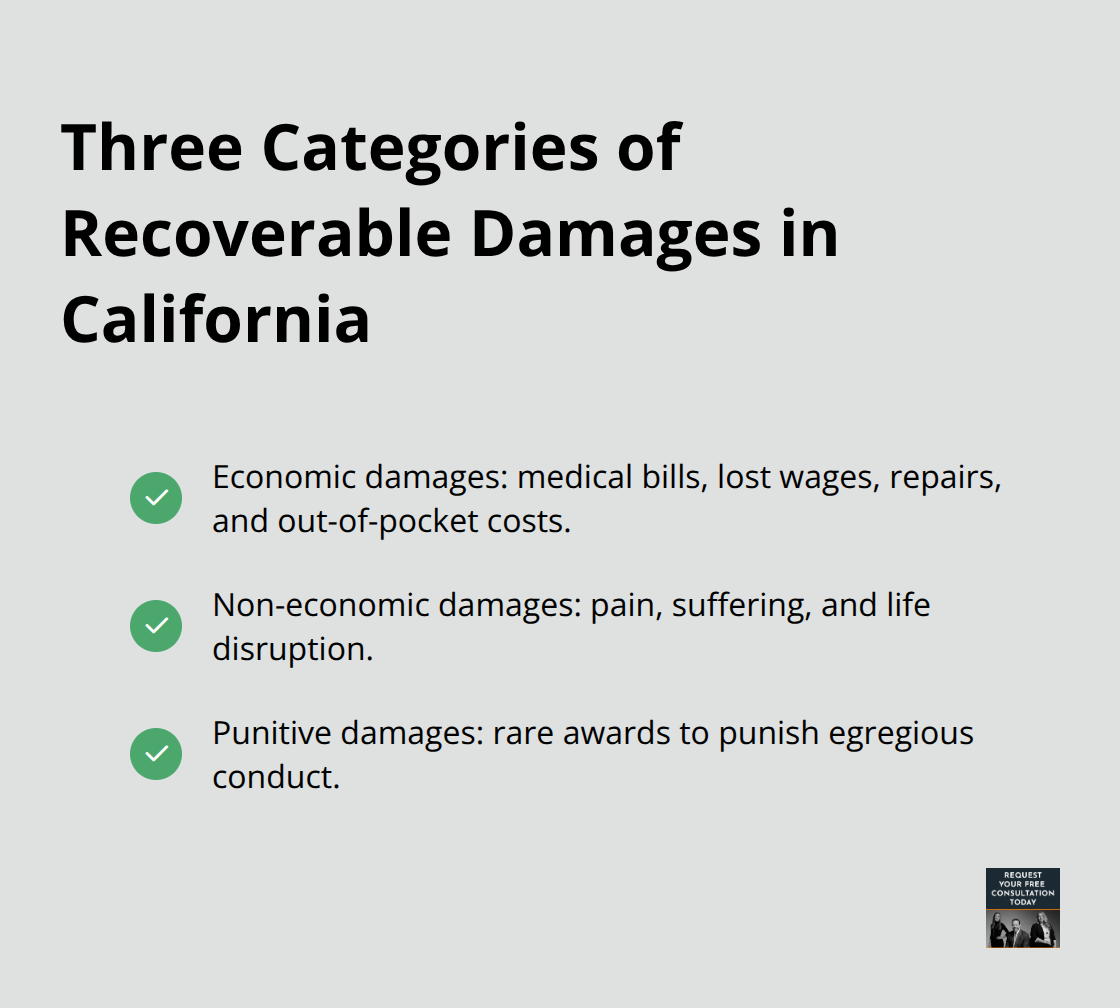
California law recognizes three distinct categories of damages in auto accident cases, and understanding which ones apply to your situation directly impacts your settlement amount.
Economic Damages: Your Documented Financial Losses
Economic damages cover your concrete financial losses-medical bills, lost wages, vehicle repairs, and out-of-pocket expenses. These are straightforward because they have documented dollar values. If you paid $8,000 for an MRI, $3,500 for physical therapy sessions, and lost $12,000 in wages during recovery, those numbers form your economic damages baseline. Insurance companies and courts accept these figures readily because receipts and pay stubs prove them. Your medical records, wage statements, and repair invoices create an undeniable record of what the accident cost you financially.
Non-Economic Damages: Compensation for Pain and Life Disruption
Non-economic damages compensate you for pain, suffering, and life disruption that money cannot directly measure. A broken ankle that keeps you from your construction job for four months justifies substantial non-economic damages because your quality of life deteriorated significantly. California courts use two primary methods to calculate non-economic damages. The multiplier method applies a factor of 1 to 5 to your economic damages-so $25,000 in medical bills multiplied by 3.5 equals roughly $87,500 in pain and suffering compensation. The per diem method assigns a daily dollar value to your suffering, perhaps $200 per day across 180 recovery days, totaling $36,000. Neither method is perfect, but multipliers tend to work better for serious injuries with long recovery periods.
Building Your Pain and Suffering Evidence
Medical records, doctor testimony, and your own detailed pain journal prove non-economic damages more effectively than anything else. A neutral witness like a coworker who observed your struggle returning to work carries significant weight. You should maintain a daily log that documents your physical pain, emotional distress, sleep disruption, and inability to perform normal activities. This documentation transforms abstract suffering into concrete evidence that judges and juries understand. The difference between a $40,000 and $120,000 settlement often comes down to how thoroughly you document your injuries and their impact on daily life.
Punitive Damages: Punishment for Egregious Conduct
Punitive damages exist for a different purpose-they punish defendants for egregious conduct rather than compensate you. A drunk driver who causes your accident, a commercial truck driver who ignored safety regulations for months, or someone who recklessly endangered your life may trigger punitive damages eligibility. However, proving the defendant’s conduct involved oppression, fraud, or malice is genuinely difficult and expensive. California courts rarely award these damages, and when they do, state law typically caps them at four times your compensatory damages. A $100,000 total settlement might support $400,000 maximum in punitive damages theoretically, but most defendants lack the insurance coverage or assets to pay anywhere near that amount.
Your focus should stay on maximizing economic and non-economic damages because those represent what you’ll actually recover. The strength of your documentation determines whether you land at the lower or upper end of settlement ranges for your injury type. As you move forward, knowing what real settlements look like in Santa Cruz County helps you set realistic expectations and recognize when an offer falls short of what similar cases have recovered.
What Settlement Numbers Look Like in Santa Cruz County
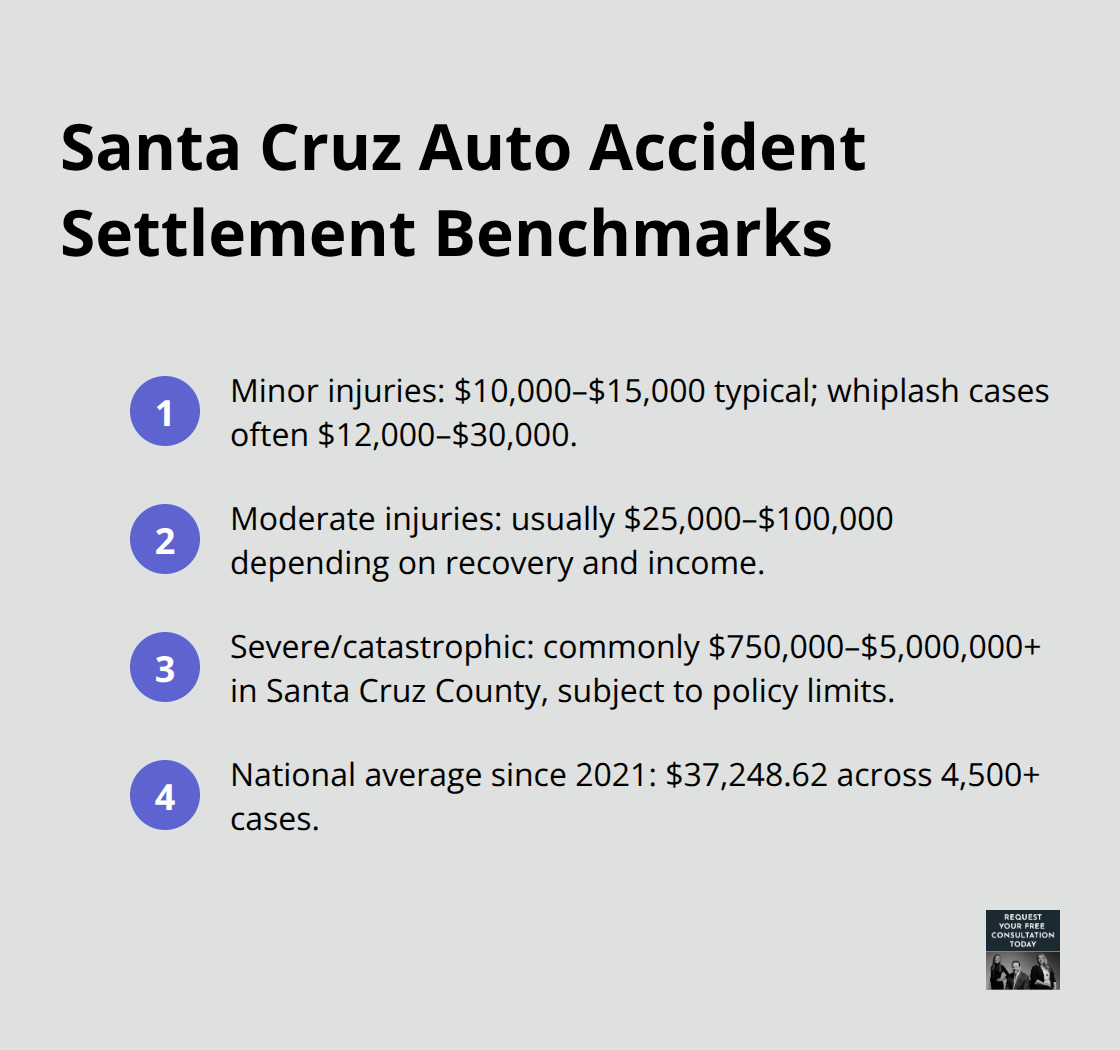
Auto accident settlements in Santa Cruz County vary dramatically based on injury severity, and knowing the actual ranges helps you evaluate whether an insurance offer is reasonable. The average car accident settlement nationally reaches $37,248.62 according to Brown & Crouppen’s analysis of over 4,500 cases since 2021, but Santa Cruz County cases often track differently depending on local jury tendencies, medical costs in our area, and the specific facts of each collision.
Minor Injuries and Quick Settlements
Minor injuries without hospitalization typically settle between $10,000 and $15,000 because treatment costs remain modest and recovery happens quickly. A whiplash case from a rear-end collision at a traffic light might generate $12,000 to $30,000 in total recovery when you combine medical expenses, a few weeks of lost wages, and reasonable pain-and-suffering compensation using a 1.5 to 2.5 multiplier. These straightforward cases close faster because liability is clear and medical documentation is straightforward.
Moderate Injuries with Extended Recovery
If your accident caused a broken ankle or moderate back injury that required several months of physical therapy, settlements typically range from $25,000 to $100,000 depending on your income level and how thoroughly you documented your suffering. A construction worker earning $60,000 annually who lost four months of work due to a broken leg has substantial lost-wage damages that push settlement value higher than someone in an office job who returned to work after six weeks. The key variable here is whether your injury created long-term complications or required ongoing treatment beyond the initial recovery period.
Severe Injuries and Catastrophic Outcomes
Severe and permanent injuries generate the highest settlements because the financial and personal impact extends indefinitely. A Los Angeles jury awarded $32.8 million for traumatic brain injury and spinal injuries from a rear-end collision, with past medical expenses around $700,000 and future medical costs estimated at $9 million, illustrating how catastrophic injuries justify settlements that dwarf typical cases. In Santa Cruz County, permanent disability from spinal cord damage, loss of limb, or severe burns typically settles between $750,000 and $5,000,000 or higher, though the defendant’s insurance policy limits often cap what you actually recover.
Insurance Coverage Limits Your Recovery
A settlement amount means nothing if the at-fault driver carries only $100,000 in liability coverage-you’ll hit that ceiling regardless of injury severity. This reality makes identifying all responsible parties critical because multiple defendants might carry separate insurance policies that stack together. When we at Schaar & Silva LLP evaluate your case, we assess whether the at-fault party had adequate coverage and whether additional defendants share liability, which directly impacts your recovery ceiling.
Documentation Determines Your Settlement Range
Document your injuries meticulously from day one because the difference between settling at $35,000 versus $85,000 often comes down to how thoroughly you prove your pain, medical treatment, and lost income through organized records and credible witness testimony.
Final Thoughts
Your auto accident personal injury settlement amounts depend on injury severity, medical costs, lost wages, and how thoroughly you document everything from day one. The ranges we’ve covered show that minor injuries settle around $10,000 to $15,000 while severe cases reach hundreds of thousands or more. Your specific situation falls somewhere on that spectrum, and the difference between a low offer and fair compensation often comes down to preparation and evidence.
Working with a legal team matters because insurance companies negotiate differently when they know you have representation. At Schaar & Silva LLP, we handle the complexities while you focus on recovery, and we assist with property damage claims to verify fair valuation for your vehicle loss. We also connect you with medical lien services so exorbitant medical bills don’t drain your resources while your case resolves.
Gather your medical records, repair estimates, pay stubs showing lost wages, and any photos from the accident scene, then contact Schaar & Silva LLP for a case evaluation. We serve Santa Cruz County and can review your specific situation to explain what your claim might be worth and what steps come next. You don’t pay anything upfront, and understanding your options costs nothing.
