
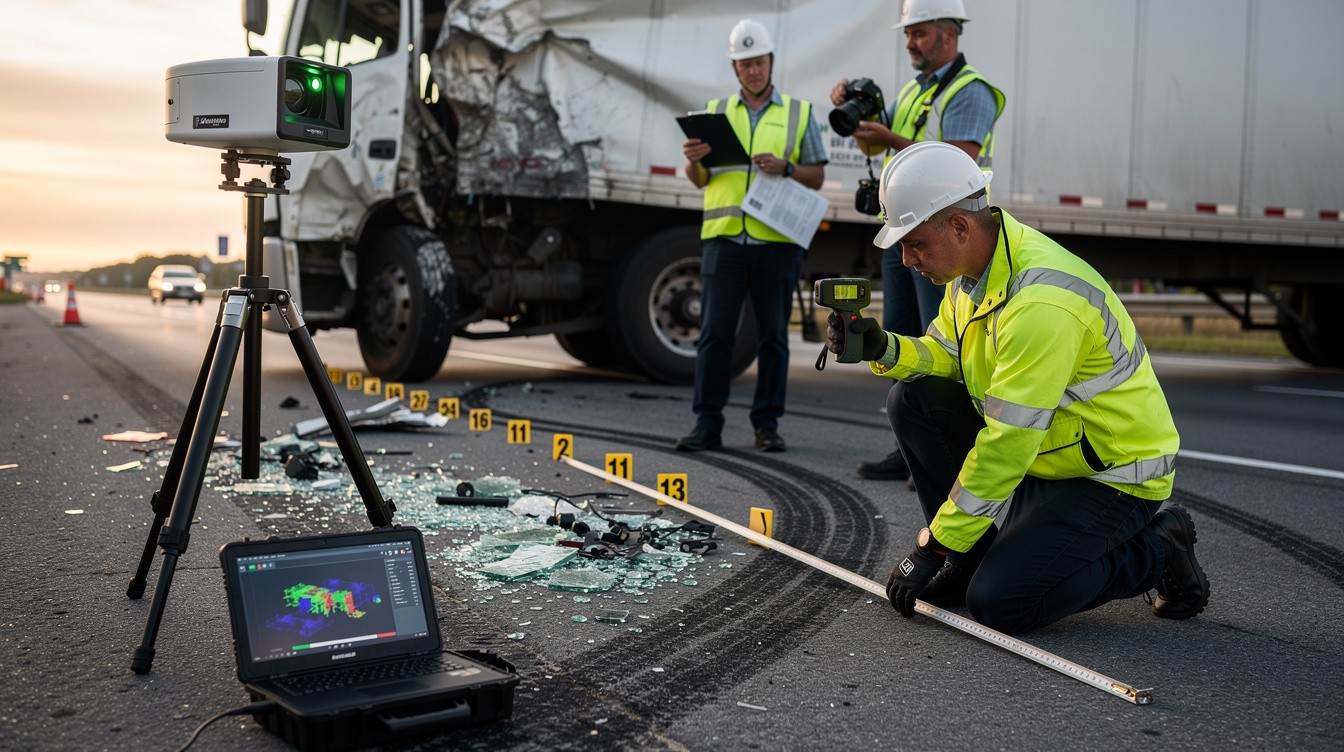
Truck accidents leave behind physical evidence that tells the real story of what happened. From skid marks to vehicle damage patterns, accident reconstruction professionals analyze these details to establish exactly how a collision occurred.
At Schaar & Silva LLP, we’ve seen how reconstruction evidence transforms truck accident claims. When insurance companies deny liability or undervalue your case, scientific forensic data becomes your strongest tool to prove fault and secure fair compensation.
What Accident Reconstruction Actually Reveals
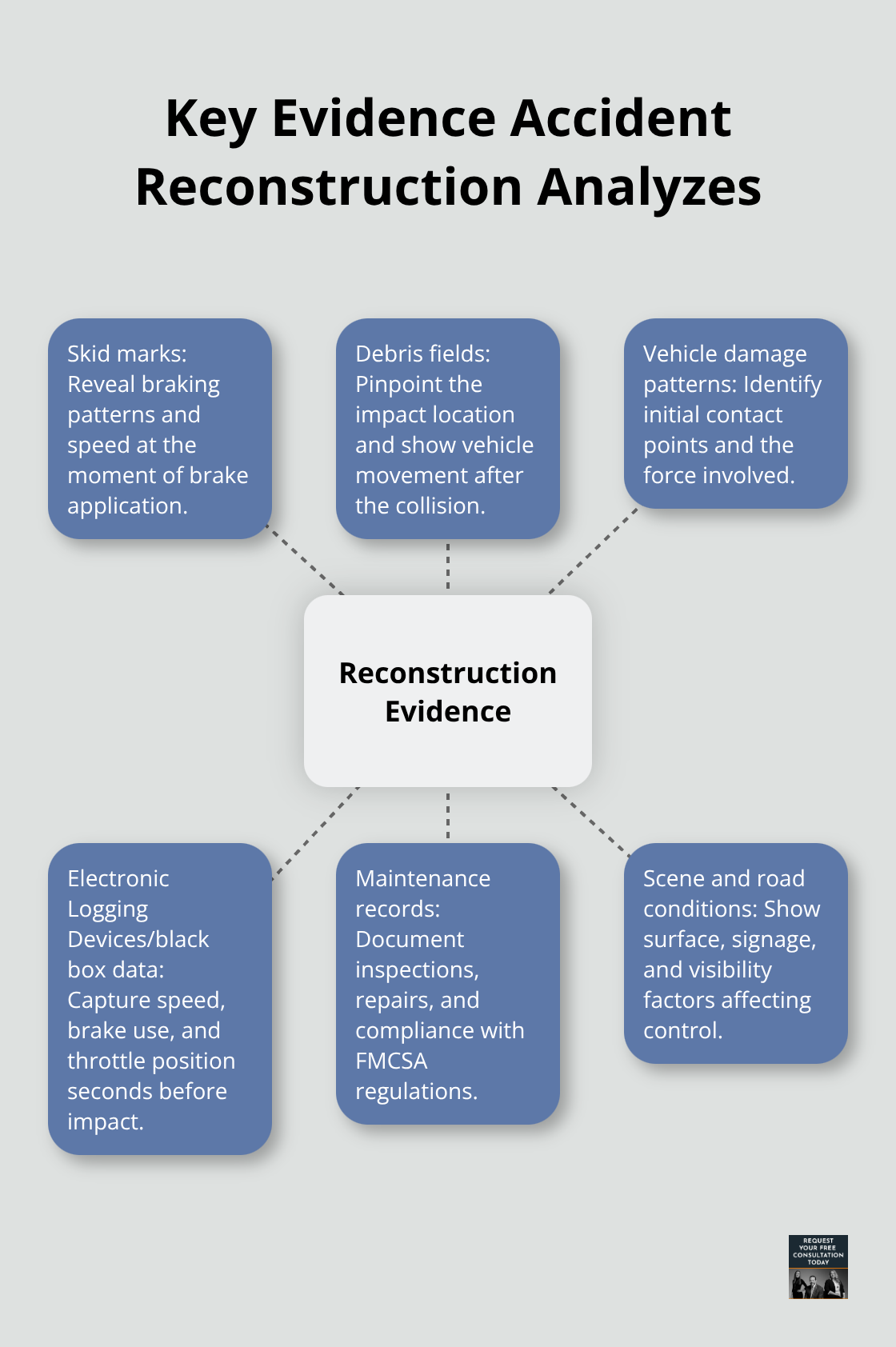
Accident reconstruction professionals examine physical evidence at crash scenes to establish the sequence of events with measurable precision. Skid marks reveal braking patterns and vehicle speed at the moment a driver applied the brakes. Debris fields show the point of impact and how vehicles moved after collision. Vehicle damage patterns indicate which parts made contact first and the force involved.
Mechanical Evidence Speaks Louder Than Claims
Truck maintenance logs required by Federal Motor Carrier Safety Administration regulations become critical evidence in reconstruction analysis. If brake pads weren’t replaced or inspections were missed, maintenance records prove negligence directly. Electronic Logging Devices and black box data record driver actions, vehicle speed, brake application, and throttle position in the seconds before impact. This data doesn’t lie, unlike witness statements that often conflict.
When a driver claims they braked suddenly but black box data shows no brake engagement, reconstruction professionals translate that contradiction into liability. Insurance companies know this data is difficult to challenge, which is why they often settle cases more favorably once reconstruction reports are presented.
Isolating Variables to Establish Fault
Road conditions, weather, and vehicle performance must be separated from driver behavior to determine who bears responsibility. A truck might have failed brakes, but if the driver was also fatigued and speeding, liability extends to both the driver and the trucking company. Reconstruction analysis examines each variable independently.
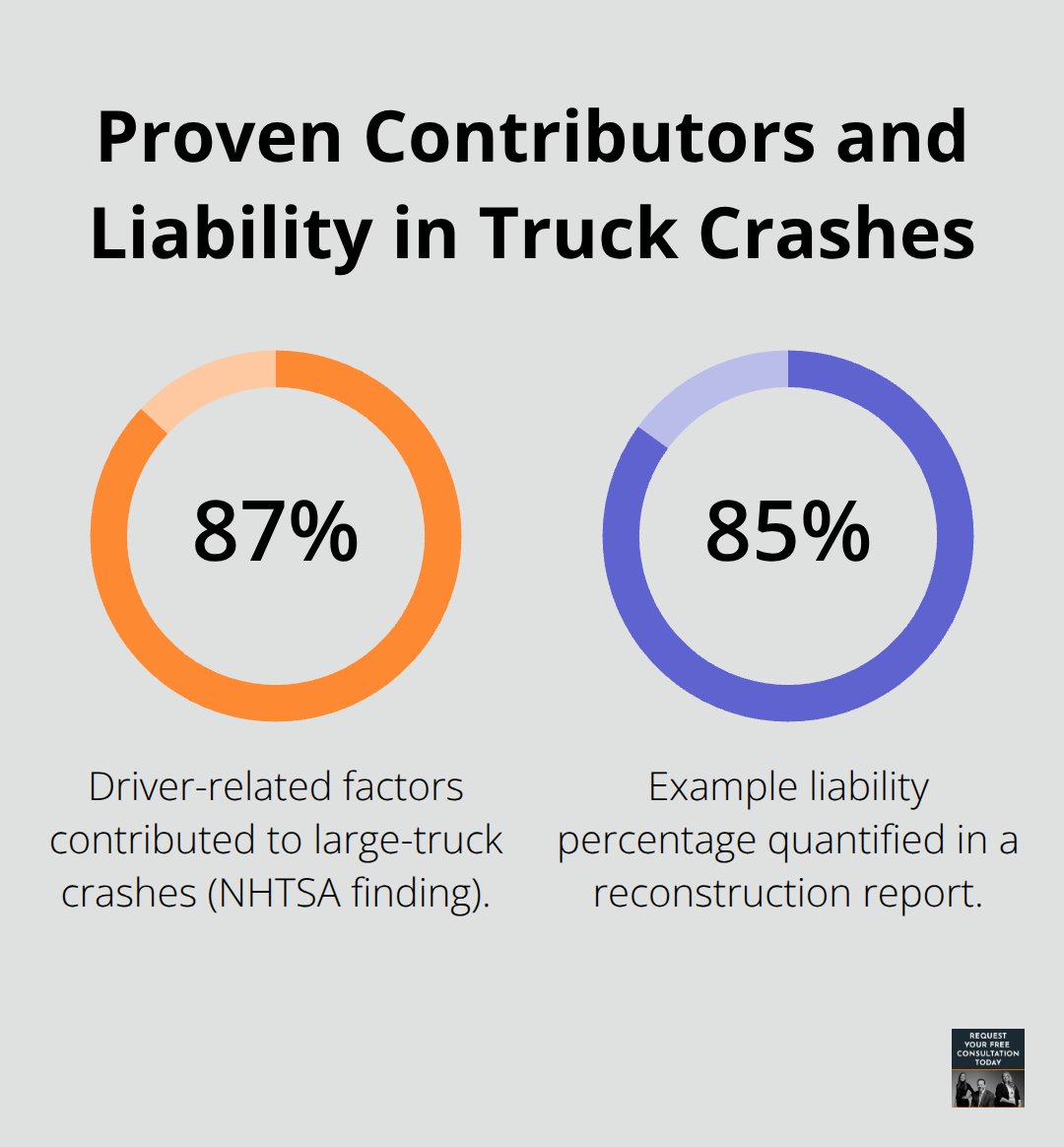
The National Highway Traffic Safety Administration found driver-related factors contributed to about 87 percent of large-truck crashes, but that statistic doesn’t apply universally to every case. Your specific crash might involve mechanical failure, inadequate maintenance, or both. Reconstruction evidence clarifies exactly which negligent party caused your injuries.
How Reconstruction Shifts Settlement Dynamics
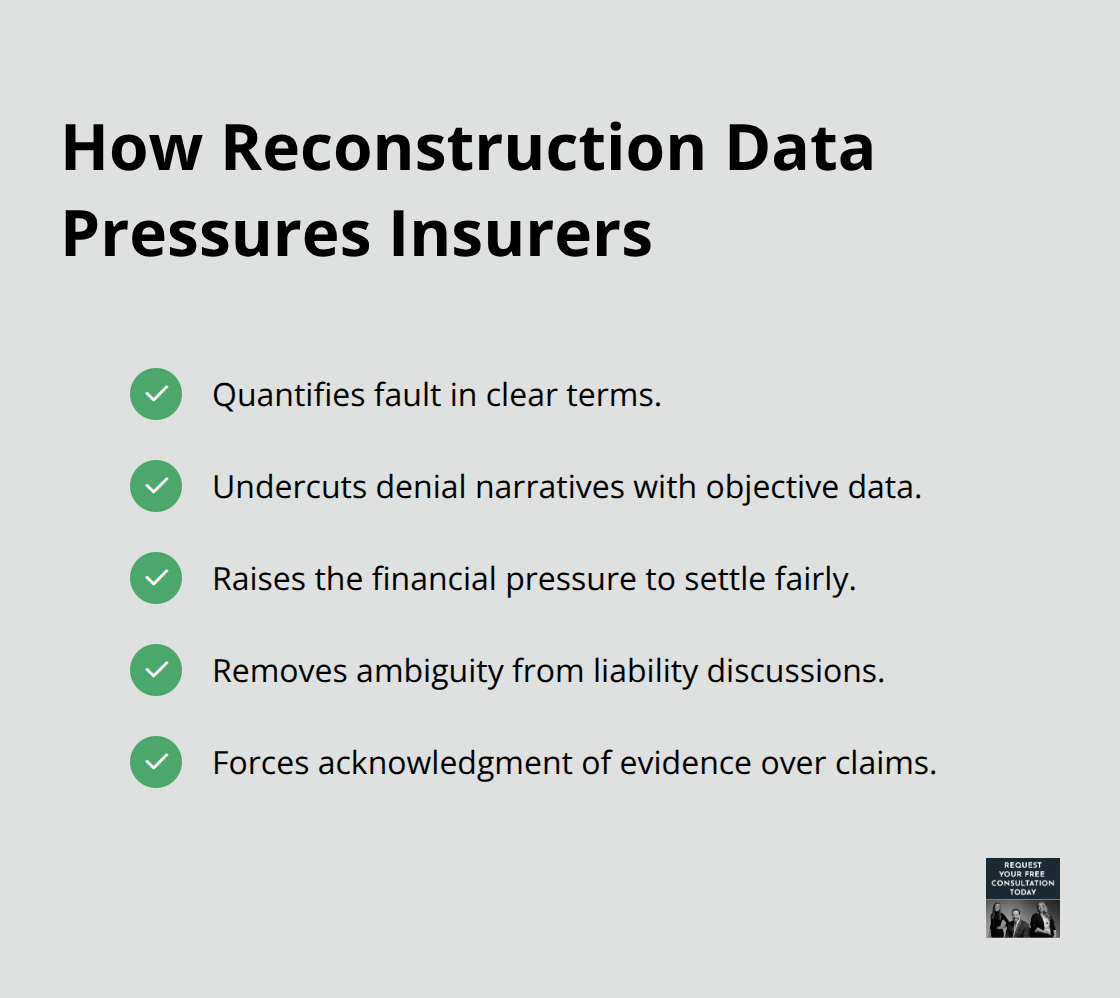
During settlement negotiations, insurance adjusters face reconstruction reports that quantify fault percentages and causation. These reports make their denial positions increasingly difficult to defend. When reconstruction data contradicts an insurance company’s narrative, the financial pressure to settle fairly increases substantially. The scientific foundation of reconstruction reports removes ambiguity from liability discussions and forces insurers to acknowledge the evidence rather than dispute it based on competing claims.
What Causes Truck Accidents and How Reconstruction Uncovers It
Brake Failure and Maintenance Negligence
Brake failure stands as one of the most dangerous and provable causes of truck accidents. Reconstruction professionals examine brake components, fluid levels, and wear patterns documented in maintenance logs. FMCSA regulations require trucking companies to maintain detailed inspection records, and missing brake pad replacements or failed safety inspections become direct evidence of negligence. Reconstruction reports calculate the stopping distance the truck actually needed versus the distance it would have needed with properly maintained brakes.
If maintenance records show skipped inspections, the trucking company faces liability regardless of driver actions. This is why obtaining complete maintenance records immediately after a crash matters-they often prove negligence before any other evidence surfaces.
Driver Fatigue and Hours-of-Service Violations
Driver fatigue causes approximately one-third of fatal truck crashes according to the National Highway Traffic Safety Administration, but proving fatigue requires more than witness statements. Electronic Logging Devices and black box data reveal how long a driver operated the truck without rest, whether they took required breaks, and their driving patterns in the hours before impact.
A driver operating 16 hours straight shows erratic speed changes, late braking, and lane drift patterns that reconstruction analysis identifies clearly. These data points transform fatigue from an assumption into measurable evidence that courts and insurance companies cannot dismiss.
Environmental Factors and Driver Responsibility
Road conditions and environmental factors complicate liability but never eliminate it. Wet pavement reduces traction, but reconstruction calculates whether the driver adjusted speed accordingly. If a truck travels 65 miles per hour on rain-soaked roads during a storm, reconstruction determines whether that speed was negligent given the conditions.
Poor road maintenance, inadequate signage, or hazardous designs become secondary liability targets when reconstruction proves the driver’s actions alone did not cause the crash. Reconstruction isolates each factor-mechanical defects, driver behavior, and environmental conditions-so compensation reaches every party responsible for your injuries. Understanding how these elements interact in your specific accident sets the foundation for the next phase: how reconstruction reports directly influence settlement negotiations and insurance company decisions.
How Reconstruction Reports Shift Insurance Company Decisions
Reconstruction Evidence Forces Reassessment
Reconstruction reports arrive on insurance company desks as irrefutable documentation that their initial liability assessments were wrong. When an adjuster denies your claim based on the truck driver’s statement, a reconstruction report backed by black box data, maintenance records, and scene analysis forces them to reconsider. Insurance companies employ claims adjusters trained to minimize payouts, but they also employ risk managers who understand that fighting reconstruction evidence in court costs significantly more than settling fairly.
Cases with reconstruction evidence settle at substantially higher values than cases without it, according to the American Association of Justice, though exact settlement increases depend on case specifics. An insurance company facing a reconstruction report that quantifies fault at 85 percent liability knows that a jury will likely reach a similar conclusion. This mathematical certainty shifts their negotiating position dramatically-they move from denial to haggling over settlement amounts because the reconstruction data removes the ambiguity they previously exploited.
How Reconstruction Eliminates Insurance Company Defenses
Insurance companies fear the public presentation of reconstruction findings. When a reconstruction professional testifies that maintenance records show brake pads overdue for replacement by 40,000 miles, or that black box data proves the driver never applied brakes before impact, that testimony becomes discoverable and part of the public record. Trucking companies facing reputation damage often push their insurance carriers to settle rather than litigate.
Reconstruction reports also expose patterns that insurance companies cannot defend. If electronic logging device data shows the driver operated 18 hours without a break in violation of Federal Motor Carrier Safety Administration regulations, the insurance company cannot claim the driver was alert and attentive. Forensic data eliminates the gray area where insurance companies typically operate.
Why Early Reconstruction Evidence Changes Negotiations
Settlement offers increase substantially once reconstruction reports demonstrate specific negligence through measurable evidence. The opposing party’s legal team recognizes that a jury presented with reconstruction testimony will award damages based on scientific analysis rather than competing narratives. When you provide reconstruction evidence early in the claim process, insurance adjusters understand immediately that this case will not settle for minimal amounts.
Human factors like fatigue and distraction become quantifiable through black box records and hours-of-service logs. Mechanical failures transform from disputed claims into documented facts through maintenance records and vehicle inspections. Road conditions and environmental factors receive proper analysis when reconstruction professionals isolate each variable independently. Insurance companies cannot manufacture reasonable doubt when reconstruction data speaks with precision.
Final Thoughts
Accident reconstruction transforms your truck accident claim from a dispute over competing stories into a case built on measurable scientific evidence. Black box data, maintenance records, and forensic analysis of the crash scene provide documentation that insurance companies cannot reasonably challenge. When you have reconstruction evidence supporting your claim, settlement negotiations shift dramatically in your favor because the opposing party understands that a jury will likely reach the same conclusions the accident reconstruction expert did.
Building a strong truck accident claim requires immediate action after your accident. Maintenance records must be obtained while they still exist, and electronic logging device data needs extraction before trucking companies claim it was overwritten. Photographs of the crash scene, vehicle damage, and road conditions should be documented thoroughly so that reconstruction analysis becomes as strong as possible.
If you’ve been injured in a truck accident in Santa Cruz County, Sacramento, or Oakland, contact Schaar & Silva LLP for a free consultation. We’ll evaluate your evidence, discuss reconstruction strategy, and explain how scientific analysis strengthens your path to fair compensation.
