
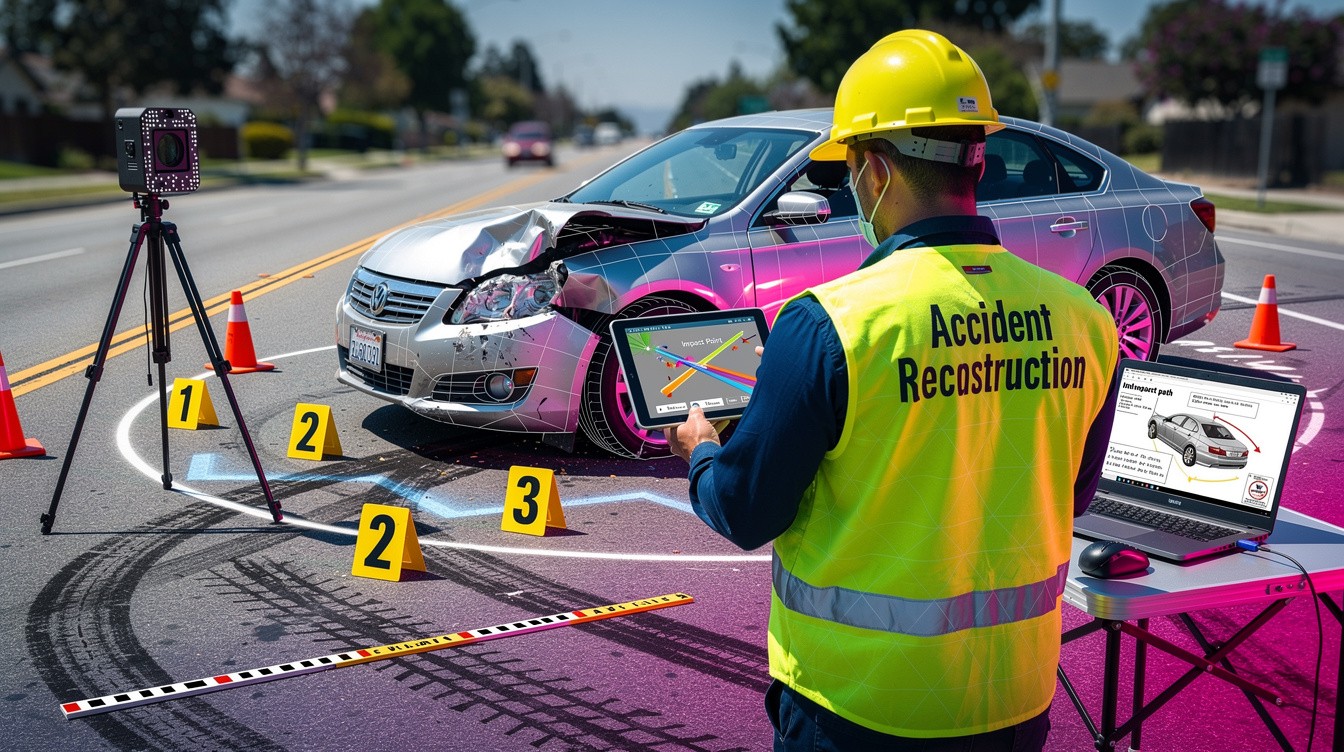
Insurance companies often dismiss injury claims by questioning how the accident actually happened. When you have forensic evidence backing your case, their arguments fall apart.
At Schaar & Silva LLP, we’ve seen how accident reconstruction in California transforms weak claims into strong ones. Physical evidence, vehicle damage analysis, and technology create an undeniable picture of what occurred and who caused it.
How Accident Reconstruction Reveals What Actually Happened
Accident reconstruction in California starts with a fundamental principle: the physical evidence at a crash scene tells the truth. Police reports and eyewitness accounts often contradict each other, but vehicle damage patterns, skid marks, debris fields, and road conditions speak a consistent language. When we examine a crash, we read the evidence left behind by physics itself.
Physical Evidence Speaks Louder Than Memory
Skid marks show braking distance and vehicle speed before impact. The location and severity of vehicle damage reveal where vehicles made contact and how much force transferred between them. Debris scatter patterns indicate the direction vehicles traveled after collision. Environmental factors like road surface conditions, weather at the time, and visibility all contribute to understanding what happened. The key is that we don’t rely on what people remember or claim-we measure, photograph, and document the physical reality that remains.
Event Data Recorders Eliminate Guesswork
Event Data Recorder data, commonly called black box information, provides objective measurements that eyewitness testimony cannot match. Modern vehicles record speed, brake application, throttle position, steering angle, and airbag deployment timing in the seconds before and during a crash. A driver might claim they were traveling at 25 miles per hour, but EDR data shows 45. An insurance company might argue sudden acceleration caused a rear-end collision, but EDR proves the driver was braking hard. Certified EDR analysts extract this data accurately and present it clearly.
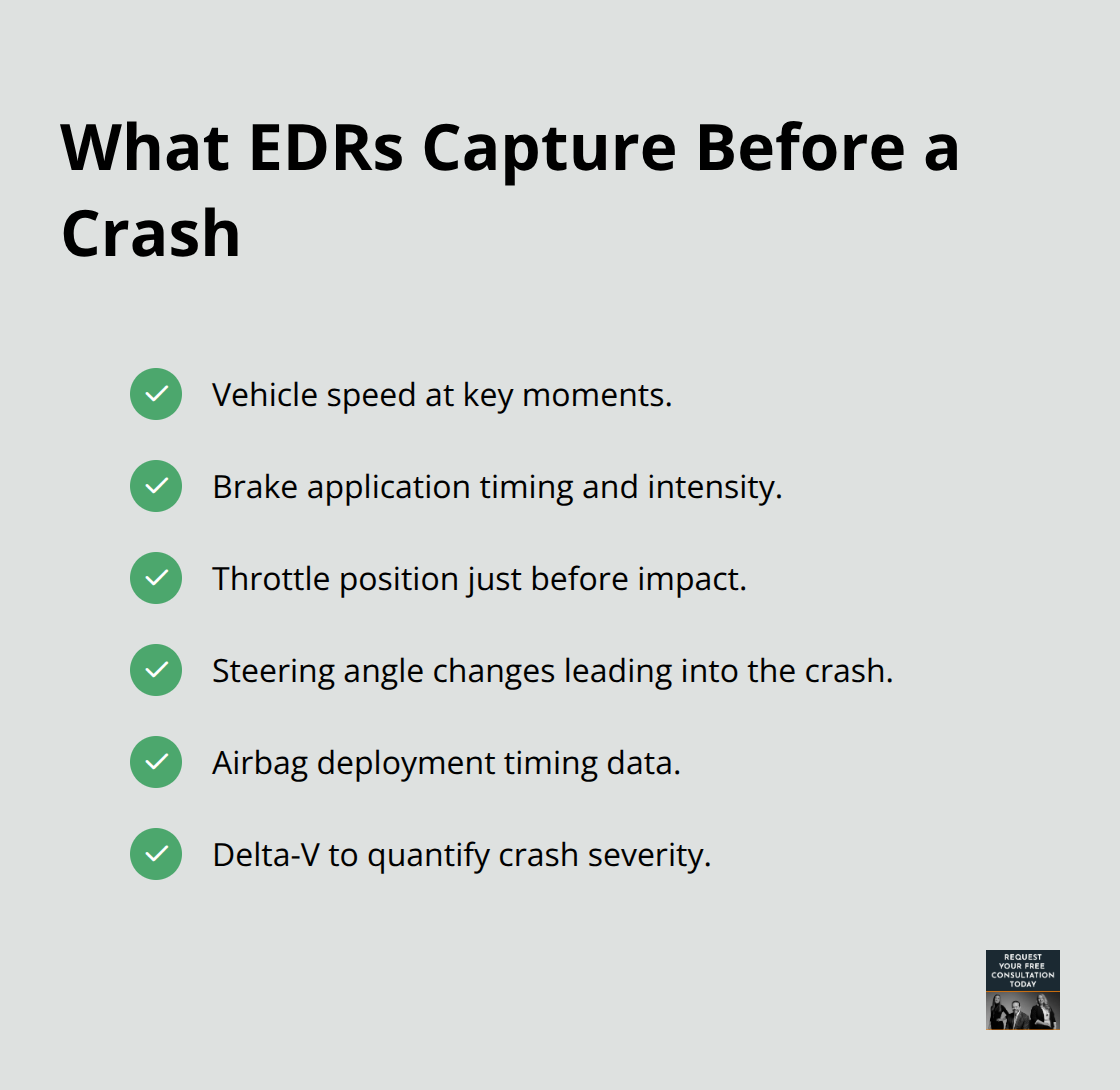
Delta-V measurements quantify how rapidly a vehicle decelerated during impact and help connect crash forces to the injuries victims sustained.
Simulations Transform Data Into Visual Evidence
Three-dimensional computer simulations translate all collected data-damage measurements, EDR readings, scene photographs, and road conditions-into visual reconstructions that show exactly how the collision unfolded. Insurance companies struggle to dispute what a detailed simulation demonstrates. Comprehensive vehicle inspections document physical damage with precision measurements and photographic evidence. We identify the point of initial impact, the angle of collision, and classify whether it was head-on, rear-end, sideswipe, or offset. This classification matters because different impact types produce predictable injury patterns.
Aligning Evidence Creates Undeniable Liability
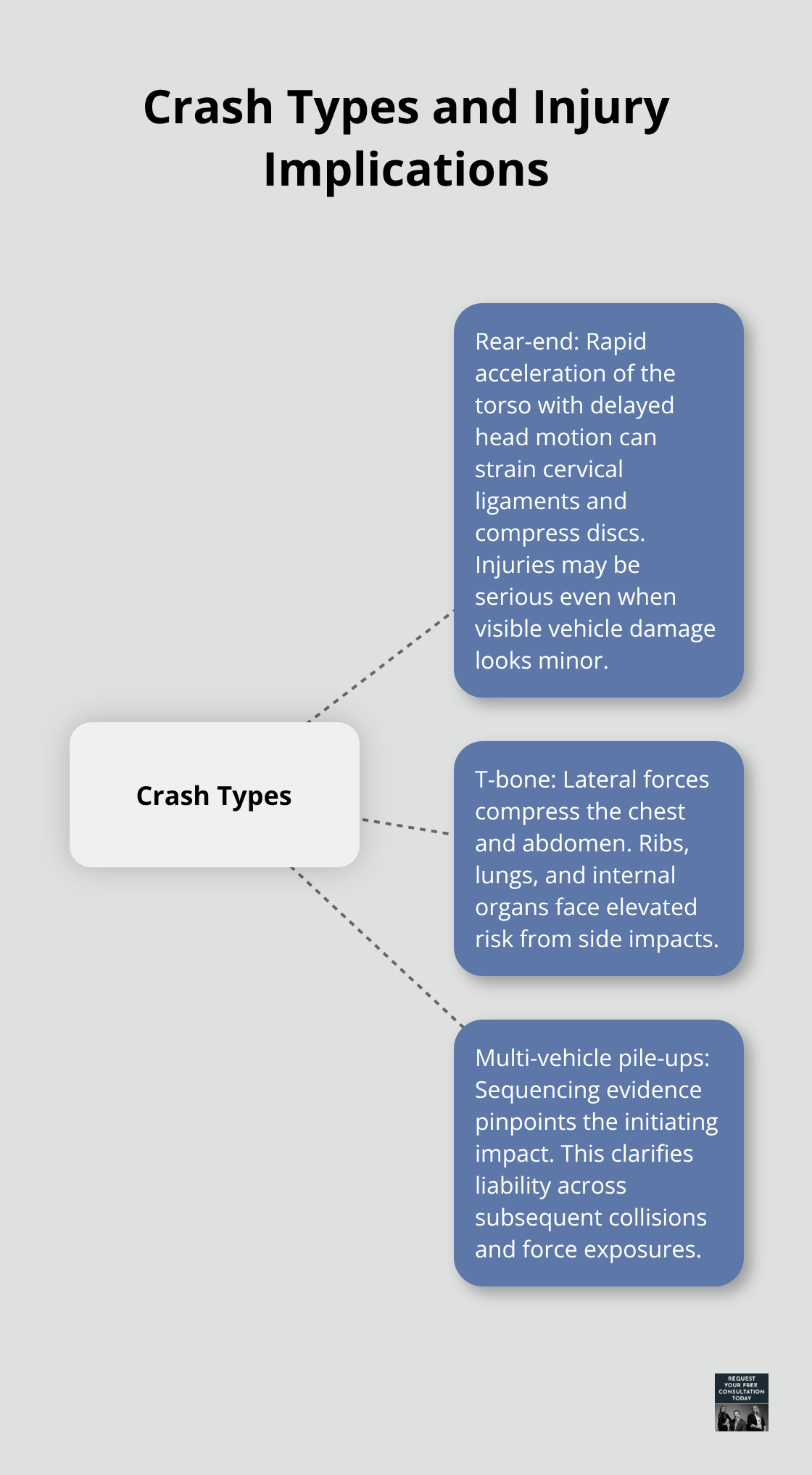
A rear-end collision at 30 miles per hour creates specific forces on the cervical spine that biomechanics research has thoroughly documented. A T-bone impact distributes forces completely differently. When we align vehicle damage patterns with EDR data, scene evidence, police reports, and witness statements, inconsistencies become obvious. Insurance adjusters who claim your injuries don’t match the accident severity face a wall of engineering data they cannot overcome. The reconstruction becomes your strongest defense against dismissal or lowball settlement offers. Understanding how these forces connect to specific injury patterns requires examining what happens to your body during different types of collisions.
Why Reconstruction Evidence Wins Against Insurance Denial
Insurance Companies Rely on Victims Lacking Forensic Data
Insurance companies count on victims not having forensic data to back their claims. When you present accident reconstruction findings, the dynamic shifts entirely. Physical evidence creates a factual record that insurers cannot argue around without looking unreasonable to a judge or jury. The reconstruction establishes exactly what forces acted on your vehicle and body during the collision, which directly connects the crash mechanics to your injuries. This connection separates a dismissed claim from a settlement that reflects what actually happened to you.
Three Tactics Insurers Use-and How Reconstruction Defeats Them
Insurers typically deploy three tactics to minimize payouts: they question whether the accident was severe enough to cause your injuries, they blame you for contributing to the collision, or they claim your medical expenses are inflated. Accident reconstruction dismantles each tactic with measurable data. When EDR data shows a vehicle traveling 47 miles per hour before impact and the vehicle decelerated at 8.5 g-forces during the collision, an insurance adjuster claiming whiplash cannot occur at that speed has no credible response. Delta-V measurements quantify the severity with precision that subjective arguments cannot match.
Physical Evidence Transforms Liability Arguments
Site inspections reveal road conditions, visibility factors, and traffic control devices that either support or contradict liability claims. A reconstruction report documenting that sight lines at an intersection were obstructed by vegetation or parked vehicles becomes powerful evidence that the other driver should have seen the danger. Biomechanics research shows that rear-end impacts at 30 miles per hour generate cervical spine forces capable of causing soft tissue damage and nerve compression. When your medical records show exactly those injury patterns and the reconstruction proves the collision generated those forces, denying your claim becomes indefensible.
Settlement Outcomes Shift With Forensic Support
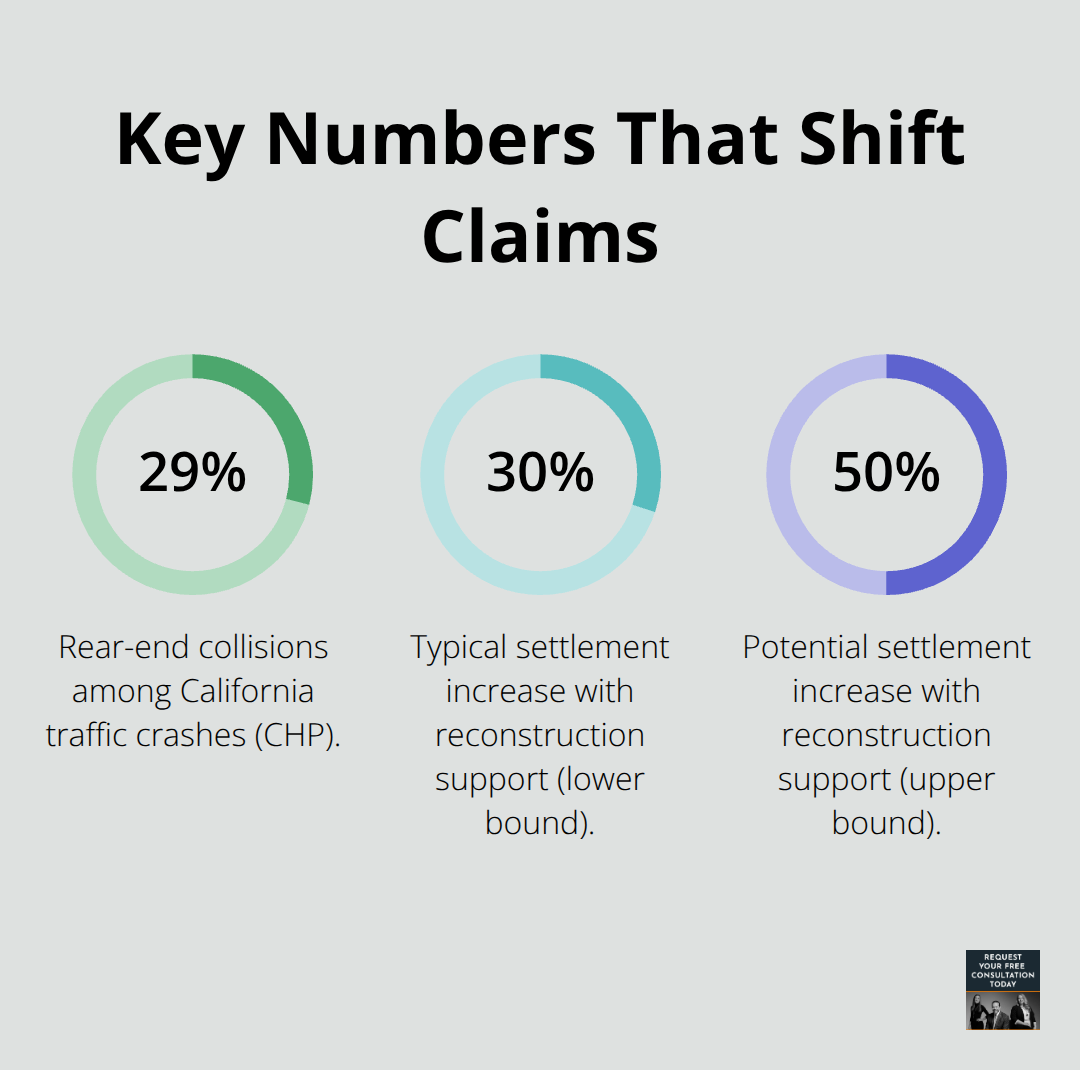
Insurance companies know that reconstruction data strengthens claims significantly. The cost of litigation and the risk of a jury seeing your reconstruction evidence typically push settlements upward by 30 to 50 percent compared to claims without forensic support. This is why insurers settle faster when reconstruction data enters the conversation.
The next step involves understanding how your attorney builds and wins your case through evidence collection and protection from insurance tactics.
How Different Crashes Create Different Injury Patterns
Rear-End Collisions and the Deception of Minor Damage
Rear-end collisions represent the most common type of accident in California, accounting for roughly 29 percent of all traffic crashes according to the California Highway Patrol. What makes these collisions deceptive is that low-speed impacts often cause serious injuries despite minimal vehicle damage. A vehicle struck from behind at 20 miles per hour experiences rapid acceleration that forces the head backward relative to the torso, stretching cervical ligaments and compressing discs. EDR data from rear-end crashes consistently shows deceleration rates between 4 and 8 g-forces during the impact phase.
Insurance companies exploit the gap between visible damage and actual injury severity by arguing that minor dents cannot produce whiplash or cervical strain. This is where reconstruction data becomes essential. When we document that a vehicle’s center of gravity shifted 2.3 inches during impact and the occupant’s head underwent 18 degrees of rearward rotation, medical evidence showing cervical disc herniation becomes scientifically connected to the collision mechanics. The reconstruction establishes that soft tissue damage and nerve compression injuries are biomechanically predictable outcomes of that specific impact force, not fabricated claims.
T-Bone Impacts and Lateral Force Injuries
T-bone collisions present a fundamentally different injury mechanism because the force vector strikes perpendicular to the vehicle’s long axis. A vehicle hit on the driver’s door at 30 miles per hour experiences lateral deceleration that compresses the thoracic cavity, potentially damaging ribs, lungs, and internal organs. Vehicle damage patterns in side-impact crashes are immediately obvious, which makes insurance denials less credible, but liability questions often emerge about right-of-way and traffic signal compliance.
Reconstruction analysis of traffic control devices, sight lines, and vehicle approach speeds determines whether the at-fault driver had adequate opportunity to see and avoid the collision. The physical evidence from the scene-combined with EDR measurements and damage documentation-creates a factual record that insurers cannot reasonably dispute.
Multi-Vehicle Pile-Ups and Causation Sequencing
Multi-vehicle pile-ups create compound liability questions because determining which vehicle initiated the chain reaction requires precise sequencing of impact points and timing. EDR data from all involved vehicles, combined with damage pattern analysis and scene photographs, establishes the collision sequence with mathematical certainty. Insurance companies frequently attempt to distribute fault across multiple parties to reduce their payout obligation, but reconstruction evidence showing that the first vehicle struck the second at a specific speed and angle, then the second vehicle struck the third at a different angle and speed, eliminates ambiguity about causation.
The physical evidence documents which driver’s negligence triggered the entire sequence, concentrating liability where it belongs. When multiple vehicles collide in rapid succession, the reconstruction separates the initiating cause from secondary impacts, making clear which party bears responsibility for the entire chain of events.
Final Thoughts
Forensic evidence transforms how insurance companies view your claim. When you present accident reconstruction findings backed by physical data, EDR measurements, and damage analysis, insurers recognize that dismissing your case will cost them more in litigation than settling fairly. The reconstruction creates an objective record that protects your rights by removing subjective arguments from the conversation entirely.
An accident reconstruction expert in California builds this protection through systematic evidence collection and analysis. They measure vehicle damage, extract black box data, document scene conditions, and connect crash mechanics to your injuries with scientific precision. This work eliminates the gap between what happened and what insurers claim happened, and your medical records align with biomechanical data showing that the forces generated by the collision predictably caused your specific injuries.
Insurance adjusters who once questioned your injuries now face engineering reports, EDR data, and biomechanics research that validate every aspect of your claim. Contact Schaar & Silva LLP to discuss how accident reconstruction evidence can strengthen your case and protect your recovery.
