
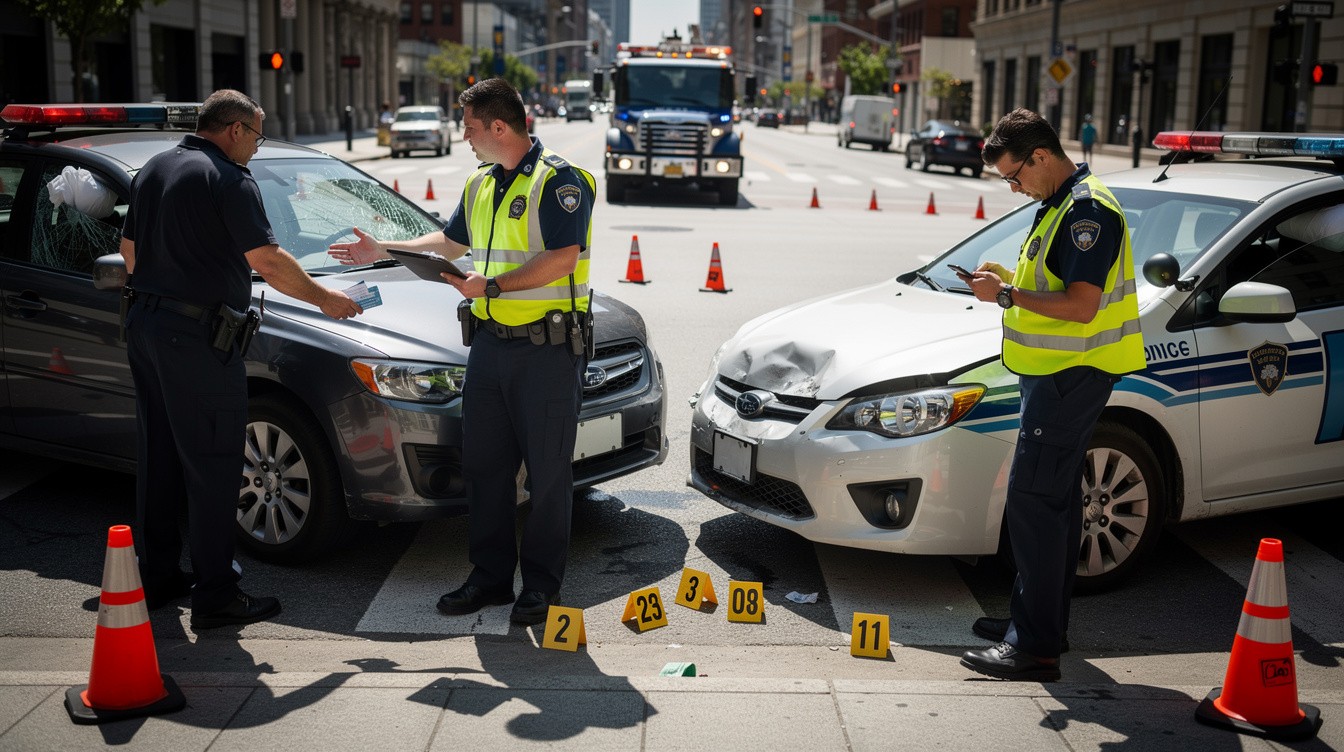
A car accident in Santa Cruz County can leave you confused about who’s responsible and what happens next. Driver fault Santa Cruz isn’t always straightforward, especially when multiple parties share responsibility for the crash.
We at Schaar & Silva LLP help accident victims understand their rights and navigate the claims process. This guide breaks down how fault gets determined, what causes accidents, and the steps you should take after a collision.
How Fault Gets Determined in Santa Cruz Car Accidents
The Four Elements of Negligence
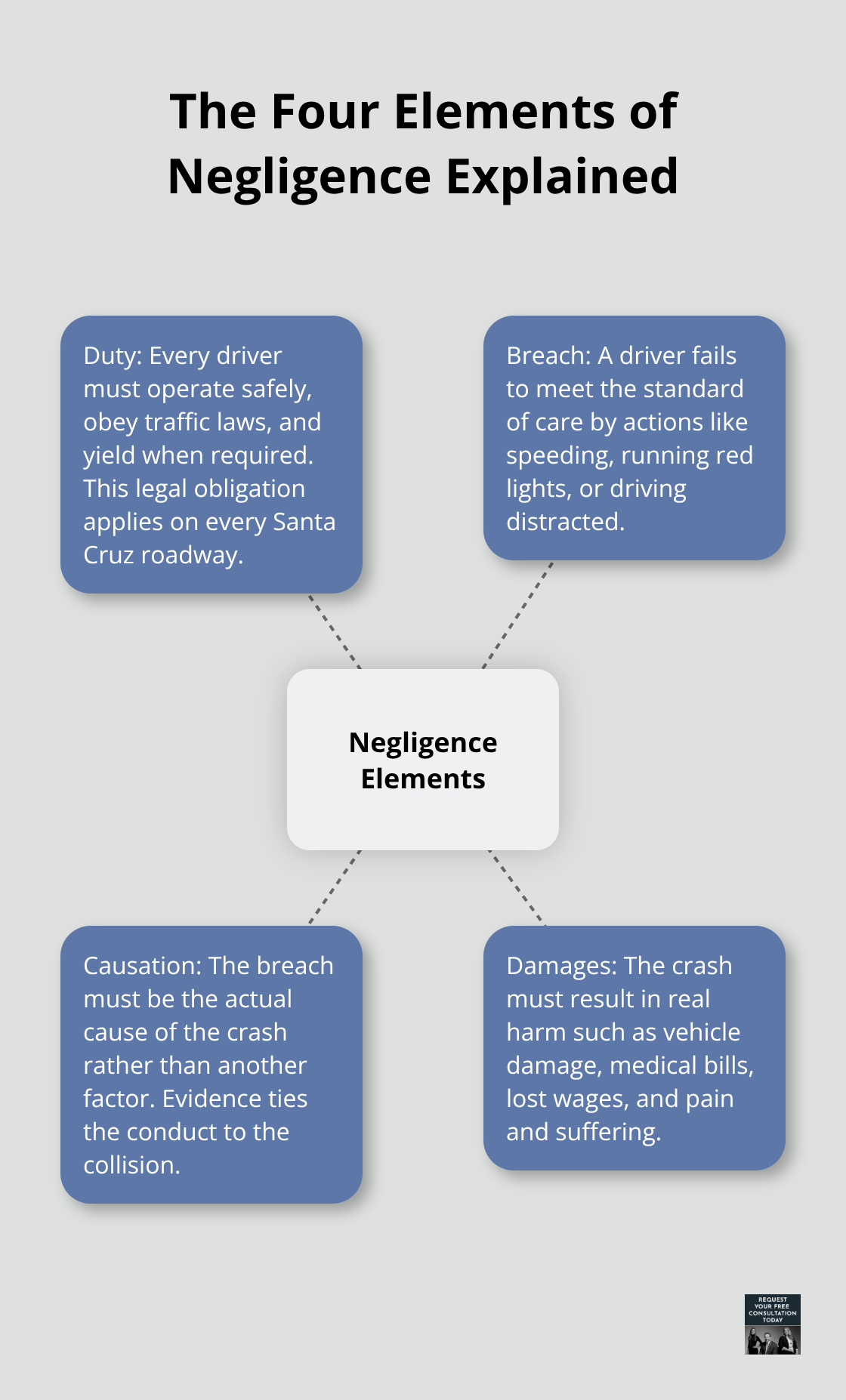
Fault in Santa Cruz car accidents follows a specific legal framework built on four elements: duty, breach, causation, and damages. Every driver has a duty to operate their vehicle safely, follow traffic laws, maintain a safe following distance, and yield when required. A breach occurs when a driver fails to meet this standard-speeding, running a red light, or driving distracted all count as breaches. Causation means the driver’s breach actually caused the crash, not some other factor. Damages refer to the actual harm: vehicle damage, medical bills, lost wages, and pain and suffering. All four elements must be present for someone to be found negligent.
Police Reports and Official Records
Police reports form the foundation of fault determination. When officers respond to a crash, they document the scene, interview witnesses, photograph vehicle positions and damage, and note environmental conditions. The Statewide Integrated Traffic Records System (SWITRS) captures this data, which the Transportation Injury Mapping System (TIMS) then maps and analyzes. This official record carries significant weight in insurance claims and legal proceedings, though it is not the final word on fault. Witness statements, dash-cam footage, skid marks, and the location of vehicle damage all contribute to the investigation.
How Insurance Adjusters Assign Fault
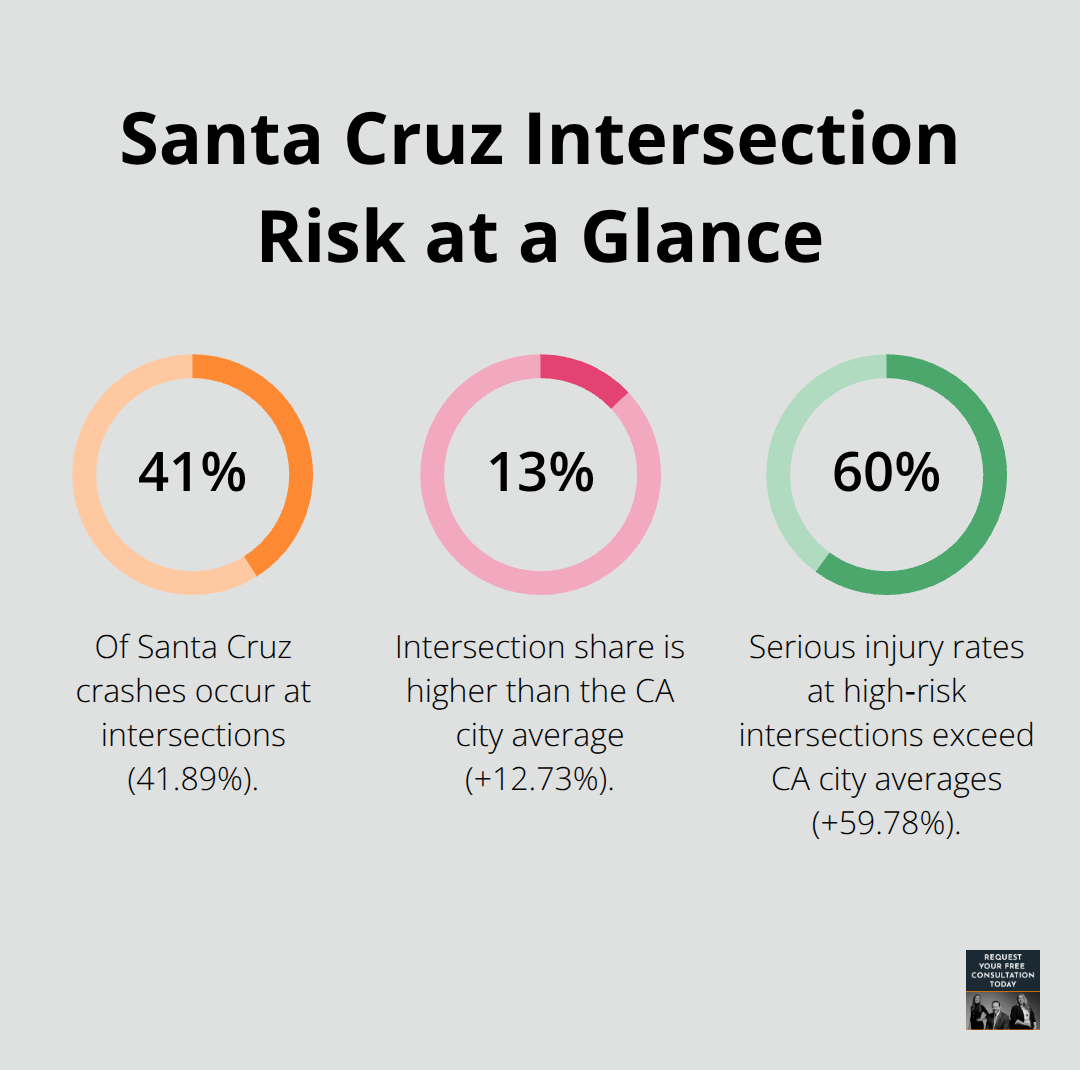
Insurance adjusters analyze evidence to assign fault percentages. In Santa Cruz, where intersection crashes account for 41.89% of all accidents-12.73% higher than the California city average-proper scene documentation becomes even more critical. Intersections like Highway 1 and Highway 9, which recorded 11 crashes between 2020 and 2024, present complex liability scenarios where right-of-way rules and signal compliance heavily influence who bears responsibility.
California’s Comparative Negligence System
California’s pure comparative negligence system means you can recover damages even if you share partial fault, though your recovery is reduced by your percentage of responsibility. This differs from other states and works in your favor. Insurance companies calculate fault percentages based on the evidence, and these percentages determine how much each party pays. If you disagree with the fault determination, review the insurer’s written rationale, present your own evidence, and challenge any inaccuracies in the police report. Many accident victims accept unfair fault assignments without pushback. Do not admit fault at the scene, even if you think you caused the crash-liability is complex and often shifts once all facts emerge. If negotiations stall, you have the option to file a lawsuit within California’s two-year deadline.
Infrastructure and Environmental Factors
The concentration of high-injury crashes along Highway 1, Pacific Avenue, and Beach Street suggests that road design, signage, and maintenance also influence liability outcomes. Courts and insurers increasingly recognize that driver conduct alone does not always explain crashes; environmental and infrastructure factors matter too. Understanding these broader patterns helps you build a stronger case when you challenge fault assignments or pursue a claim.
What Causes Most Santa Cruz Car Accidents
Distracted Driving and Phone Use
Distracted driving ranks as the leading cause of crashes in California, accounting for roughly 8% of all injury collisions statewide. In Santa Cruz County, where intersection crashes already exceed the state average by 12.73%, adding distraction multiplies the risk exponentially. Phone use while driving impairs reaction time as much as a 0.08 blood alcohol level does. When you text, check navigation, or scroll social media, you stop watching the road and fail to anticipate what other drivers will do.
After an accident, document any admission from the other driver about phone use immediately and report it to police and your insurance company. Many drivers downplay phone use after a crash, so dash-cam footage or witness statements become your strongest evidence. These records shift liability clearly toward the distracted driver because the connection between inattention and crash causation is direct and measurable.
Speeding and Reckless Driving
Speeding and reckless driving create liability that courts rarely excuse. A driver traveling 10 mph over the limit has less time to stop and causes more severe injuries when impact occurs. Santa Cruz’s dangerous intersections, particularly Highway 1 and Highway 9 (which recorded 11 crashes between 2020 and 2024), often involve drivers ignoring speed limits or traffic signals.
If you were hit by a speeding driver, the police report should note the estimated speed. Insurance adjusters weight speed violations heavily in fault determination because the connection between excessive speed and crash causation is direct and measurable. The severity of injuries at these high-risk intersections-with serious injury rates 59.78% higher than the average across studied California cities-reinforces how speed amplifies liability.
Failure to Yield and Traffic Violations
Failure to yield at intersections and running red lights or stop signs cause the majority of intersection collisions. Right-of-way rules exist precisely to prevent these crashes, so violating them creates clear liability. If another driver failed to yield to you, that failure is usually the proximate cause of the accident regardless of other factors.
Witness statements carry enormous weight in these cases because they confirm what the traffic signal showed and who had the legal right to proceed. After a crash, ask witnesses specifically whether they saw the traffic light color for each vehicle and get their contact information immediately. Many accident victims assume the police report will capture everything, but officers sometimes arrive after the fact and rely on driver accounts rather than witness observations. If witnesses saw a red light violation, their statements can override a conflicting police report conclusion.
Road Design and Driver Responsibility
The concentration of high-injury crashes along Pacific Avenue and Beach Street in Santa Cruz suggests that some intersections have design flaws or poor visibility that make violations more likely. Even so, the driver who violates the signal or fails to yield bears primary fault because they had a duty to follow traffic laws regardless of road conditions. Understanding how these dangerous intersections function helps you build a stronger case when you challenge fault assignments or pursue a claim. The next section walks you through the practical steps to take immediately after a collision occurs.
Immediate Steps That Protect Your Claim
The moments after a crash determine whether you build a strong case or hand control to insurance companies. Do not admit fault at the scene, even if you believe you caused the collision-liability is far more complex than initial impressions suggest, and statements made under stress often contradict what evidence reveals later. Call 911 if anyone is injured or if significant property damage occurred; Santa Cruz County law enforcement will document the scene officially through SWITRS, which feeds into the Transportation Injury Mapping System and creates an official record that carries weight in fault determination.
Photograph and Document Everything
While waiting for police, photograph vehicle positions, all visible damage, road conditions, traffic signals, and street signs from multiple angles. These images become critical evidence if you later challenge a fault assignment. Get the names, phone numbers, and email addresses of every witness before they leave-do not rely on police to collect complete contact information. Ask witnesses specifically what they saw: the traffic light colors for each vehicle, vehicle speeds, phone use by drivers, and the sequence of events.
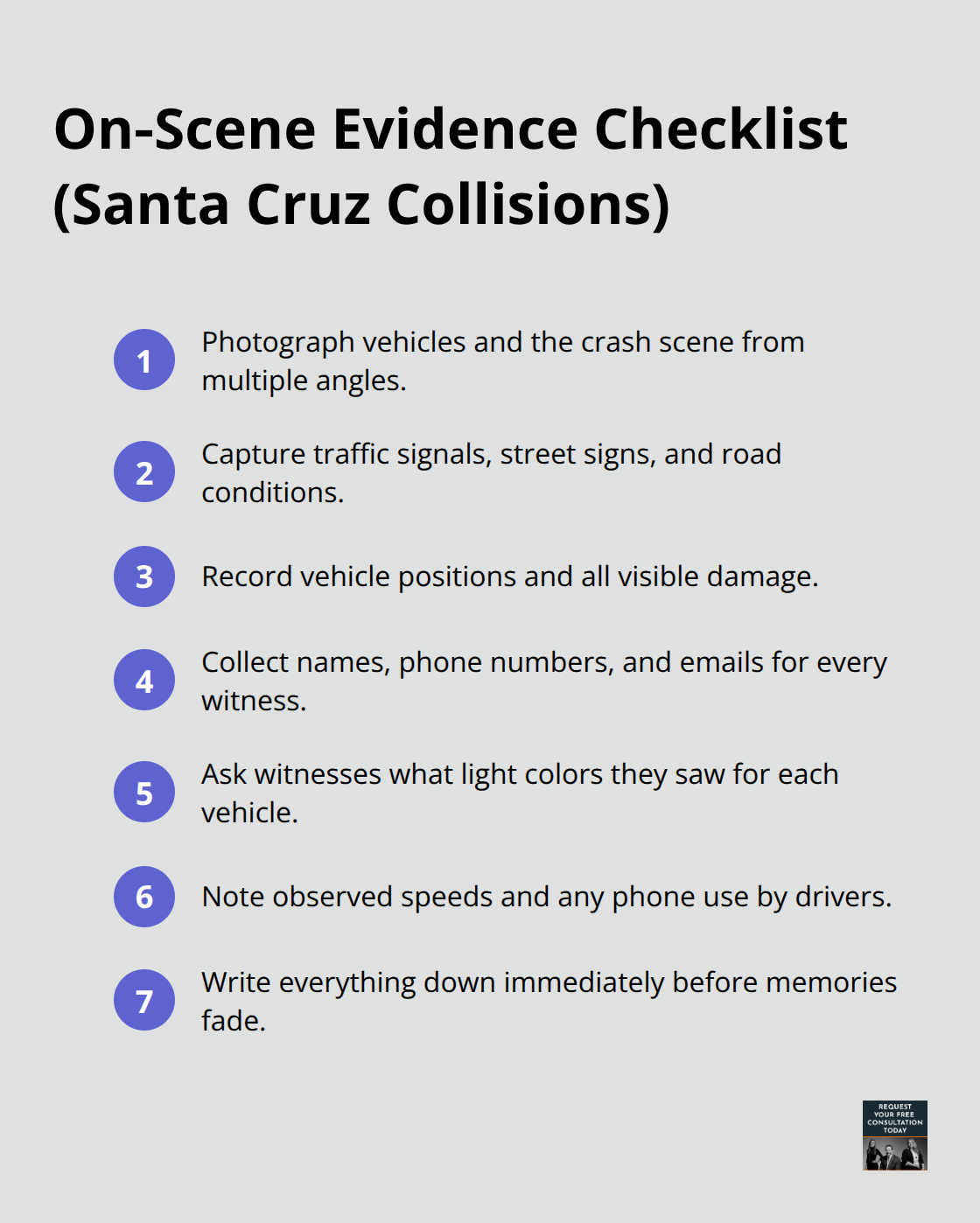
Write their responses down immediately because memory fades within hours.
Handle Conversations With Care
If the other driver admits fault or discusses the crash, note the exact words they use, but do not argue or negotiate liability at the scene. Notify your insurance company promptly, but provide only basic facts: date, time, location, vehicles involved, and injuries. Do not volunteer a detailed account of how the crash happened or speculate about fault. Insurance adjusters will contact you with follow-up questions; answer honestly but concisely.
Seek Medical Evaluation and Official Records
If you sustained injuries, seek medical evaluation even if you feel fine-some injuries emerge days later, and medical records establish a direct link between the crash and your condition, which strengthens your claim. Request a copy of the police report from the Santa Cruz County Sheriff’s Office or local police department within 10 days; review it for inaccuracies or missing details and challenge errors in writing. If the report incorrectly identifies you as at-fault or omits witness statements, submit a correction request with supporting evidence.
Protect Your Settlement Rights
Contact an attorney before accepting any settlement offer from the other driver’s insurance company. Many accident victims settle too quickly for amounts far below what their case is worth, especially in Santa Cruz’s high-injury intersection crashes where serious injury rates run 59.78% higher than the California city average. The legal team at Schaar & Silva LLP can evaluate your claim, negotiate with insurers on your behalf, and pursue litigation if necessary to recover full damages. We also assist with medical bill assistance through lien services and help ensure you receive fair valuation for property damage.
Final Thoughts
California law protects you through pure comparative negligence, which means you can recover damages even when you share partial fault for a crash. Understanding how driver fault Santa Cruz gets determined-through the four elements of negligence, police reports, insurance investigation, and evidence analysis-puts you in a stronger position to challenge unfair fault assignments. The dangerous intersections in Santa Cruz, where serious injury rates run 59.78% higher than the California city average, underscore how critical proper documentation and legal guidance become after a collision.
We at Schaar & Silva LLP help accident victims in Santa Cruz County navigate the claims process from start to finish. Our team handles medical bill assistance through lien services so you can focus on healing while your case moves forward, evaluates property damage claims to ensure you receive fair valuation for your vehicle loss, and negotiates with insurance companies on your behalf. We pursue litigation if necessary to recover the full damages you deserve.
Contact our legal team at schaarsilvalaw.com to discuss your accident and learn how we can help. Bring any documentation you gathered at the scene, your police report, medical records, and insurance correspondence so we can evaluate your claim and explain your rights under California law. Do not settle with an insurance company before speaking with us-many accident victims accept far less than their cases are worth.
