
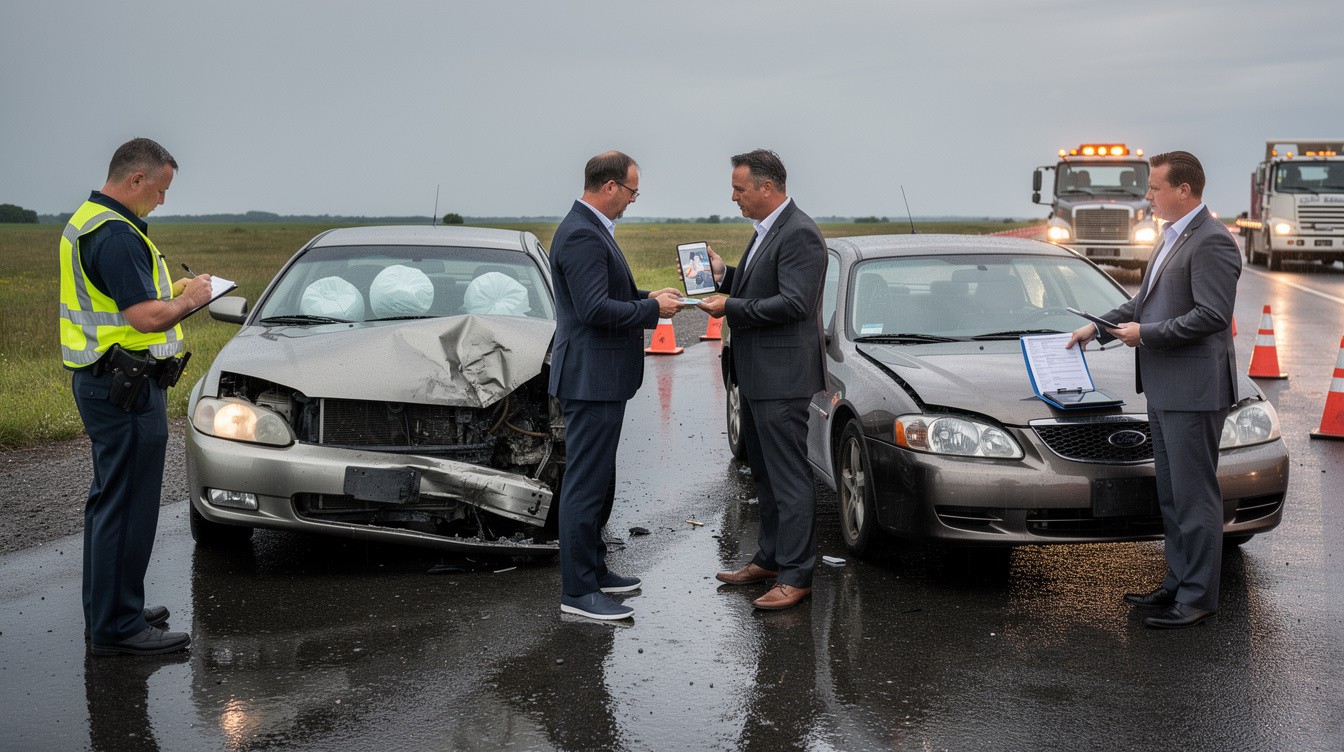
A car accident can leave you facing unexpected bills and confusion about who pays for what. Liability in vehicle accidents determines which driver’s insurance covers the damages, medical costs, and other losses.
At Schaar & Silva LLP, we help accident victims in Santa Cruz County, Sacramento, and Oakland understand their rights and recover the compensation they deserve. This guide walks you through how fault gets established, what your insurance covers, and what to do when the other driver has little or no coverage.
How Fault Gets Established After an Accident
Police reports form the backbone of liability determination, but they’re not the final word on who pays. When officers arrive at a crash scene, they document vehicle positions, road conditions, traffic signals, and driver statements, then file this information with the California Department of Justice. However, police conclusions about fault are often inadmissible in civil claims, meaning the report serves mainly as a starting point for investigation rather than proof of liability. What matters more is the evidence within that report-skid marks, vehicle damage patterns, and witness observations-that you and your attorney can use to build a stronger case.
Gathering Evidence at the Scene
Gather the police report number at the scene and request a copy within days, not weeks, because details fade and evidence gets lost. Photographs of vehicle damage, road conditions, and traffic signals taken immediately after the accident carry significant weight because they show the actual scene before cleanup crews arrive. Insurance adjusters and attorneys rely heavily on these visual records to reconstruct what happened. Collect contact information from everyone who saw the crash, not just those who stop to help, and ask them to write down what they observed while memory is fresh.
California’s Comparative Negligence Rule Changes Everything
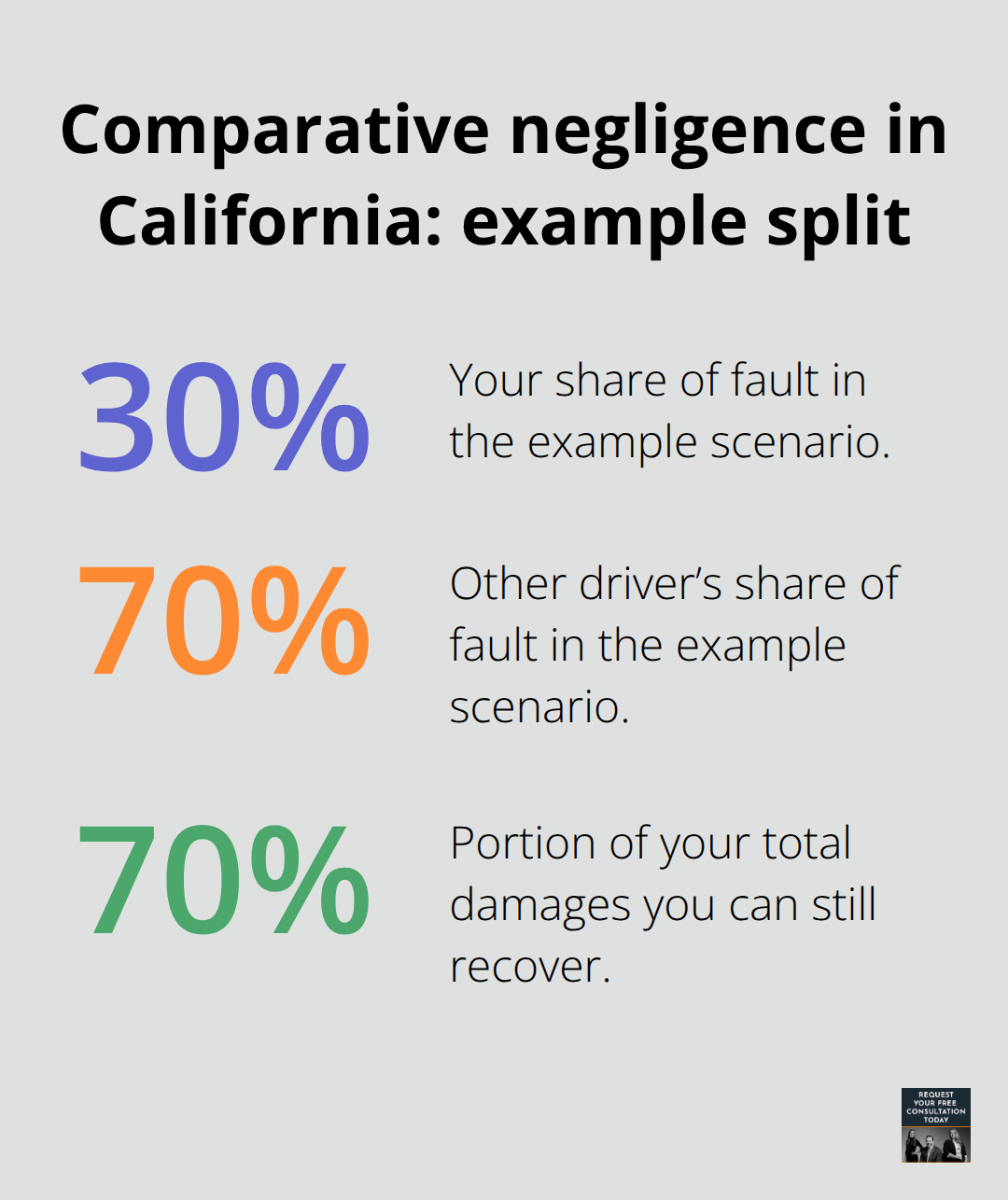
California uses comparative negligence, meaning you can recover damages even if you bear some responsibility for the crash. Under California law, as established in Li v. Yellow Cab Co., your recovery gets reduced by your percentage of fault, but you can still pursue compensation if you’re 50 percent or less at fault. If you’re 30 percent responsible and the other driver is 70 percent responsible, you recover 70 percent of your total damages rather than nothing.
How Negligence and Liability Get Assessed
Insurance companies and juries assess relative responsibility by examining negligence-whether a driver violated traffic laws, failed to yield, or drove unsafely-and strict liability theories when applicable. The burden falls on the at-fault driver’s insurer to prove you share some fault; without substantial evidence of your negligence, comparative fault instructions shouldn’t even apply in court. Witness statements become invaluable here because they provide independent accounts of how the accident unfolded. Documentation matters enormously: medical records showing treatment dates, employment records proving lost wages, and repair estimates all quantify your actual losses and support your damage calculations. Once you understand how fault gets determined, the next step involves navigating your insurance coverage and filing claims to recover those documented losses.
How Your Insurance Covers Accident Damages
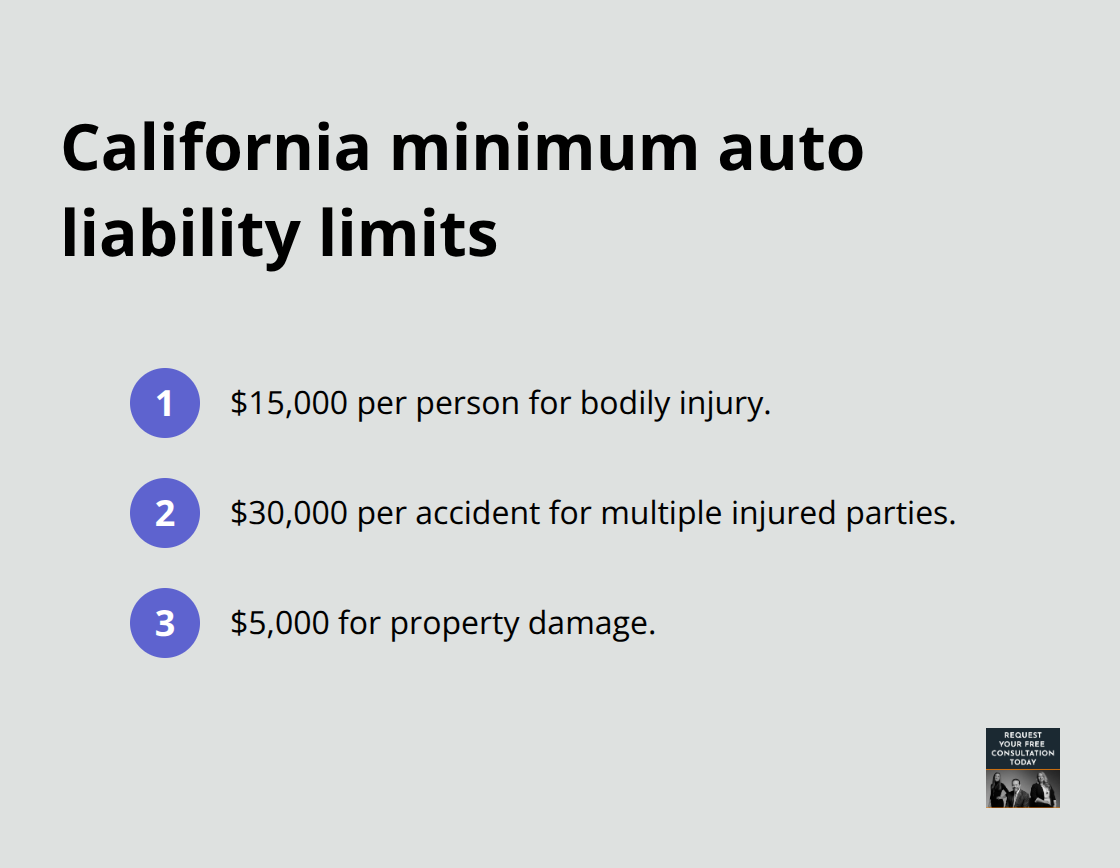
After an accident, your liability insurance becomes the primary mechanism for paying damages to the other party, while your own coverage protects you from financial ruin. California’s minimum liability requirements are $15,000 per person for bodily injury, $30,000 per accident for multiple injured parties, and $5,000 for property damage, according to the California Vehicle Code. However, these minimums often fall short of actual losses in serious crashes.
When you file a claim, the at-fault driver’s liability insurance covers medical expenses, repair costs, lost wages, and pain and suffering up to the policy limit. The insurer typically pays the repair facility or medical providers directly, though sometimes checks go to you as the vehicle owner or to any lienholder on your loan. If the at-fault driver’s insurance limit is exhausted, you may pursue an underinsured motorist claim through your own policy to bridge the gap.
Property Damage Claims Move Faster Than Injury Claims
Property damage claims move faster than injury claims because they involve concrete repair estimates rather than ongoing medical treatment. Your insurer must acknowledge your claim within 15 working days and explain any delays after 60 days, per California Department of Insurance guidelines. Request multiple repair estimates from shops of your choice-there’s no state requirement limiting how many estimates you submit. You have the right to select your own repair shop rather than using the insurer’s preferred vendor, though using their shop may streamline the process.
Medical Payments Coverage Reimburses Without Fault Proof
Medical Payments coverage, also called Med Pay, reimburses reasonable medical expenses without requiring you to prove fault, making it valuable when the other driver disputes liability. This coverage pays hospital bills, emergency room visits, surgery, physical therapy, and sometimes ambulance fees up to your policy limit (typically $1,000 to $5,000). Personal Injury Protection, or PIP, available in some policies, covers medical expenses plus a portion of lost wages and household services, providing broader protection than Med Pay alone. Unlike Med Pay, PIP continues paying even if you’re partially at fault under California’s comparative negligence rules.
Documentation Protects Your Medical Claims
When you receive treatment, notify your healthcare provider immediately about the accident so they can bill the correct insurance. Providers sometimes place a medical lien on your settlement, meaning they claim a portion of your recovery to pay their bills, which can significantly reduce your net compensation. At Schaar & Silva LLP, we help direct you to medical lien services that facilitate the payment of your bills until your case is resolved, reducing the financial pressure during recovery. Keep every receipt, medical record, and proof of lost income because insurers scrutinize medical claims heavily and may deny expenses they deem unrelated to the accident. The next section addresses what happens when the at-fault driver carries insufficient or no insurance coverage at all.
When the Other Driver Has No Insurance
Most drivers in California carry liability insurance, but roughly 15 percent of motorists on the road remain uninsured according to the California Department of Insurance. When an uninsured driver causes your accident, their lack of coverage does not eliminate your right to recover damages-it simply shifts where you file your claim. Your own uninsured motorist coverage, often called UM coverage, becomes your safety net.
How UM Coverage Protects You
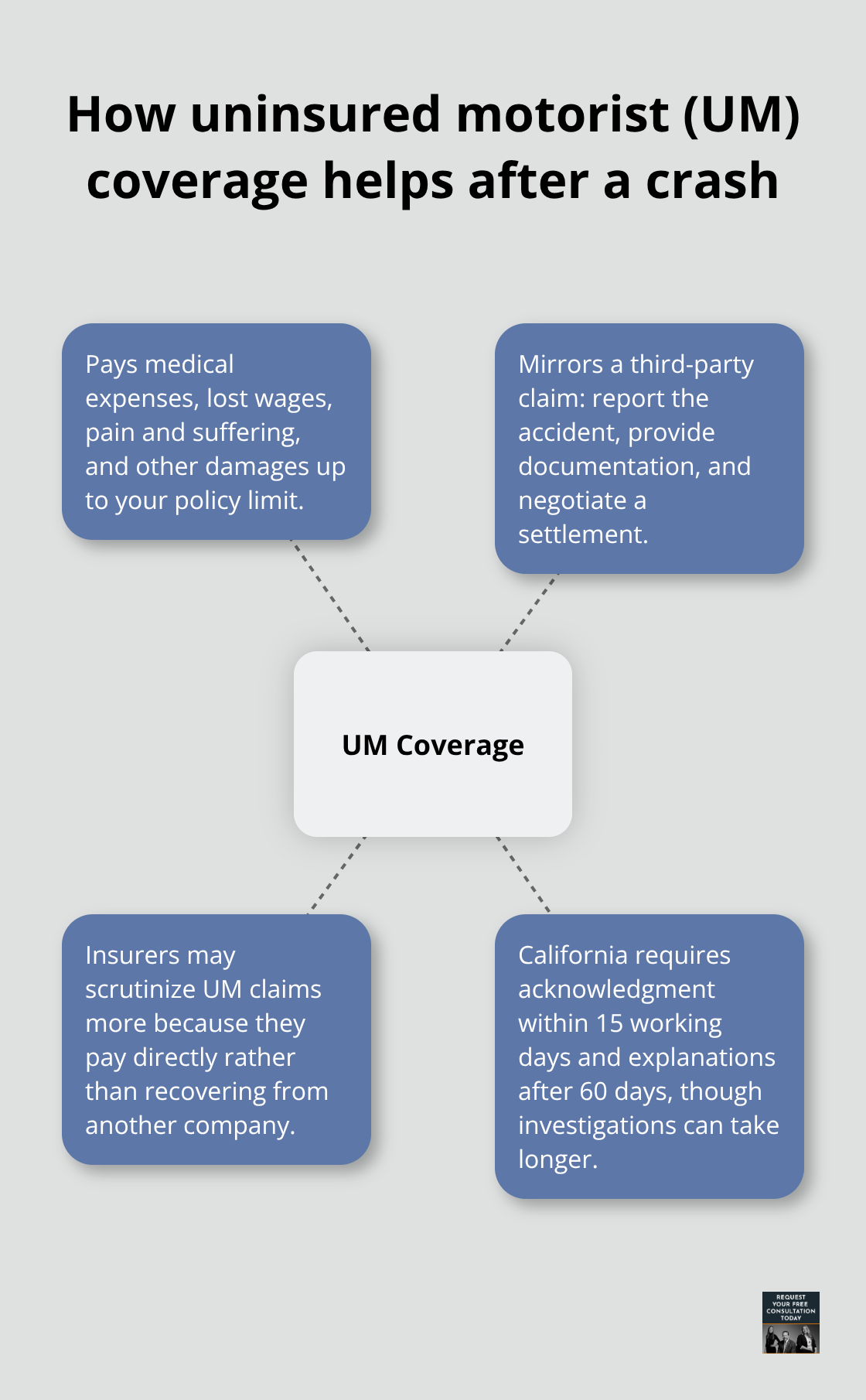
UM coverage pays medical expenses, lost wages, pain and suffering, and other damages up to your policy limit when the at-fault driver has zero insurance. The process mirrors a third-party claim in many ways: you report the accident to your insurer, provide documentation of your injuries and losses, and negotiate a settlement. However, your own insurer may scrutinize the claim more heavily since they pay from their own pocket rather than recovering from another company. California law requires insurers to acknowledge UM claims within 15 working days and explain delays after 60 days, though investigation and negotiation often take longer than property-only claims.
Documentation Strengthens Your UM Claim
If the uninsured driver caused serious injury, you must document everything meticulously-medical records, police reports, witness statements, and repair estimates-because your insurer will demand concrete proof before paying substantial amounts. Some drivers skip this coverage to save money on premiums, but that gamble leaves them vulnerable to paying their own medical bills and lost income out of pocket when hit by an uninsured motorist.
Underinsured Motorist Coverage Fills the Gap
Underinsured motorist coverage, called UIM, addresses a different but equally frustrating scenario: the at-fault driver carries insurance, but their policy limit falls short of your actual damages. If you incur $50,000 in medical expenses and the other driver’s liability limit is only $30,000, your UIM coverage bridges that $20,000 gap up to your UIM limit. California law allows you to stack UM and UIM coverage across multiple vehicles you own, significantly increasing your available protection-a strategy many accident victims overlook.
Filing a UIM Claim Requires Strategic Coordination
Filing a UIM claim requires proving the at-fault driver’s liability first, then demonstrating that their policy limit is exhausted before your UIM activates. Your insurer may take weeks or months to resolve a UIM claim because they must coordinate with the other driver’s insurer and verify that settlement is truly final. If your case involves serious injuries or the damages substantially exceed the at-fault driver’s coverage, having experienced representation prevents costly mistakes that could reduce your final recovery by thousands of dollars.
Final Thoughts
Understanding liability in vehicle accidents empowers you to navigate insurance claims, protect your rights, and recover fair compensation for your losses. Fault determines who pays, but California’s comparative negligence rule means you can still recover even if you share partial responsibility. Document everything at the accident scene, gather witness statements, and preserve medical records because insurers demand concrete evidence before settling claims.
Know your coverage limits for liability, medical payments, uninsured motorist, and underinsured motorist protection, then review your policy annually to ensure adequate limits. If the at-fault driver carries insufficient insurance, your own UM and UIM coverage becomes your financial lifeline, so don’t skip these protections to save a few dollars on premiums. Many victims accept quick payouts without understanding their full entitlement, leaving thousands of dollars on the table.
Contact Schaar & Silva LLP for a free consultation to discuss your accident claim and evaluate whether settlement offers reflect your true damages. Our team helps you coordinate with medical providers and pursue maximum recovery through negotiation or litigation. We focus on reducing your financial stress during recovery so you can concentrate on healing.
