

Car accidents in California happen fast, but the legal process that follows doesn’t. Understanding auto accident litigation in California is essential if you’ve been injured or caused damage on the road.
At Schaar & Silva LLP, we’ve helped countless people navigate claims, insurance disputes, and courtroom battles. This guide walks you through California’s fault-based system, the claims process, and how much compensation you might receive.
Understanding California’s Fault-Based System
How Fault Determines Liability
California operates under a fault-based system, meaning the driver who caused the accident bears responsibility for damages. According to the California Department of Insurance, the at-fault driver’s insurance covers medical expenses, lost wages, and property damage for injured parties. This straightforward principle shapes everything that follows in your claim.
Comparative Negligence Works in Your Favor
California’s comparative negligence rule sets the state apart from many others. You can recover damages even if you share some fault in the accident-your compensation simply gets reduced by your percentage of responsibility. If you’re deemed 20% responsible for a crash that caused $100,000 in damages, you recover $80,000. Many accident victims wrongly assume they have no case if they bear any responsibility. That assumption costs them money. California’s law gives you a path to recovery regardless of partial fault.
Time Limits Demand Immediate Action
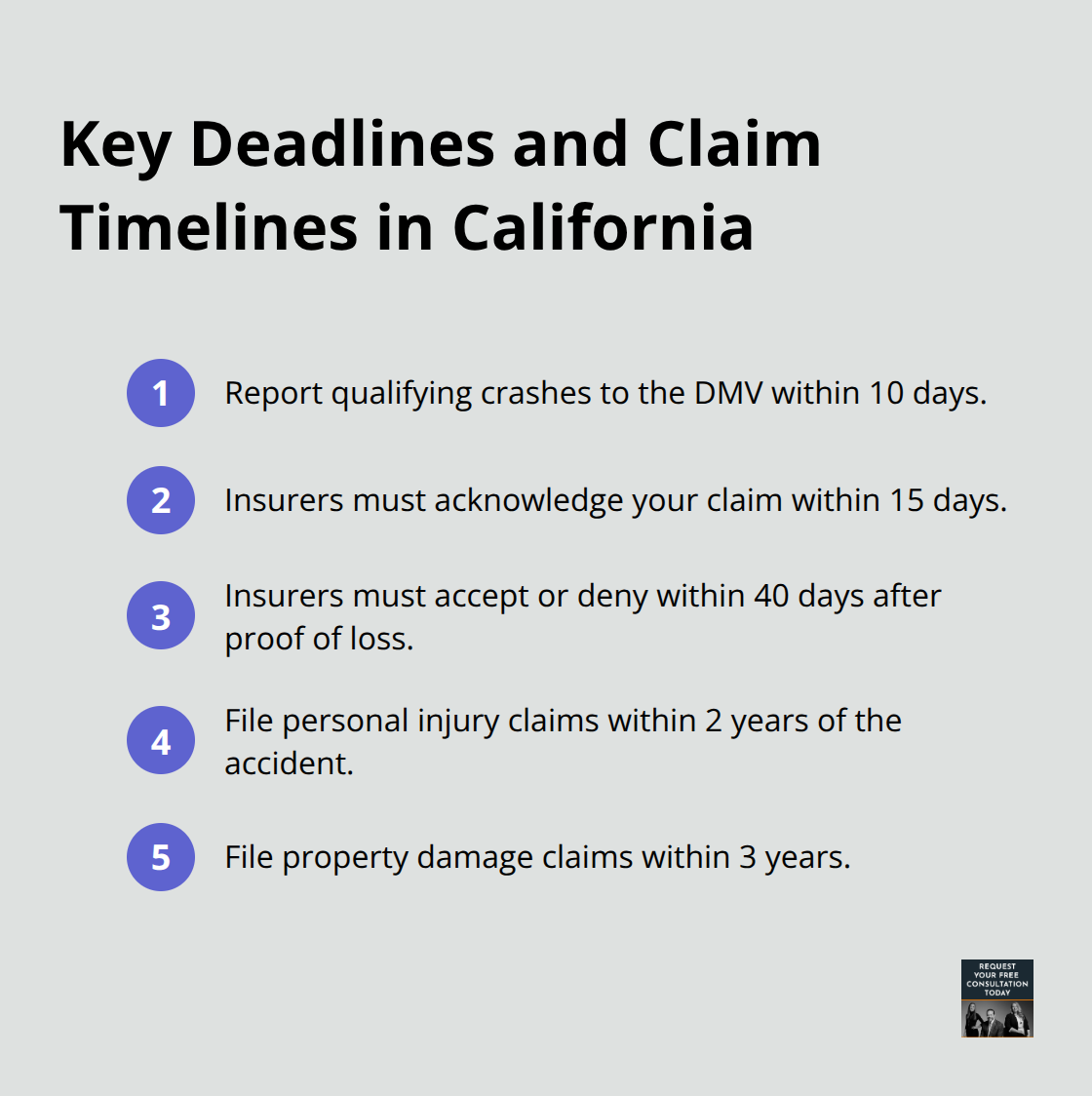
The statute of limitations for personal injury claims is two years from the accident date, according to California Code of Civil Procedure Section 335.1. Property damage claims have three years under Section 338. Missing these deadlines bars you from pursuing compensation entirely. Acting quickly protects your rights and prevents permanent loss of your claim.
Minimum Insurance Coverage Often Falls Short
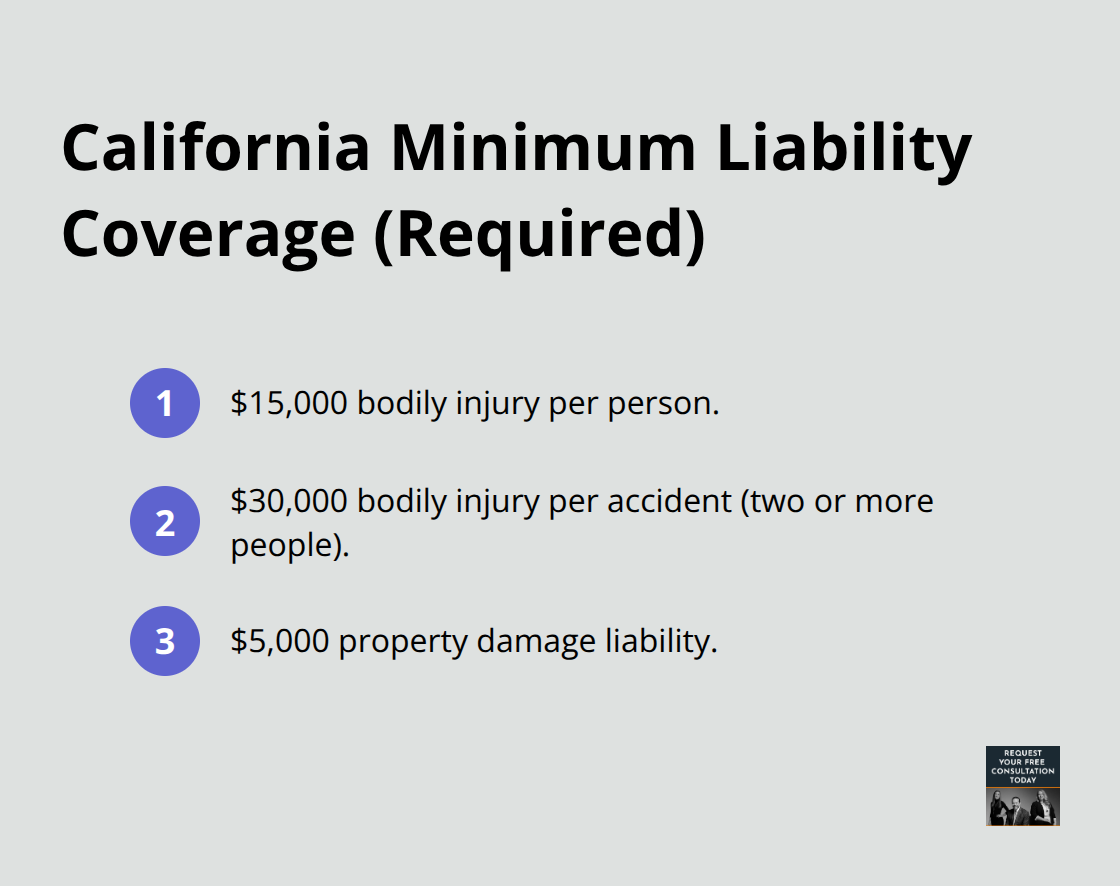
California requires all drivers to carry minimum liability insurance: $15,000 per person, $30,000 per accident for two or more people, and $5,000 for property damage, per the California Department of Insurance. These minimums frequently prove inadequate in serious cases. If the at-fault driver carries only minimum coverage and your injuries exceed those limits, you may need to pursue additional recovery through your own uninsured motorist coverage or a lawsuit. Reviewing your policy limits now-before an accident happens-helps you understand gaps in your protection and plan accordingly.
Understanding these foundational rules positions you to take the right steps immediately after an accident occurs.
What to Do Right After Your Accident
The first hour after a car accident determines how strong your claim becomes. Call 911 immediately if anyone is injured, then contact local police to file an accident report. According to the California Department of Insurance, you must report accidents involving injuries or vehicle damage to the DMV within 10 days, so don’t delay this step. At the scene, exchange names, driver’s license numbers, license plate numbers, and vehicle details with the other driver. Get contact information from witnesses-their statements often prove decisive when insurance companies or courts evaluate fault. Take photos of vehicle damage, road conditions, traffic signals, and the overall scene from multiple angles. These images create an objective record that memories cannot. Notify your insurance agent or insurer immediately; the California Department of Insurance notes that insurers must acknowledge claims within 15 days, so early reporting starts this timeline. Don’t argue with the other driver, don’t sign any fault statements, and don’t promise to pay their damages.
These mistakes can undermine your case later.
Collect Documentation Systematically
Obtain the official police report once it becomes available within days-it carries significant weight in fault determination. Collect medical records and bills from day one, even for minor injuries, since many accident victims discover serious conditions weeks later. Write down your account of the accident while details remain fresh, noting road conditions, visibility, vehicle speeds, and what you observed. If you sought medical attention, keep every receipt and record. The California Department of Insurance requires insurers to respond to claims within 15 days and accept or deny them within 40 days after proof of loss, so organized documentation accelerates this process. Don’t rely on the insurance adjuster’s inspection alone; the adjuster works for the insurer, not you. Your own evidence-photos, witness statements, medical documentation-protects your interests when the insurer’s damage evaluation begins. If additional damage appears during repairs, the insurer may re-inspect or request new estimates, which is why thorough initial documentation matters.
Protect Yourself During Insurance Communications
When the insurer contacts you, provide factual information but avoid recorded statements without legal guidance. Many insurers request written or recorded statements and sometimes examinations under oath; these statements can be used against you if you’re not careful with your wording. If the insurer delays responding beyond the 15-day acknowledgment window or the 40-day decision deadline, contact the California Department of Insurance at 1-800-927-4357 for assistance. Don’t accept the first settlement offer without understanding what it covers and what it excludes. Insurers typically pay the lesser of repair costs or the actual cash value of your vehicle, so review your policy for coverage limits and exclusions regarding original equipment manufacturer parts versus aftermarket parts. If you and the insurer disagree on the vehicle’s value, many policies include an appraisal provision where each side selects an appraiser, they choose an umpire, and the agreed amount becomes binding.
Know When Legal Representation Becomes Essential
For injuries exceeding the at-fault driver’s minimum coverage limits, you’ll need uninsured motorist protection or litigation. An attorney preserves critical evidence, counters insurer tactics, and calculates full damages including future medical costs and lost earning potential that you might otherwise overlook. The next section covers compensation and damages in detail-understanding what you can recover helps you evaluate whether a settlement offer truly reflects your losses.
What Compensation Can You Actually Recover
Economic Damages Cover Your Tangible Losses
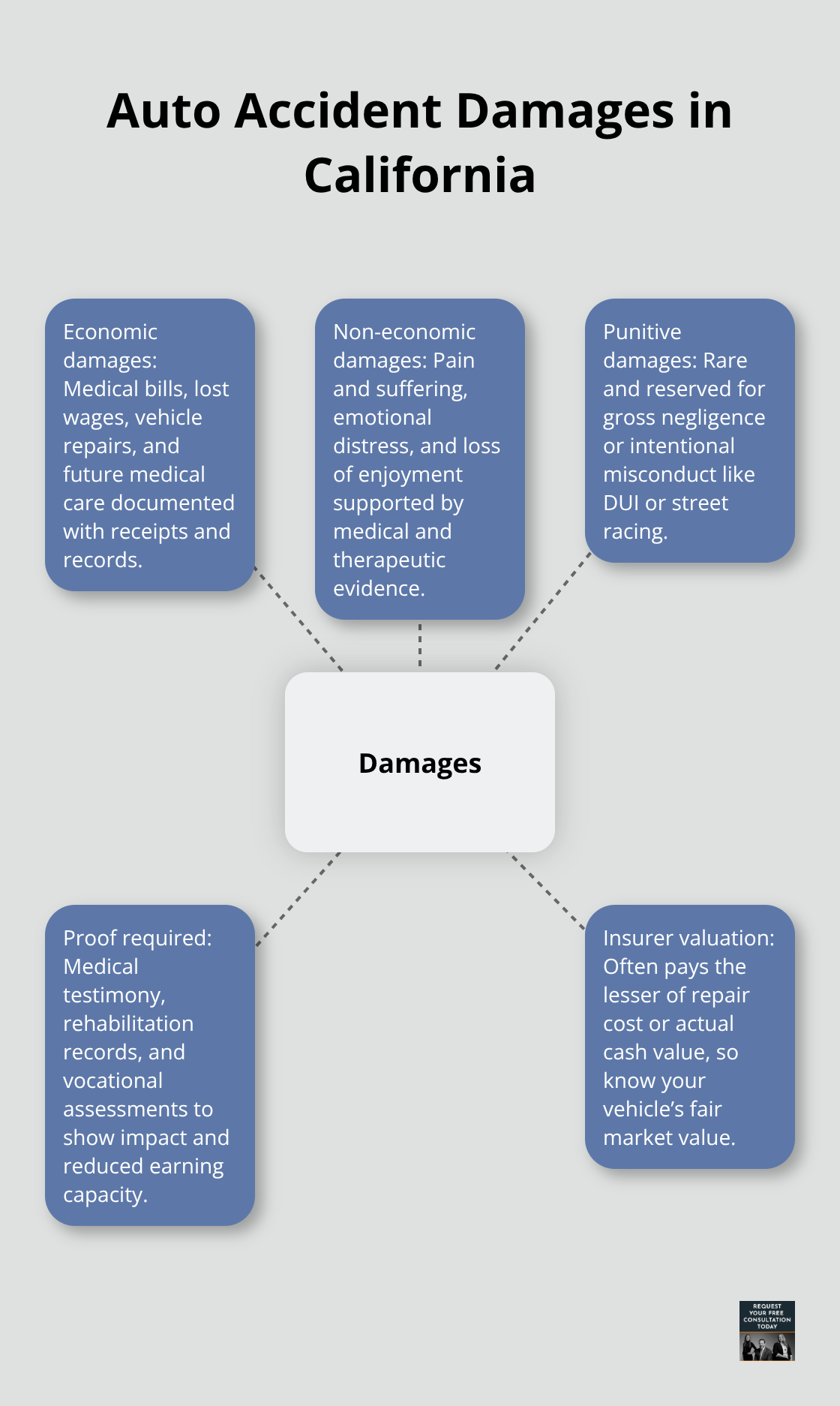
California courts award two main categories of damages in auto accidents: economic and non-economic. Economic damages cover tangible losses you can calculate precisely-medical bills, lost wages, vehicle repairs, and future medical care. The California Department of Insurance notes that insurers typically pay the lesser of repair costs or actual cash value, so knowing your vehicle’s fair market value at the time of loss protects you from accepting lowball offers. If you earned $60,000 annually and missed four months of work due to your injuries, you recover $20,000 in lost wages. If your medical treatment cost $45,000, that entire amount should be included in your claim.
Many accident victims undervalue their economic damages by overlooking prescription medications, physical therapy sessions, home modifications for mobility issues, or transportation costs to medical appointments. Document every expense systematically from day one, keeping receipts and invoices organized by category. Your medical records establish the scope and duration of treatment, which directly impacts the value of your claim.
Non-Economic Damages Reflect Your Suffering
Non-economic damages compensate for pain and suffering, emotional distress, loss of enjoyment of life, and reduced quality of life. California courts recognize that serious injuries-spinal cord damage, traumatic brain injury, permanent disfigurement-create lifelong consequences beyond medical bills. A person who sustained a spinal cord injury requiring permanent care and rehabilitation deserves compensation for the decades of medical management, lost earning potential, and psychological impact ahead.
Courts typically calculate non-economic damages by multiplying economic damages by a factor ranging from 1.5 to 5 depending on injury severity, though catastrophic cases often exceed this multiple significantly. If your economic damages total $100,000 and you sustained a severe brain injury affecting cognitive function permanently, a reasonable non-economic damages award might reach $300,000 to $500,000 or more. The challenge lies in proving the full extent of your suffering and future needs through medical testimony, rehabilitation records, and vocational assessments that project your reduced earning capacity.
Punitive Damages Apply in Extreme Situations
Punitive damages appear rarely in auto accident cases but become relevant when a driver’s conduct was grossly negligent or intentional. If a driver operated under the influence with a prior DUI conviction, or if they were street racing at extreme speeds, punitive damages may be awarded to punish the behavior and deter similar conduct. California limits punitive damages in most cases, but severe circumstances-such as a wrongful death resulting from an intoxicated driver with multiple prior convictions-can justify substantial punitive awards beyond compensatory damages.
Building Your Damages Case
When the insurer’s initial settlement offer arrives, you need someone who understands how courts value pain and suffering in your jurisdiction and whether pursuing litigation will yield better results than accepting the insurer’s position. An attorney evaluates your full damages picture, identifies economic losses you might overlook, and builds the evidence necessary to support non-economic damage claims.
Final Thoughts
California auto accident litigation follows predictable patterns once you understand the rules governing fault, comparative negligence, and strict deadlines. Your first 48 hours after an accident determine how strong your claim becomes-call 911, contact police, exchange information, photograph the scene, and notify your insurer immediately. Collect documentation systematically from day one, keeping medical records, repair estimates, and receipts organized so you can support your damages claim with concrete evidence.
Serious injuries demand professional evaluation of your full damages picture, including future medical costs and reduced earning capacity that many accident victims overlook. Insurers work within strict timelines (15 days for acknowledgment, 40 days for a decision), and if they delay beyond these windows, contact the California Department of Insurance at 1-800-927-4357 for assistance. An attorney calculates what you truly deserve and builds evidence supporting non-economic damage claims that courts recognize in auto accident litigation California cases.
We at Schaar & Silva LLP help you evaluate property damage claims and address the emotional trauma that serious accidents leave behind. If you’ve been injured in Santa Cruz County or surrounding areas, contact us for a consultation to understand your rights and next steps.
