
A car or truck accident in Santa Cruz County can turn your life upside down in seconds. Medical bills pile up, your vehicle needs repairs, and lost work means lost income-all while you’re trying to recover.
At Schaar & Silva LLP, we’ve helped countless accident victims understand what compensation they’re actually entitled to. This guide walks you through your options and shows you exactly what steps protect your rights.
The Real Cost of a Santa Cruz Accident
Intersection Crashes Hit Harder in Santa Cruz
A vehicle accident in Santa Cruz County hits your wallet hard and fast. Within days, you face medical bills, repair estimates, and lost paychecks. The physical injuries alone can derail your finances for months or years. The National Highway Traffic Safety Administration recommends that crash victims seek medical evaluation within 48 hours because injuries like whiplash often don’t show symptoms immediately.
Santa Cruz’s intersection crashes pose particular danger. About 41.89% of crashes in the county occur at intersections, and these intersections carry a fatality rate roughly 15.38% higher than the California-city average. The Highway 1 and Highway 9 intersection recorded 11 crashes between 2020 and 2024, making it the most dangerous spot in the county. Serious injuries occur in 14.7% of intersection crashes here-59.78% higher than comparable cities. If you’re hit at one of Santa Cruz’s hotspots, your recovery will likely be more complicated and expensive than you initially expect.
Medical Costs Escalate Quickly
Your medical bills will mount once treatment begins. Emergency care at Watsonville Hospital or Dominican Hospital covers immediate stabilization, but follow-up care adds up fast. Physical therapy, imaging, specialist visits, and medications create a bill that often exceeds $10,000 for moderate injuries. Each appointment, test, and prescription adds to the total you’ll need to recover through your claim.
Property Damage Requires Separate Settlement
Property damage compounds your financial burden because your vehicle’s repair costs or replacement value must be settled separately from medical claims. California law requires you to report crashes with property damage over $750 to the DMV within 10 days, which creates official documentation your insurer will request. Vehicle replacement becomes critical if your car is totaled; insurers pay the lesser of repair costs or the actual cash value at the time of loss, so an independent appraisal protects you from lowball offers.
Lost Wages Add a Third Layer of Loss
Lost wages represent your third major financial hit. If you miss work for medical appointments, recovery time, or inability to perform your job, that income vanishes while bills continue. Many accident victims lose two to four weeks of income during initial recovery, and those with serious injuries lose months or more. These three categories of losses compound quickly, which is why understanding your compensation options becomes your next priority.
What Compensation Can You Actually Claim
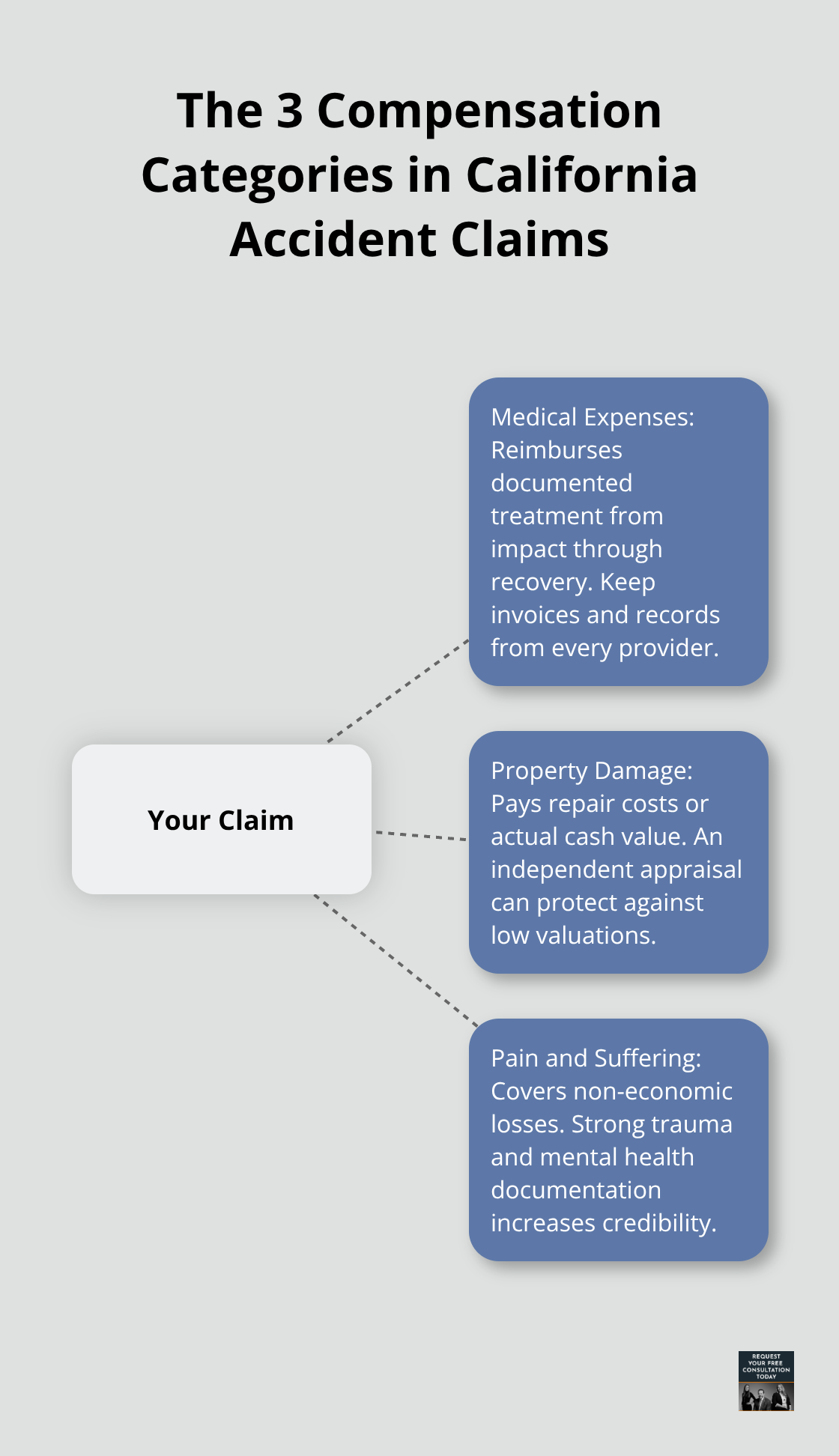
California law ties your compensation to three distinct categories, and understanding each one prevents you from leaving money on the table. Medical expense coverage reimburses documented treatment costs from the moment of impact through your full recovery. Property damage claims compensate you for vehicle repair or replacement at actual cash value. Pain and suffering awards recognize the non-economic losses that medical bills don’t capture. The California Department of Insurance sets clear timelines for how insurers must handle your claim: acknowledgment within 15 days, investigation start within 15 days, response within 15 days, and settlement within 30 days after you accept an offer.
These deadlines matter because delays often signal a low-priority claim or an insurer testing whether you’ll accept inadequate compensation.
Medical Bills Require Meticulous Documentation
Medical bills demand meticulous documentation from day one. Collect invoices from Watsonville Hospital, Dominican Hospital, or any follow-up provider, including physical therapy, imaging, medications, and specialist visits. Your insurer will request proof of every expense, so organize these chronologically and cross-reference them with your medical records. For serious intersection crashes in Santa Cruz, where 14.7% result in serious injuries, your medical costs typically reach $15,000 to $25,000 for moderate-to-severe trauma. Medical lien services allow providers to place liens on your settlement, meaning you receive care without upfront bills and the provider recovers from your final award.
Property Damage Claims Hinge on Accurate Valuation
Property damage claims rest on the actual cash value calculation, which differs from what you paid for the vehicle. An independent appraiser determines fair market value by comparing your vehicle’s condition, mileage, and market data at the time of loss. If the insurer’s valuation seems low, you have the right to pursue a formal appraisal where both sides select an appraiser and an umpire whose decision becomes binding. California law requires you to report crashes with property damage over $750 to the DMV within 10 days, which creates official documentation your insurer will request.
Pain and Suffering Awards Require Strong Documentation
Pain and suffering awards remain the most contested category because they lack a fixed formula. Insurers often apply multipliers to medical expenses, typically 1.5 to 5 times the total medical bills depending on injury severity and liability clarity. In Santa Cruz’s high-risk intersections like Highway 1 and Highway 9, where fatality rates run 15.38% higher than comparable cities, your pain and suffering claim gains credibility through documented trauma treatment. Mental health documentation strengthens this category significantly: about 46% of crash victims experience panic attacks in the first week, 70% develop nightmares or sleep problems within the first month, and up to 32.3% develop PTSD within six months according to the American Psychological Association. Women face roughly 2.5 times higher PTSD risk, making trauma-focused therapy like cognitive behavioral therapy or EMDR particularly relevant for your claim.
Building Your Compensation Demand
When you compile your compensation demand, list all three categories separately with supporting documentation rather than presenting a single number. Insurers respect itemized claims backed by medical records, repair estimates, pay stubs, and therapy notes far more than round-number requests. The California Department of Insurance provides complaint assistance at 1-800-927-4357 if your insurer misses the statutory timelines or refuses reasonable compensation across any category. With proper documentation in place, you’re ready to navigate the actual claims process-a step that determines whether you receive fair compensation or settle for less than you deserve.
How to Handle Your Claim Step by Step
Act Immediately at the Accident Scene
The first 24 hours after a crash determine how strong your claim becomes. Call 911 immediately if anyone is injured, then move to a safe location and photograph the damage, road conditions, and surrounding area from multiple angles. Collect the other driver’s name, address, phone number, driver’s license number, license plate, and vehicle identification number before leaving the scene. If the other driver won’t provide information, leave a note with your contact details on their windshield and notify your insurer within 24 hours. California law requires you to report crashes with property damage over $750 to the DMV within 10 days, so obtain the police report number at the scene or contact the Santa Cruz Police Department afterward. This official documentation becomes the foundation of your claim because insurers verify accident details against the police report.
Notify Your Insurer Without Delay
Notify your insurance company immediately rather than waiting days, since the California Department of Insurance requires insurers to acknowledge claims within 15 days and initiate investigation within 15 days. A prompt call shows you’re serious about the claim and prevents your insurer from treating it as low-priority. Request written confirmation of all conversations with your insurance company rather than relying on phone calls alone, since written records protect you if disputes arise later. When your insurer requests a recorded statement, provide factual information about what happened but avoid speculation about injuries or liability, as insurers use recorded statements to limit payouts.
Build a Detailed Recovery File
Documentation separates victims who receive fair compensation from those who accept lowball offers. Maintain a detailed recovery file from day one containing the police report number, photos from the scene, medical records from Watsonville Hospital or Dominican Hospital, all repair estimates, pay stubs showing lost wages, and every communication with your insurer. Track when your insurer acknowledges receipt, initiates investigation, responds to your documentation, and makes a settlement offer. If your insurer misses these 15-day intervals without explanation, contact the California Department of Insurance at 1-800-927-4357 to file a complaint.
Challenge Low Property Damage Valuations
For property damage disputes, California law allows you to pursue a formal appraisal if you disagree with the insurer’s valuation. Each side selects an appraiser and an umpire whose decision becomes binding. This appraisal process prevents you from accepting an actual cash value that undervalues your vehicle based on faulty market comparisons. The California Department of Insurance sets clear timelines for claim handling, so your documentation file protects you throughout the process.
Final Thoughts
A Santa Cruz vehicle accident creates immediate pressure to make decisions while you’re recovering physically and emotionally. The steps outlined in this guide protect your rights at every stage: act quickly at the scene, notify your insurer within 24 hours, and document everything meticulously. California’s statutory timelines give you leverage-insurers must acknowledge claims within 15 days, investigate within 15 days, respond within 15 days, and settle within 30 days after acceptance.
Your compensation demand should itemize medical expenses, property damage, and pain and suffering separately rather than presenting a single number. This approach forces insurers to justify any reduction and prevents them from lumping categories together to minimize payouts. In Santa Cruz’s high-risk intersections where serious injuries occur 59.78% more frequently than comparable cities, your documentation of trauma treatment becomes particularly valuable for pain and suffering awards.
Professional legal guidance matters because accident victims often underestimate their claims or accept settlements that don’t cover long-term recovery costs. We at Schaar & Silva LLP help Santa Cruz County residents navigate property damage disputes, connect with medical lien services to cover bills during recovery, and address the emotional trauma that compounds physical injuries. Contact Schaar & Silva LLP to discuss your specific situation and ensure you’re not leaving compensation on the table.
