
Insurance claim denials happen more often than you’d think. After a car accident, you expect your insurance company to cover your damages and injuries. When they reject your claim instead, it feels unfair and leaves you scrambling for answers.
We at Schaar & Silva LLP have helped countless people in Santa Cruz County, Sacramento, and Oakland fight back against wrongful denials. This guide walks you through why claims get rejected and what you can actually do about it.
Why Insurance Companies Reject Claims
Insurance companies reject car accident claims far more often than they should, and the reasons usually fall into a few predictable patterns.
Insufficient Medical Documentation
The most common culprit is insufficient medical documentation. If you wait more than 72 hours after your accident to seek treatment, insurers will use that delay against you, claiming your injuries weren’t serious enough to warrant immediate care. They’ll argue that any treatment you receive later stems from something unrelated to the crash. Seek medical attention within 24 hours of your accident-not just for your health, but for your claim.
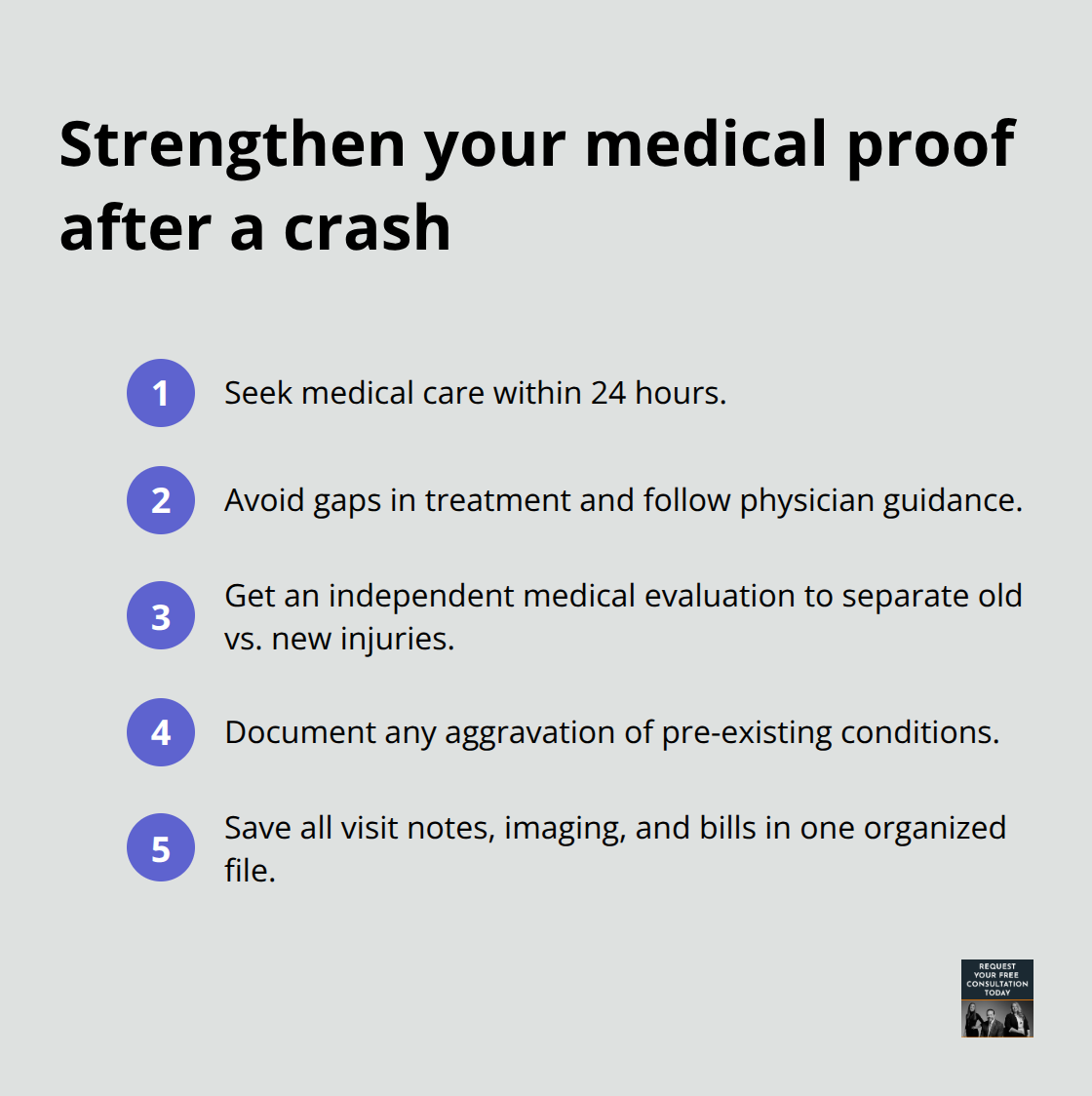
Your medical records become the backbone of your case, and gaps in treatment give insurers easy ammunition for denial.
Insurers also scrutinize your entire medical history looking for pre-existing conditions. If you had a prior back injury and the accident aggravated it, the insurer may try to deny your claim entirely, even though California law allows you to recover for new or worsened injuries caused by the accident. An independent medical evaluation that clearly documents what the accident caused versus what existed beforehand will counter this tactic.
Coverage Lapses and Policy Exclusions
Coverage lapses and policy exclusions create another minefield. Many people don’t realize their coverage lapsed or that their policy limits don’t apply to their specific situation. If your policy wasn’t active at the time of the accident, the insurer has every right to deny you. If you were driving for commercial purposes but your policy excludes commercial use, denial follows. Review your entire policy-including limits, exclusions, and endorsements-to understand what actually applies to your accident.
Disputes Over Fault and Liability
Disputes over fault represent the third major rejection category, and this one stings because California’s comparative negligence rule means you can recover even if you’re partially at fault (your award just gets reduced by your percentage of blame). Yet insurers frequently deny claims outright by arguing you caused the accident, leaving you to prove otherwise. Police reports help, but witness statements and accident reconstruction reports carry more weight. An attorney can investigate the accident thoroughly, gather evidence the insurer overlooked, and build a factual case that counters their fault argument. The insurers banking on you not fighting back when they deny your claim are betting you’ll give up.
What to Do Immediately After Your Claim Gets Denied
Read the Denial Letter Word-for-Word
The denial letter arrives, and your first instinct might be to panic or give up. Don’t. That letter is actually your roadmap to fighting back, and the next 30 days are critical. Read the denial letter multiple times, paying close attention to the legal language insurers use to bury their reasons. Insurers must cite the specific policy provision they’re relying on and explain their factual findings. Write down exactly why they denied you-was it insufficient medical evidence, a coverage lapse, disputed liability, or something else?
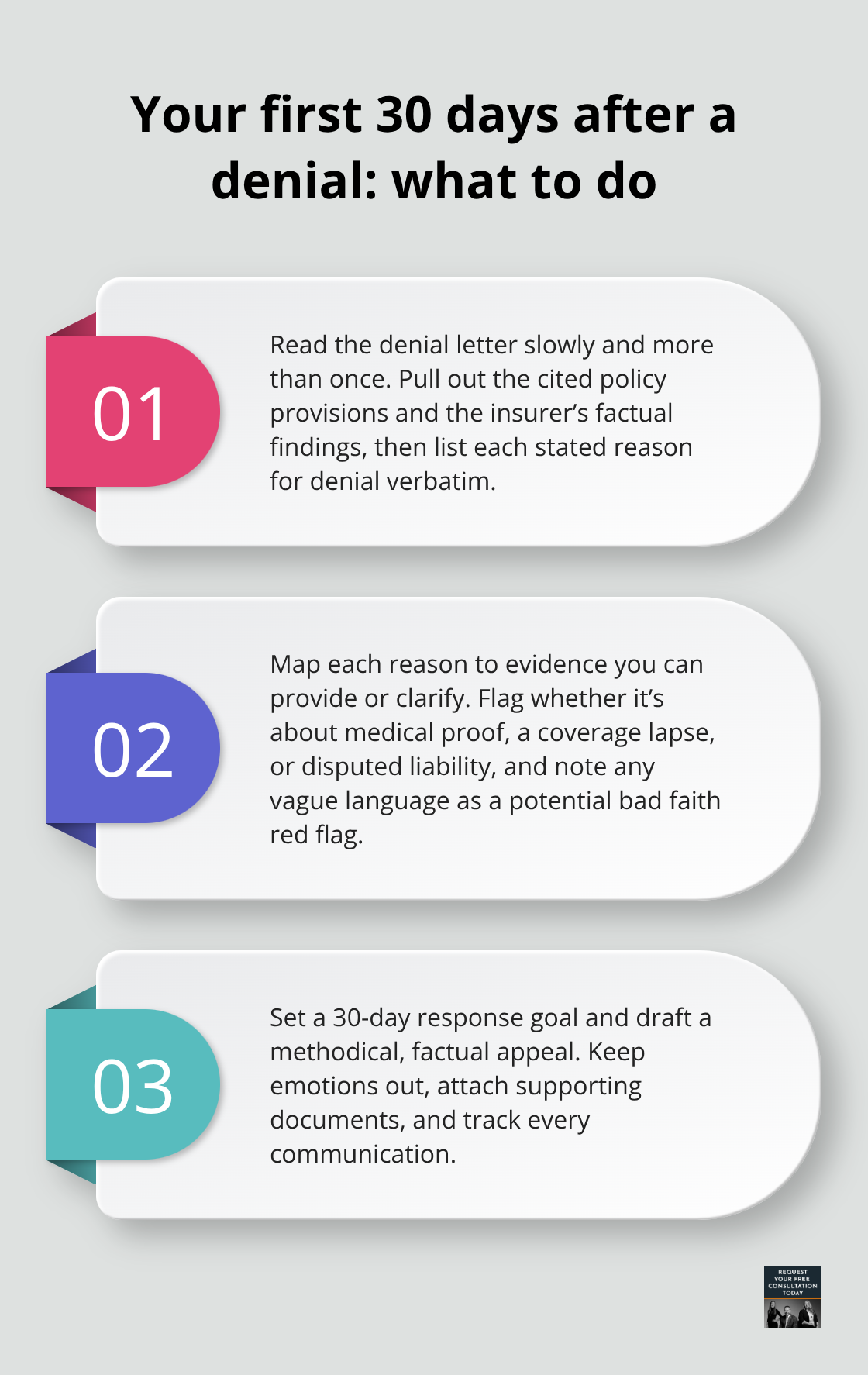
This specificity matters because your appeal will directly address each reason they listed. If the letter is vague or doesn’t cite actual policy language, that’s a red flag for bad faith, and you’ll want to document it.
Organize Your Documentation
Grab copies of everything: your policy, the denial letter, all correspondence with the insurer, medical records, accident photos, repair estimates, and the police report. Organize these chronologically in a single folder. This isn’t busywork-insurers count on claimants being disorganized and giving up when they can’t quickly find supporting documents. A well-organized file demonstrates that you take your claim seriously and makes it harder for the insurer to dismiss your appeal as incomplete or careless.
Gather New Evidence the Insurer Missed
Now gather evidence the insurer either missed or ignored. If you have witness contact information, reach out to them and ask for written statements about what they saw. If you haven’t obtained an independent medical evaluation, do it now. California courts and insurers take independent medical opinions seriously because they come from doctors with no financial stake in your claim. If your injuries worsened after the initial accident or if you discovered new injuries weeks later, medical records documenting that timeline carry significant weight. Accident reconstruction reports also hold substantial value, especially in fault disputes.
File Your Formal Appeal
File your formal appeal within 30 days if possible, though California law typically gives you longer. Address each denial reason point-by-point in writing, referencing the new or clarified evidence directly. Don’t be emotional or argumentative; be methodical and factual. If the insurer still refuses after your appeal, file a complaint with the California Department of Insurance. The department takes bad faith seriously, and an investigation can pressure insurers to reconsider.
Consider Legal Representation
At any stage, an attorney can strengthen your position enormously by handling communications, evaluating whether bad faith occurred, and preparing for litigation if necessary. The decision to pursue legal action depends on factors like the strength of your evidence, the insurer’s response to your appeal, and whether bad faith indicators exist in how the insurer handled your claim.
Fighting Back Against Your Insurer
How Legal Representation Changes the Dynamic
A denial letter doesn’t mean you’ve lost. You have concrete legal paths forward, and the sooner you act, the stronger your position becomes. When you hire an attorney, that person handles all communication with the insurer, which immediately shifts the balance in your favor. Insurers know that a represented claimant is far more likely to appeal, file complaints, or pursue litigation. They take your case more seriously the moment a lawyer enters the picture. Your attorney will review the denial letter against your actual policy language, identify weaknesses in the insurer’s reasoning, and determine whether their denial violates California law.
The Power of the Insurance Fair Conduct Act
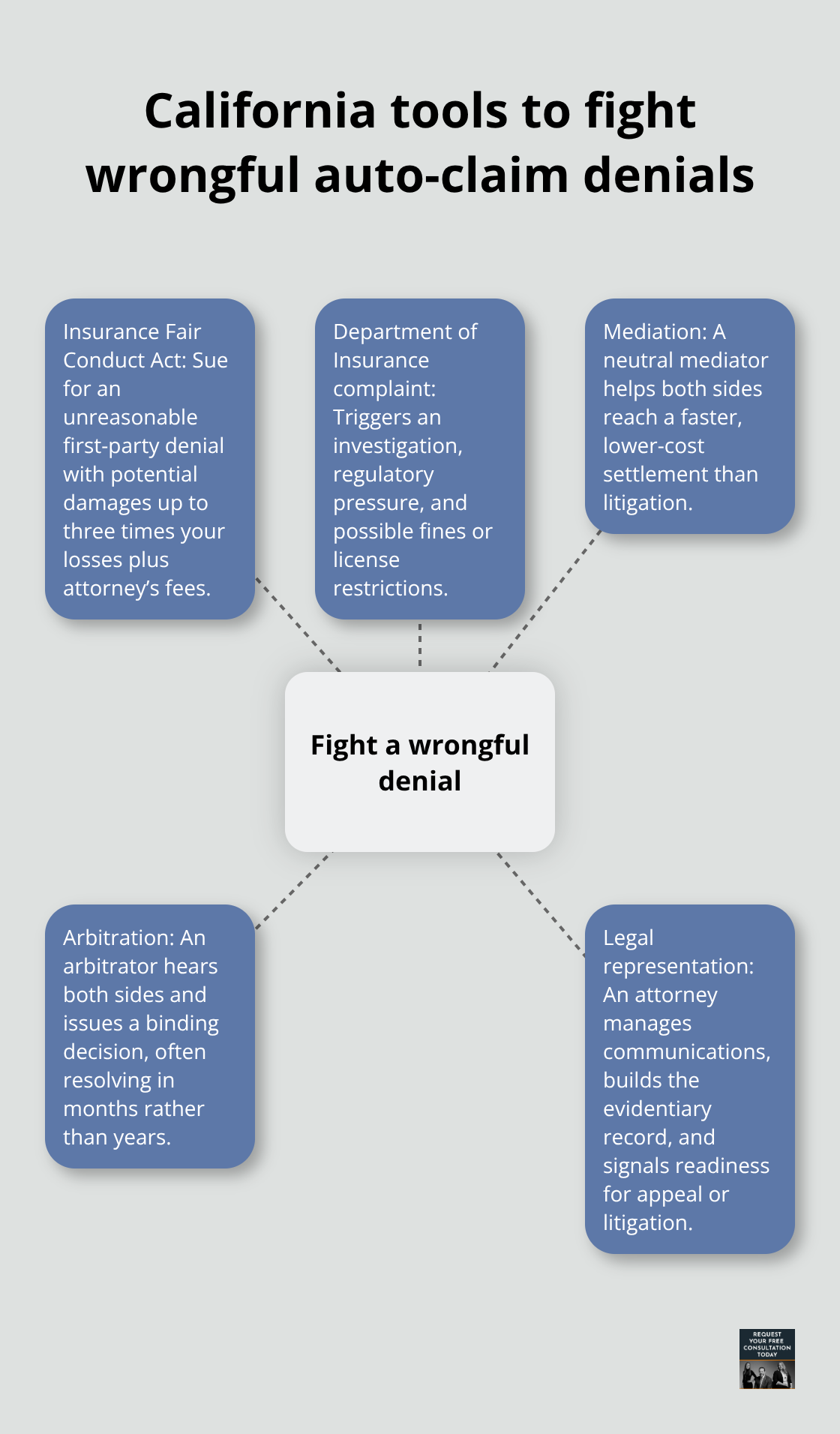
California law gives you real teeth to fight back, especially when insurers act in bad faith. The Insurance Fair Conduct Act allows you to sue an insurer for unreasonably denying a first-party claim, with potential damages up to three times your actual losses plus attorney’s fees. This isn’t theoretical-it’s a powerful incentive for insurers to reconsider denials when they lack solid justification. Many insurers will settle rather than face the exposure that comes with a bad faith lawsuit.
Filing a Complaint with the California Department of Insurance
If your internal appeal fails, file a complaint with the California Department of Insurance. The department investigates insurer conduct and takes bad faith seriously. When the department opens an investigation, insurers face regulatory pressure and the possibility of fines or license restrictions. This investigation often prompts insurers to settle rather than face public scrutiny and potential penalties.
Mediation and Arbitration as Faster Alternatives
Mediation and arbitration offer faster paths to resolution than litigation. In mediation, a neutral third party helps you and the insurer reach a settlement without going to court. Arbitration is more formal-an arbitrator hears both sides and makes a binding decision. Both processes cost less than litigation and move faster (typically resolving within months rather than years). The choice between these paths depends on your evidence strength, the insurer’s willingness to negotiate, and whether bad faith indicators exist in how they handled your claim.
Determining Your Next Move
An attorney can guide you through each option and recommend the approach most likely to recover your full compensation. The decision to pursue legal action depends on factors like the strength of your evidence, the insurer’s response to your appeal, and whether bad faith indicators exist in how the insurer handled your claim. In Santa Cruz County, the legal team at Schaar & Silva LLP stands ready to evaluate your case and determine whether an appeal, complaint, or litigation makes the most sense for your situation.
Final Thoughts
A car accident insurance claim denial feels like the end of the road, but California law protects you with real remedies and concrete options to recover what you’re owed. The Insurance Fair Conduct Act allows you to sue for bad faith denials, comparative negligence lets you recover even if partially at fault, and the California Department of Insurance investigates insurer misconduct. These aren’t theoretical protections-they’re tools you can use to fight back.
Your next steps depend on the strength of your evidence and the insurer’s willingness to negotiate fairly. If your appeal fails, file a complaint with the California Department of Insurance. If bad faith indicators exist in how they handled your claim, litigation becomes a viable path, and many insurers will settle once they realize you have legal representation backing your position.
We at Schaar & Silva LLP help people throughout Santa Cruz County, Sacramento, and Oakland recover compensation after wrongful denials. Contact us for a case evaluation to determine whether an appeal, complaint, or litigation makes sense for your situation.
