
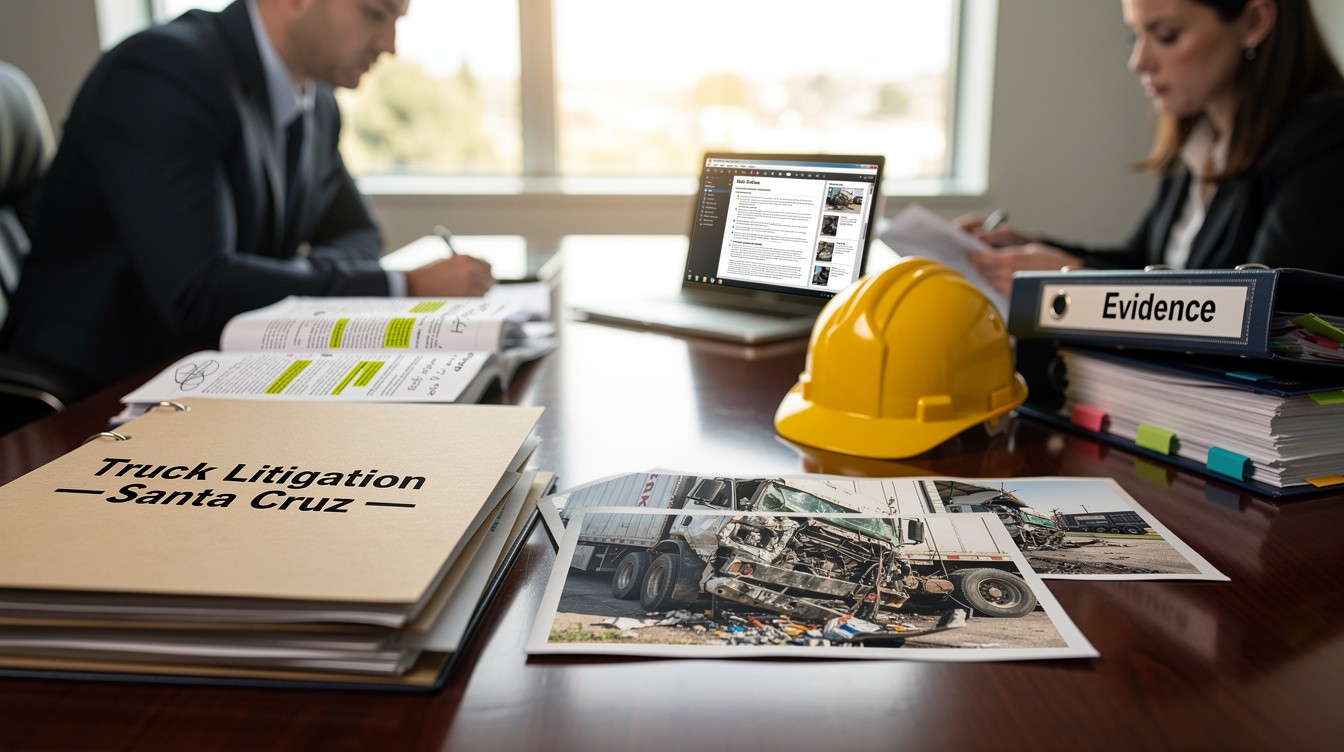
Truck accidents in Santa Cruz County often involve complex liability questions and significant damages. When you’re injured in a collision with a commercial vehicle, understanding your legal options becomes critical to recovering fair compensation.
At Schaar & Silva LLP, we help accident victims navigate truck litigation in Santa Cruz by gathering solid evidence, calculating what you’re actually owed, and building cases that hold responsible parties accountable. This guide walks you through the key steps to strengthen your claim.
Who Is Liable When a Truck Crashes in Santa Cruz
Multiple Parties Share Responsibility
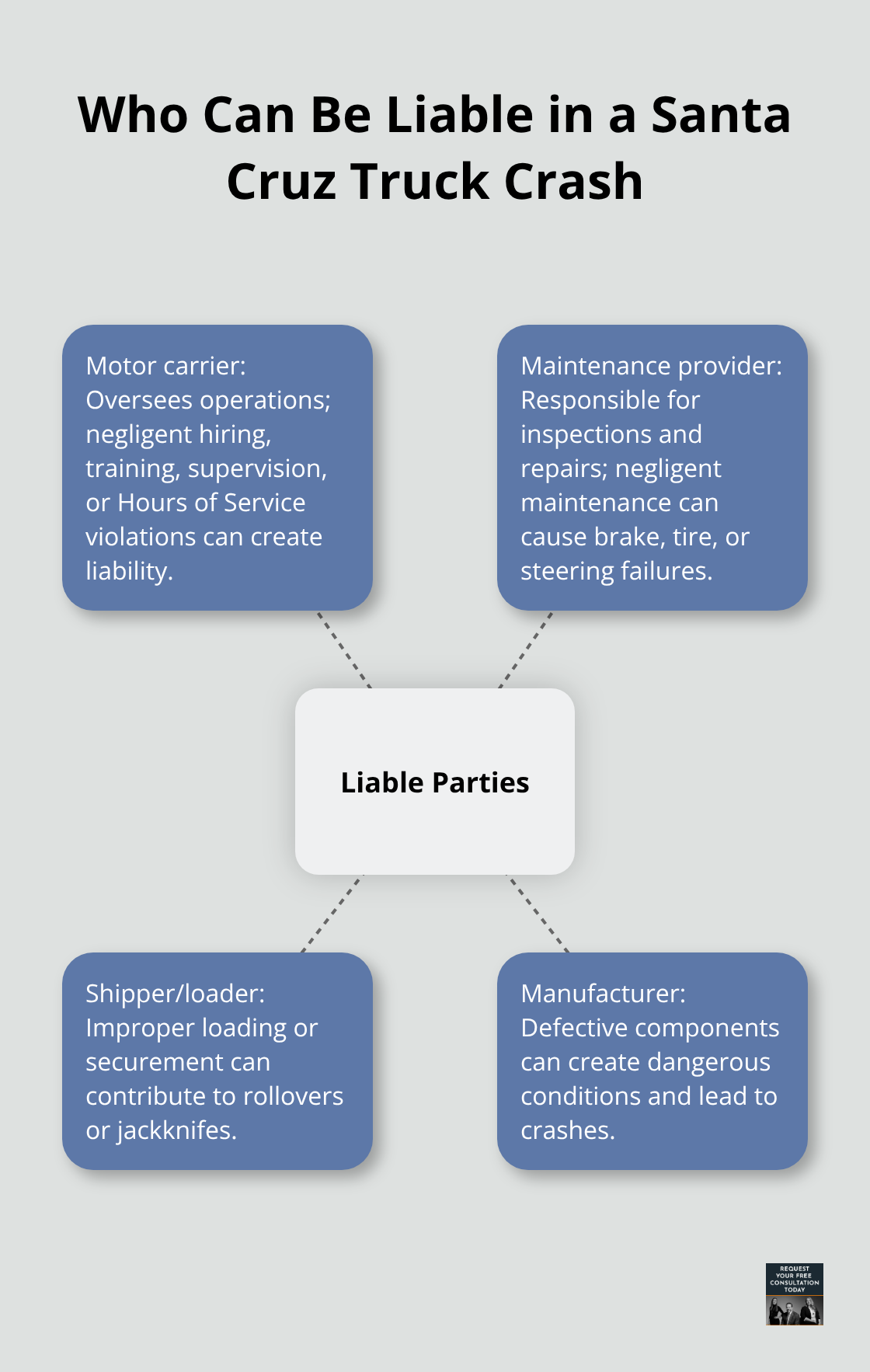
Truck accidents in Santa Cruz County rarely involve a single responsible party. Highway 17, Highway 1, and Highway 9 see frequent commercial vehicle collisions, and determining who bears liability requires understanding the unique regulatory framework that governs trucking operations. Multiple parties-the motor carrier itself, the maintenance provider, the shipper or loader, and sometimes the vehicle manufacturer-can all share responsibility for a single accident.
Hours of Service Violations and Driver Fatigue
Federal Hours of Service rules under 49 C.F.R. Part 395 restrict how long drivers can operate without rest, and violations of these requirements constitute negligence under California law. Since December 2017, most interstate trucks must use Electronic Logging Devices that automatically record driving time, engine hours, vehicle movement, and location data. This evidence showing whether a driver exceeded legal hours exists in digital form and can be retrieved if you act quickly. Driver fatigue from long hours and deadline pressure remains a leading cause of serious crashes, reducing reaction times and increasing multi-vehicle collision risk.
Maintenance Failures and Vehicle Defects
Truck maintenance failures-particularly brake, tire, and steering problems-often stem from cost-cutting practices that create dangerous conditions on steep grades. Federal regulations require regular inspections and maintenance; violations indicate negligent fleet practices and support liability claims. The mass of an 80,000-pound truck means greater crash forces and longer stopping distances, making errors far more dangerous than passenger vehicle mistakes.
Cargo and Loading Issues
Overloaded or improperly secured cargo degrades handling and increases stopping distance, raising the risk of rollovers or jackknives. Inadequate driver training leaves inexperienced operators unprepared for emergencies or Northern California terrain. California Civil Code §1714 imposes a duty of ordinary care on all drivers, informed by federal trucking regulations, so violations of Hours of Service rules or maintenance standards breach that duty and establish liability.
Maximizing Insurance Coverage Through Early Investigation
When you identify all potentially liable parties early, you maximize available insurance coverage beyond any single policy-federal regulations set minimum liability coverage at $750,000 for property-carrying interstate trucks, with hazmat carriers sometimes requiring up to $5 million depending on cargo. Critical documentation like maintenance records, inspection reports, and driver logs can disappear or be altered within weeks, so gathering evidence quickly becomes essential to preserving your claim.
What Evidence Matters Most in Your Truck Accident Claim
Act Fast to Preserve Critical Evidence
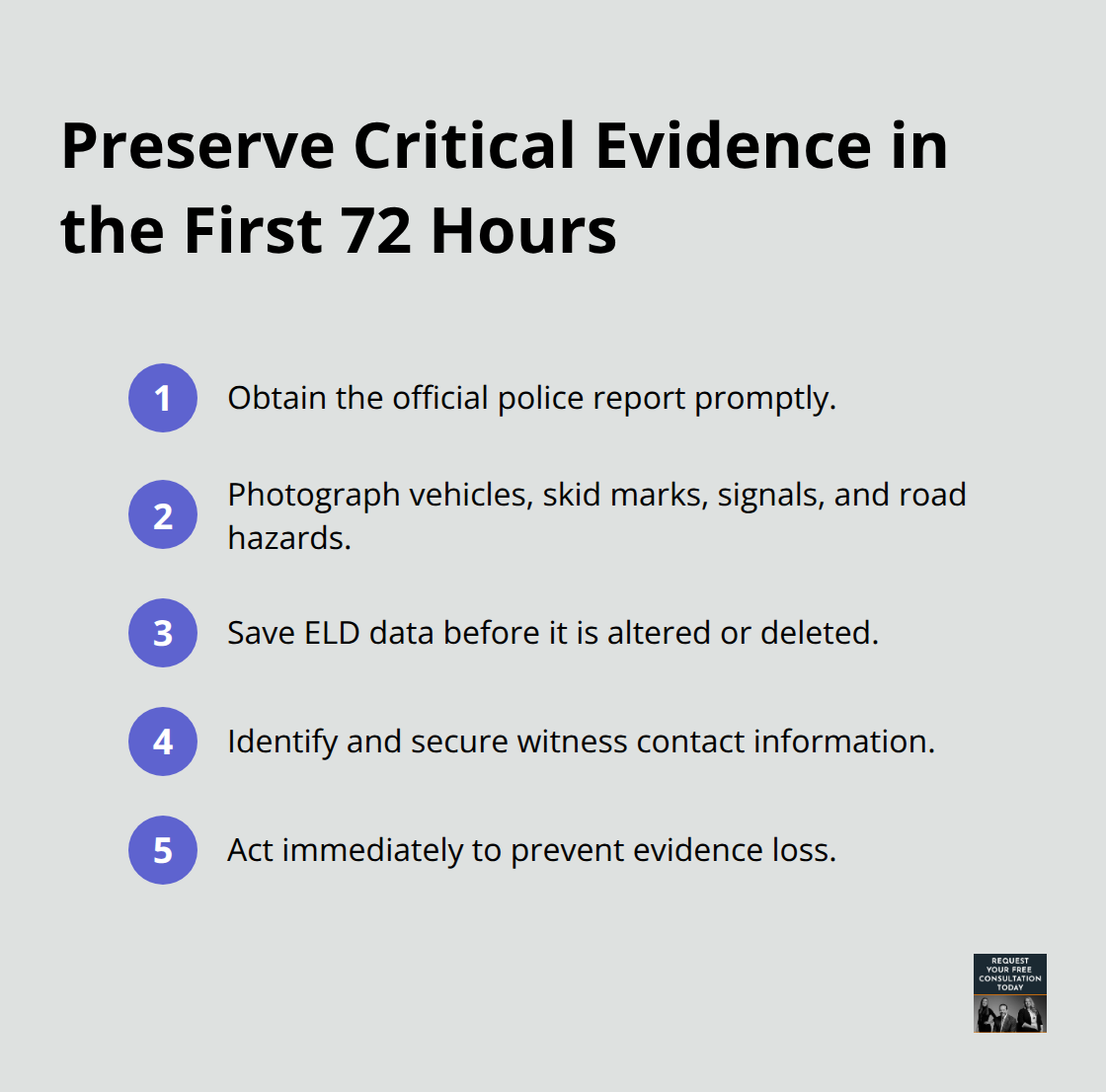
The first 72 hours after a truck collision determine whether your case succeeds or fails. Evidence disappears fast. Police reports get filed and archived. Accident scene photos fade from memory. ELD data sits on company servers, vulnerable to deletion or alteration.
Cases collapse when victims wait too long to gather documentation. Your immediate action directly impacts how much compensation you recover.
Start by obtaining the official police report from the Santa Cruz County Sheriff or local police department within two weeks of the accident. Request the full incident report, not just a summary, because it contains officer observations about road conditions, vehicle damage patterns, and statements from witnesses. Photograph everything at the scene if you’re physically able: vehicle positions, skid marks, traffic signals, road hazards, cargo spills, and license plates. These images establish the accident’s mechanics before investigators or insurance adjusters reshape the narrative.
Document Your Medical Treatment Thoroughly
Medical records demand equal urgency. You must document every treatment, from emergency room visits to follow-up appointments, physical therapy sessions, and imaging results like X-rays or MRIs. Insurance companies scrutinize gaps in treatment to argue your injuries weren’t serious. Request records directly from hospitals and clinics rather than relying on memory. Include receipts for medications, co-pays, and transportation to appointments because these constitute recoverable damages under California Civil Code §3283.
Obtain Maintenance Records and Driver Logs
The evidence that separates winning cases from losing ones lives in the truck’s maintenance history and the driver’s logs. Federal regulations require carriers to maintain detailed inspection reports, service records, and maintenance logs. Issue a litigation hold immediately to prevent spoliation of Electronic Logging Devices that record driving time, engine hours, vehicle movement, and location data. These ELDs, mandatory since December 2017 under 49 C.F.R. Part 395, prove whether the driver violated Hours of Service rules that restrict continuous driving to 11 hours per day.
Request the driver’s logbooks for the 30 days preceding the accident because fatigue patterns emerge from this data. Brake inspection reports matter because maintenance failures rank among the leading causes of commercial truck collisions. Tire condition records, steering system checks, and lighting inspections reveal whether cost-cutting created dangerous conditions on Santa Cruz’s steep grades.
Review Training Records and Safety Policies
Demand the carrier’s training records and safety policies to show whether inadequate driver preparation contributed to the crash. These documents establish whether the company failed to train drivers properly for Northern California terrain or emergency situations. Safety policy violations often indicate systemic negligence that extends beyond a single driver’s mistake.
Identify All Insurance Coverage and Liable Parties
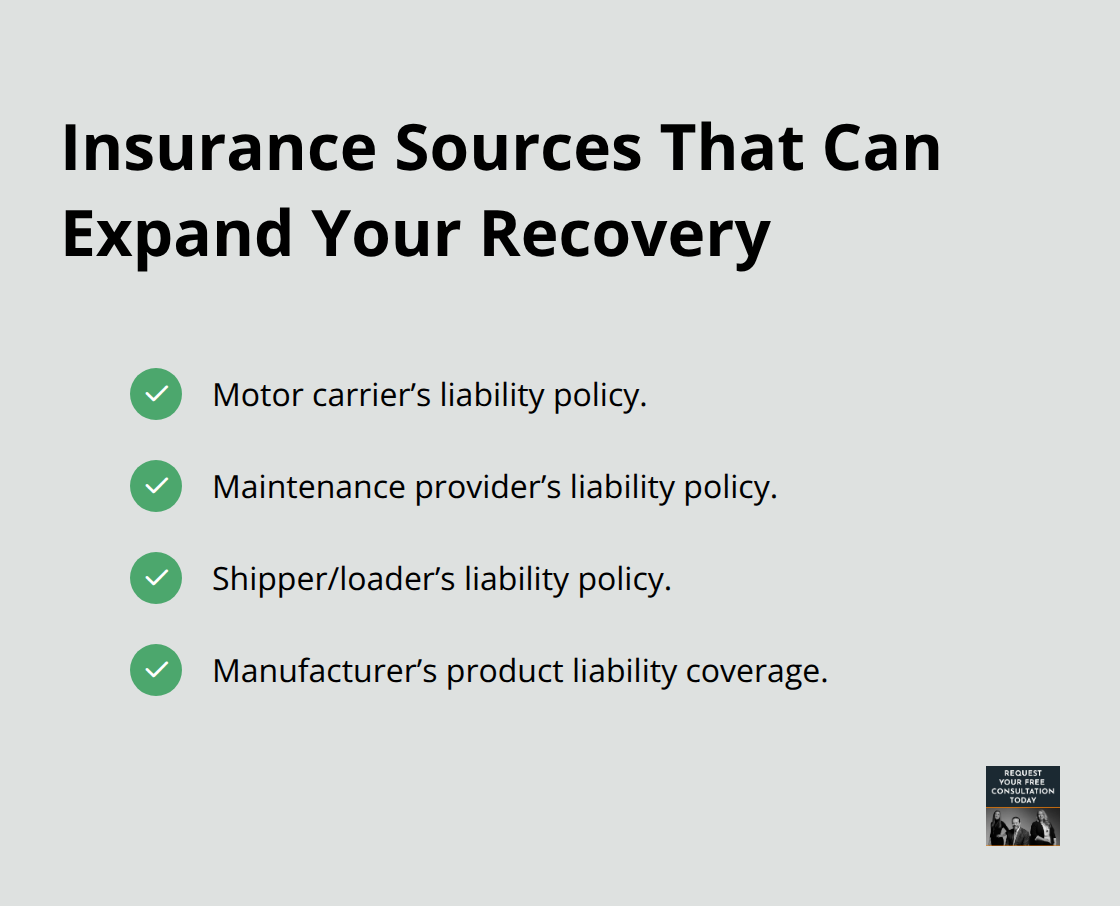
Insurance coverage documentation is equally critical. Federal minimum liability for property-carrying interstate trucks sits at $750,000, but many carriers carry higher limits. Identify all potentially liable parties-the motor carrier, maintenance provider, shipper, and manufacturer if applicable-because each carries separate insurance that expands available compensation beyond a single policy limit. Once you’ve gathered this evidence, the next step involves calculating what your injuries and losses actually cost.
What Your Truck Accident Claim Is Actually Worth
Medical Expenses Add Up Fast and Extend Into the Future
Calculating compensation in a truck accident case requires more than adding up medical bills. You need to account for every financial loss the collision created, plus damages for pain and suffering that courts recognize under California law. Most victims dramatically underestimate what they’re owed because they focus only on immediate expenses and ignore future costs that compound over years or decades.
Start with medical expenses, but think beyond the emergency room visit. Serious truck accident injuries average $50,000 to $100,000 in initial treatment costs, yet many victims stop calculating damages there. You must document every expense: ambulance transport, hospital admission, surgical procedures, imaging studies like CT scans or MRIs, medication costs, and ongoing physical therapy. California Civil Code §3283 allows recovery for future healthcare costs as well, which matters enormously in truck accidents because severe injuries often require lifetime care. If your collision caused spinal cord damage or traumatic brain injury, you’ll need future medical testimony projecting costs over your remaining lifespan. Neurosurgeons and rehabilitation specialists can quantify these projections, and courts accept them as recoverable damages.
Request itemized medical records from every provider immediately because gaps in documentation weaken your claim. Insurance adjusters exploit missing records to argue injuries weren’t serious.
Lost Wages and Reduced Earning Capacity Matter More Than You Think
Lost wages and earning capacity form the second major damage category, and this is where most victims leave substantial money on the table. Calculate not just the wages you lost during recovery, but also reduced earning capacity if your injuries prevent you from returning to your previous job. If you earned $65,000 annually as a construction worker before the accident and your back injury now limits you to sedentary work paying $35,000 annually, you’ve lost $30,000 per year in earning capacity. Over 30 years until retirement, that totals $900,000 in recoverable damages.
Vocational rehabilitation specialists can establish this loss by analyzing your pre-injury work history, education level, and post-injury physical capabilities. Tax returns and employment records document your actual earnings, which courts prefer over estimates. Self-employed victims must provide business tax returns showing income for the two years before the accident.
Pain and Suffering Compensation Reflects Your Actual Life Changes
Pain and suffering damages compensate for physical pain, emotional distress, and diminished quality of life. California courts don’t use formulas for these damages; instead, juries evaluate the nature and severity of your injuries alongside testimony about how the accident changed your daily life. Truck collision victims often suffer chronic pain, sleep disruption, depression, and anxiety that persist long after physical wounds heal. Medical records documenting treatment for these conditions strengthen your claim.
If you underwent surgery, spent weeks in the hospital, or required extended rehabilitation, document that timeline because severity justifies higher pain and suffering awards. Courts in Santa Cruz County have awarded pain and suffering damages ranging from $50,000 for moderate injuries to $500,000 or more for catastrophic injuries involving permanent disability. The key is connecting your medical treatment to specific limitations you now face: inability to work in your previous profession, lost recreational activities, damaged relationships, or permanent scarring.
Multiple Liable Parties Expand Your Total Recovery
Identifying all potentially liable parties and their insurance coverage directly impacts the total compensation available to you because each party carries separate policies that expand your recovery potential beyond any single limit. Federal minimum liability for property-carrying interstate trucks sits at $750,000, but many carriers carry higher limits. The motor carrier, maintenance provider, shipper, and manufacturer (if applicable) each carry separate insurance that increases available compensation. When you identify all responsible parties early, you maximize what you can recover from the full range of available coverage.
Final Thoughts
Truck litigation in Santa Cruz requires coordination across multiple professionals who each bring specific knowledge to your case. Accident reconstruction specialists analyze vehicle damage patterns, skid marks, and road conditions to establish how the collision occurred, while they examine Electronic Logging Device data, maintenance records, and driver logs to determine whether Hours of Service violations or mechanical failures contributed to the crash. Medical professionals document your injuries and project future treatment needs, providing testimony about severity and the likelihood of ongoing care requirements that directly support your damage calculations.
We at Schaar & Silva LLP coordinate these professionals on your behalf while handling the legal strategy that maximizes your recovery. We connect you with lien services that facilitate payment until your case resolves, evaluate property damage claims to verify fair valuation, and link you with psychological support specialists who address the emotional trauma that truck accidents create. Our team manages settlement negotiations with insurance carriers and prepares your case for trial if necessary.
Settlement discussions typically begin once evidence gathering is complete and damage calculations are finalized, though insurance adjusters will make initial offers that rarely reflect your actual losses. If settlement negotiations stall, your case proceeds to trial in Santa Cruz Superior Court, where a jury evaluates the evidence and determines liability and damages. Contact Schaar & Silva LLP today for a free consultation to discuss your truck litigation claim and learn how we can help you recover the compensation you deserve.