

Truck accidents create immediate chaos and uncertainty. The path from that moment to a settlement check involves multiple stages, each with its own timeline and requirements.
At Schaar & Silva LLP, we’ve guided countless clients through this process. Understanding what happens next-and when-helps you make informed decisions about your case.
What to Do First After a Truck Accident
The first 24 to 48 hours after a truck crash determine the strength of your case. Police reports filed immediately create an official record that insurers cannot later dispute, and photographs taken while the scene remains intact provide evidence that investigators cannot reconstruct from memory alone. Call 911 before moving vehicles if safety permits, then document everything: vehicle positions, road conditions, traffic signals, skid marks, and debris patterns. Get the truck driver’s name, commercial license number, carrier name, and insurance details. Obtain contact information from witnesses who saw the crash happen, not just bystanders who arrived afterward. Take photographs of all vehicle damage from multiple angles and wide shots showing the overall scene. If you suffer any physical pain, soreness, or visible injury, seek medical attention the same day, even if symptoms feel minor. Truck crash injuries often worsen over days or weeks as swelling increases and movement becomes painful. A medical record dated to the crash day establishes that your injuries resulted from the accident, not from a pre-existing condition. Report the crash to your own insurance company within the timeframe stated in your policy (typically within 30 days) and provide only factual information without admitting fault or speculating about liability.
Preserve Electronic Data and Physical Records
The truck’s electronic data recorder, driver logs, maintenance records, and onboard camera footage vanish quickly if not preserved. Send a spoliation letter to the trucking company and its insurance carrier within one week to demand preservation of all evidence. This letter creates a legal duty to retain records and prevents the carrier from claiming documents were routinely deleted. Request maintenance records, inspection reports, and service history for the truck involved. Your attorney can subpoena the driver’s logbook hours and dispatch records, which reveal whether the driver was fatigued or pressured to violate Federal Motor Carrier Safety Administration regulations. Scene photographs and surveillance footage from nearby businesses must be requested immediately because cameras often record over footage within 7 to 14 days. Medical records should be obtained directly from your healthcare providers, not from the insurance company, to prevent selective editing. Gather all receipts for medical treatment, transportation costs, lost wages, and household services you cannot perform due to injury.
What Happens Next in Your Claim
Once you have secured evidence and documented your injuries, the insurance claim process begins in earnest. Your attorney will coordinate with medical providers to obtain complete treatment records and will work with vocational rehabilitation experts to calculate lost earning capacity. The insurer will assign a claims adjuster to your case, and that adjuster will request additional documentation as the investigation proceeds. Understanding this next phase helps you prepare for the demands that follow.
Settlement Negotiation and Litigation Process
After your medical treatment reaches maximum medical improvement, the real negotiation begins. This stage typically spans 9 to 18 months from the time your attorney submits a formal written demand to the insurance carrier. The timeline depends heavily on insurer cooperation and liability clarity. Carriers responding cooperatively provide counteroffers within 30 to 60 days, but disputed liability or catastrophic injuries trigger independent medical examinations that extend timelines significantly.
How Insurers Delay and Obstruct
Bad faith delay tactics are common in truck crash cases. Insurers submit token offers or repeatedly request documentation already provided, pushing cases toward litigation. Your demand package must be comprehensive and unassailable, including medical records, billing documentation, accident reconstruction findings, FMCSA compliance violations, lost earning capacity projections from vocational experts, and a detailed 20 to 50 page liability and damages analysis. Insurance coverage layering across primary, umbrella, excess, and cargo policies adds complexity because each layer triggers differently and requires separate negotiation. Mapping all available coverage upfront prevents surprises later when settlement amounts exceed primary limits.
What Happens When Carriers Refuse Fair Offers
If the carrier denies reasonable settlement demands or submits insulting counteroffers, your case moves into formal discovery. Written discovery exchanges typically consume 3 to 6 months as both sides request documents, interrogatories, and admissions. Depositions follow over another 3 to 6 months, where witnesses and experts answer questions under oath recorded by court reporters. Expert reports on causation, future medical care, and economic damages require 2 to 4 additional months.
Mediation and Trial Preparation
Mediation often occurs before trial and resolves a significant percentage of truck accident cases when strong evidence collection and complete demand packages create settlement leverage. If mediation fails, trial preparation begins, with California Superior Court timelines averaging 18 to 30 months from complaint filing to verdict in Los Angeles and other major jurisdictions. Trials themselves last 1 to 3 weeks depending on injury severity and number of defendants. Settlement speed accelerates when the statute of limitations deadline approaches, forcing insurers to make serious offers rather than risk judgment at trial. As your case progresses through these phases, understanding the factors that control your timeline becomes essential to protecting your recovery.
What Really Controls Your Settlement Timeline
Injury Severity and Maximum Medical Improvement
Injury severity dominates the settlement timeline more than any other factor. Maximum medical improvement, or MMI, is the point when your condition stabilizes and doctors can accurately project future care costs. Cases with catastrophic injuries often take 12 to 24 months to reach MMI, which means no realistic settlement demand can be submitted until that documentation exists in writing from your treating physicians. Minor injuries settle faster because MMI arrives in weeks or months, but fast settlements are almost always undervalued because future complications and long-term treatment needs remain unknown.
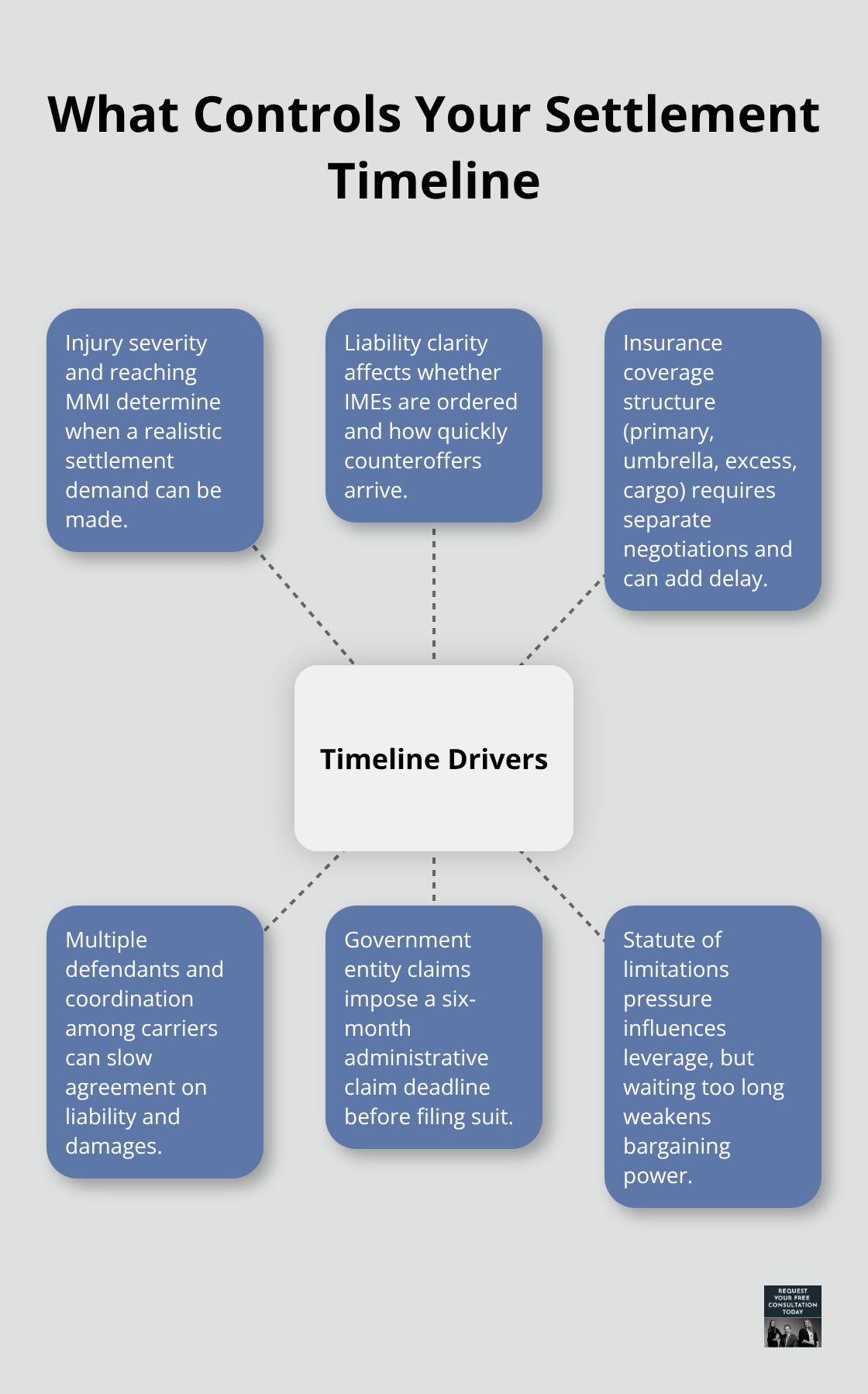
Settling before MMI is a mistake, no matter how tempting an early offer appears. Accepting compensation before your medical condition stabilizes risks permanent undercompensation if conditions worsen or additional surgeries become necessary. The statute of limitations gives you two years to file a personal injury lawsuit in California, but waiting until the deadline approaches is equally problematic because settlement leverage disappears when insurers know you have no time left.
Liability Clarity and Insurance Coverage Structure
Liability clarity and insurance coverage structure control the second and third major timeline factors. When liability is disputed, the insurer demands independent medical examinations that consume 60 to 90 additional days and shift settlement pressure away from the carrier. Clear liability cases with cooperative insurers generate counteroffers within 30 to 60 days, but catastrophic injuries or multiple defendants extend negotiations significantly.
Insurance coverage layering across primary, umbrella, excess, and cargo policies creates complexity because each layer triggers under different conditions and must be negotiated separately. A case with $500,000 in primary coverage but $5 million in umbrella limits requires mapping all available funds upfront to avoid leaving recovery on the table. Each party’s insurance carrier moves at different speeds, and settlement cannot occur until all responsible parties agree on liability allocation and damages division.
Government Entity Claims and Administrative Deadlines
Cases involving government entities trigger different timelines entirely. Administrative claims must be filed within six months under California Government Code section 945.4 before any lawsuit can proceed, which compresses your negotiation window dramatically. This compressed timeline forces faster action and requires immediate attention to preserve your rights.
Final Thoughts
A truck crash settlement timeline typically spans 12 to 24 months for straightforward cases, though catastrophic injuries or disputed liability can extend timelines to 18 to 30 months or longer. The most critical factor controlling your timeline is reaching maximum medical improvement, the point when your condition stabilizes and doctors can accurately project future care costs. Settling before MMI arrives almost always results in undercompensation because additional treatments or complications may emerge after you accept a settlement check.
Settlement offers arrive in stages as your case progresses through investigation, demand submission, and negotiation. After you file your claim and document injuries, the insurance adjuster begins investigation within the first month. If liability is clear and injuries are minor, a preliminary offer may arrive within 3 to 6 months, but this early offer rarely reflects full value. Serious settlement negotiations begin only after your attorney submits a comprehensive demand package that includes medical records, expert reports on future care costs, accident reconstruction findings, and FMCSA compliance violations. Cooperative insurers respond with counteroffers within 30 to 60 days, but bad faith delay tactics are common, pushing cases toward litigation and extending timelines significantly.
The statute of limitations gives you two years to file a personal injury lawsuit in California, but waiting until the deadline approaches weakens your negotiating position. Filing a protective lawsuit before the deadline expires maintains settlement leverage while preserving your right to sue. If you’ve been injured in a truck crash in Santa Cruz County, contact us for a free consultation to discuss your truck crash settlement timeline and recovery options.
