

Truck accidents in California leave victims facing medical bills, lost income, and life-altering injuries that standard car crashes rarely cause. The stakes are higher because trucks weigh up to 80,000 pounds and operate under federal regulations that create unique liability questions.
At Schaar & Silva LLP, we’ve helped accident victims navigate truck accident claims and recover the compensation they deserve. This roadmap walks you through damages, settlements, and the steps needed to build a strong case.
Why Truck Accidents Demand Different Legal Strategies
Truck accidents operate under a completely different legal framework than standard car crashes, and this distinction directly affects how much compensation you can recover. The Federal Motor Carrier Safety Administration sets strict standards that go far beyond what applies to passenger vehicles. Drivers cannot operate more than 11 hours after 10 hours off within a 14-hour window, and violations of these Hours of Service rules create presumptive evidence of negligence under federal law. This means if a truck driver violated these rules before hitting you, the liability case becomes substantially stronger without requiring as much investigation into what the driver was thinking.
Electronic Data Preserves Objective Evidence
Electronic Logging Devices record speed, braking patterns, and hours worked automatically, and this data typically only stays on the truck for about 30 days unless legally preserved. Sending a preservation letter immediately after a crash is not optional-it’s the difference between having objective proof and losing it forever. Maintenance violations matter equally. Federal regulations require documented brake inspections and timely repairs, so if a truck’s brakes failed because the carrier ignored maintenance logs, you have a direct path to establishing liability that doesn’t exist in typical car accidents.
Injury Severity Tells a Different Story
Truck crashes produce injuries that are fundamentally more severe than standard auto accidents. A fully loaded 18-wheeler weighs up to 80,000 pounds compared to a passenger car at around 3,500 pounds, which means the force involved is incomparably greater. Victims in Santa Cruz County and surrounding areas face higher rates of spinal injuries, traumatic brain injuries, and permanent disability from truck collisions. These injuries translate to substantially larger settlement values-herniated discs with surgery routinely settle between $200,000 and $750,000 in California truck cases, while the same injury from a passenger car might settle at half that amount due to the reduced injury severity and smaller available insurance limits.
Multiple Liable Parties Expand Your Recovery Options
Truck accident claims complicate when multiple parties bear responsibility, but this also expands your recovery options. The truck driver, the carrier, maintenance contractors, cargo handlers, and sometimes manufacturers all bear potential liability depending on what caused the crash. A cargo handler who improperly loads freight (creating an unsafe weight distribution that leads to a rollover) means you have a claim against that handler’s employer in addition to the trucking company. This multiplicity of defendants means investigating port documentation, dispatch records, and loading procedures becomes essential to maximizing your recovery.
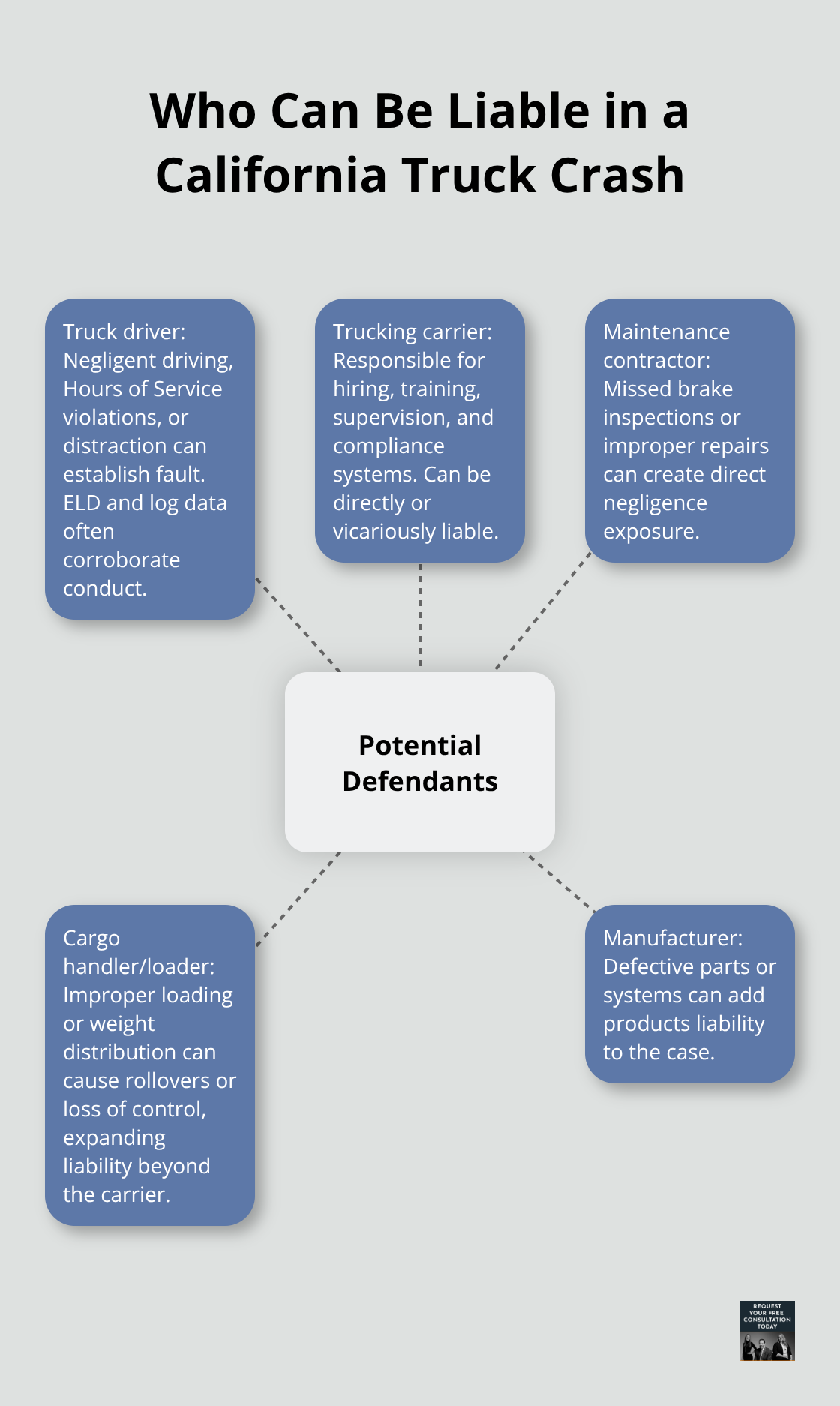
Understanding which parties bear responsibility requires careful analysis of how the accident occurred and what violations or failures contributed to your injuries.
What Compensation Can You Actually Recover After a Truck Accident
Economic Damages: Medical Bills, Lost Wages, and Property Damage
Truck accident settlements in California break down into three distinct categories, and understanding what falls into each one directly affects how much money you recover. Economic damages cover tangible, measurable losses: medical bills, lost wages, and property damage to your vehicle. These are straightforward to calculate because they have receipts and documentation. A herniated disc requiring surgery in a truck accident can generate medical costs between $100,000 and $300,000 just for the surgical procedure alone, plus another $5,000 to $30,000 annually for ongoing pain management. If you miss six months of work due to recovery, that lost income gets added to your claim.
Non-Economic Damages: Pain, Suffering, and Loss of Life Quality
Non-economic damages are where settlements expand significantly, and this is where most victims leave money on the table. Pain and suffering, emotional distress, and loss of enjoyment in daily life have no receipt, but California courts allow substantial awards for these losses. The multiplier method, which many insurers use, calculates non-economic damages by multiplying your economic damages by 1.5 to 5 times depending on injury severity. A victim with $200,000 in medical bills and lost wages from a herniated disc could reasonably expect $300,000 to $1,000,000 in pain and suffering damages. Truck crashes produce chronic pain and mobility restrictions that fundamentally alter how people live, and California recognizes this through generous non-economic damage awards.
Punitive Damages for Gross Negligence and Reckless Conduct
Punitive damages stand apart because they punish the defendant rather than compensate you, and they apply only when the truck carrier or driver acted with gross negligence or intentional misconduct. If a trucking company knowingly hired a driver with a suspended commercial license, ignored required maintenance inspections for a year, and dispatched the truck despite safety violations, that combination demonstrates reckless disregard for public safety. Punitive damages in truck cases have reached into the millions when evidence shows systematic negligence rather than isolated mistakes.
Settlement Ranges and the Factors That Drive Them
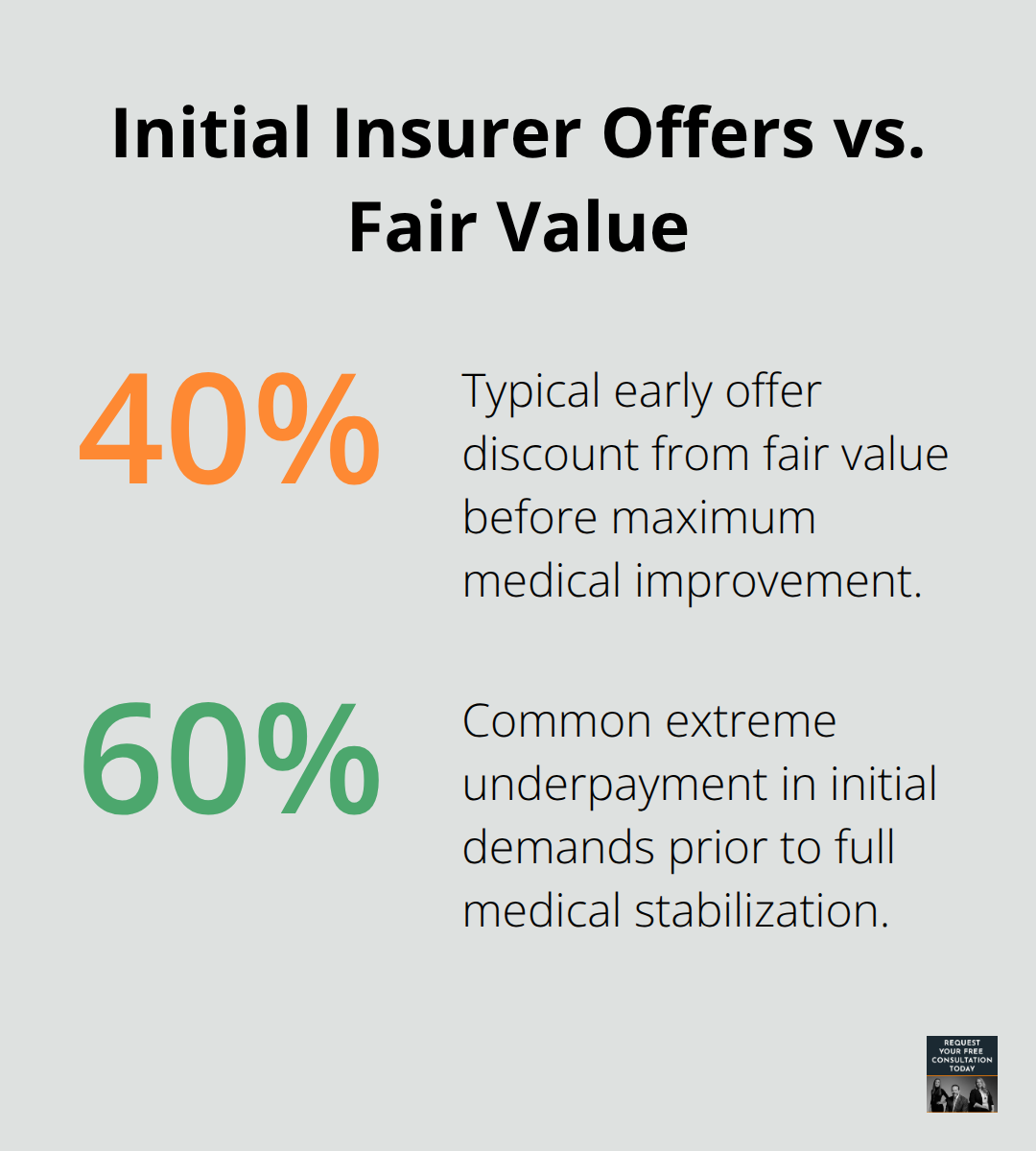
The practical reality is that most truck accident settlements fall between $200,000 and $750,000 for serious injuries like herniated discs, with cases involving spinal fusion or permanent nerve damage regularly exceeding $1,000,000. Settlements depend heavily on four factors: the severity of your injury confirmed by MRI or CT imaging, the intensity and duration of your medical treatment, the clarity of liability evidence, and the insurance limits available. A case with disputed liability where you were partially at fault reduces settlement value by your percentage of responsibility under California’s pure comparative negligence rule. The difference between settling too quickly and waiting until maximum medical improvement can be hundreds of thousands of dollars, because insurers routinely offer 40 to 60 percent less than fair value in initial settlement demands before your medical condition has stabilized.
How Liability and Insurance Limits Shape Your Recovery
The strength of your liability case directly determines whether you recover the full value of your damages or face significant reductions. Clear evidence of federal Hours of Service violations, maintenance failures, or improper cargo loading strengthens your position substantially. Insurance limits also matter-a truck carrier with $1,000,000 in coverage cannot pay a $2,000,000 settlement, which is why identifying all liable parties (the driver, the carrier, maintenance contractors, and cargo handlers) becomes essential. Multiple defendants with separate insurance policies expand the total recovery available to you. Understanding which parties bear responsibility requires careful analysis of how the accident occurred and what violations or failures contributed to your injuries, which then determines what evidence you need to gather and what settlement demands you can reasonably make.
Building Your Truck Accident Claim
Act within 24 hours of a truck accident because evidence disappears quickly. Police reports, eyewitness statements, and scene photos fade in value as time passes, and Electronic Logging Device data vanishes entirely within 30 days unless legally preserved. Send a preservation letter immediately to the trucking company demanding they retain all ELDs, maintenance records, cargo documentation, and dispatch logs. This single step prevents spoliation claims later and forces the carrier to acknowledge they received notice. Photograph the accident scene from multiple angles, capture the truck’s license plate and company markings, and collect contact information from anyone who witnessed the crash.
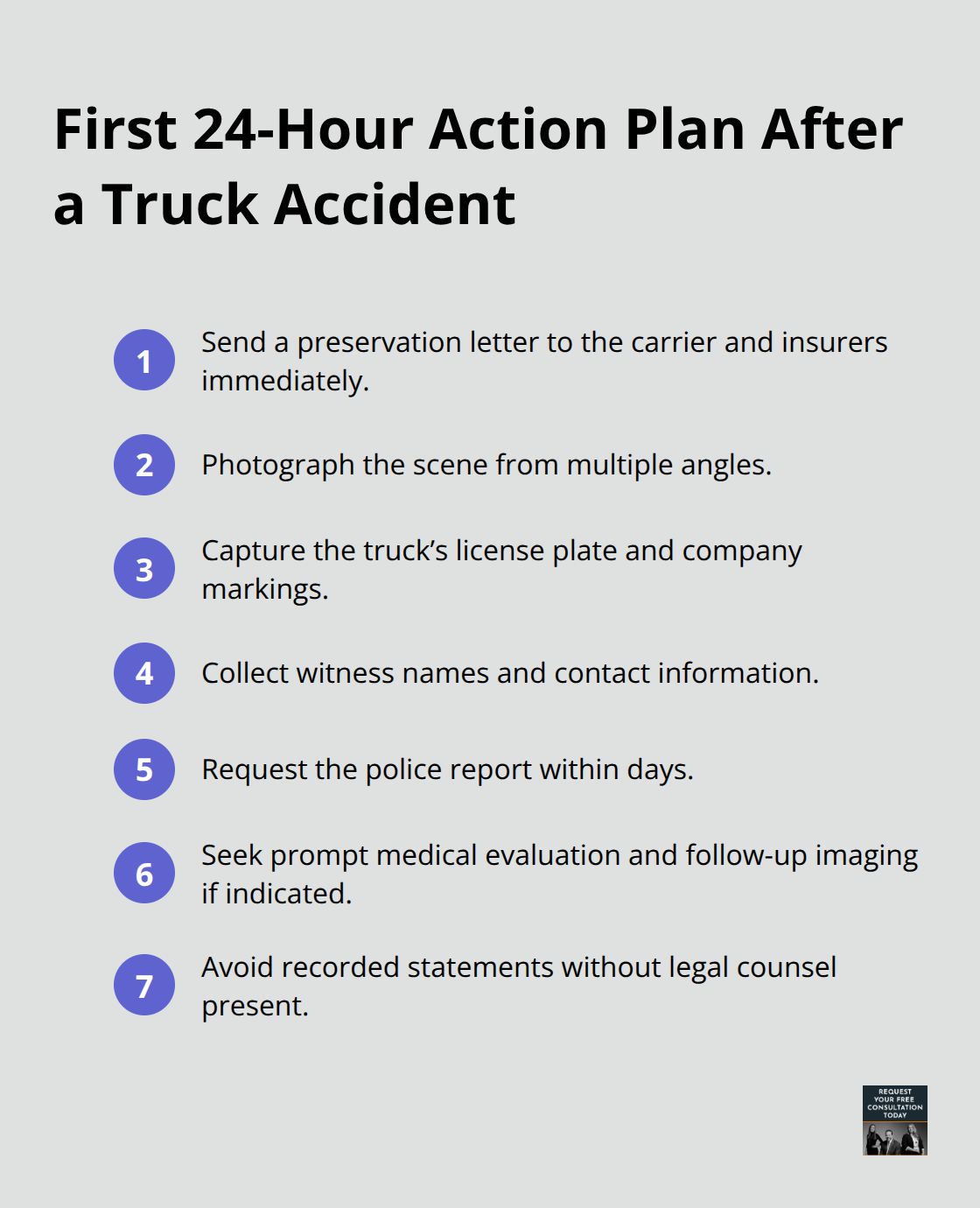
Request the police report within days, not weeks, because details become unreliable after time passes.
Preserve Evidence Before It Disappears
The preservation letter stands as your most powerful tool in the first hours after a crash. Send it to the trucking company, their insurance carrier, and any other potentially liable parties before 24 hours pass. This letter legally obligates them to retain Electronic Logging Devices, maintenance records, cargo documentation, dispatch logs, and driver qualification files. Failure to preserve evidence after receiving notice creates sanctions and strengthens your liability case substantially. Photograph the accident scene from multiple angles, capture the truck’s license plate and company markings, and collect contact information from anyone who witnessed the crash. Request the police report within days, not weeks, because details become unreliable after time passes.
Obtain Maintenance Records and Driver Qualifications
Maintenance records reveal whether the carrier performed required brake inspections and repairs. Federal regulations mandate documented inspections, so gaps in maintenance logs directly establish negligence. Request the driver’s logbook or ELD data showing hours worked before the crash. Hours of Service violations create presumptive evidence of negligence under federal law, meaning you don’t need to prove the driver was tired-the violation itself proves negligence. Collect cargo loading documentation and weight records to determine if improper loading contributed to a rollover or loss of control. Port records in Santa Cruz County operations often reveal whether dispatch occurred under unsafe conditions or whether tight delivery timelines pressured the driver into violations. Ask for the driver’s qualification file, which must include a valid commercial driver’s license, medical certification, and hazmat endorsements if applicable. Missing or invalid qualifications mean the carrier bears direct liability regardless of what happened during the crash itself.
Document Medical Treatment and Build Settlement Value
Seek medical care immediately even if you feel fine, because injuries like herniated discs and spinal cord damage develop over hours or days. MRI or CT imaging confirmation matters enormously-settlements for bulging discs without imaging average $30,000 to $100,000, while the same injury confirmed by MRI averages $75,000 to $350,000. Follow your treatment plan completely and attend every appointment because gaps in treatment reduce settlement value. Insurance companies argue that missing appointments means you weren’t seriously injured, so consistency matters. Document everything: keep receipts for all medical bills, maintain a daily pain journal describing how injuries affect work and daily life, and save wage loss documentation from your employer. Medical costs directly influence settlement value-a herniated disc with epidural injections ($5,000 to $20,000 per injection) and physical therapy ($5,000 to $25,000) builds a foundation for higher non-economic damages. Treating physicians provide testimony about injury severity and future treatment needs, which significantly influences settlement negotiations. Avoid recorded statements to insurance adjusters without counsel present, because statements made before maximum medical improvement often understate injury severity and get used against you in settlement negotiations.
Final Thoughts
Truck accident claims in California demand immediate action because federal regulations, severe injuries, and multiple liable parties create substantially higher settlement values when you act fast. Insurance companies deploy tactics specifically designed to minimize your claim by labeling injuries as non-serious, blaming pre-existing conditions, or pressuring quick settlements before your medical condition stabilizes. The difference between handling your case alone and working with legal representation often exceeds hundreds of thousands of dollars because carriers understand that most victims lack the resources to preserve Electronic Logging Device data, interpret maintenance violations, or identify secondary liable parties like cargo handlers or maintenance contractors.
Medical care comes first after a truck accident, but evidence preservation must happen simultaneously because the window for securing critical data closes within days. Acting within 24 hours to send a preservation letter, photograph the scene, and collect witness information separates victims who recover fair compensation from those who accept inadequate settlements. Most truck accident victims in Santa Cruz County, Sacramento, and Oakland leave significant money on the table by settling too quickly or failing to identify all responsible parties before negotiations begin.
We at Schaar & Silva LLP help accident victims navigate these complexities by securing evidence, analyzing federal compliance violations, and building settlement demands backed by objective data rather than estimates. If you’re facing medical bills, lost wages, or uncertainty about your claim’s value, contact us to discuss your situation. We serve Santa Cruz County and surrounding areas, and we work on contingency, meaning you pay nothing unless we recover compensation for you.
