
Truck accidents in California cause serious injuries and complex legal battles. At Schaar & Silva LLP, we’ve helped countless victims navigate truck accident litigation California and recover the compensation they deserve.
This guide walks you through every stage of the process, from protecting evidence at the scene to preparing for trial. You’ll learn what negligence means in truck cases and how federal regulations strengthen your claim.
Immediate Steps to Take After a Truck Accident
The first minutes after a truck accident determine whether you preserve evidence or lose it forever. Your priority is safety and medical care, but once you’re in a secure location, start documenting everything.
Document the Scene with Photos and Videos
Take photos and videos of vehicle positions, road conditions, traffic signals, weather, cargo spills, and visible damage from multiple angles. Capture the truck’s license plate, company name, and any logos. If dashcam footage exists from your vehicle or nearby businesses, note those locations immediately.
In 2026, electronic data from the truck’s event data recorder and electronic logging device will almost certainly exist, but physical scene evidence degrades quickly. Police reports filed at the scene create an official record, which strengthens your claim later. Call law enforcement and report the accident, then notify your insurance company promptly.
Limit Your Initial Statements
When you speak with law enforcement and insurers, stick to basic facts. Do not admit fault or speculate about what happened. Avoid discussing injuries in detail with the insurer, as their goal is to minimize payout, not to help you.
Gather Contact Information from Witnesses
Get names, phone numbers, and addresses from anyone who saw the accident. Ask witnesses to describe what they observed, and if possible, have them write a brief statement or record a video of their account. Photographs of witness statements add credibility later. Collect contact information from emergency responders and note the police report number.
Preserve Medical Records and Evidence
Keep all medical records and receipts from the day of the accident onward, including ambulance bills, emergency room visits, and follow-up appointments. Photograph your injuries as they develop over the following days and weeks. Store all documents in one secure location (a folder, cloud storage, or both works well).
Do not post anything about the accident on social media, as insurers and opposing counsel monitor these posts. Do not sign any settlement documents or medical authorizations without reviewing them carefully. If you have questions about what to sign, wait until you’ve consulted with a truck accident attorney.
Act Within California’s Time Limits
The statute of limitations in California gives you two years to file a personal injury claim, but evidence degrades and witness memories fade much faster. Contact an attorney early to preserve evidence and strengthen your position from day one. Understanding how negligence applies to your specific accident requires knowledge of California law and federal trucking regulations.
Understanding California Truck Accident Liability
How Negligence Works in Truck Cases
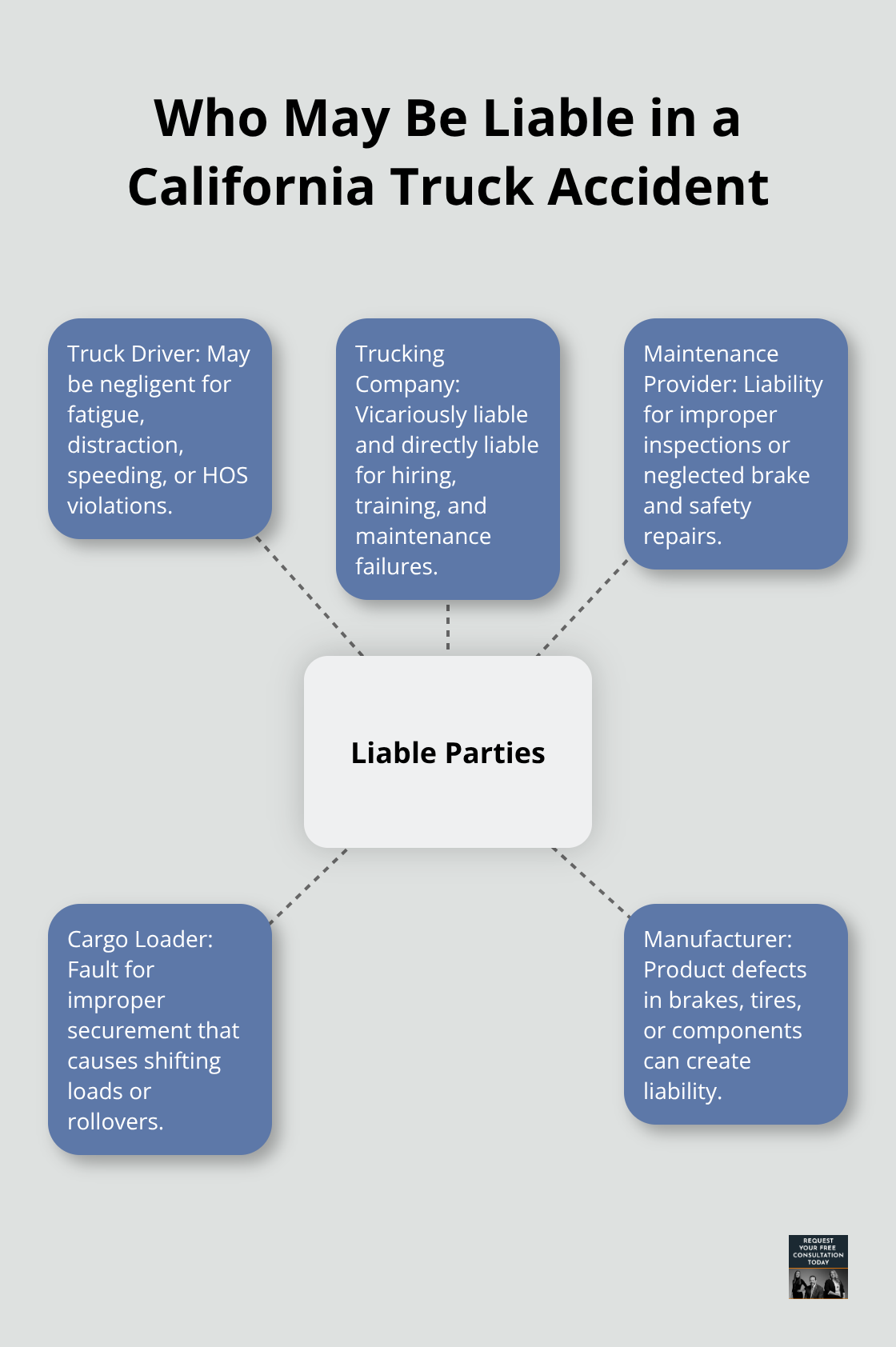
Negligence in California truck accidents requires proving four elements: the defendant owed you a duty of care, they breached that duty, their breach caused your injuries, and you suffered damages. In truck cases, this framework applies to drivers, trucking companies, maintenance contractors, and manufacturers. A truck driver who falls asleep at the wheel breaches their duty to operate safely. A trucking company that fails to maintain brakes breaches its duty through negligence. A cargo loader who secures freight improperly creates liability when cargo shifts and causes a rollover.
The key difference from standard car accidents is that truck negligence often involves multiple parties, and federal regulations establish baseline duties that go beyond state law. If a driver violates FMCSA hours-of-service rules and causes a crash, that violation provides strong evidence of negligence. Under California’s comparative negligence system, fault can be split among parties, and your recovery reduces by your percentage of fault. If you were 10% at fault, you recover 90% of damages.
Common Causes of Truck Accidents in California
Truck accidents in California happen most often from fatigue, improper cargo loading, mechanical failures, and distraction. NHTSA data show that jackknife collisions, underride crashes, and rollovers dominate serious truck incidents. These accidents stem from preventable failures: drivers who exceed safe hours, loaders who fail to secure cargo properly, and companies that skip maintenance inspections.
Federal and State Regulations Create Liability
Federal regulations address these risks directly. FMCSA hours-of-service rules limit drivers to 11 hours of driving within a 14-hour window. Mandatory electronic logging devices track compliance. Vehicle maintenance standards require regular brake inspections and cargo securement procedures. When a trucking company ignores these federal standards, they create liability not just under federal law but also under California Vehicle Code provisions on weight limits, driver qualifications, and safety standards.
A truck operating with failed brakes violates both federal maintenance rules and California safety codes, strengthening your negligence claim significantly. The interaction between federal and state law means that noncompliance with FMCSA rules does not shield a party from state liability; instead, it compounds liability. Insurance industry data for 2026 show that trucking companies face higher premiums and stricter underwriting, reflecting the rising costs of truck accident claims. This pressure on insurers translates to more aggressive defense tactics, making early involvement with a truck accident attorney essential to protect your interests.
Multiple Parties Share Responsibility
Truck accident liability rarely falls on a single party. The driver, the trucking company (under vicarious liability), maintenance providers, cargo loaders, and even manufacturers can all share fault. Thorough investigation identifies all liable parties and establishes their specific breaches of duty. This multi-party structure complicates claims but also expands your potential sources of recovery. The next phase of litigation-filing your claim and gathering evidence-requires understanding these liability layers and how they interact with California’s legal framework.
Moving Your Claim Forward
Act Quickly to Preserve Evidence
Filing a truck accident claim in California requires immediate action because the statute of limitations gives you only two years from the accident date to file a personal injury lawsuit. This deadline sounds distant until you realize that evidence deteriorates, witnesses become unavailable, and insurance companies use delay tactics to weaken your position. Contact an attorney within weeks of the accident, not months. Early involvement allows your legal team to send preservation notices to the trucking company, requiring them to retain the truck’s electronic logging device data, event data recorder information, dashcam footage, maintenance records, and driver logs. Without this notice, companies sometimes claim data was overwritten or lost.
Navigate the Insurance Claim Process Strategically
The insurance claim process begins when you notify your insurer, but do not accept their first settlement offer. Initial offers typically undervalue claims by 30 to 50 percent because insurers count on injured victims accepting quick payouts without understanding the full scope of their damages. Document every medical expense, lost wage, and transportation cost from day one. Keep receipts for medications, therapy sessions, and equipment like crutches or braces. Calculate future medical care by obtaining statements from your treating physicians about ongoing treatment needs. If your injuries prevent you from working long-term, have your employer document lost wages and lost earning capacity. Insurers scrutinize these figures, so precision matters.
Leverage Discovery to Expose Liability
Discovery phase begins after filing suit and involves exchanging evidence with the opposing party. Request the truck driver’s personnel file, training records, and prior accident history. Obtain the trucking company’s maintenance logs, which often reveal ignored safety violations. Pull the driver’s commercial driving license record and any violations recorded with the California Department of Motor Vehicles. Electronic data from the truck becomes central here: event data recorders capture vehicle speed, brake application, steering input, and seatbelt use in the seconds before impact. This data either supports or contradicts the defendant’s version of events.
Deploy Expert Witnesses to Strengthen Your Case
Expert witnesses strengthen your case significantly. Vehicle reconstruction experts analyze crash dynamics and determine fault based on physics and evidence. Medical experts quantify your injuries and project future treatment costs. Mechanics examine the truck for maintenance failures that contributed to the crash. These professionals ground their opinions in solid evidence, not speculation, and their testimony often proves decisive in settlement negotiations or at trial.
Prepare for Settlement or Trial
Settlement negotiations typically occur after discovery when both sides understand the evidence strength. Insurance adjusters will pressure you to settle quickly, but your attorney should counter with a demand letter backed by medical records, lost wage documentation, and expert reports. If the insurer’s offer falls short of your actual damages, trial becomes necessary. Trial preparation requires organizing evidence chronologically, preparing witnesses to testify clearly under cross-examination, and developing a narrative that walks the jury through negligence elements and damages systematically. Jury awards in California truck cases vary widely, but serious injury cases with clear liability often exceed insurance policy limits, making multi-party claims essential.
Final Thoughts
Truck accident litigation in California demands immediate action, thorough documentation, and strategic legal guidance. The steps you take in the first hours after a crash-photographing the scene, gathering witness statements, and preserving electronic data-directly determine whether you recover full compensation or accept an inadequate settlement. Negligence in truck cases involves multiple parties and federal regulations that standard car accident claims rarely encounter, making the legal landscape more complex but also expanding your sources of recovery.
Your claim’s success depends on understanding how California’s comparative negligence system works alongside federal trucking standards. A driver’s violation of FMCSA hours-of-service rules, a company’s failure to maintain brakes, or a loader’s improper cargo securement all create liability that strengthens your position. Insurance companies count on injured victims accepting quick payouts without understanding the full value of their damages, including future medical care and lost earning capacity.
If you’ve been injured in a truck accident in California, contact Schaar & Silva LLP to discuss your case. We help victims navigate truck accident litigation California, connect you with medical support resources, and fight for the compensation you deserve. Your recovery matters, and so does protecting your legal rights from day one.
