
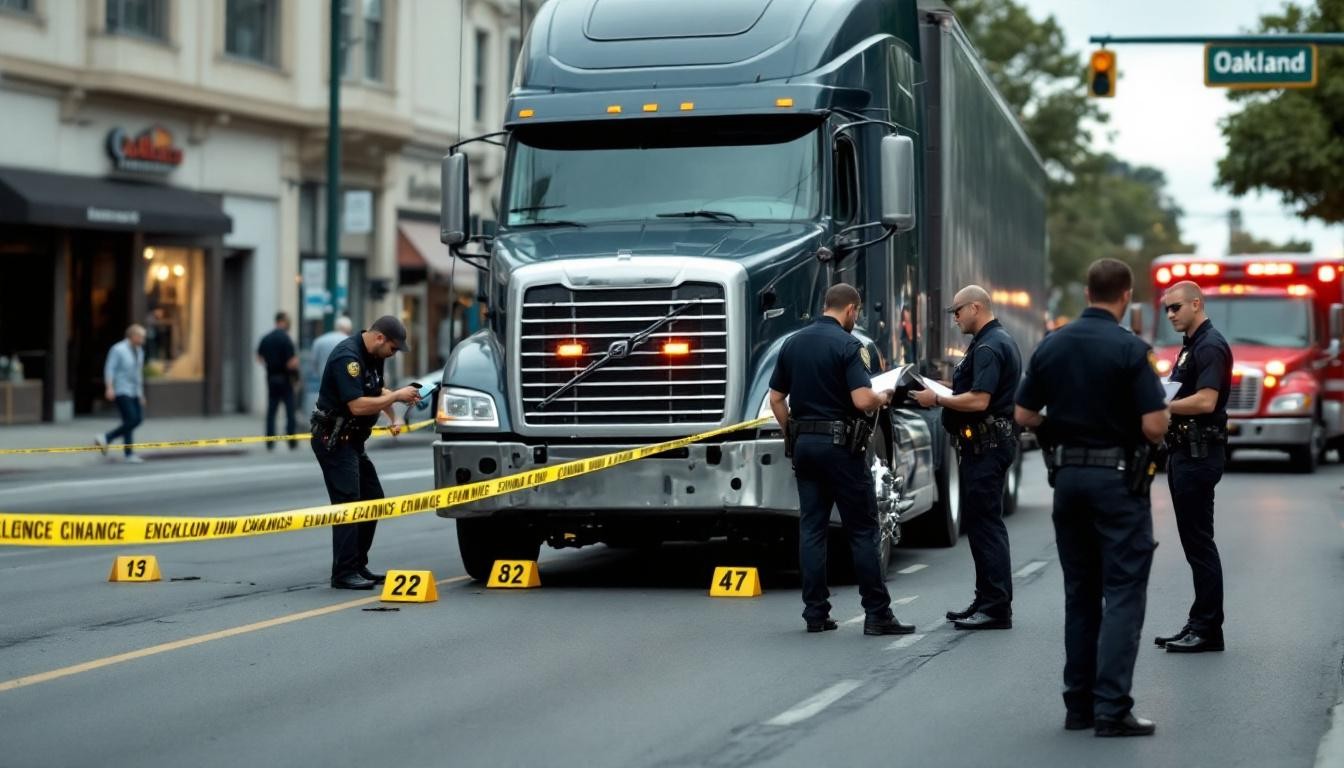
Truck accidents in Oakland carry serious consequences for victims and their families. The investigation process is complex, involving police reports, evidence collection, and technical analysis that determines who bears responsibility.
At Schaar & Silva LLP, we’ve seen how quickly these cases become complicated when multiple parties-drivers, carriers, port operators, and warehouse managers-are involved. Understanding what happens after an Oakland truck accident can protect your rights and strengthen your claim.
How Investigations Start After an Oakland Truck Accident
The first 24 hours after a truck accident in Oakland determine the strength of your case. Police officers responding to the scene document driver statements, vehicle positions, and road conditions, but their reports often miss critical details that matter in liability claims. Photograph the accident scene yourself before authorities clear it, capturing skid marks, cargo spillage, traffic signals, and road defects from multiple angles. Measure distances between vehicles and landmarks using a smartphone app or tape measure, as these measurements become essential when accident reconstruction experts later analyze fault. The police report provides an official record, but it reflects only what officers observed in those first minutes, not the full mechanical or regulatory picture that determines whether a truck driver or carrier violated safety standards.
What Physical Evidence Reveals About Negligence
Electronic data from trucks tells the real story that photographs cannot. Modern commercial trucks contain event data recorders that capture braking patterns, acceleration, steering inputs, and speed for the 30 seconds before and after a crash. This data from the truck’s onboard diagnostics system proves whether a driver was speeding, braking suddenly, or traveling too fast for conditions. Vehicle maintenance records, driver logs, and Hours of Service violations documented by the Federal Motor Carrier Safety Administration reveal whether carriers ignored safety protocols. Cargo loading records matter too, especially in Oakland’s port operations where improperly secured or overweight loads shift during transit and cause jackknifes or rollovers. Accident reconstruction specialists, typically costing $3,000 to $8,000, analyze vehicle damage patterns, tire marks, and physics calculations to determine impact speeds and point of impact with mathematical precision.
Securing Evidence Before It Disappears
Trucking companies have financial incentive to destroy or modify evidence after accidents. Vehicle inspection records, maintenance logs, and driver qualification files require preservation immediately through formal legal requests. Dashboard camera footage from the truck or nearby vehicles often vanishes within 30 days as storage systems overwrite old data. Police dashcam footage and body camera recordings from officers at the scene require public records requests filed within weeks. Witness statements deteriorate as memories fade, so contact information from bystanders, other drivers, and emergency responders should be documented while details remain fresh. Oakland’s port and warehouse operations involve security cameras that capture approach routes and accident moments, but facilities routinely delete footage after 14 to 30 days. The Federal Motor Carrier Safety Administration maintains the SAFER database with carrier safety records, inspection histories, and crash data that establishes patterns of negligence or maintenance failures for any trucking company involved in your accident.
Moving From Investigation to Liability
The evidence you preserve in these early stages directly supports the next phase of your case. Police reports, photographs, electronic data, and witness statements form the foundation that determines who bears responsibility for the accident.
Who Bears Responsibility in Oakland Truck Accidents
The Driver’s Role in Accident Liability
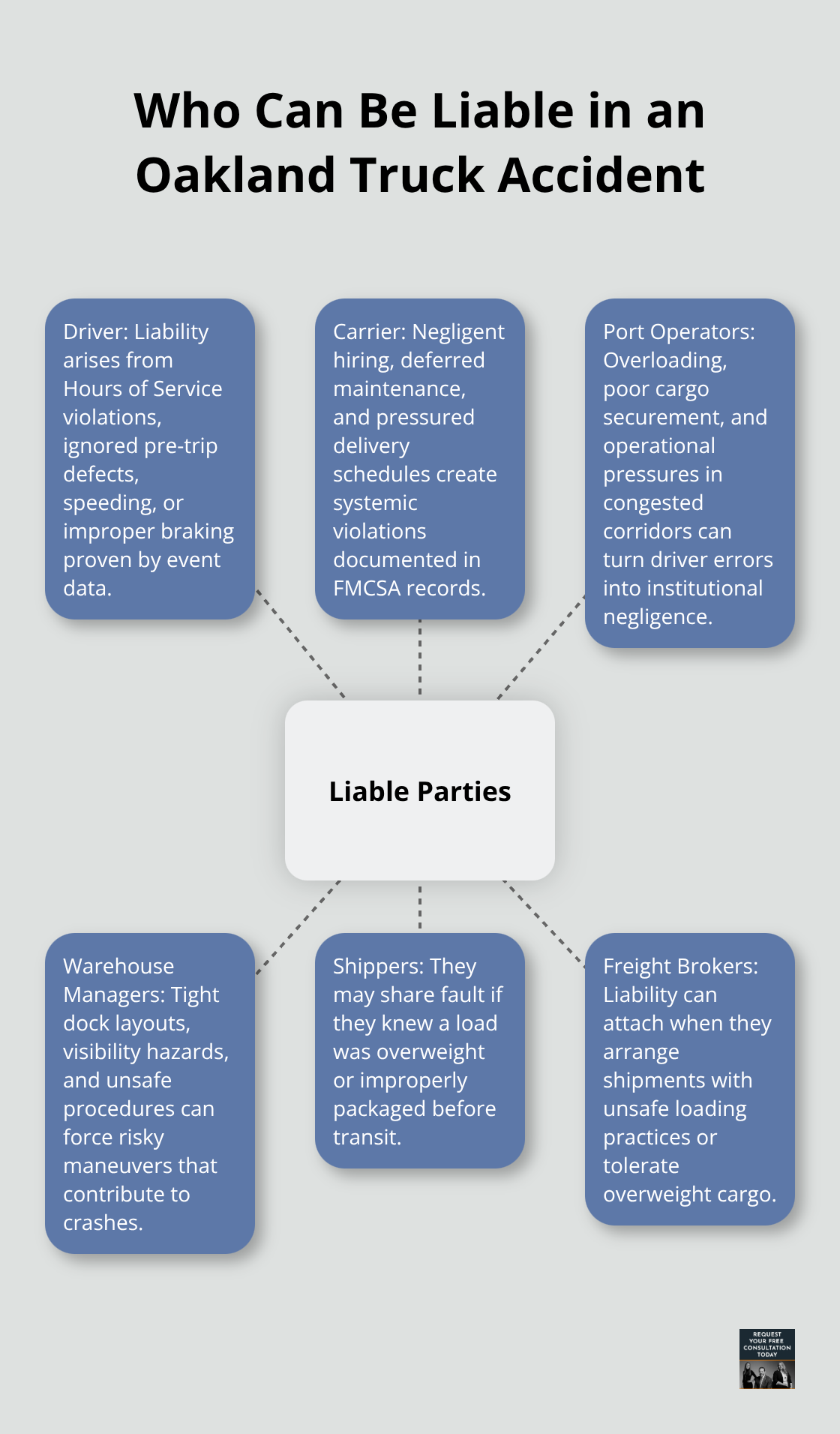
The driver bears responsibility when Hours of Service violations show fatigue, when pre-trip inspections reveal ignored mechanical failures, or when event data proves excessive speed or improper braking. Federal Motor Carrier Safety Administration records document safety violations that establish patterns of negligent driving. Event data recorders capture the driver’s actions in the moments before impact, providing objective proof of whether the driver operated the vehicle safely or recklessly.
How Trucking Carriers Create Liability
Trucking carriers face liability for negligent hiring if they employ drivers with safety violations, for inadequate maintenance if inspection records show deferred repairs, and for unrealistic delivery schedules that pressure drivers into speeding. A carrier’s safety rating from the FMCSA SAFER database directly impacts liability assessment, as repeated violations or poor maintenance scores demonstrate a pattern of negligence. Maintenance records spanning at least two years reveal whether carriers ignored mechanical problems that contributed to the accident.
Port Operations and Warehouse Liability in Oakland
Port operators and warehouse managers in Oakland create liability when they overload trucks beyond federal weight limits, when they fail to secure cargo properly, or when their facility designs force drivers into dangerous maneuvers. Oakland’s congested port corridors and warehouse districts generate specific accident patterns: drivers unfamiliar with narrow approach routes, tight loading dock areas that obscure visibility, and heavy traffic mixing port trucks with passenger vehicles. Port security footage and warehouse loading records establish whether operational pressure contributed to negligence, transforming what appears as driver error into systemic corporate negligence.
Identifying All Liable Parties and Insurance Coverage
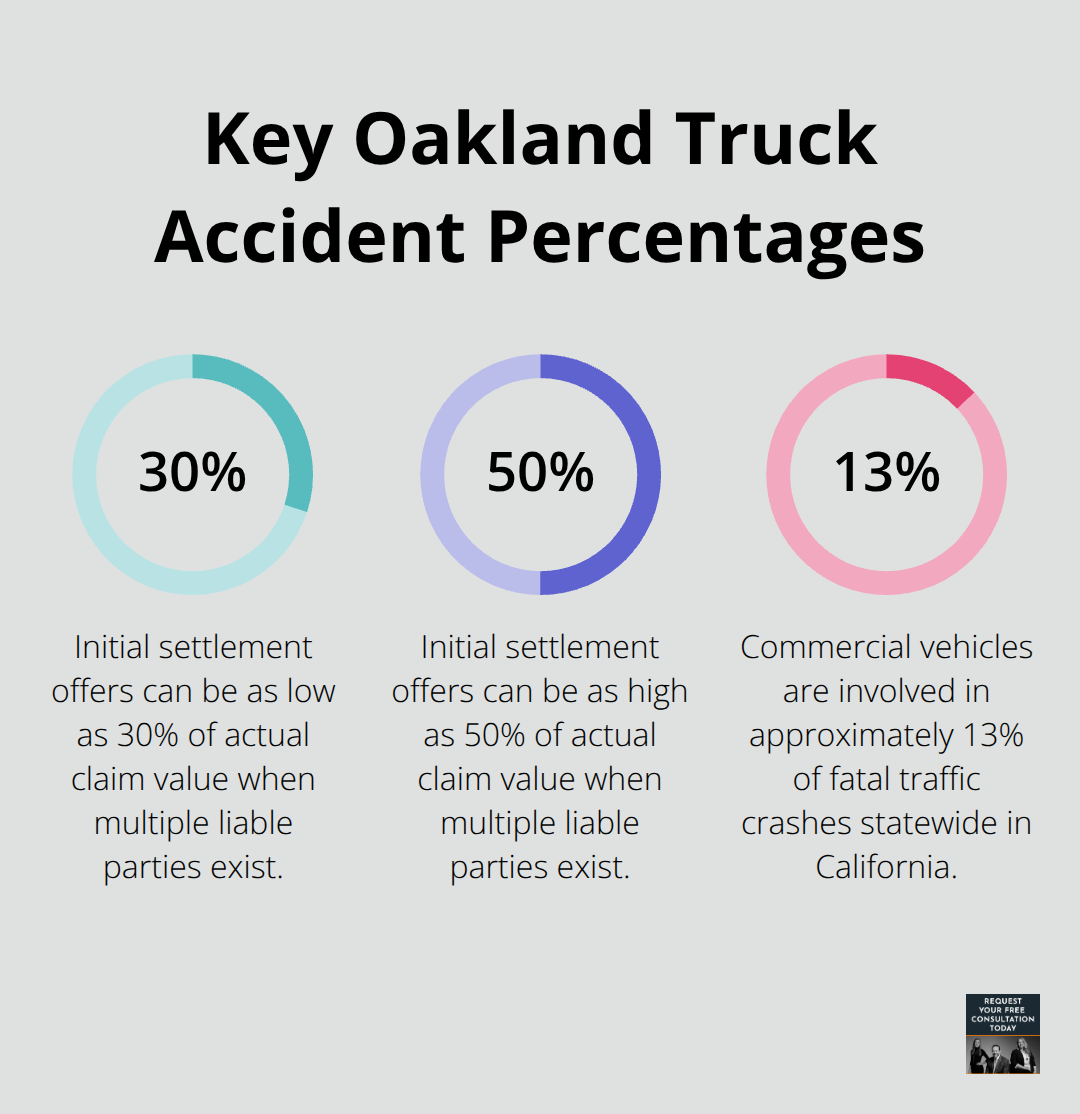
Multiple parties share fault in Oakland truck accidents, and identifying each one requires understanding how commercial operations create liability chains. Cargo ownership matters significantly because shippers and freight brokers can share liability if they knew the load was improperly packaged or overweight. Insurance adjusters often pressure accident victims into accepting early settlements before all liable parties are identified, which undervalues claims when multiple defendants exist. The California Department of Transportation reports that commercial vehicles are involved in approximately 13 percent of fatal traffic crashes statewide, yet liability determination requires proving negligence through specific violations rather than general accident involvement.
California’s Comparative Fault and Your Recovery Rights
Courts apply California’s comparative fault doctrine, meaning you can recover damages even if you bear partial responsibility, provided your fault does not exceed the defendant’s. A complete carrier background check, thorough review of maintenance records, and identification of all parties with insurance coverage must occur before settlement discussions begin. This investigation phase determines whether you recover full compensation or face reduced damages based on comparative fault percentages assigned by the court or settlement agreement.
Your First Actions After an Oakland Truck Accident
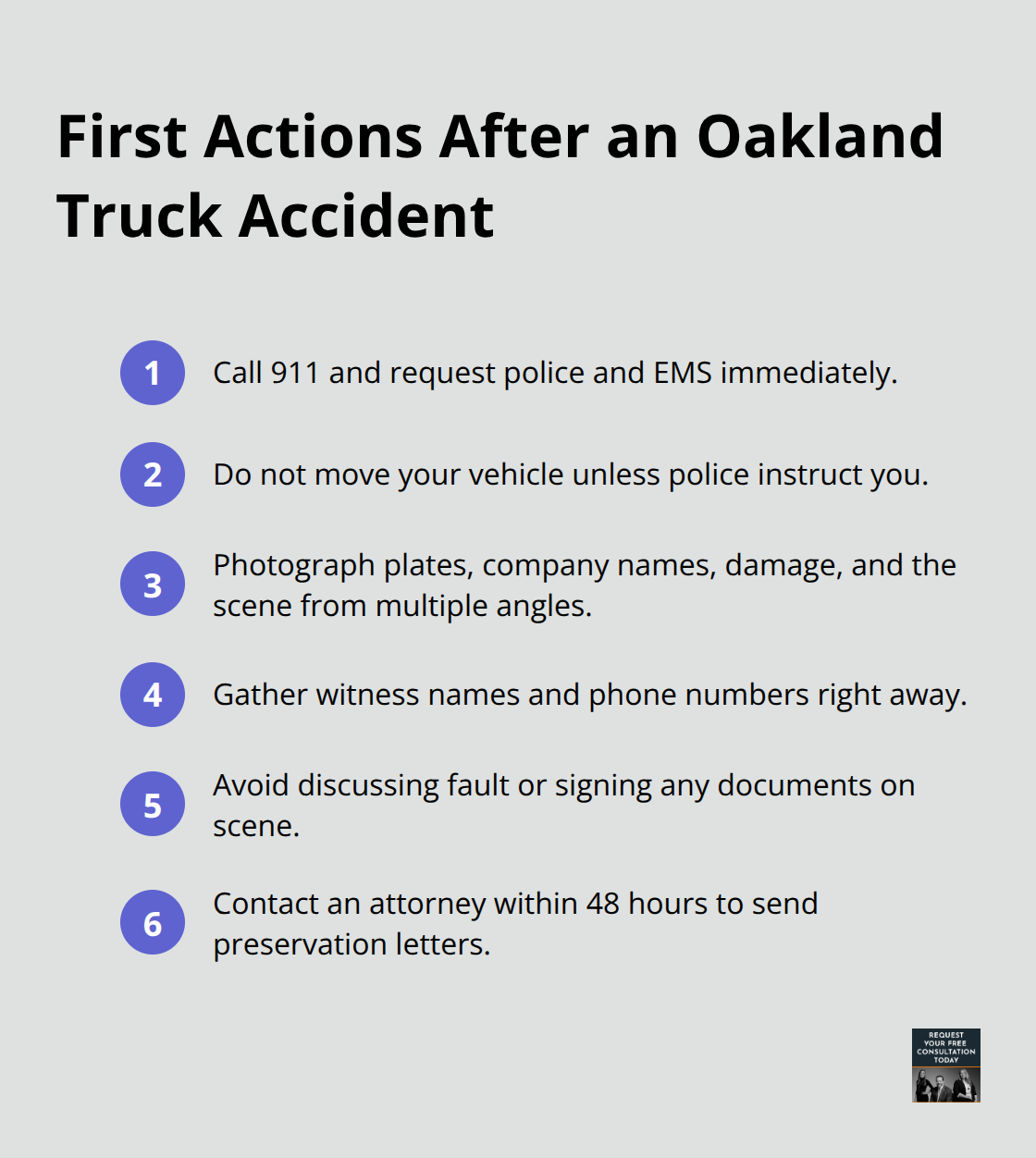
Your decisions in the first hours after a truck accident directly determine whether you recover full compensation or accept a reduced settlement. Do not move your vehicle unless police order you to, as its position at the scene becomes critical evidence for accident reconstruction. Call 911 immediately and request both police and emergency medical services, even if injuries seem minor, because some injuries from truck impacts manifest days later and medical documentation from the scene establishes the accident’s severity. Take photographs of the truck’s license plate, company name, and any visible damage to both vehicles before the scene is cleared.
Preserve Witness Information and Avoid Early Commitments
If witnesses remain, obtain their names and phone numbers within the first 15 minutes, as people disperse quickly and memories fade fast. Do not discuss fault or accept blame, and do not sign anything the trucking company’s representative offers. Refuse early settlement offers from insurance adjusters who contact you within days of the accident, as these initial offers typically represent 30 to 50 percent of actual claim value when multiple liable parties exist. Oakland’s busy port corridors and warehouse districts mean trucking companies and their insurers move quickly to control narratives, so contact an attorney within 48 hours to issue preservation letters that prevent destruction of electronic data, maintenance records, and security footage.
Collect Medical Records and Document Your Injuries
Request your medical records from every healthcare provider who treats you, including emergency room reports, imaging results, physical therapy notes, and any specialist evaluations, as gaps in medical documentation weaken damage calculations. Document lost wages by collecting pay stubs, employer statements of time missed, and written confirmation of future income loss if injuries prevent full-time work. Photograph visible injuries daily for the first two weeks, as this visual progression supports non-economic damage claims for pain and suffering. Keep a detailed journal recording daily pain levels, limitations on activities, sleep disruption, and emotional impacts, providing concrete examples that adjusters cannot dismiss as exaggeration.
Investigate the Carrier’s Safety History
The Federal Motor Carrier Safety Administration’s SAFER database and NHTSA crash statistics show that commercial vehicles involved in Oakland accidents frequently have prior safety violations, so request the at-fault carrier’s inspection history, accident records, and safety ratings. Insurance adjusters count on victims accepting settlements before discovering all liable parties and their coverage limits, so avoid direct communication with any insurance representative and funnel all conversations through legal counsel who understands Oakland’s specific liability patterns involving port operations and warehouse management.
Final Thoughts
Oakland truck accident investigations expose patterns that victims miss when acting alone. The evidence you preserve in the first 24 hours, the carrier safety records you obtain, and the liable parties you identify determine whether you recover full compensation or accept a settlement worth far less than your claim. Insurance adjusters count on victims accepting early offers before understanding the full scope of negligence involved in port operations, warehouse management, and driver violations.
Professional legal representation matters because Oakland’s liability landscape requires expertise in port corridors, warehouse operations, and commercial carrier regulations. Attorneys who understand how cargo loading practices, facility designs, and delivery pressures create negligence identify all responsible parties and their insurance coverage before settlement discussions begin. California’s comparative fault law allows recovery even with partial responsibility, but only if your attorney proves negligence through specific violations rather than general accident involvement.
We at Schaar & Silva LLP recognize that truck accident victims face pressure from insurance companies, medical bills, and lost income while navigating complex liability questions. Contact us for a free consultation to understand your options and begin the investigation that determines your case’s true value.
