
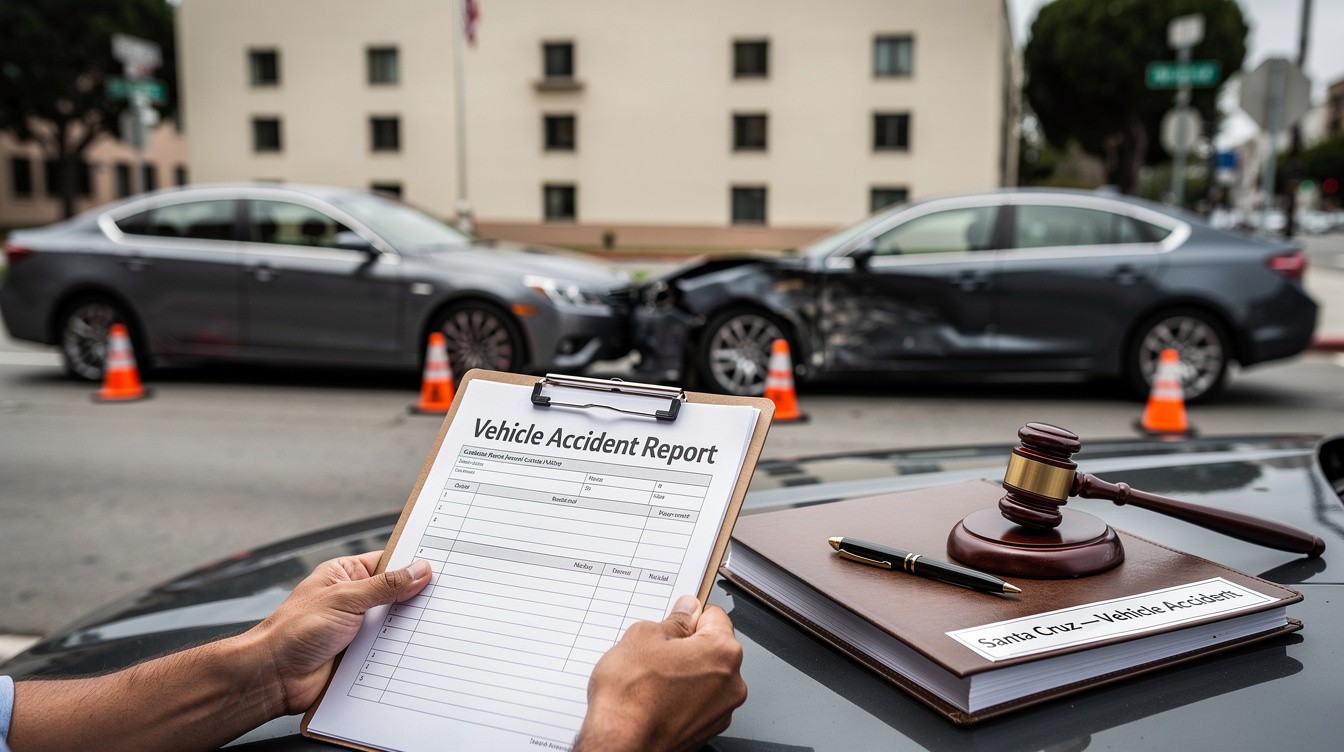
A vehicle accident can turn your life upside down in seconds. Between insurance calls, medical appointments, and legal questions, the vehicle accident legal process feels overwhelming for most Santa Cruz residents.
We at Schaar & Silva LLP have guided hundreds of accident victims through this exact situation. This guide breaks down what happens next, what your rights are, and how to protect yourself.
What to Do Right After Your Accident
Move to Safety and Call for Help
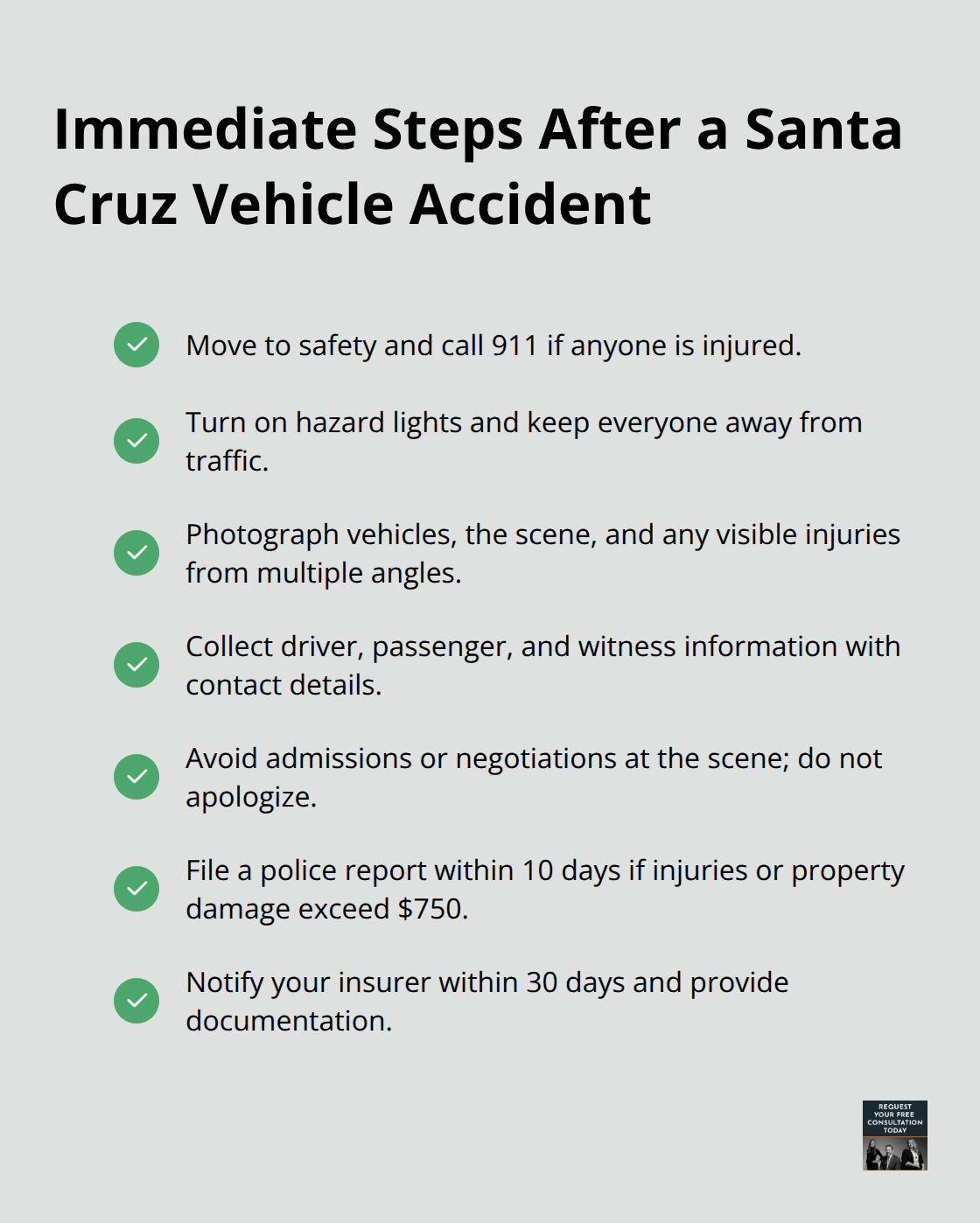
The first hour after a vehicle accident determines how strong your claim will be. Your actions in this window directly affect insurance settlements and legal outcomes. Move to safety if possible-get yourself and passengers away from traffic, turn on hazard lights, and call 911 if anyone is injured. The California Highway Patrol or local Santa Cruz police will document the scene, creating an official record that insurers rely on heavily.
Photograph and Document Everything
While waiting for police, photograph everything from multiple angles: vehicle damage, road conditions, traffic signs, skid marks, and weather. Take wide shots and close-ups. Video captures context and movement even better than still photos. Photograph any visible injuries on yourself or passengers. This documentation becomes your strongest evidence.
Many Santa Cruz accident victims assume the police report alone suffices-it does not. Insurance companies conduct their own investigations and will scrutinize your photos to determine fault and damage severity. Complete this documentation within the first 24 hours while details remain fresh and conditions have not changed.
Collect Information at the Scene
Exchange information with the other driver before anyone leaves the scene: full names, addresses, driver’s license numbers, license plate numbers, and insurance details. Collect the same from passengers. Obtain witness contact information immediately-witnesses disappear quickly and memory fades fast. Ask witnesses to write down what they saw or record a brief video statement on your phone. If the other driver admits fault, that statement holds value, but do not negotiate or apologize at the scene as it can be used against you later.
File Reports and Notify Your Insurer
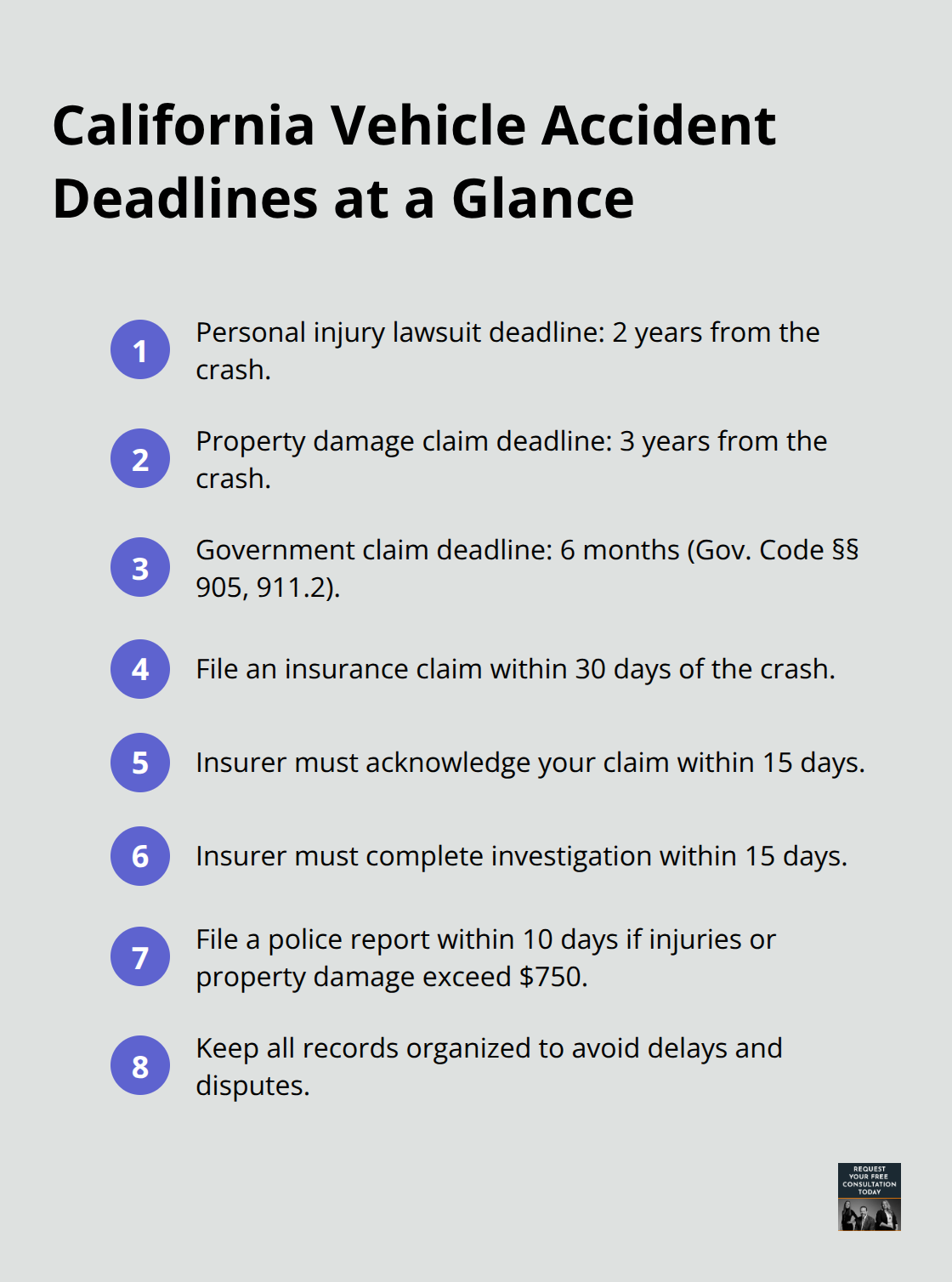
File a police report within 10 days if injuries or property damage exceed $750-California law requires this, and the police report creates leverage in negotiations. Call your insurance company within 30 days to speed processing and reduce memory gaps. California’s Department of Insurance requires insurers to acknowledge claims within 15 days and complete investigations within 15 days, so timing matters throughout this process. Provide your insurer with the police report number and all scene documentation you have gathered. Keep copies of everything for your records and store them digitally as backup.
Understanding what California law actually allows you to recover-and what your insurance covers-separates victims who receive fair compensation from those who settle for far less.
What California Law Actually Allows You to Recover
California’s Comparative Negligence Rule Works in Your Favor
California’s comparative negligence rule gives you a significant advantage that many accident victims overlook. Under California Code of Civil Procedure Section 1431.2, you can recover damages even if you are partially at fault for the accident, as long as you are not more than 50% responsible. Your recovery gets reduced proportionally by your percentage of fault, but you still recover something. In Santa Cruz, this matters enormously in rear-end crashes, where the following driver typically bears fault, and left-turn collisions, where the turning vehicle usually bears fault.
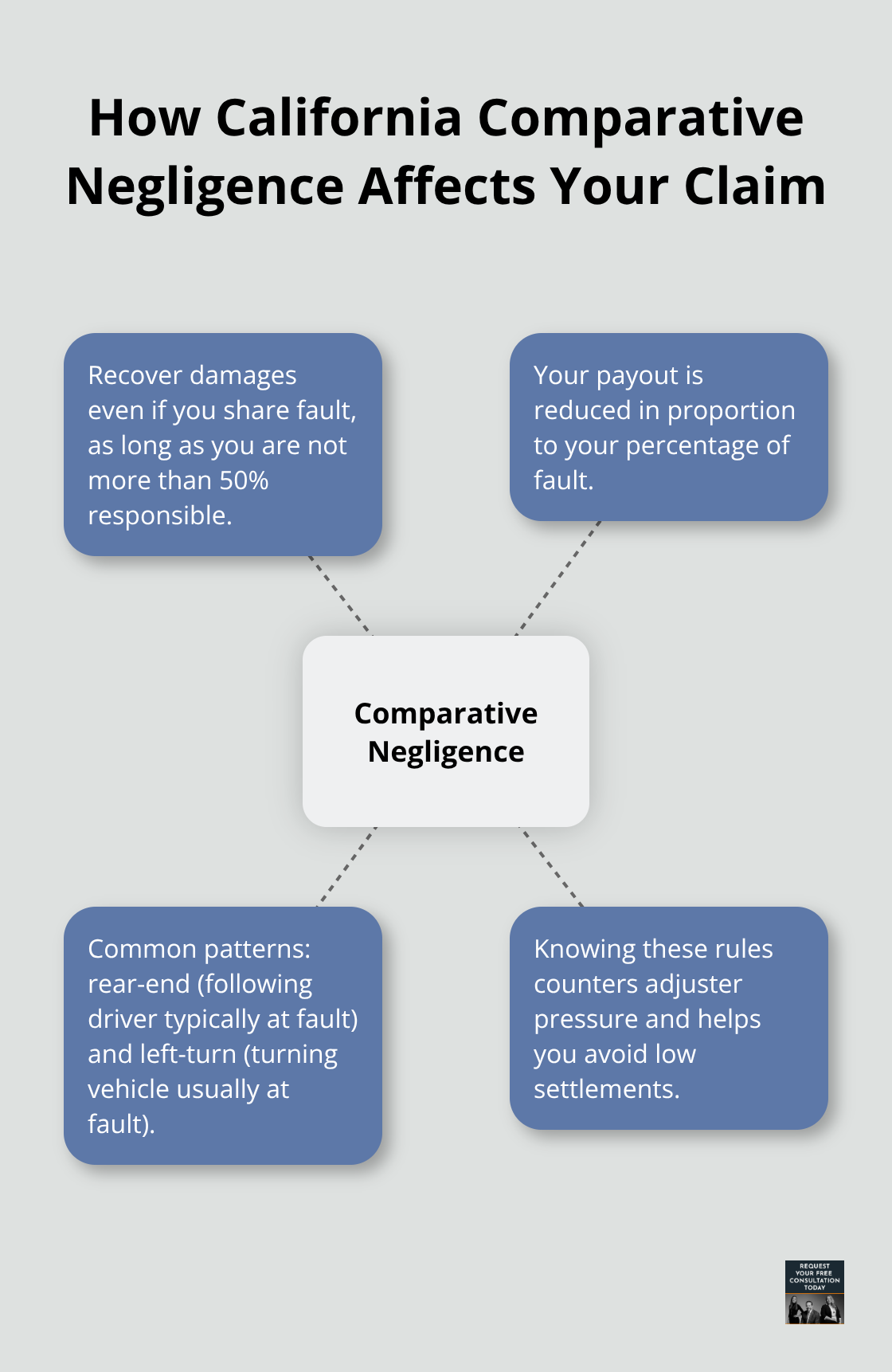
Insurance adjusters know these patterns and often use them to pressure you into low settlements. Understanding your actual liability exposure prevents you from accepting pennies when you deserve dollars.
Your Insurance Coverage Likely Includes More Than You Realize
Your insurance policy contains more coverage than you realize, but the details matter tremendously. California requires minimum liability coverage of $15,000 per person and $30,000 per accident, though most drivers carry higher limits. If the at-fault driver’s insurance limit falls short of your damages, your own uninsured or underinsured motorist coverage steps in to bridge the gap (provided you have it). Medical payments coverage pays your treatment costs regardless of fault, up to your policy limit, and this coverage does not reduce your final settlement. Property damage claims must cover the lesser of repair costs or your vehicle’s actual cash value, which is fair market value minus depreciation. Request itemized repair estimates from at least two body shops and challenge the insurance company’s valuation if it seems low. If new damage appears during repairs, the insurer must cover those additional costs. Many policies include an appraisal provision with two appraisers and a neutral umpire to determine binding value if you dispute the settlement amount, giving you leverage without going to court.
Timing Determines Everything in Your Claim
California law gives you two years from the crash date to file a personal injury lawsuit and three years for property damage claims, according to the Judicial Council of California. However, waiting that long weakens your case dramatically. File an insurance claim within 30 days of the crash to speed processing and reduce memory gaps. The California Department of Insurance requires insurers to acknowledge claims within 15 days and complete investigations within 15 days, so the clock moves fast. If a government vehicle caused the crash, personal injury claims must be filed within six months under Government Code sections 905 and 911.2 (a much tighter deadline).
Medical expenses are fully recoverable from the at-fault driver’s insurance, including all reasonable and necessary treatment costs and future medical expenses supported by medical documentation. Lost wages and earning capacity are recoverable too, backed by pay stubs and medical notes that establish your reduced ability to work. Acting promptly preserves your evidence, keeps memories fresh, and prevents missed deadlines that could cost you significantly.
The insurance company’s initial offer rarely reflects what your claim is actually worth, which is why understanding common disputes and how to counter them becomes your next critical step.
What Insurance Companies Won’t Tell You
How Adjusters Use Time Pressure Against You
Insurance adjusters count on your confusion and urgency to settle fast. The California Department of Insurance requires insurers to acknowledge claims within 15 days and complete investigations within 15 days, creating artificial time pressure that works against you. Their first offer typically covers only immediate, documented expenses and deliberately undervalues future medical costs, lost earning capacity, and pain and suffering. Adjusters use specific tactics: they may accept liability quickly to seem reasonable, then lowball the damages figure; they may request recorded statements that you should refuse without legal guidance; they may claim your medical treatment was unnecessary or unrelated to the crash.
Building Your Counter-Offer with Documentation
The Insurance Information Institute emphasizes that documentation gaps in medical records weaken settlements dramatically, so start treatment immediately and obtain detailed records showing the connection between your injuries and the accident. If the adjuster denies liability, they must provide a written explanation citing specific evidence. Push back on their valuation by submitting itemized medical bills, not just summaries, and include medical codes to increase credibility. Request their damage calculation in writing and challenge any figure that seems inconsistent with your documentation. Many Santa Cruz accident victims accept first offers within weeks and later discover they left thousands on the table when long-term physical therapy or psychological treatment becomes necessary.
Using the Appraisal Provision to Your Advantage
The appraisal provision in your policy gives you leverage: if you and the insurer cannot agree on vehicle value, you can demand appraisal with two independent appraisers and a neutral umpire who makes a binding decision, avoiding court entirely. This process costs roughly $300 to $500 but often recovers thousands more than negotiation alone.
Calculating Your Total Medical and Wage Recovery
Medical bills and lost wages represent the largest portion of your recovery, yet many victims underestimate these costs or fail to document them properly. Medical expenses are fully recoverable from the at-fault driver’s insurance, including all reasonable and necessary treatment: emergency care, surgery, physical therapy, mental health counseling, and future medical care supported by physician recommendations. Collect every receipt, invoice, and explanation of benefits from every provider. If your health insurance paid first, the at-fault driver’s insurer still owes the full amount as a matter of law.
Lost wages include income lost during recovery and any long-term reduction in earning ability due to permanent injury. Gather pay stubs from at least 12 months before the crash to establish your baseline income, then document every hour missed for medical appointments, recovery time, or reduced work capacity. If you are self-employed, provide tax returns and detailed income records. Medical notes from your doctors stating that you cannot work or can only work reduced hours carry enormous weight.
Maximizing Your Property Damage Settlement
Property damage claims must cover the lesser of repair costs or your vehicle’s actual cash value, which is fair market value minus depreciation according to the Judicial Council of California standards. Request estimates from at least two independent body shops and provide them both to the insurer. If the insurer’s valuation seems low, research comparable vehicles in Santa Cruz County using NADA Guides or Kelley Blue Book to build a data-backed counter-offer. If new damage appears during repairs, photograph it immediately and notify the insurer in writing because they must cover those additional costs. Gap insurance becomes critical if you owe more on your vehicle loan than the insurance payout; California minimums are $15,000 per person and $30,000 per accident, which leaves many drivers short. Before accepting any settlement, calculate your total damages by adding medical expenses, lost wages, property damage, rental car costs, and transportation costs, then add 25 to 50 percent for pain, suffering, and disruption to your life. This total becomes your opening position in negotiations, not your final expectation.
Final Thoughts
Recovery after a vehicle accident involves more than healing from injuries-it means navigating the vehicle accident legal process while protecting your financial future. The steps you take now determine whether you receive fair compensation or settle for far less than you deserve. Insurance companies count on victims making rushed decisions without full information, so the knowledge you now possess about California’s comparative negligence rules, damage calculations, and insurance tactics gives you real leverage.
Start by organizing all your documentation in one secure location: police reports, medical records, photos, witness statements, repair estimates, and insurance correspondence. Track every deadline, especially the two-year window for personal injury claims and three-year window for property damage. If your case involves significant injuries, disputed liability, or an offer that seems low, contact Schaar & Silva LLP for a consultation-many Santa Cruz residents wait too long or handle claims alone and later regret leaving thousands unclaimed.
Your rights matter, and your recovery matters. Act now to protect both.
