
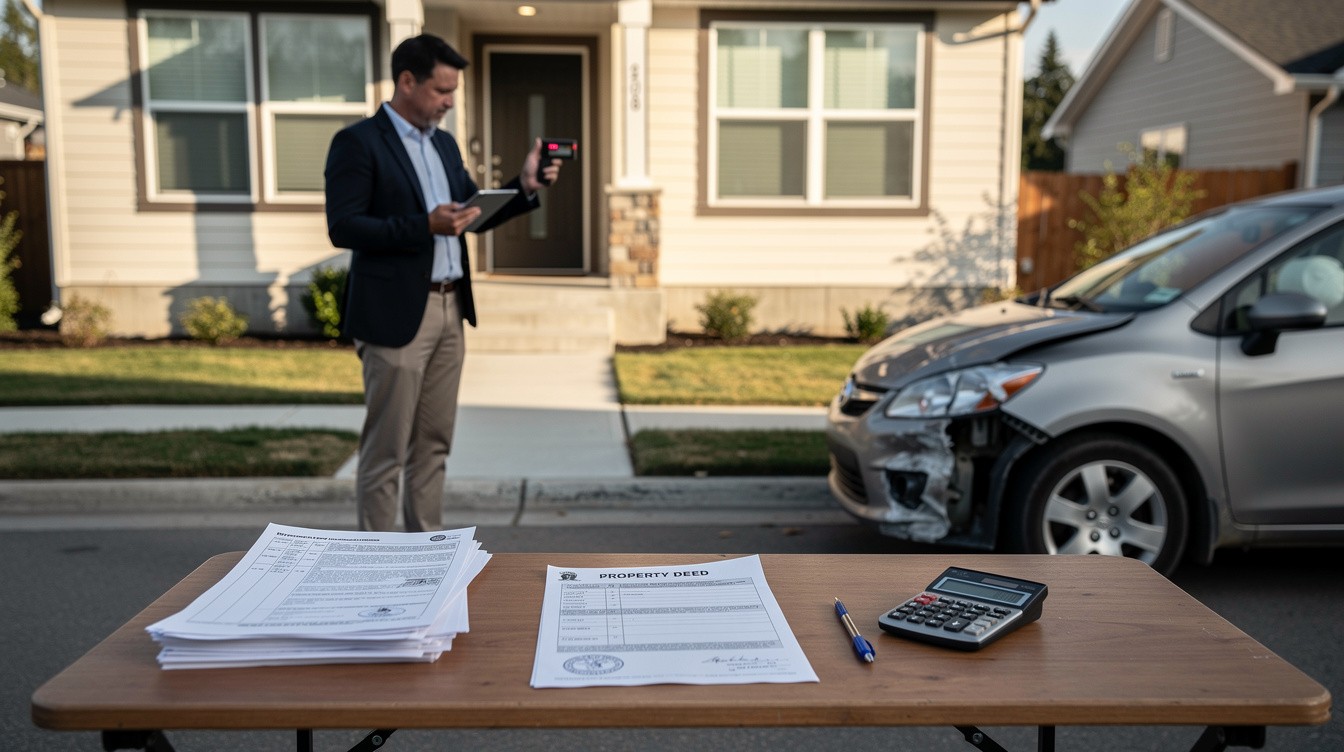
After a car accident in Santa Cruz County, figuring out what your damaged vehicle is actually worth can feel overwhelming. Insurance companies use specific methods to calculate Santa Cruz property valuation, and understanding these methods helps you get fair compensation.
We at Schaar & Silva LLP have helped countless accident victims navigate property damage claims and recover what they deserve. This guide walks you through the valuation process, common pitfalls, and how to strengthen your claim.
How Your Vehicle Gets Valued After an Auto Accident
Insurance companies in Santa Cruz County typically rely on actual cash value to determine what they’ll pay for your damaged vehicle. This method calculates what your car was worth immediately before the accident, not what it costs to replace it new. The difference matters significantly-actual cash value almost always produces the lowest payout of the three valuation methods insurers use. Local Santa Cruz repair costs run 15–25% higher than national averages, yet many insurers default to national databases like NADA Guides that undervalue what repairs actually cost in your area. This gap between what the database says and what local shops charge is where you lose money if you don’t push back.
Independent Estimates Counter Low Valuations
The most effective way to counter a low valuation is to obtain three independent estimates from AAA or ASE-certified repair shops in Santa Cruz County-not from the insurer’s preferred vendors. Each estimate should itemize labor, parts, and overhead separately so you can see exactly where costs originate. Local labor rates and parts availability in Santa Cruz drive expenses higher than national averages, and your three estimates prove this reality better than any argument.
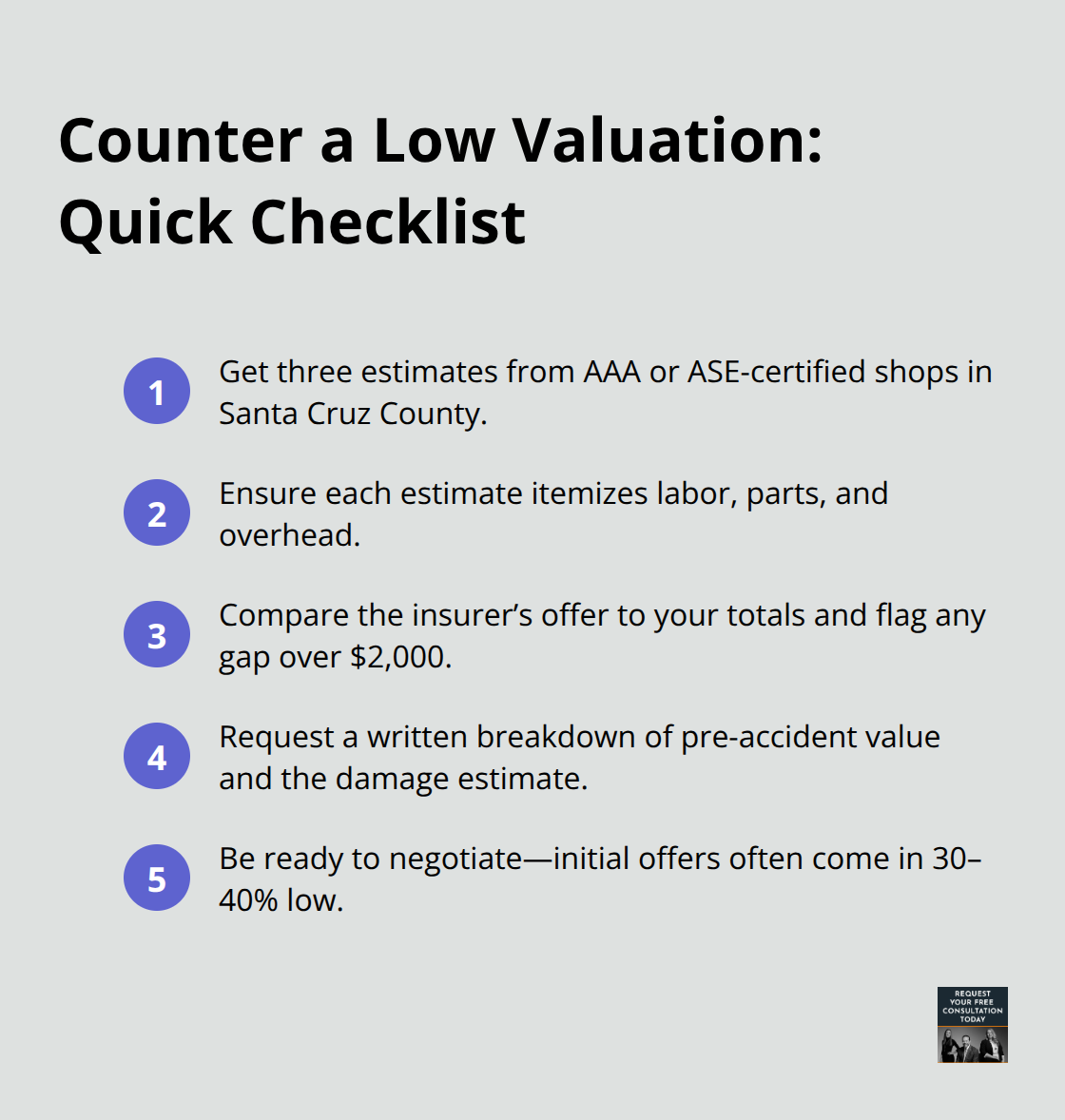
If the gap between what the insurer offers and what your independent estimates total exceeds $2,000, California’s Appraisal Provision gives you the right to pursue binding appraisal with an umpire. Initial offers typically sit 30–40% below actual repair costs, so expect to negotiate. Request a written explanation of how the insurer calculated both your vehicle’s pre-accident value and the damage estimate-this forces transparency and often reveals errors you can challenge.
Build Your Claim With Maintenance Records and Photos
Collect maintenance receipts for oil changes, brake service, tire replacements, and any other work performed on your vehicle before the accident. These records prove proper upkeep and directly support a higher pre-accident valuation. Photographs matter too-gather any photos showing the vehicle in good repair before the accident. Within 48 hours of the accident, photograph the damage from multiple angles, document scene conditions, and file a police report if applicable. For complex claims or significant discrepancies, hire a certified independent appraiser (costing $300–$600) to justify an extra recovery of roughly $2,000–$5,000 by documenting your vehicle’s pre-crash condition and current market data.
Uncover Hidden Damage That Increases Repair Costs
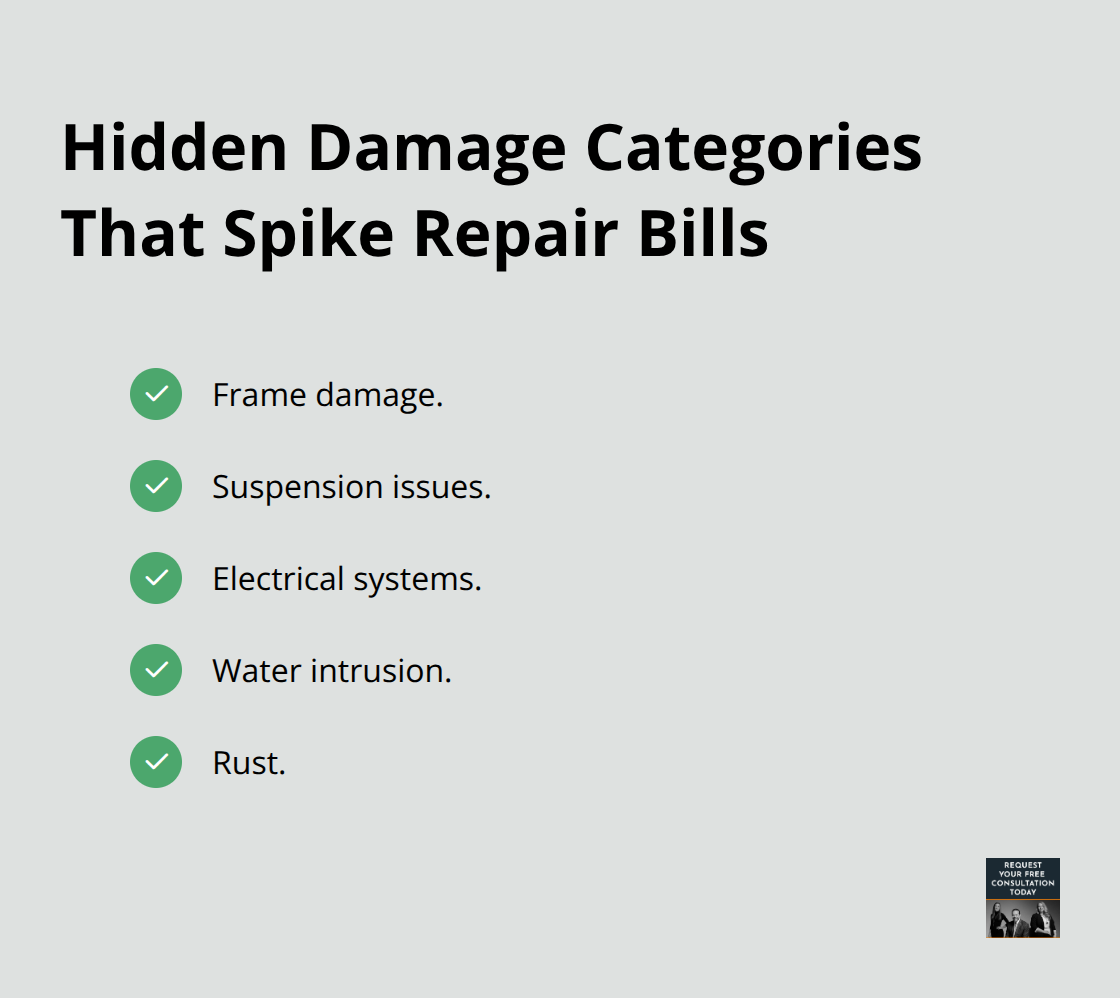
Hidden damage categories-frame damage, suspension issues, electrical systems, water intrusion, and rust-can add $5,000–$10,000 to the actual repair bill, and independent shops often uncover these issues that insurers miss. AAA or ASE-certified repair shops in Santa Cruz have the tools and knowledge to identify damage that national databases and insurer adjusters overlook. When you submit your claim with three independent estimates that account for these hidden costs, you shift the negotiation in your favor. The insurer must then justify why they’re ignoring documented damage that local shops have identified.
This documentation becomes your strongest leverage when disputes arise over property valuation and fair compensation for your loss.
What Really Determines Your Settlement Amount
Pre-Accident Condition Sets Your Baseline Value
Your vehicle’s age and condition before the accident form the foundation of any settlement offer, but insurers often misrepresent this baseline. A ten-year-old vehicle with full maintenance records and recent brake work differs significantly from a ten-year-old vehicle with no documented care-yet many adjusters treat them identically when pulling values from national databases. The pre-accident condition determines actual cash value, and this is where you gain or lose thousands.
Collect maintenance receipts showing regular oil changes, tire replacements, suspension work, and any major repairs completed within the last three years. When you present this documentation alongside photos of your vehicle before the accident, you establish a higher baseline that justifies increased settlement offers. Insurers will claim your vehicle’s condition was average or below average without this proof, so documentation becomes your only defense against undervaluation.
Repair Costs and Total Loss Thresholds
Repair costs versus total loss determination creates another critical decision point that many accident victims misunderstand. Your vehicle reaches total loss status when repair costs exceed 70–80% of its pre-accident value, depending on your insurer’s specific threshold. This matters because total loss settlements typically pay less than the actual cost to repair and return your vehicle to working condition.
If repairs cost $18,000 and your vehicle’s actual cash value is $22,000, the insurer may declare it a total loss and offer $22,000-but you cannot replace an equivalent vehicle for that amount in today’s market. Request a detailed breakdown of how your insurer calculated both the repair estimate and the total loss threshold. Challenge this calculation with your three independent local estimates, which often reveal hidden damage costs that push repairs higher and justify refusing the total loss designation.
Coverage Limits and Deductibles Shape Your Recovery
Insurance coverage limits and deductibles directly reduce what you receive, and this is non-negotiable once your policy is issued. A $1,000 deductible means the insurer subtracts $1,000 from any settlement, regardless of actual damages. Review your policy declarations page now to confirm your coverage limits and deductible amounts.
If your coverage limit is $15,000 and repairs total $22,000, your maximum recovery is $15,000 minus your deductible-leaving a $7,000 gap you must cover yourself unless you pursue additional legal action. This is why understanding your policy before an accident occurs matters so much. After an accident, these numbers are fixed, and negotiation cannot change them. When settlement offers fall short of your actual losses, legal action becomes your path forward to recover the full amount you deserve.
Navigating Property Damage Claims in Santa Cruz County
Insurance Timelines Create Accountability
Insurance adjusters operate on a timeline that favors delay, and understanding this dynamic shifts your negotiating position immediately. California law requires insurers to acknowledge receipt within 15 days of your claim filing and settle within 40 days after you submit proof of loss. Most accident victims miss these deadlines because they don’t track them, which gives adjusters room to drag out the process indefinitely. Start a simple spreadsheet on the day you file your claim and note both the 15-day acknowledgment deadline and the 40-day settlement deadline.
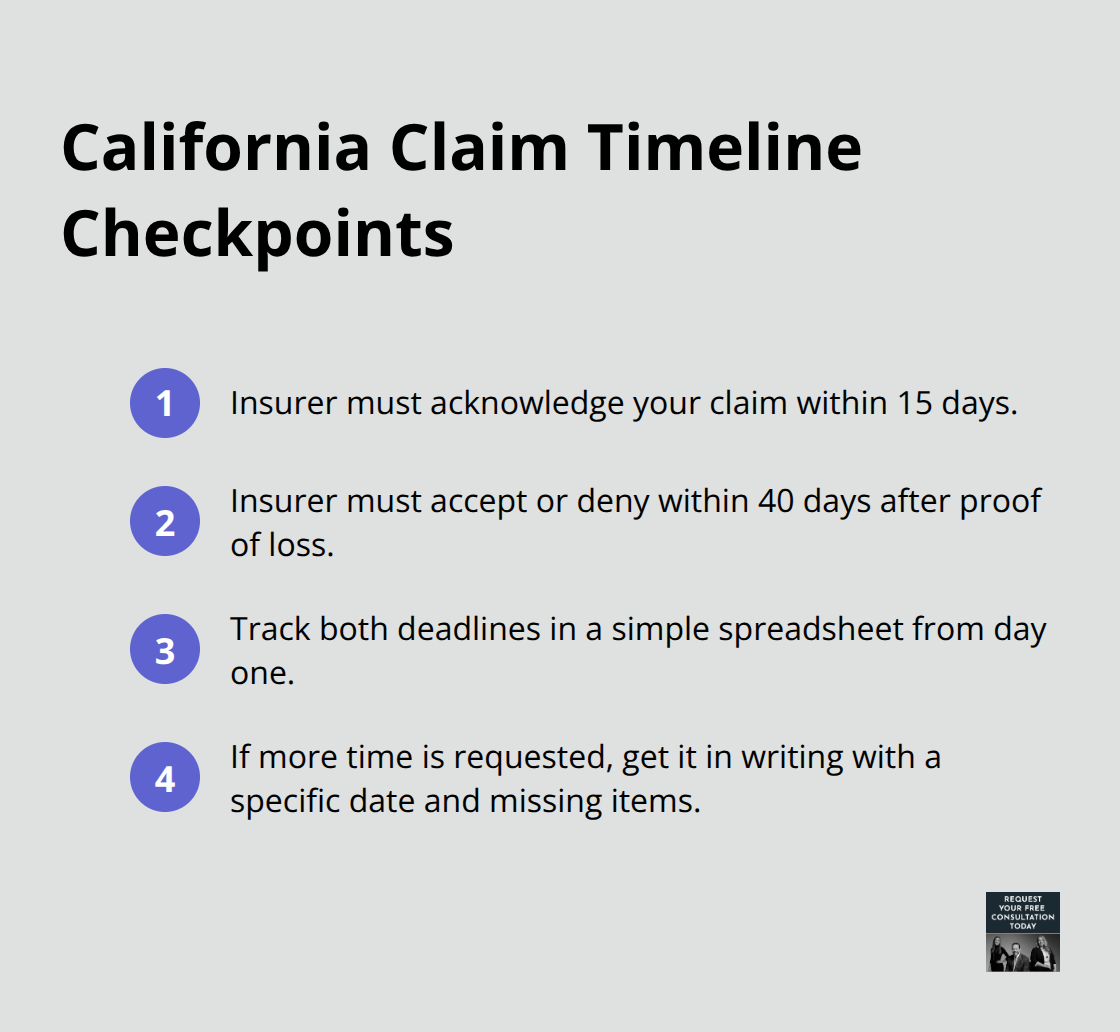
When the insurer misses these windows, you have documented evidence of delay that strengthens your position in any dispute.
Adjusters will request documentation repeatedly, sometimes asking for items you’ve already submitted. Push back on redundant requests and ask for a specific list of what remains outstanding. If an adjuster claims they need more time, request this in writing and ask them to specify the exact deadline and what information is missing. This creates accountability and prevents the slow-motion stalling that benefits insurers financially.
When to Hire Legal Support for Your Claim
The decision to hire legal support depends on the gap between what the insurer offers and what you can document as actual repair costs. If your three independent local estimates total $18,000 and the insurer offers $12,000, that $6,000 difference justifies legal intervention immediately. Many accident victims attempt to negotiate alone and accept lowball offers simply because they lack confidence in their documentation or feel pressured by the adjuster’s authority.
Once you hire a lawyer, communication shifts to your legal representative, which stops the pressure tactics and forces the insurer to justify their valuation in writing. The cost of hiring legal support typically comes from your settlement recovery, so you don’t pay out of pocket if you win. We assist in evaluating property damage claims and help you receive fair valuation for your loss.
The Appraisal Provision as Your Formal Dispute Resolution
If the gap between the insurer’s offer and your independent estimates exceeds $2,000, California’s Appraisal Provision provides a formal mechanism where both sides present their case to a neutral umpire who makes a binding decision. This process costs less than litigation and moves faster than court proceedings, often resolving disputes within 60–90 days. Both you and the insurer select appraisers, and those two appraisers select an umpire if they cannot agree on a value. The umpire’s decision becomes final and binding on both parties, eliminating the back-and-forth negotiation that can drag on for months.
Final Thoughts
Property valuation after an auto accident in Santa Cruz County hinges on three core principles: obtaining independent local estimates, documenting your vehicle’s pre-accident condition, and understanding the timelines that hold insurers accountable. National databases like NADA Guides consistently undervalue Santa Cruz repairs by 15–25%, which is why your three itemized estimates from AAA or ASE-certified shops become your strongest negotiating tool. When you present maintenance records, pre-accident photos, and detailed repair breakdowns, you shift the conversation from what the insurer wants to pay toward what your vehicle actually costs to repair or replace in your local market.
The gap between initial offers and fair compensation typically runs 30–40%, meaning most accident victims leave thousands on the table by accepting the first number without pushback. California’s Appraisal Provision exists specifically to resolve these disputes when the gap exceeds $2,000, offering a faster and less expensive alternative to court proceedings. Tracking the 15-day acknowledgment deadline and 40-day settlement deadline creates documented accountability that prevents insurers from stalling indefinitely.
We at Schaar & Silva LLP help Santa Cruz County residents navigate Santa Cruz property valuation claims by evaluating the full extent of your loss and ensuring you receive fair compensation. If your claim stalls or the insurer’s offer falls short of your documented repair costs, contact us for a free consultation to discuss your options and next steps toward maximizing your recovery.
