
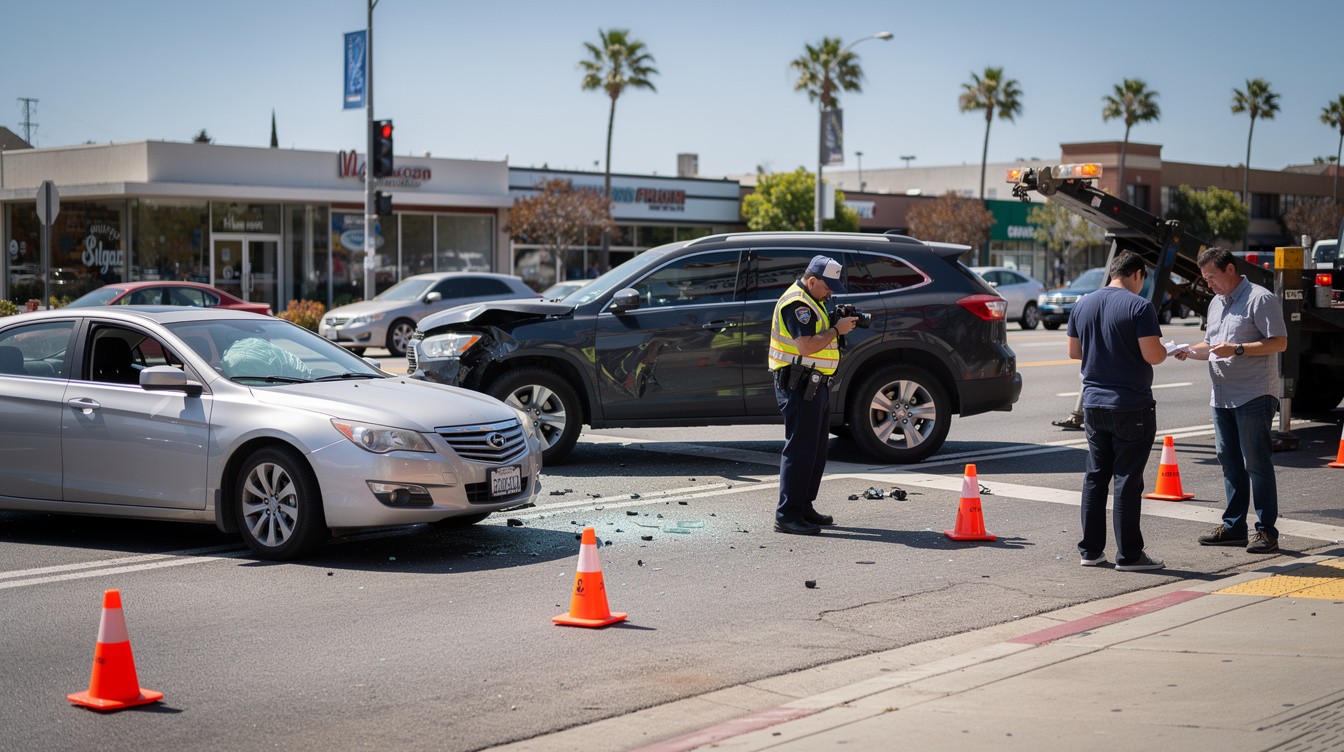
When you’re hit by another driver in California, figuring out who’s legally responsible isn’t always straightforward. Road collision liability in California depends on proving negligence, understanding comparative fault rules, and navigating insurance coverage limits.
At Schaar & Silva LLP, we help accident victims understand how California courts assign responsibility and what that means for their compensation. This guide walks you through the legal framework that determines liability in auto cases.
How California Courts Assign Fault After a Collision
California operates under a fault-based system where the driver responsible for causing the collision pays for damages through their liability insurance. The injured party pursues compensation directly from the at-fault driver’s insurer rather than filing a claim with their own insurance first. Fault determination relies on concrete evidence including police reports, witness statements, photographs from the scene, and whether traffic laws were violated.
Evidence That Establishes Fault
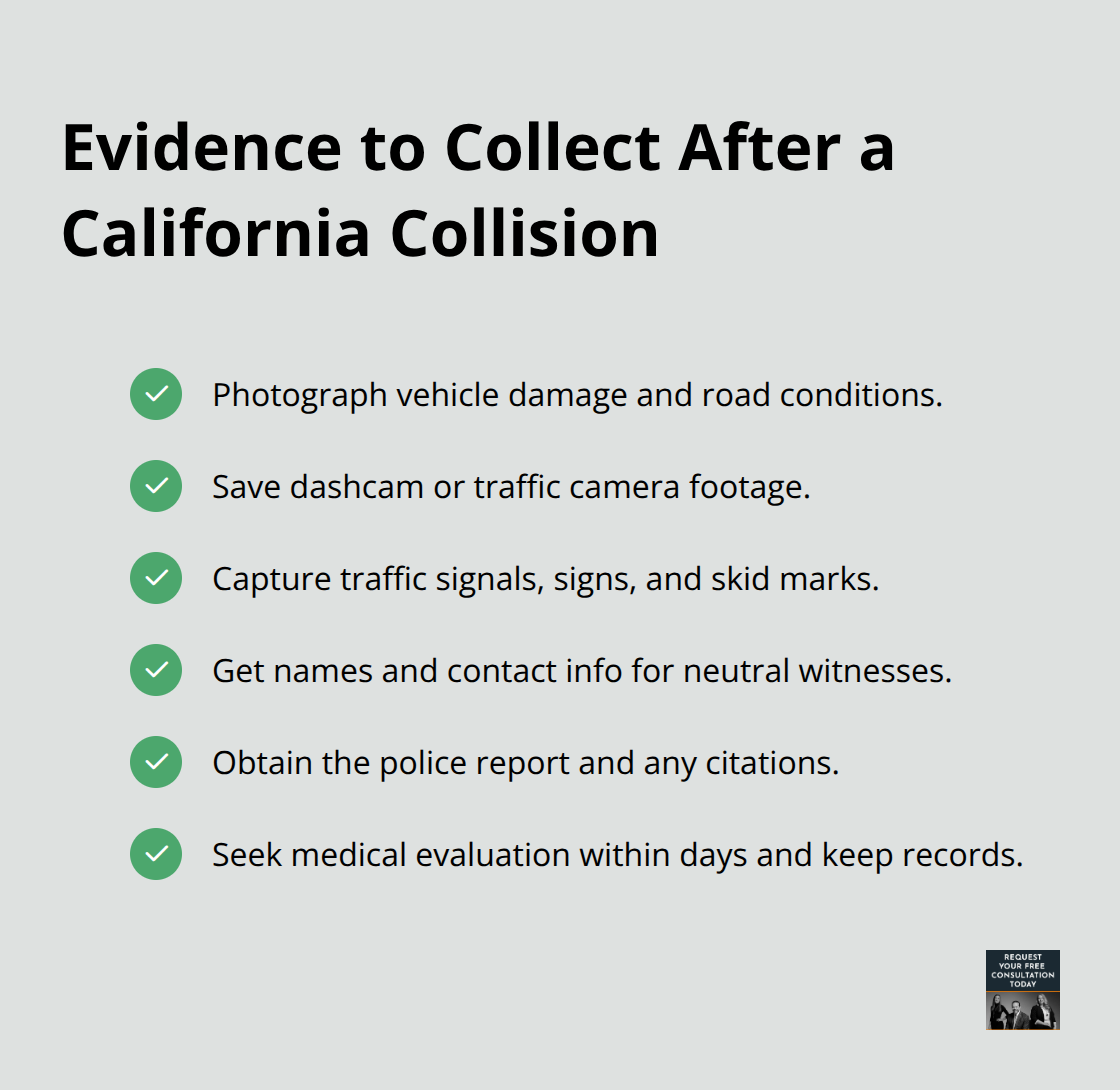
Police officers document violations like running a red light, speeding, or failure to yield, which form the backbone of fault assessment. The California Highway Patrol and local police departments generate reports that insurance adjusters and courts use to establish liability. You should gather as much evidence as possible at the scene: photos of vehicle damage, road conditions, traffic signals, and contact information from witnesses who saw what happened.
The Four Elements of Negligence
Negligence in California auto cases requires four specific elements: a duty of care existed, that duty was breached, the breach caused your injuries, and you suffered damages. Every driver on California roads has a legal duty to obey traffic laws and operate their vehicle safely. A breach occurs when a driver ignores this duty through actions like texting while driving, running a stop sign, or traveling at unsafe speeds.
Courts do not care about intent; a driver does not need to deliberately cause harm for negligence to apply. What matters is whether their actions fell below the standard of a reasonably careful driver. If another driver breached this standard and caused your collision, you have grounds for a liability claim.
Why Objective Evidence Outweighs Personal Accounts
Your eyewitness account carries weight, but insurance companies and courts prioritize objective evidence. Dashcam footage, traffic camera recordings, and skid marks on the roadway provide undeniable proof of how the collision occurred. Witness statements from neutral third parties who saw the collision often carry more credibility than accounts from involved parties.
Medical records documenting your injuries within days of the collision strengthen your claim by showing the collision caused real harm. Police citations issued to the other driver for traffic violations create strong evidence of fault. Without proper documentation, insurance adjusters may dispute your version of events or attempt to assign shared blame even when the other driver was primarily at fault.
Understanding how California courts weigh evidence sets the stage for grasping comparative negligence rules, which determine how much compensation you actually receive when fault is shared between parties.
How Shared Fault Reduces What You Actually Receive
California’s comparative negligence rule allows you to recover damages even if you bear partial responsibility for the collision, but your award shrinks by your percentage of fault. If a court finds you 20% at fault, your compensation drops by exactly 20%, regardless of the total damages awarded. This system differs fundamentally from states with all-or-nothing liability rules, giving California accident victims more recovery options when circumstances are complex. Courts apply this rule consistently across cases, making it predictable but also making your percentage of fault the single most important factor in determining your final payout. Insurance adjusters know this rule well and use it aggressively to lower settlements by inflating your share of responsibility whenever possible.
How Fault Percentages Get Assigned
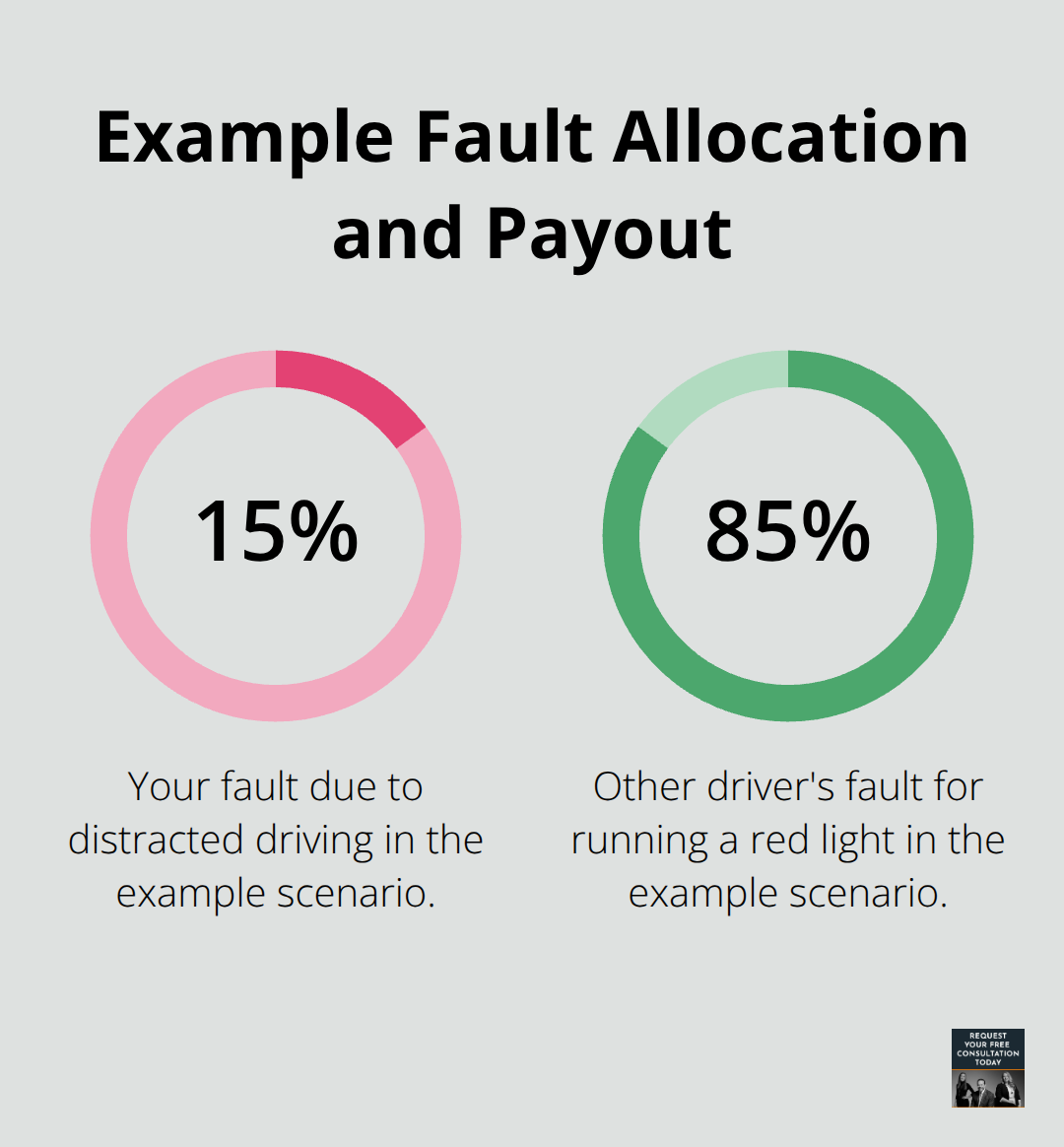
Insurance companies and courts examine the same evidence used to determine initial liability-police reports, witness statements, traffic violations, and physical evidence from the scene. However, they now assess not just whether you were hit, but whether your own actions contributed to the collision. If you texted while driving and another driver ran a red light, both actions may factor into fault allocation. An adjuster might assign you 15% fault for distracted driving while assigning the other driver 85% for the traffic violation. This means if your total damages equal $100,000, you receive $85,000 instead. The percentage assigned to you directly reduces your recovery dollar-for-dollar, making this calculation far more consequential than simply establishing that the other driver caused the collision.
Why Insurance Companies Push Higher Fault Percentages for You
Adjusters have financial incentives to maximize your assigned fault percentage because every percentage point they add saves their company money. A company handling 500 claims annually can save millions by shifting just 5% more fault onto injured parties across all cases. They accomplish this through tactics like emphasizing minor traffic violations on your part while downplaying serious violations by the other driver, selectively presenting witness statements that support higher fault for you, or challenging medical documentation to suggest your injuries were less severe than claimed. This is why organizing objective evidence immediately after your collision matters enormously-dashcam footage or traffic camera recordings can override an adjuster’s narrative about your fault percentage. Without strong documentation, you rely on your account against a company with financial motivation to dispute it.
Real Numbers Show How Fault Percentages Impact Recovery
If you suffered $150,000 in documented damages but a court assigns you 25% fault, your recovery drops to $112,500. In cases involving severe injuries across Santa Cruz County and Oakland, this difference translates to tens of thousands of dollars in lost compensation. A pedestrian hit by a delivery truck in Oakland might receive 10% fault for not making eye contact with the driver, reducing a $500,000 claim to $450,000. Brain injury cases involving multiple vehicles sometimes see fault split three ways, with each party assigned 20-40% responsibility, dramatically reducing individual payouts. California courts have upheld this system consistently, meaning fault percentage assignments are rarely overturned on appeal unless new evidence emerges. This permanence underscores why disputing inflated fault percentages during the claim process-before settlement-proves far more effective than fighting them later.
How Strong Evidence Shifts Fault Percentages in Your Favor
Objective evidence can dramatically reduce the fault percentage assigned to you or eliminate it entirely. Dashcam footage showing the other driver crossing into your lane without signaling can override an adjuster’s claim that you failed to maintain proper distance. Traffic camera recordings from intersections provide undeniable proof of who violated traffic laws. Medical records documenting your injuries within days of the collision strengthen your position by establishing that the collision caused real harm, not pre-existing conditions. Police citations issued to the other driver for traffic violations create strong evidence that shifts fault away from you. When you present this evidence early in the claims process, adjusters have less room to inflate your fault percentage, and your final recovery increases accordingly.
Understanding how adjusters calculate fault percentages sets the stage for recognizing how insurance coverage limits affect what you actually receive when damages exceed policy minimums.
What Happens When Coverage Falls Short
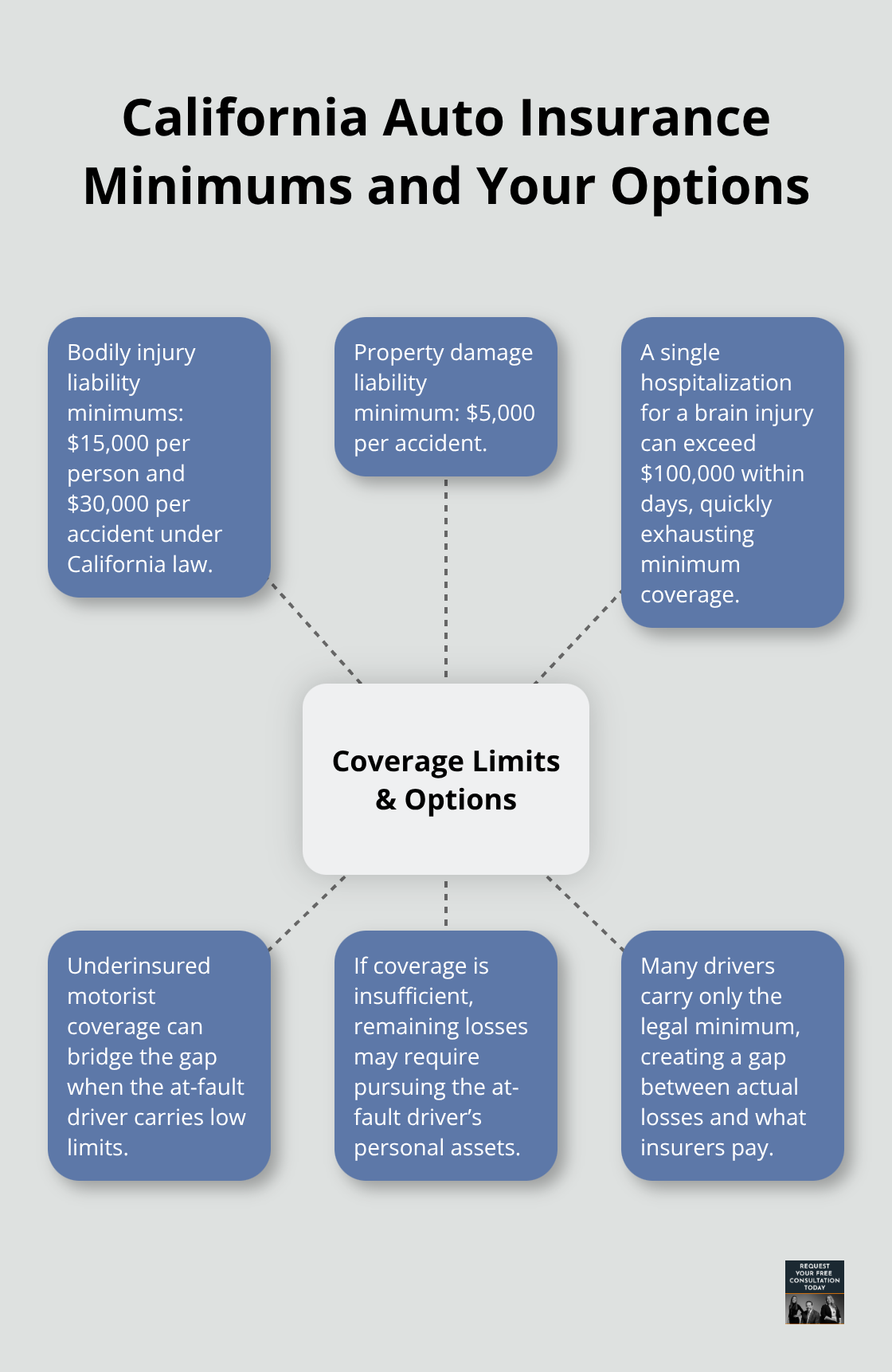
California requires drivers to carry minimum liability insurance, but these minimums often prove inadequate when serious injuries occur. The state mandates drivers maintain at least $15,000 in bodily injury liability per person and $30,000 per accident, plus $5,000 for property damage. A single hospitalization for a brain injury can exceed $100,000 within days, leaving the at-fault driver’s minimum policy coverage depleted before your medical treatment ends. Many drivers carry only the legal minimum because it costs less, creating a gap between what you need and what insurance will actually pay.
How Insurance Companies Assess Coverage Limits
Insurance companies assess fault using the same evidence discussed earlier, but their primary goal involves determining what portion of their policyholder’s coverage applies to your claim. An adjuster will argue your fault percentage is as high as possible to reduce the company’s payout obligation, then they’ll argue the policy limits cap their responsibility at the minimum. When you suffered $200,000 in damages but the at-fault driver carries only $30,000 in bodily injury coverage, the insurance company pays their full $30,000 limit and stops. You then pursue the remaining $170,000 through other means, which might include the at-fault driver’s personal assets, your own underinsured motorist coverage if you have it, or a lawsuit.
Why Underinsured Motorist Coverage Protects You
Carrying adequate uninsured and underinsured motorist protection on your own policy matters enormously for accident victims in Santa Cruz County, Sacramento, and Oakland. If you carry $100,000 in underinsured motorist coverage and the at-fault driver has $30,000 in liability coverage, your own policy bridges that gap up to $100,000. Without this protection, you absorb the loss yourself. The extra cost for underinsured motorist protection typically runs $15-30 monthly but protects you against exactly this scenario. Many people skip this coverage to save money on premiums, then face financial devastation when serious injuries occur.
Pursuing Personal Assets When Insurance Falls Short
When damages exceed available coverage, pursuing the at-fault driver’s personal assets becomes necessary, though collecting from individuals proves far harder than collecting from insurance companies. Courts can issue judgments against individual drivers, but actually recovering money from someone’s wages or bank accounts involves lengthy legal processes and often yields nothing if the driver has minimal assets. This gap between what you need and what insurance will actually pay becomes your problem unless you understand how coverage limits interact with your claim and what options exist when damages exceed policy boundaries. Strong evidence gathered immediately after your collision strengthens your position when pursuing recovery from available insurance coverage before pursuing personal assets.
Final Thoughts
California’s fault-based system means proving negligence and understanding comparative fault directly determines what compensation you receive after an auto accident. Road collision liability in California hinges on objective evidence gathered at the scene, how insurance companies assign fault percentages, and whether available coverage meets your actual damages. Many accident victims in Santa Cruz County, Sacramento, and Oakland lose thousands of dollars by failing to act quickly after a collision.
Insurance adjusters move fast to lock in statements and assign high fault percentages to injured parties, knowing most people won’t fight back. Collecting dashcam footage, photographing the scene, obtaining witness contact information, and seeking medical attention within days of your collision creates the foundation for protecting your claim. Without this evidence, you negotiate from weakness against a company with financial incentives to minimize what they pay.
We at Schaar & Silva LLP help accident victims navigate the complexities of liability claims and understand what compensation you might recover. Contact us for a case review to evaluate your options and learn how strong documentation shifts fault percentages in your favor.
