
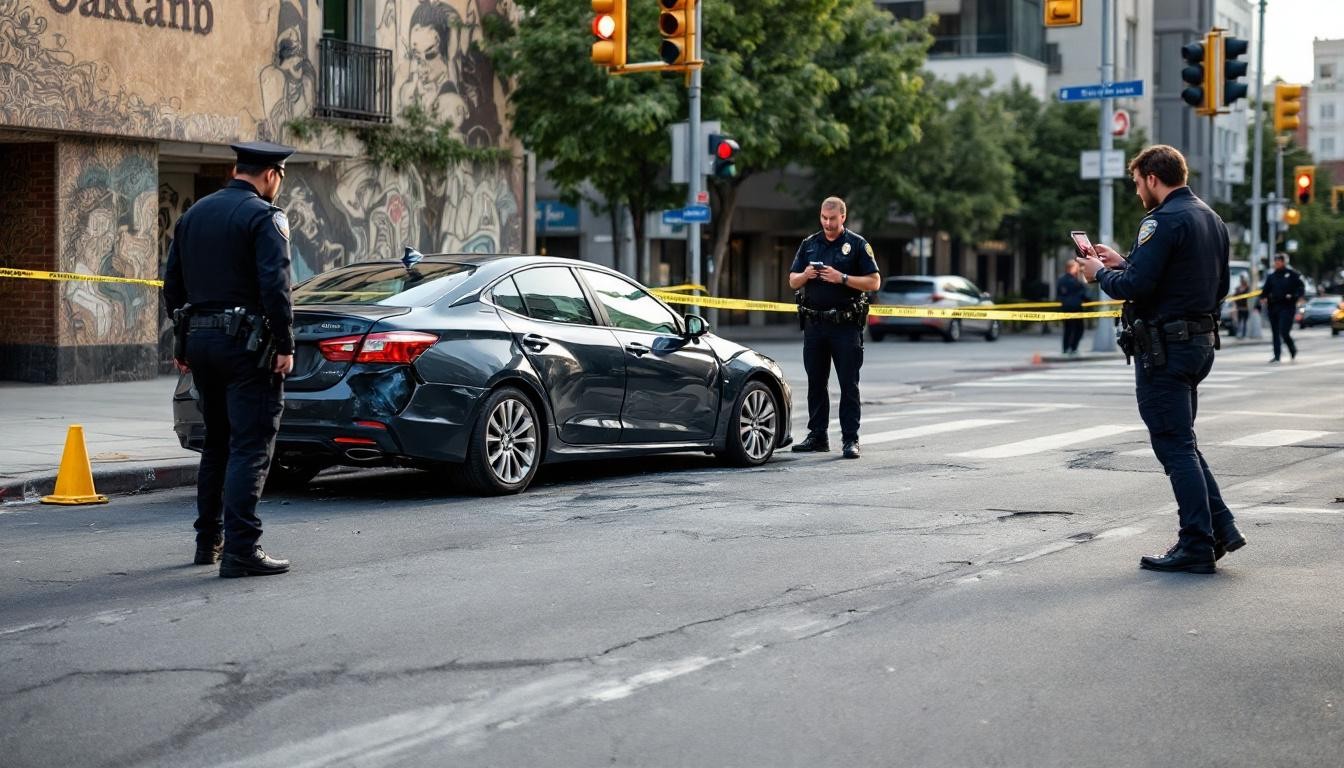
An Oakland hit-and-run can leave you injured, confused, and unsure of your next move. The first hours after the accident are critical-the actions you take now directly affect your ability to recover compensation later.
We at Schaar & Silva LLP have helped dozens of hit-and-run victims navigate this process. This guide walks you through exactly what to do right away.
Immediate Actions at the Scene of a Hit-and-Run
Photograph and Record Everything
The moments immediately after a hit-and-run are chaotic, but what you capture and record directly determines whether investigators can identify the driver. Your phone is your most powerful tool right now. Photograph the damage to your vehicle from multiple angles-close-ups of dents, scratches, and broken glass matter because paint transfer and debris patterns help forensic experts link the at-fault vehicle to the collision. Document the accident scene itself: road conditions, traffic signals, street signs, and skid marks.
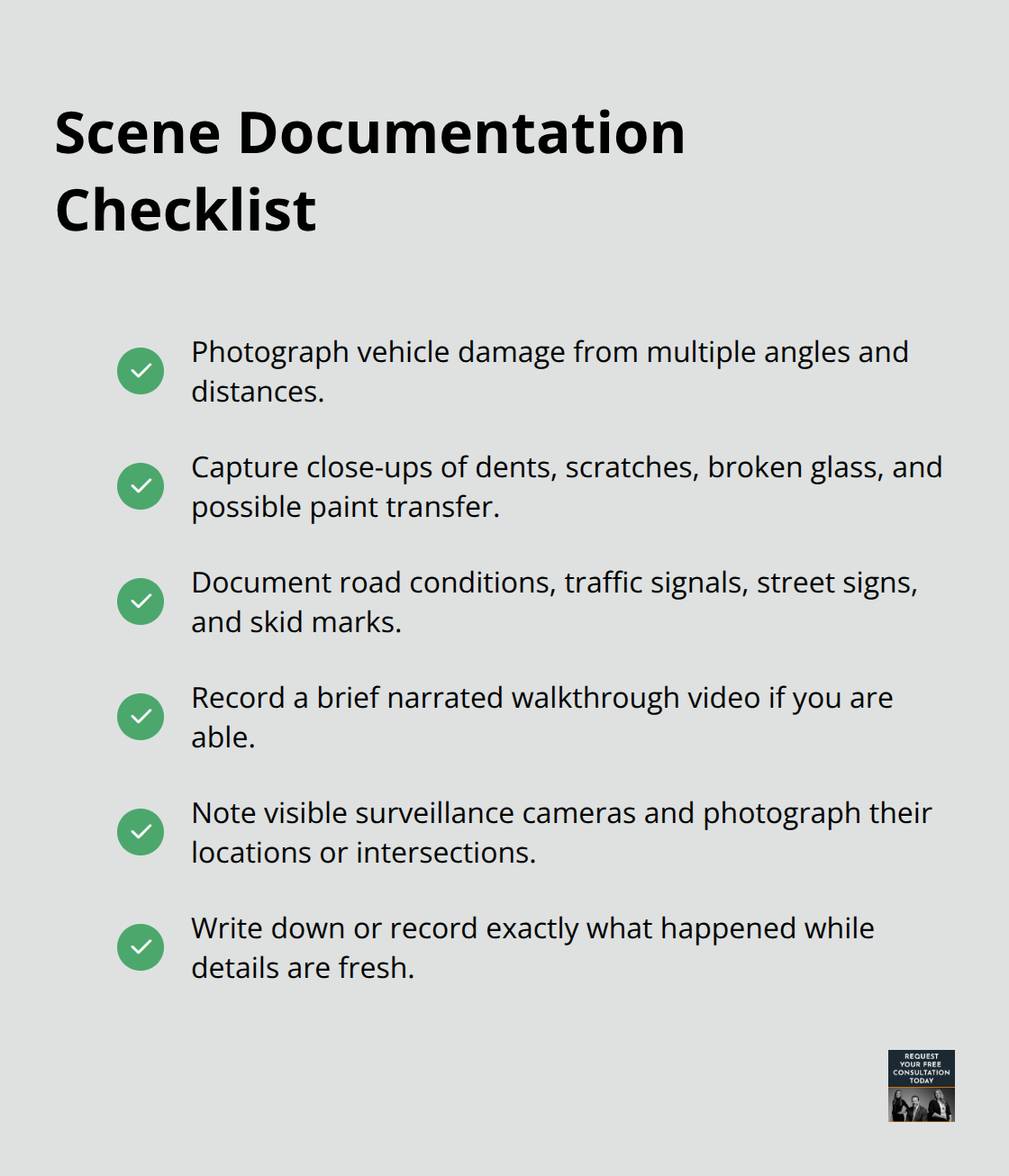
If there’s surveillance footage visible from nearby businesses or traffic cameras, note their locations immediately. Take photos of the street address or intersection so you can reference it later when filing your report with Oakland Police Department. Video footage proves even more valuable than still images because it captures movement and context. If you’re physically able, record a brief walkthrough of the scene and narrate what happened. California hit-and-run investigations rely on three categories of evidence: eyewitnesses, forensics, and circumstantial evidence. Your documentation feeds directly into the forensic and circumstantial categories that prosecutors need to build a case.
Collect Witness Information
Witness statements are your second priority because eyewitness testimony establishes that a hit-and-run occurred and identifies the driver. Approach anyone who saw the collision and ask for their name, phone number, email address, and what they observed. Ask specifically about the vehicle’s color, size, body style, and any visible damage-these details narrow down the search significantly.
If witnesses mention the license plate number, write it down exactly as they describe it, even if you’re unsure. Get their account of which direction the vehicle fled and at what speed. Don’t rely on memory; write everything down immediately or record their statement on your phone with their permission. When you file your police report with Oakland PD, you’ll need this witness contact information because investigators may follow up if additional information is needed after your report.
Record Vehicle Details
Note every detail about the fleeing vehicle you observed yourself: the make and model if visible, the color, any distinctive features like custom wheels or bumpers, and the license plate number if you caught any digits. Even partial plate information helps investigators narrow their search significantly. The more specific your details, the higher the likelihood that Oakland Police can identify the at-fault driver before evidence degrades. This information becomes the foundation for your official report and any subsequent investigation.
Reporting Your Hit-and-Run to Oakland Police
File Your Report Immediately
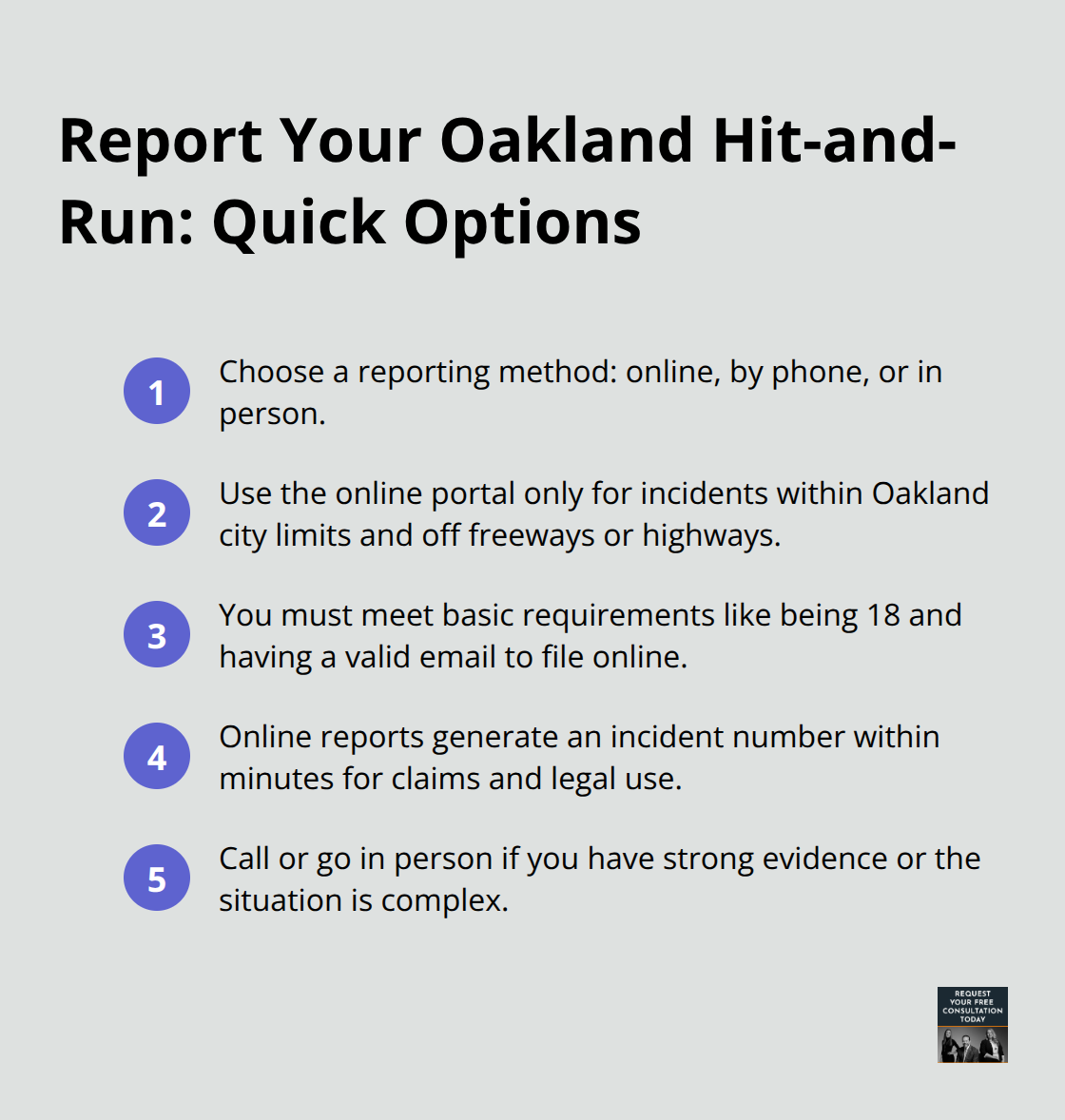
File a report with the Oakland Police Department right after a hit-and-run. The faster you report, the fresher the evidence and the higher the chance investigators locate the at-fault driver. Oakland offers three reporting methods: online, by phone, or in person. The online portal works only if the incident occurred within Oakland city limits, happened off a freeway or highway, and you meet basic requirements like being 18 years old with a valid email. This option takes minutes and generates an incident number instantly, which you’ll need for insurance claims and legal action.
Choose the Right Reporting Method for Your Situation
If you have photos, video, or you know the suspect’s identity, skip the online system and call Oakland Police at 510-777-3333 or report in person at 455 7th Street, Room 306. If the damage exceeds $5,000, the hit-and-run occurred outside Oakland, or it involved a hate crime, you must report in person or by phone. The phone line operates 24/7, so time of day doesn’t matter. When you report, provide every detail you documented at the scene: witness names and contact information, vehicle descriptions, partial or full license plate numbers, paint transfer evidence, and the exact location with street addresses or intersection names.
Provide Evidence That Identifies the Driver
Investigators frequently rely on physical evidence like tire marks, paint, and glass to reconstruct the crash and assign fault, so specificity matters tremendously. Paint transfer on a suspect vehicle serves as visual proof of involvement. Surveillance footage can identify the vehicle and driver. Vehicle damage records, especially paint transfer, link a fleeing driver to the crash. DNA analysis and blood evidence can indicate seatbelt use and involvement of individuals. Tire marks and other forensic details help estimate speed and crash dynamics. The more specific your details, the higher the likelihood that Oakland Police can identify the at-fault driver before evidence degrades.
Request Your Police Report Through Public Records
After filing your report, request a copy of the police report through Oakland’s Public Records Request process. Contact the Public Records Request Coordinator at opdrecordrequest@oaklandca.gov, by phone at 510-238-7143, or mail a written request to OPD Records Section, 455 7th Street, Room 306, Oakland, CA 94607. Copies cost five cents per page, and you’ll receive a response within 10 calendar days. This report becomes essential documentation for your insurance company, which typically requires an incident number and police report before processing your claim. The report also protects you legally because it establishes an official record of what happened, when it happened, and what evidence exists. If investigators need additional information after your initial report, you can add details later using your incident number. Strong evidence-witness statements, surveillance footage, and vehicle damage records-improves your likelihood of recovering compensation significantly. The sooner you have this report, the sooner you can move forward with insurance negotiations or legal action.
Medical Care and Insurance Claims After a Hit-and-Run
Seek Medical Attention Immediately
Get medical attention right after a hit-and-run, even if you feel fine. Adrenaline masks injuries that appear hours or days later, and treatment delays weaken your insurance claim because insurers connect gaps in medical records to claims of exaggeration. Document every injury with photographs and maintain detailed records of all medical visits, treatments, prescriptions, and therapy sessions. Your medical documentation directly increases your settlement value because insurers calculate damages based on treatment costs, injury severity, and recovery timeline.
Report to Your Insurance Company
Contact your insurance company and provide your incident number from the police report. Explain that an unidentified driver hit you and fled the scene. Your insurer activates your uninsured motorist coverage, which typically covers medical expenses, lost wages, and vehicle damage when the at-fault driver cannot be identified or located. Report the incident to your insurer within 30 days to avoid coverage disputes later.
Provide copies of your police report, witness statements, photographs of vehicle damage, and any medical records you’ve accumulated. Your insurer may assign an adjuster to investigate independently and will request surveillance footage, witness contact information, and your detailed account of what happened at the scene. California Vehicle Code Section 20001 establishes that hit-and-run drivers face fines up to $10,000 and up to three years in prison for injury cases, so your insurance company takes these claims seriously.
Use Medical Lien Services to Cover Bills
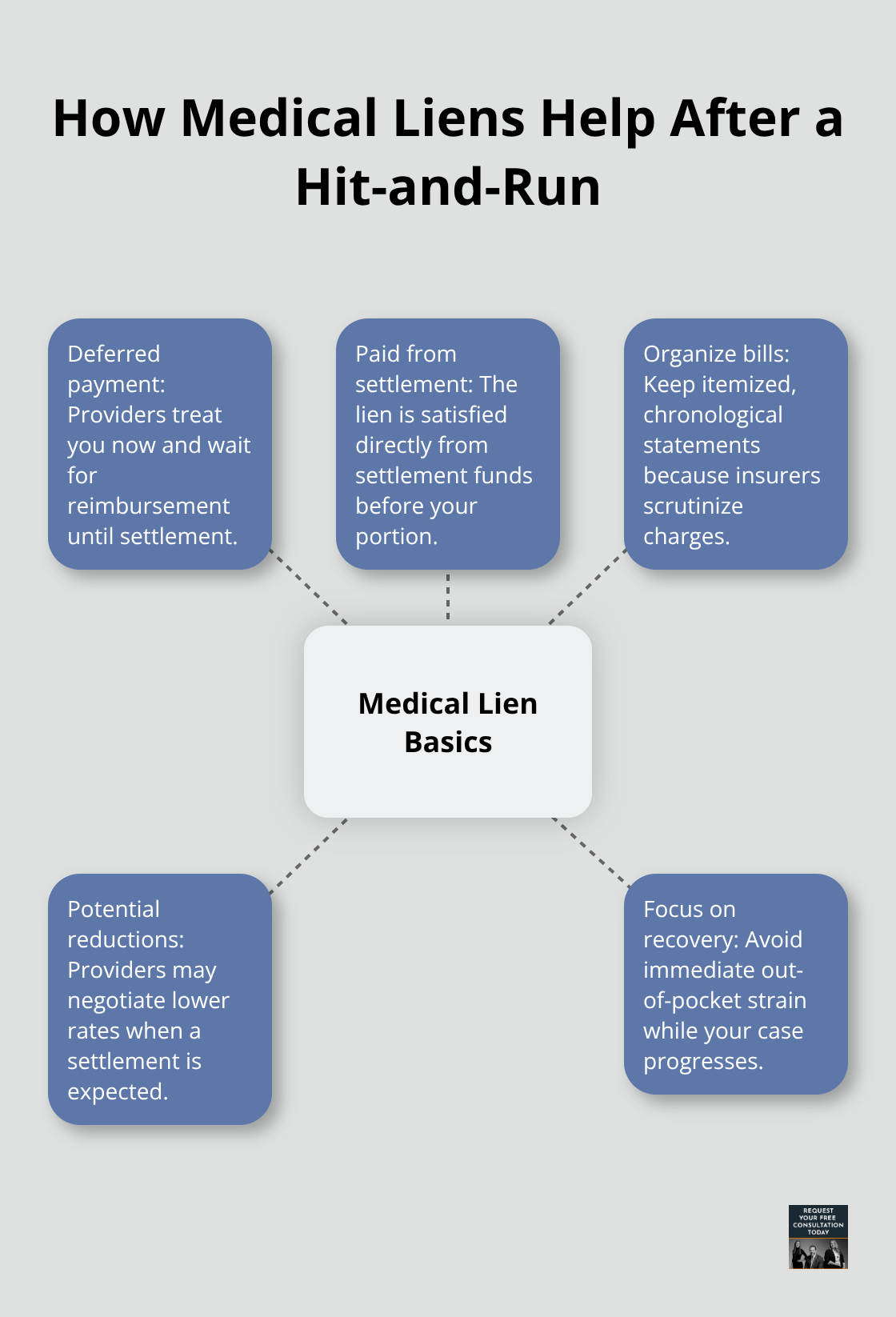
Medical bills from hit-and-run injuries accumulate quickly, and many victims cannot afford to pay out of pocket while waiting for case resolution. Medical lien services allow healthcare providers to defer payment until your case settles, meaning you receive treatment now without immediate payment obligations. The provider agrees to wait for reimbursement from your settlement proceeds, protecting your credit and allowing you to focus on healing rather than bankruptcy risk.
When you settle your case through insurance or legal action, the lien is paid directly from settlement funds before you receive your portion. Request itemized medical bills from every provider and maintain them in chronological order because insurers scrutinize charges carefully. If bills seem inflated, your medical providers may negotiate lower rates, especially when they know a settlement is coming (this is particularly true for providers experienced with personal injury cases).
Organize Documentation for Maximum Settlement Value
The more comprehensive your medical records, the stronger your negotiating position when demanding fair compensation for your losses. Insurers link treatment costs, injury severity, and recovery timeline to settlement amounts, so thorough documentation matters tremendously. Keep all receipts, invoices, and correspondence from healthcare providers in one organized file. This documentation becomes your foundation when negotiating with insurance adjusters or pursuing legal action against the at-fault driver once they are identified.
Final Thoughts
An Oakland hit-and-run investigation involves complex interactions between police evidence collection, insurance negotiations, and potential criminal prosecution of the at-fault driver. Insurance adjusters scrutinize every detail of your claim and employ tactics designed to minimize payouts. Without legal guidance, you risk accepting settlements far below what your injuries and losses actually warrant.
We at Schaar & Silva LLP understand how Oakland Police investigations work, what evidence carries weight with insurance companies, and how to value your claim accurately. We connect you with medical lien services so you receive treatment without financial hardship while your case develops. We evaluate property damage claims and fight for fair valuations that reflect the true cost of repairs or replacement.
Contact our office for a free consultation about your Oakland hit-and-run case. Bring your police report, witness contact information, medical records, and photographs from the scene. You focus on healing while we handle the legal complexities.
