
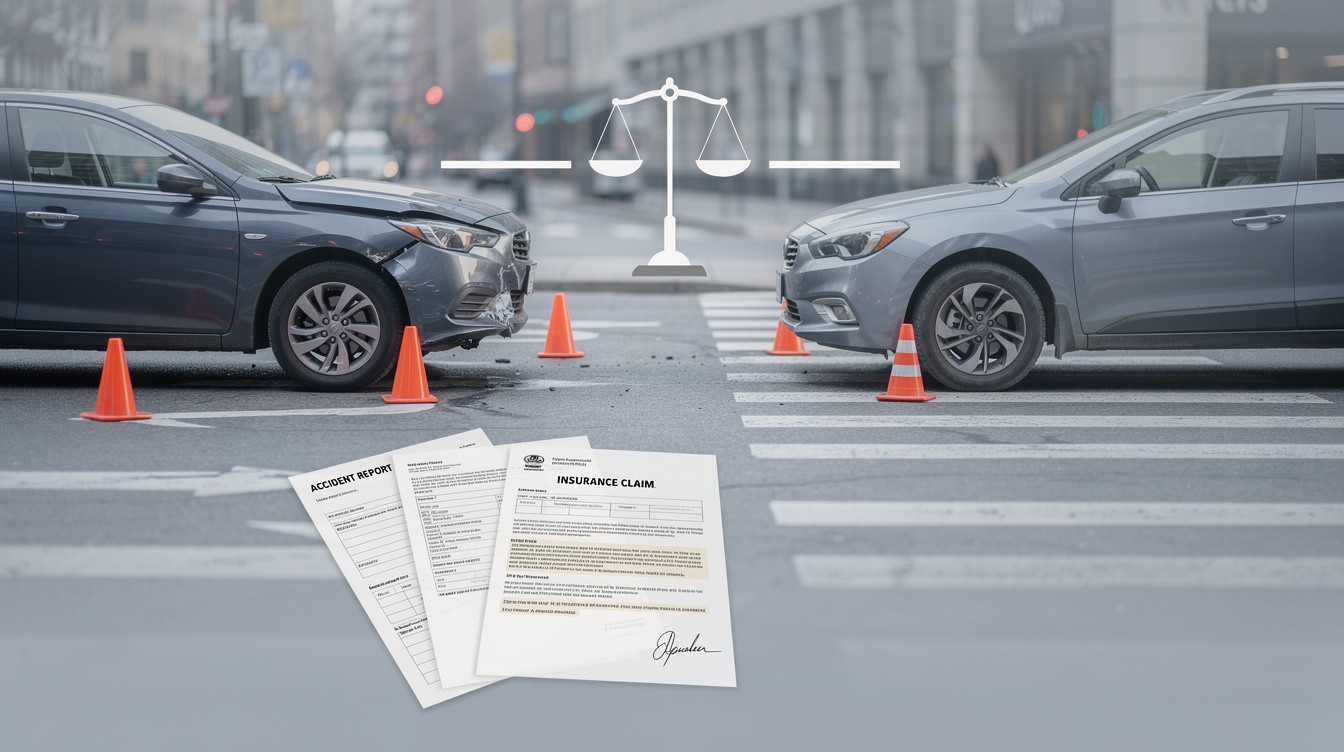
After a vehicle accident, figuring out who’s responsible isn’t always straightforward. Liability in vehicle accidents depends on evidence, insurance assessments, and California’s specific legal rules.
At Schaar & Silva LLP, we help accident victims understand how fault gets determined and what it means for their case. When multiple parties share blame, the compensation you receive changes significantly.
How Liability Gets Determined After an Accident
Police Reports and Initial Evidence
Police reports form the foundation of liability determination, but they don’t represent the final word. The officer who arrives at the scene documents vehicle positions, witness statements, and visible damage-yet this report carries weight as evidence rather than legal proof. Insurance companies use these reports as a starting point, then conduct their own investigations by reviewing medical records, obtaining additional witness statements, and sometimes hiring accident reconstruction professionals. In Santa Cruz County, California law requires that liability be established through a preponderance of the evidence standard, meaning it must be more likely than not that one party caused the accident. This standard is significantly easier to prove than criminal standards, which is why many accident victims successfully recover compensation even when fault seems unclear initially.
How Insurance Adjusters Assess Fault
Insurance adjusters often try to minimize payouts by shifting blame to accident victims or claiming shared fault where none exists. The initial insurance determination frequently underestimates a victim’s claim. Physical evidence collected immediately after the accident counters these tactics: photographs of vehicle damage, road conditions, traffic signals, and skid marks provide objective proof that adjusters cannot easily dispute. Witness statements matter tremendously, particularly from neutral parties who have no stake in the outcome. Medical records that document your injuries create a clear link between the accident and your damages.
Building a Strong Liability Case
When negligence is present, California law holds the responsible party accountable regardless of their insurance coverage limits (though uninsured motorist claims may apply in certain situations). Acting quickly to preserve evidence and understand how insurance companies operate in Santa Cruz County specifically strengthens your position. The next section explores how liability becomes complicated when multiple parties share responsibility for an accident.
How Shared Fault Reduces Your Compensation
California’s Comparative Negligence Rule
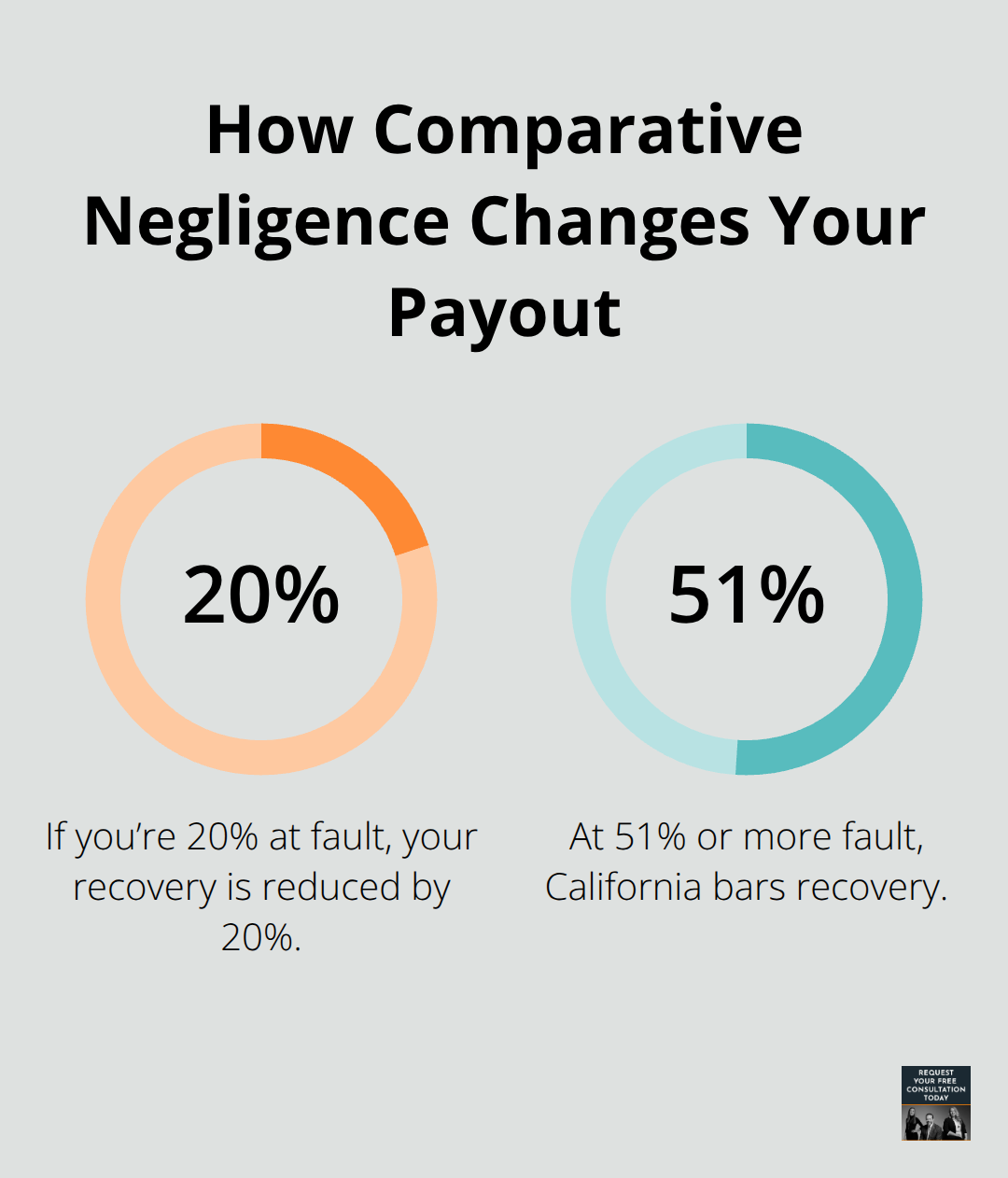
California’s comparative negligence law allows you to recover damages even if you share partial fault for an accident, but your compensation decreases by your percentage of blame. If you carry 20% responsibility for a collision and your total damages reach $100,000, you receive $80,000. Once you reach 51% or more fault, California law bars you from recovering anything. This rule transforms how settlements work in multi-vehicle accidents and gives insurance adjusters a powerful tool to reduce payouts.
How Insurers Weaponize Fault Percentages
Insurance adjusters inflate your fault percentage to slash settlement offers, often without solid evidence. A rear-end collision where another driver clearly hits you from behind might become a shared-fault scenario if the adjuster claims you had a broken taillight or failed to signal a lane change. These claims frequently lack supporting documentation, yet they reduce settlement offers by thousands of dollars. Accident reconstruction reports (typically costing $2,000 to $5,000) challenge inflated fault assessments and often recover far more in increased settlements. Neutral witness statements carry tremendous weight when insurers dispute fault percentages-testimony from witnesses with no stake in the outcome can shift liability balance entirely in your favor.
Liability Distribution in Multi-Vehicle Accidents
Multi-vehicle accidents create compounding complexity because liability distributes across three or four parties simultaneously. A chain-reaction collision on Highway 17 near Santa Cruz might involve the initial striking driver, a second driver who failed to brake properly, and potentially a vehicle manufacturer if a brake defect contributed to the sequence. Each party carries insurance, and each insurer attempts to minimize their client’s exposure by shifting blame elsewhere. The Ford tire rollover case that produced a $70 million verdict illustrates how product defects constitute a major liability component even when driver error also played a role. Some cases involve shared liability with manufacturers when vehicle defects amplified the accident’s severity.
Preserving Evidence to Counter Competing Fault Claims
Immediate evidence preservation prevents insurers from reconstructing the scene in ways that favor their narrative. Photographs showing all vehicle positions, damage patterns, and road conditions provide objective proof that counters competing fault claims. Medical records linking your injuries to the accident demonstrate causation and prevent adjusters from arguing your damages stem from pre-existing conditions unrelated to the collision. When multiple parties share responsibility, the evidence you collect immediately after the accident determines whether you recover full compensation or accept a reduced settlement. Understanding how liability distributes across defendants becomes critical when you face complicated accident scenarios.
When Liability Gets Complicated
Rear-End Collisions and Presumed Fault
Rear-end collisions seem straightforward until insurance adjusters start claiming you caused the accident by failing to maintain proper distance or not signaling a lane change. California law places presumed fault on the rear-end driver because they have a legal duty to maintain safe following distance regardless of circumstances. Yet adjusters frequently dispute this presumption by arguing you stopped suddenly, had broken brake lights, or made an unexpected lane change. Accident reconstruction reports become essential in these situations because they document road conditions, vehicle speeds, and braking patterns that eliminate subjective arguments. If you were rear-ended on Highway 17 near Santa Cruz, photographs of your vehicle’s final position, brake light condition, and the other vehicle’s damage pattern provide objective evidence that counters inflated fault claims.
Left-Turn Accidents and Competing Liability Arguments
Left-turn accidents present different complications because both drivers often hold legitimate liability arguments. The driver making the left turn must yield to oncoming traffic, yet the approaching driver must avoid collisions when reasonably possible. Insurance adjusters weaponize this ambiguity by claiming you failed to yield, even when witness statements clearly show you entered the intersection legally. In these situations, witness testimony from neutral parties carries exceptional weight because adjusters cannot easily discount independent observations. Neutral witnesses who saw traffic signal colors, vehicle speeds, or driver actions at the moment of impact shift liability determination dramatically in your favor.
Hit-and-Run Cases and Uninsured Motorist Coverage
Hit-and-run accidents create the most frustrating liability scenarios because the responsible driver vanishes, leaving you without a clear defendant. California’s uninsured motorist coverage applies in these cases, but only if you carry this protection on your policy. Many accident victims discover too late that their uninsured motorist limits fall far below their actual damages. If you were hit by an uninsured driver in Oakland or Sacramento, your own insurance becomes the primary recovery source, making your policy limits critically important. Dashboard camera footage or witness descriptions of the fleeing vehicle significantly strengthen your uninsured motorist claim by providing evidence that an actual collision occurred.
Evidence Preservation in Complex Scenarios
These complicated scenarios demand immediate evidence preservation and experienced legal guidance to maximize your recovery. Photographs showing all vehicle positions, damage patterns, and road conditions provide objective proof that counters competing fault claims. Medical records linking your injuries to the accident demonstrate causation and prevent adjusters from arguing your damages stem from pre-existing conditions unrelated to the collision. When multiple parties share responsibility, the evidence you collect immediately after the accident determines whether you recover full compensation or accept a reduced settlement. The legal team at Schaar & Silva LLP can help you navigate these complex situations and protect your rights throughout the claims process.
Final Thoughts
Liability in vehicle accidents rarely follows a simple path, and insurance adjusters weaponize fault percentages to reduce what you receive. Manufacturers sometimes share responsibility through defective products, and California’s comparative negligence law means your compensation shrinks with each percentage point of assigned blame. The evidence you collect immediately after an accident determines whether you recover full damages or accept a reduced settlement that leaves you financially short.
Acting quickly matters tremendously because California law gives you two years to file a wrongful death claim, yet evidence degrades rapidly and witness memories fade within weeks. Photographs of vehicle positions, damage patterns, and road conditions provide objective proof that counters inflated fault claims. Medical records linking your injuries to the accident prevent adjusters from arguing your damages stem from unrelated conditions, and dashboard camera footage strengthens your case exponentially when liability becomes disputed.
We at Schaar & Silva LLP understand how insurance companies operate in Santa Cruz County and across California, and our team helps accident victims navigate complex liability scenarios and challenge inflated fault assessments. Contact us to discuss your accident and understand how shared liability affects your recovery, because the sooner you reach out, the sooner we can begin preserving evidence and building your case.
