
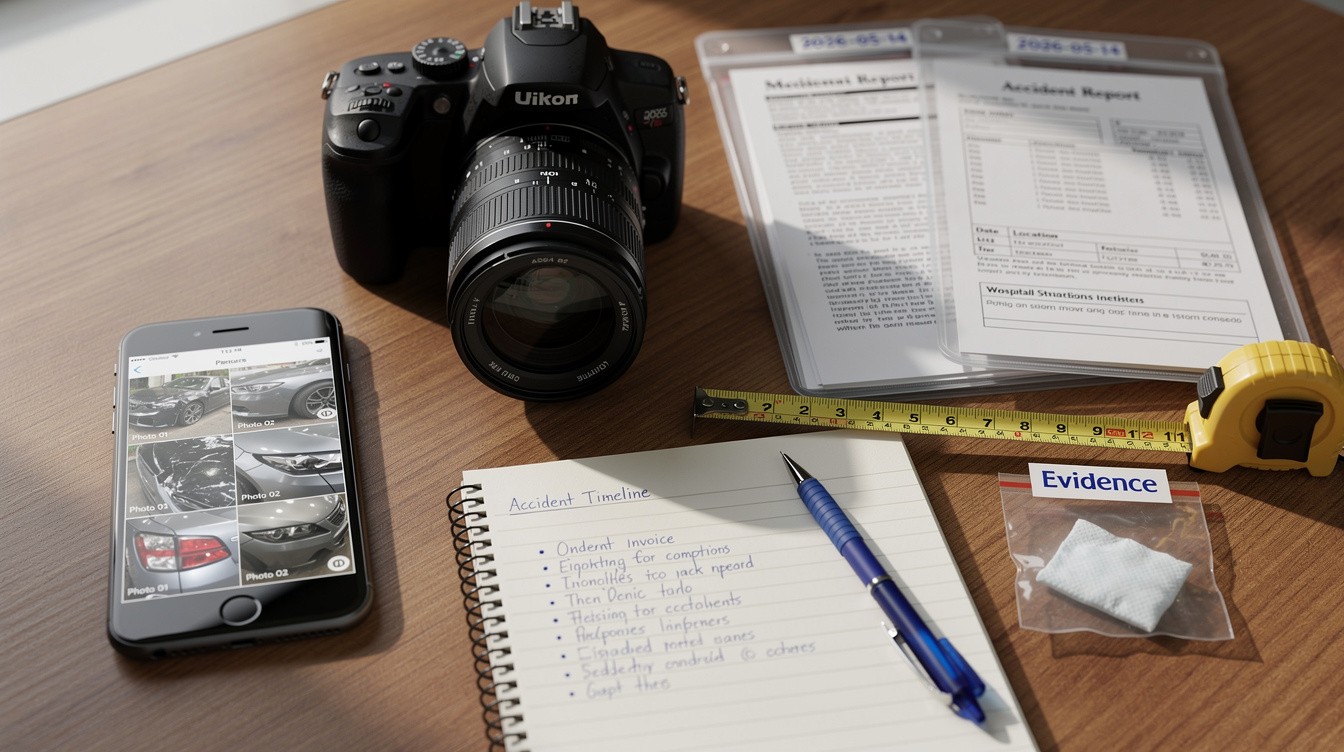
After a crash, the decisions you make in the first hours and days directly impact your claim. Injury documentation after a crash creates the foundation that insurance companies and courts rely on to understand what happened to you.
We at Schaar & Silva LLP have seen how organized evidence changes outcomes. This guide walks you through exactly what to photograph, what records to collect, and how to build a file that speaks for itself.
How to Photograph Your Injuries Right After a Crash
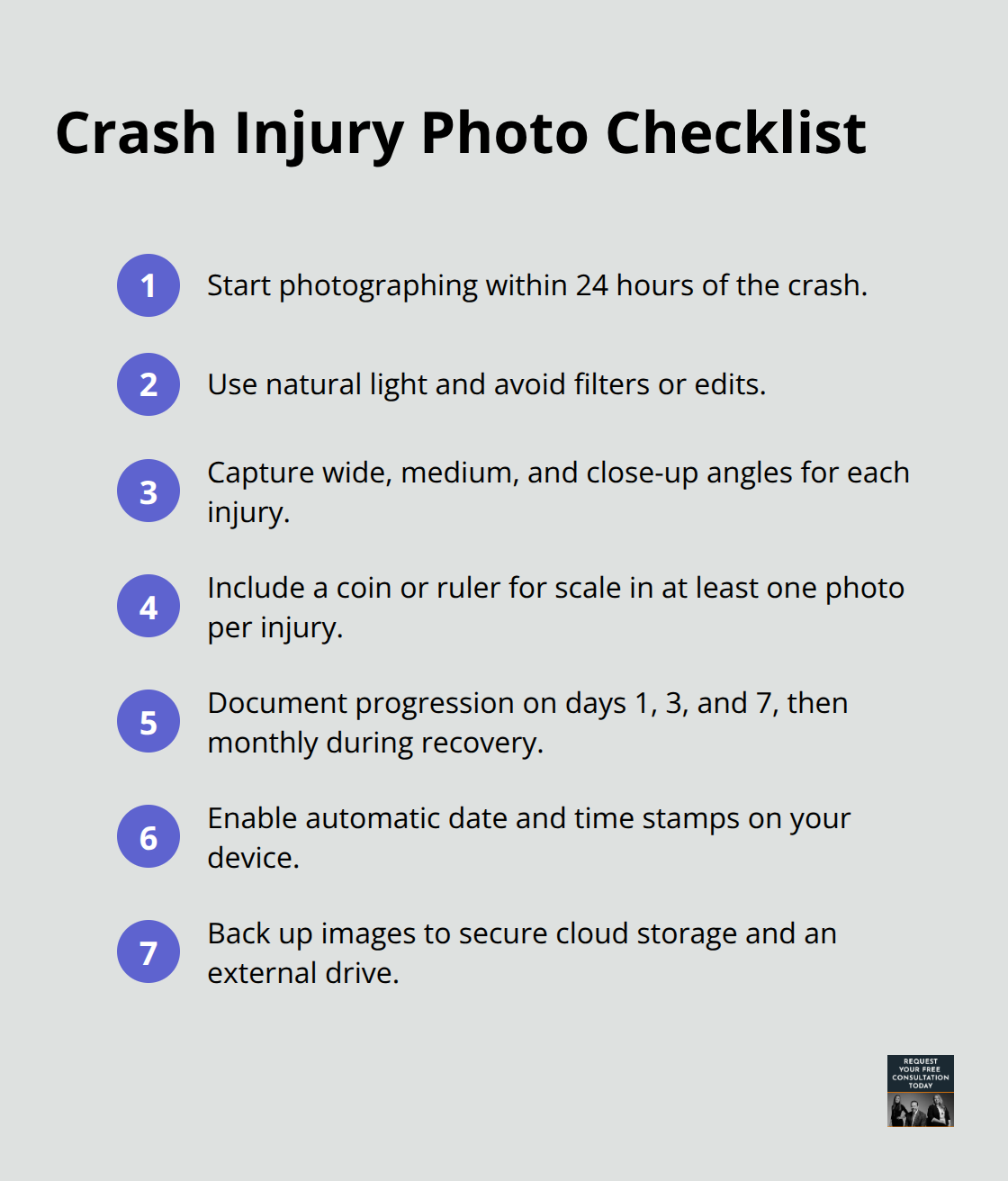
Start Photographing Within 24 Hours
Take photos of visible injuries immediately after the crash, as the visual record you create in these early moments becomes the most powerful evidence in your claim. Insurance companies scrutinize injury photos heavily because they show the immediate impact of the crash before swelling, bruising, or other effects change appearance.
Use Proper Technique and Lighting
Use natural lighting and avoid filters or editing of any kind-adjusting colors or clarity raises red flags during claim review. Photograph from multiple angles: wide shots showing the injured area in context, medium shots for detail, and close-ups that reveal texture and severity. Include a scale object like a coin or ruler in at least one photo per injury so adjusters can assess size accurately.
Document Injury Progression Over Time
Take photos on days one, three, and seven after the crash, then monthly during recovery, capturing how bruises deepen or fade, how swelling develops or decreases, and how visible marks change over time. This progression matters tremendously-it demonstrates that your injuries were real and that recovery took weeks or months, not days. The visual timeline you build becomes far more persuasive than any written description alone.
Protect Your Photo Records
Store all photos with automatic date and time stamps enabled on your phone or camera. Back up images immediately to a password-protected cloud service or external hard drive kept in a separate location from your phone. If your phone is damaged in the crash, this backup becomes irreplaceable. Many people lose photos when devices fail or get replaced, so redundant storage protects your evidence.
Create a simple spreadsheet alongside your photos listing the date, time, location, and which body parts appear in each image. This organized photo record-combined with your medical records-tells a complete story that adjusters cannot ignore or minimize. With your injury documentation in place, the next step involves gathering the medical records that support and validate what your photos show.
Organize Your Medical Records Systematically
Request Records from Every Provider Immediately
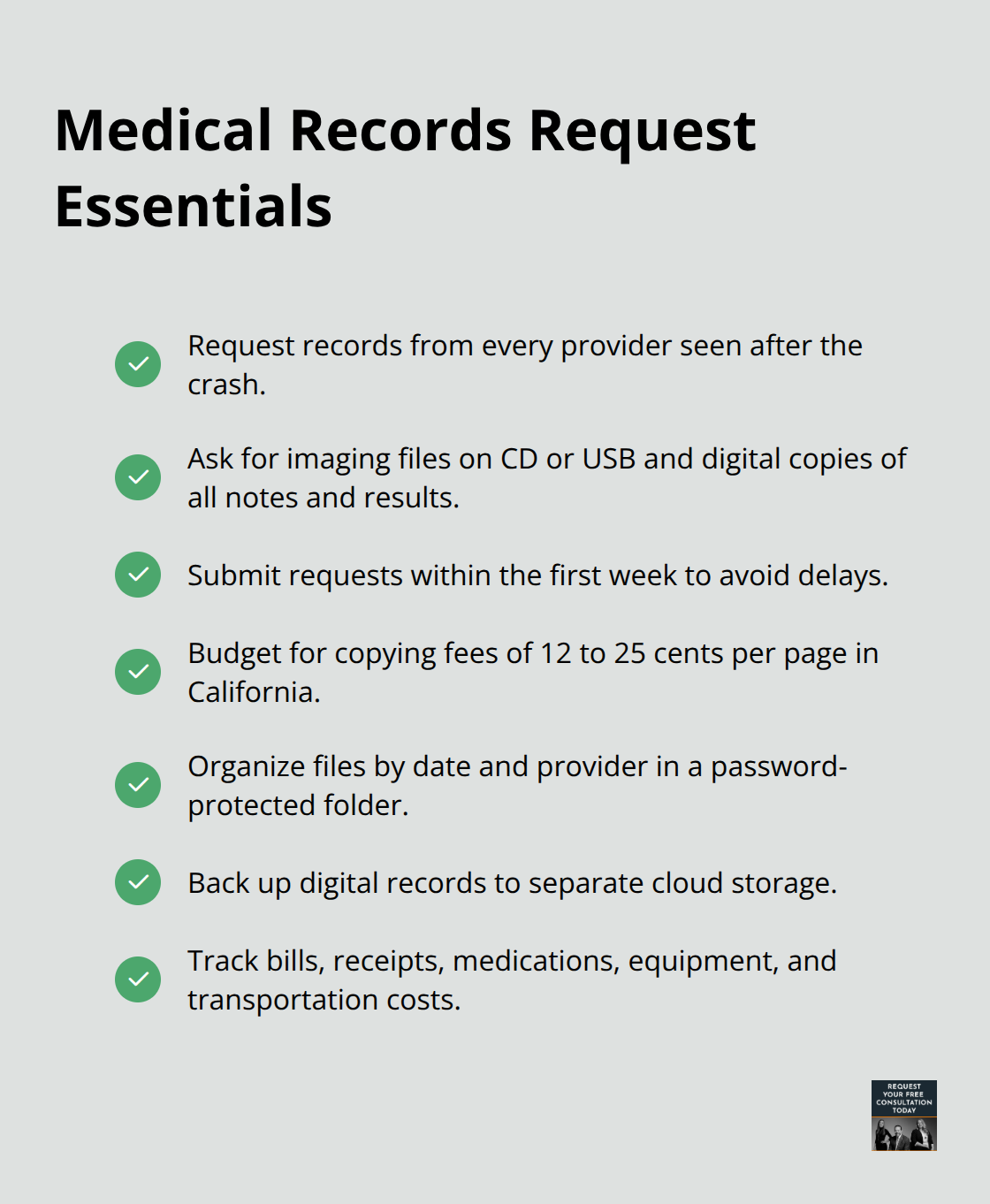
Medical records form the backbone of your claim because they document what doctors observed, diagnosed, and treated. Request records from every provider you saw after the crash, including emergency rooms, urgent care clinics, primary care physicians, physical therapists, and any other treatment providers. Start making these requests within the first week after your crash, not months later when memories fade and files get archived. Most healthcare providers in California require a written request with your signature and patient ID, though many now allow online requests through patient portals.
Create a Master List of All Providers
Create a master list with provider names, addresses, phone numbers, appointment dates, and the type of care received so you know exactly where to follow up. When you call, ask specifically for imaging files on CD or USB and request digital copies of all notes, test results, and treatment summaries. Some providers charge copying fees between 12 to 25 cents per page in California, so budget accordingly if you have extensive records. Store digital copies in a password-protected folder organized by date and provider name, then back up this folder to cloud storage separate from your computer.
Collect and Organize Medical Bills and Receipts
Bills and receipts matter as much as medical notes because they prove what you actually paid and what ongoing treatment costs. Gather invoices from hospitals, doctors, physical therapists, and any other providers, then cross-reference them against your medical records to confirm they match the dates and services documented. Keep receipts for medications prescribed after the crash, medical equipment like braces or ice packs, and transportation costs to appointments. If treatment continues, collect bills monthly so your documentation stays current throughout recovery.
Track Expenses by Category and Date
Many people underestimate this step and lose track of smaller expenses like copays or pharmacy costs, which add up significantly over weeks of treatment. Organize these financial documents in a separate folder labeled by month, then create a simple spreadsheet totaling medical expenses by category and date. This organized financial record removes any doubt about what your injuries cost you and strengthens your position when negotiating with insurance adjusters. With your medical records and bills in order, you now have the foundation to build a comprehensive evidence file that tells your complete story.
How to Organize Your Evidence Into One Cohesive File
Scattered evidence across your phone, email, and filing cabinets weakens your claim significantly. Insurance adjusters handle hundreds of cases monthly and spend minutes reviewing each one-disorganized documentation gets dismissed quickly while a consolidated file receives serious attention. Create a single master folder on your computer with subfolders organized by category: Photos, Medical Records, Bills and Receipts, Witness Information, and Daily Symptom Journal.
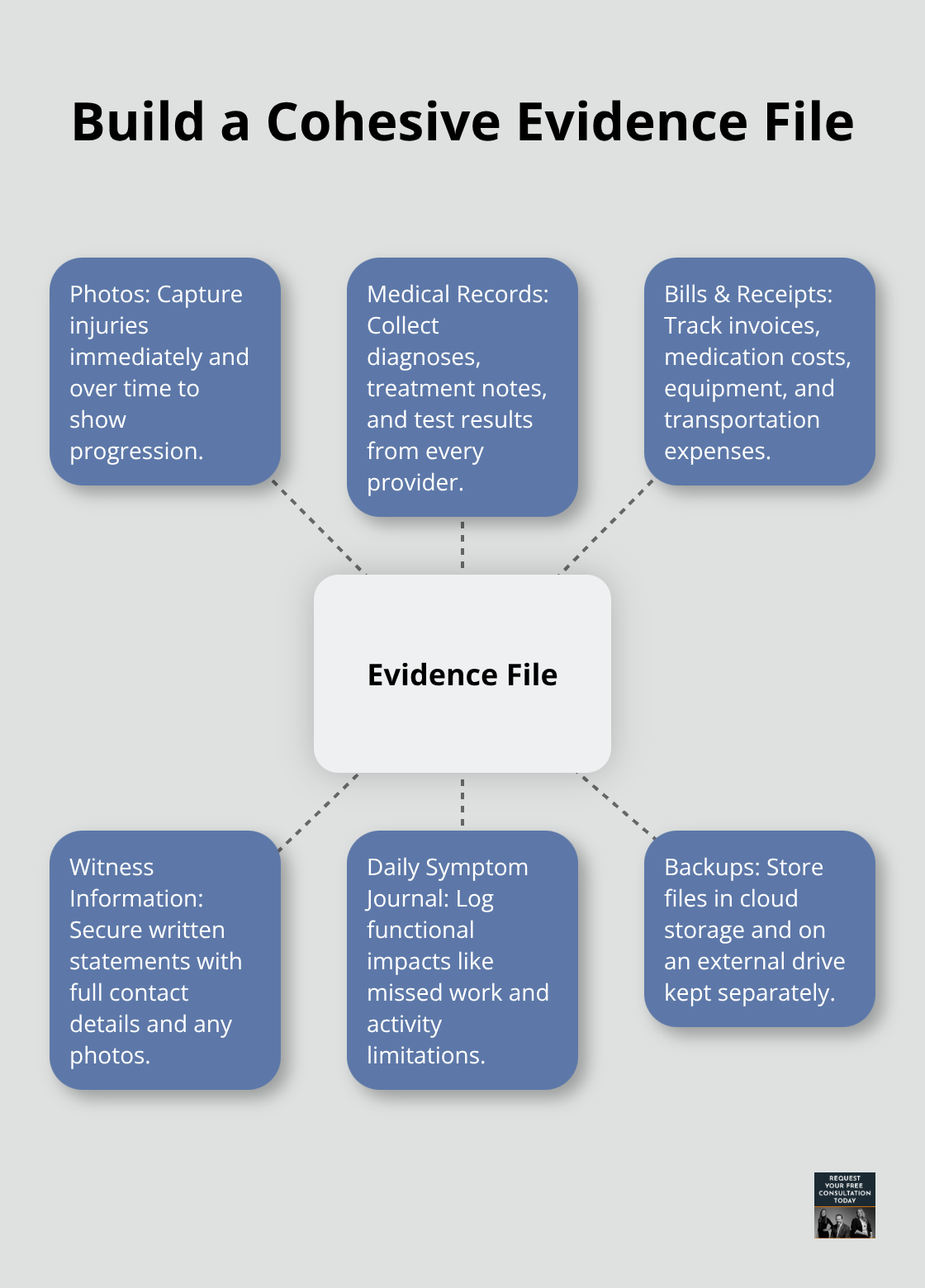
Within each subfolder, organize documents by date so the timeline of your injury becomes immediately obvious. Name your files descriptively (for example, Injury_Photo_Day3_Left_Arm_Bruising or Hospital_ER_Visit_July16_2026) so you can locate specific documents without opening each one. Back up this entire folder to cloud storage like Google Drive or Dropbox with a strong password, then keep a second backup on an external hard drive stored separately from your home. If your primary devices fail or get damaged, these backups protect evidence that took weeks to gather.
Collect Witness Statements Within 48 Hours
Witnesses matter far more than most people realize-their statements often determine whether fault is clear or disputed. Contact anyone who saw what happened within 48 hours of the crash and ask them to provide their account in writing or via email, including their full name, phone number, address, and what they observed about how the crash occurred. If they refuse to write it down, offer to type their statement and send it to them for approval. Store all witness communications in your Evidence folder with dates clearly marked. Photographs of accident scenes taken by witnesses also carry significant weight, so ask if they captured any images. Insurance companies weigh independent witness statements far more heavily than statements from the injured party alone, so prioritize collecting these accounts early when details remain fresh.
Track Daily Functional Impact in a Journal
Pain levels matter less to adjusters than functional impact-showing that injuries prevented you from working, parenting, or performing routine tasks demonstrates real damages. Start a simple daily journal the day after your crash and document specific activities you could not perform due to your injuries. Write entries like “Unable to lift my daughter due to shoulder pain” or “Missed three days of work because I could not drive” or “Slept only two hours due to back pain and headaches.” Include dates, times, and specific impacts rather than vague statements. After one month, review your journal and note patterns-if you consistently could not work or perform household tasks, that pattern strengthens your claim substantially. Many people skip this step and later struggle to explain why their medical bills were high or why they missed work, but a contemporaneous journal created during recovery removes all doubt about injury severity and its real-world consequences.
Maintain Redundant Backups for Protection
Store your complete evidence file in at least two separate locations to prevent loss from device failure or damage. Use cloud storage with strong passwords and keep physical backups on external hard drives stored away from your home or office. If your phone or computer fails after a crash, these redundant backups protect weeks of work gathering photos, medical records, and documentation. Test your backups quarterly to confirm files remain accessible and uncorrupted. This organized evidence file-photos, medical records, bills, witness statements, and functional impact documentation (combined with your backup system)-becomes your complete story, one that adjusters cannot minimize or dispute.
Final Thoughts
Your organized evidence file answers the questions adjusters always ask: What injuries did you sustain? How severe were they? How long did recovery take? What did treatment cost? How did injuries affect your daily life? Insurance companies pay claims based on evidence, not on how badly you were hurt, so injury documentation after a crash demonstrates that you took your recovery seriously and that your claim rests on facts, not emotion. A well-organized file with photos, medical records, bills, and witness statements removes all doubt and prevents adjusters from questioning or minimizing your claim.
Adjusters move faster and offer higher settlements when they can quickly verify medical treatment, see injury progression through photos, and understand functional impact through your journal entries. Disorganized claims get questioned, delayed, and undervalued because adjusters handle hundreds of cases monthly and spend minutes reviewing each one. Your evidence file (organized by category and date with redundant backups) receives serious attention while scattered documentation across your phone, email, and filing cabinets gets dismissed quickly.
If you are in Santa Cruz County, Sacramento, or Oakland and need guidance organizing your evidence or understanding your claim, we at Schaar & Silva LLP can review your documentation and help you prepare for negotiations with insurance companies. Many claims resolve faster and for more money when legal guidance starts early. Your injury documentation is your strongest tool.
