

Car accidents in California leave people with serious injuries that demand fair compensation. Bodily injury claims involve complex calculations, insurance rules, and negotiations that most people don’t understand.
At Schaar & Silva LLP, we help accident victims navigate these claims and recover what they deserve. This guide breaks down how bodily injury compensation works in California so you know what to expect.
What Injuries Do Auto Accidents Cause
Whiplash and Neck Injuries
Whiplash remains the most common injury from California car accidents, affecting the soft tissues in your neck when your head snaps forward and backward during impact. Settlement values for whiplash range from $15,000 to $75,000 depending on severity, treatment duration, and whether imaging shows disc damage. Many people underestimate whiplash because symptoms appear hours or days after the crash-neck stiffness, headaches, and limited range of motion often worsen before improving.
Seek medical evaluation immediately if you experience these symptoms; delaying treatment gives insurers ammunition to claim your injuries aren’t serious. Document every symptom in detail, including how the injury affects your daily activities, work capacity, and sleep. Insurers frequently dispute whiplash claims by arguing the mechanism was too minor or that your symptoms are exaggerated, so having a treating physician document the medical necessity of physical therapy, injections, or imaging strengthens your position significantly.
Traumatic Brain Injuries
Traumatic brain injuries represent some of the most severe outcomes from auto accidents in California. Brain injuries range from mild concussions causing headaches and concentration problems to moderate injuries resulting in memory loss and cognitive decline, with settlements typically starting at $250,000 and extending beyond $1,000,000 for permanent damage.
These injuries demand immediate emergency medical evaluation and specialist care; CT scans, MRIs, and neuropsychological testing create the medical foundation your claim requires. Insurance companies scrutinize brain injury claims heavily, often hiring their own medical reviewers to challenge diagnoses, so working with treating neurologists or neurosurgeons who document objective findings becomes essential.
Spinal Cord and Back Injuries
Spinal injuries-herniated discs, fractured vertebrae, or complete spinal cord damage-fall into similar high-value territory, with settlement ranges from $50,000 for isolated disc herniations to well over $500,000 when surgery or permanent paralysis occurs. Back injuries specifically account for substantial portions of California settlements because they frequently require ongoing treatment (epidural injections, physical therapy, or surgery) and often result in permanent restrictions that reduce future earning capacity.
These injuries demand immediate specialist evaluation and comprehensive imaging to establish the extent of damage. Insurance companies challenge spinal injury claims aggressively, so working with treating physiatrists or neurosurgeons who document objective findings through imaging and functional testing becomes essential to support your claim’s value.
How California Calculates Your Bodily Injury Compensation
Breaking Down the Three Compensation Categories
Bodily injury compensation in California splits into three distinct categories, and understanding how each works prevents insurers from undervaluing your claim. Economic damages cover concrete costs you can document with receipts and bills. Non-economic damages address pain, suffering, and lost quality of life, which have no fixed price tag. The formula sounds simple but the execution determines whether you recover $20,000 or $200,000.
The Multiplier Method for Pain and Suffering
Start with your total economic damages, then apply a multiplier to arrive at pain and suffering value. Pain and suffering calculations typically use multiplier methods, with factors ranging from 1.5 for minor injuries to 5 for severe cases. Moderate injuries like herniated discs warrant a 2 to 4 times multiplier, while severe or permanent injuries justify 4 to 5 times or higher. A whiplash case with $8,000 in medical treatment might yield $12,000 to $16,000 in pain and suffering using the lower multiplier, but a herniated disc requiring surgery with $40,000 in treatment costs could justify $160,000 to $200,000 in non-economic damages. This multiplier approach beats the per-diem method for most California cases because it reflects actual injury severity rather than arbitrary daily rates.
Documenting Medical Expenses and Lost Income
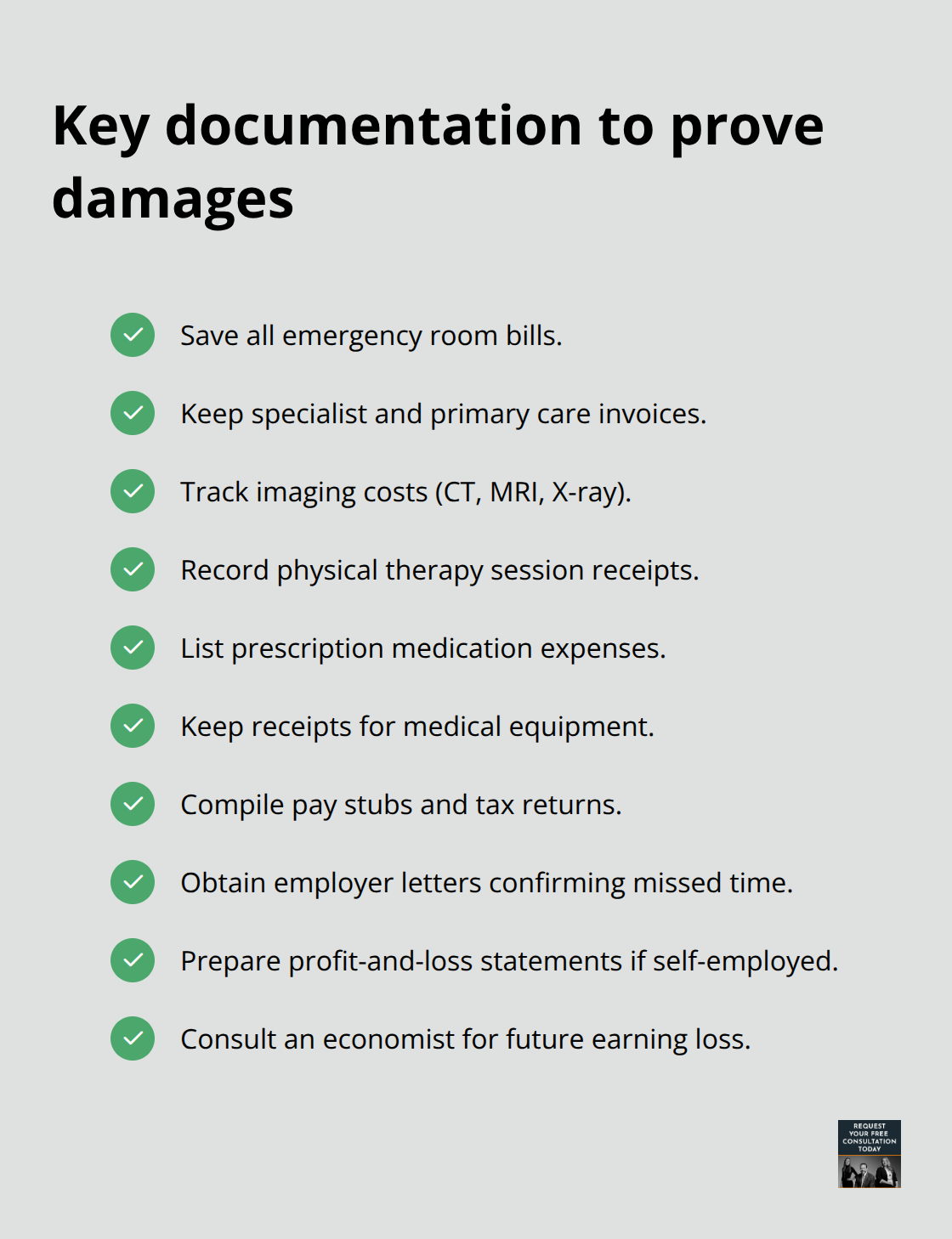
Medical bills alone rarely tell the full story of your claim’s value. Document every expense including emergency room visits, specialist consultations, imaging studies, physical therapy sessions, prescription medications, and medical equipment like braces or heating pads. Insurers scrutinize treatment necessity aggressively, so having your treating physician document why each service was medically required strengthens your position significantly. Lost wages demand equal attention and documentation through pay stubs, tax returns, and employer letters confirming time missed. Self-employed individuals and high earners need tax returns and profit-and-loss statements to substantiate income loss. Future earning capacity matters significantly in permanent injury cases, where economists can testify about lifetime income reduction from permanent restrictions.
Comparative Fault and Insurance Policy Limits
California’s pure comparative negligence rule means you recover damages even if partially at fault, though your award reduces by your percentage of responsibility. A $100,000 claim with 20 percent fault yields $80,000. Insurance policy limits act as a practical ceiling on recovery, so understanding the at-fault driver’s coverage limits early prevents wasted effort pursuing claims beyond available funds. California’s minimum coverage jumped to $30,000 per person and $60,000 per accident on January 1, 2025, but many drivers carry these minimums rather than higher limits, making uninsured or underinsured motorist coverage on your own policy essential protection. These calculations form the foundation of your claim’s value, but the next step involves gathering the evidence and documentation that actually supports these numbers in negotiations with insurance companies.
California’s Insurance Laws and Fault Determination
Minimum Coverage Requirements and the Uninsured Driver Problem
California’s minimum bodily injury liability coverage jumped to $30,000 per person and $60,000 per accident on January 1, 2025, yet roughly 16 to 20 percent of California drivers remain uninsured entirely. This gap matters enormously because it determines the maximum recovery available from the at-fault driver’s policy. If the driver who hit you carries only the state minimum and your injuries exceed $30,000, you face a hard ceiling unless you have uninsured or underinsured motorist coverage on your own policy.
Many accident victims discover this reality too late, after settling for less than their claim’s true value. Check your own policy immediately after an accident; if you lack adequate UM/UIM coverage, you’ll need to pursue the at-fault driver’s assets directly or negotiate aggressively within their policy limits.
Legal Responsibility and Insurance Company Tactics
The at-fault driver bears legal responsibility for your injuries under California law, meaning they must compensate you for all documented damages including medical expenses, lost wages, and pain and suffering. However, responsibility doesn’t guarantee payment; insurers frequently deny or minimize claims by disputing injury severity, arguing pre-existing conditions, or claiming treatment was unnecessary.
This is why documentation and medical evidence matter so intensely. Insurers exploit gaps in your evidence to reduce their payouts, so building a strong record from day one protects your claim’s value significantly.
Pure Comparative Negligence and Fault Assessment
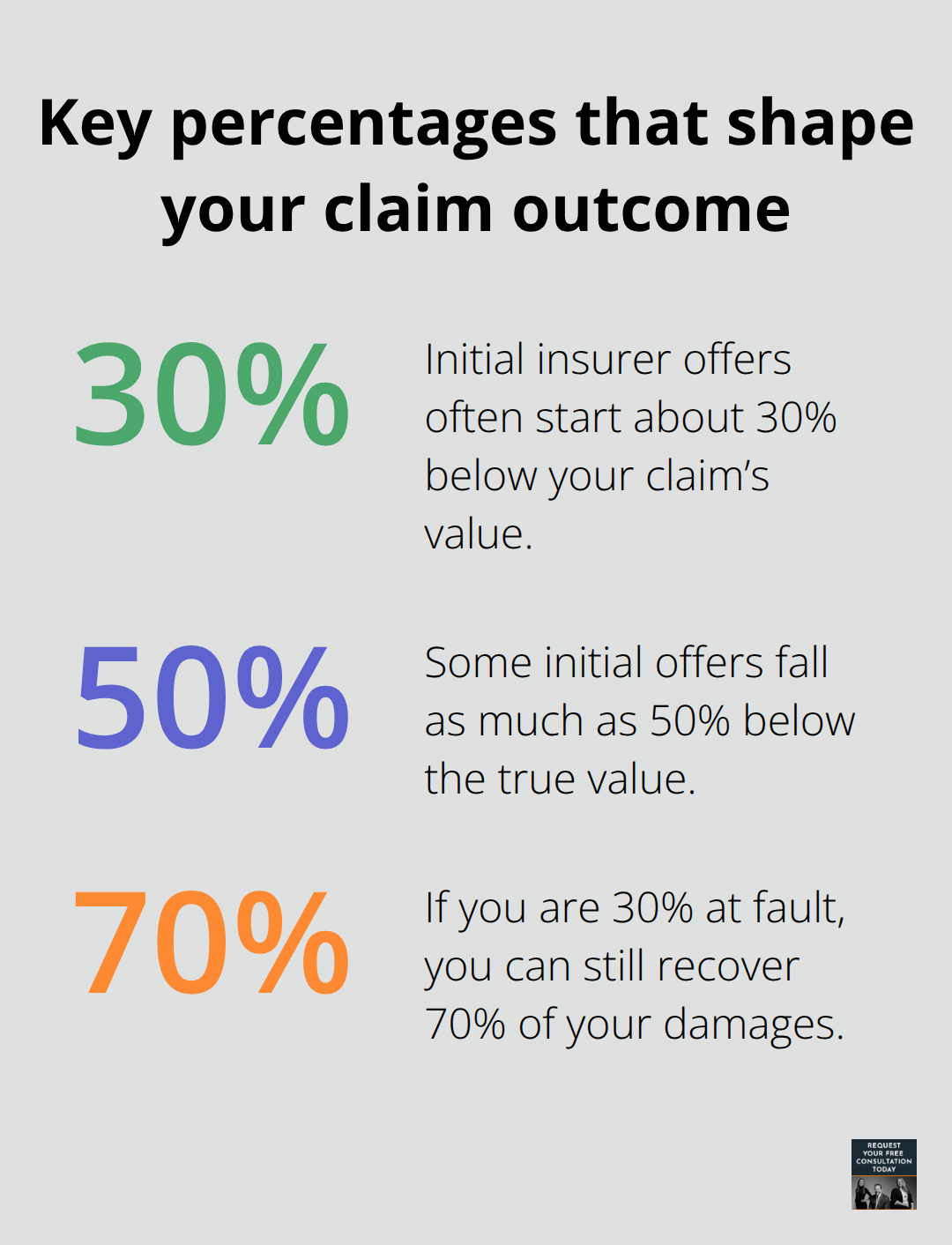
California uses pure comparative negligence to determine fault, allowing you to recover damages even if you’re partially responsible for the accident. A driver found 30 percent at fault still recovers 70 percent of their damages. Insurance companies exploit this rule by inflating their percentage of your fault to reduce their payout, so challenging their fault assessment becomes critical.
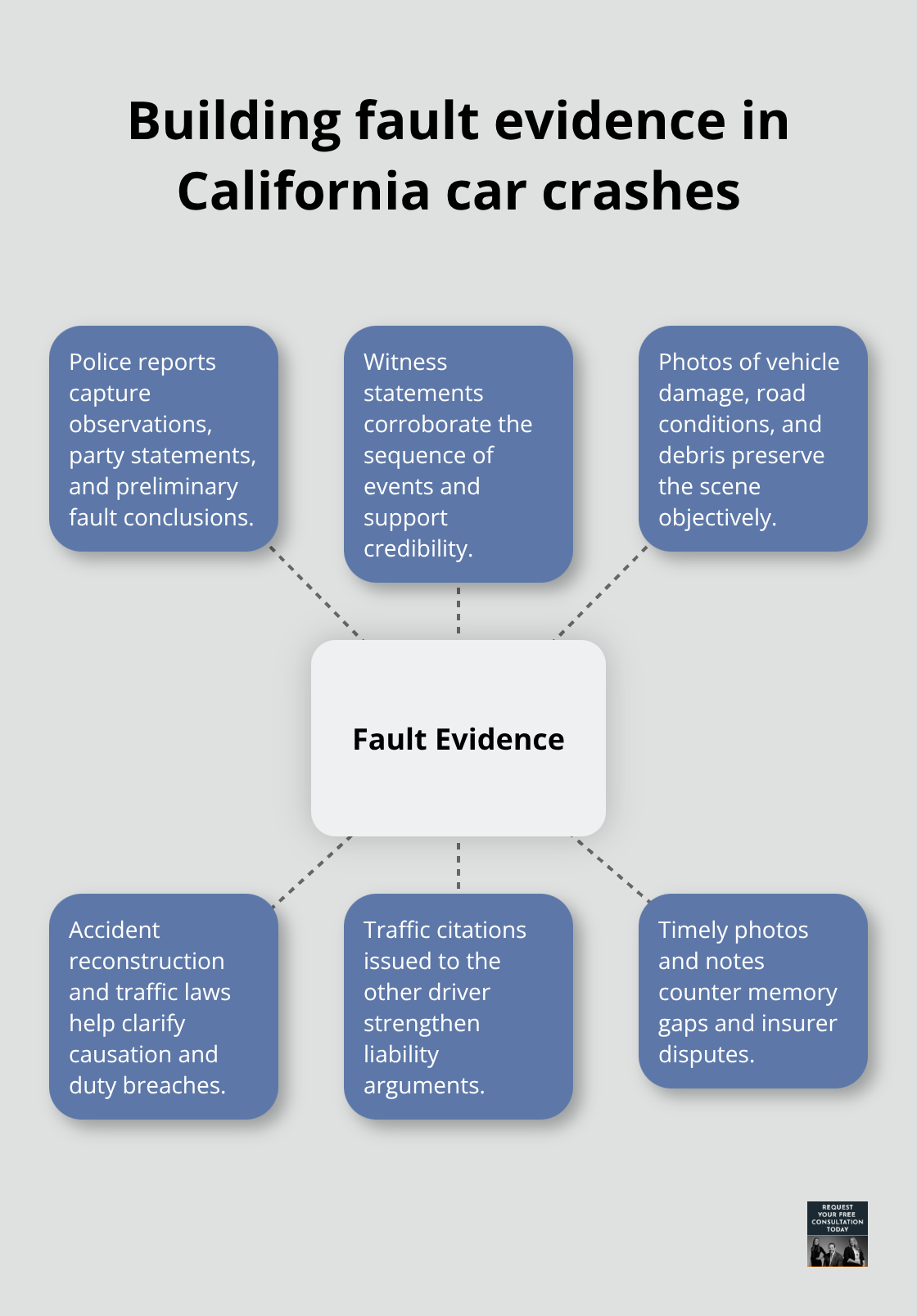
Fault determination relies on police reports, witness statements, accident reconstruction evidence, and traffic laws. Photograph vehicle damage, road conditions, and debris patterns immediately after the accident; these details support your fault position far better than memory alone. If the other driver received a traffic citation, that citation creates strong evidence of their fault and significantly strengthens your negotiating position.
Gathering Police Reports and Evidence
Request the police report using the California Public Records Act; most agencies provide copies within days and cost between $10 and $25. The report documents the officer’s observations, statements from both drivers, witness accounts, and often includes a preliminary fault determination that carries weight in settlement negotiations.
Insurers scrutinize fault positions aggressively, using selective evidence interpretation to shift blame toward you. Countering these tactics requires comprehensive documentation that establishes the other driver’s responsibility through objective facts rather than your account alone.
Final Thoughts on Bodily Injury California Claims
Start immediately after your accident by photographing vehicle damage, road conditions, and the scene from multiple angles. Request the police report within days and preserve every piece of evidence including medical records, receipts, pay stubs, and witness contact information. Insurers exploit missing documentation to minimize payouts, so treating evidence collection as your first priority protects your claim’s value significantly.
Medical professionals form the backbone of your claim’s credibility, and you should seek evaluation from treating physicians within 48 hours of your accident, even if symptoms feel minor. Document every symptom, limitation, and treatment response in detail during each visit, and have your treating physician document the medical necessity of each service to counter insurer tactics. Specialist evaluations from neurologists, physiatrists, or orthopedic surgeons carry substantial weight because they establish objective findings through imaging and functional testing rather than relying on your account alone.
Calculate your total economic damages first by summing medical bills, lost wages, and projected future costs, then apply the appropriate multiplier based on injury severity to arrive at pain and suffering value. Know your number before any conversation with the insurer, and understand that their initial settlement offer typically falls 30 to 50 percent below your claim’s actual value.
We at Schaar & Silva LLP help accident victims navigate these negotiations and recover what they deserve through legal representation that handles the complexities while you focus on recovery.
