
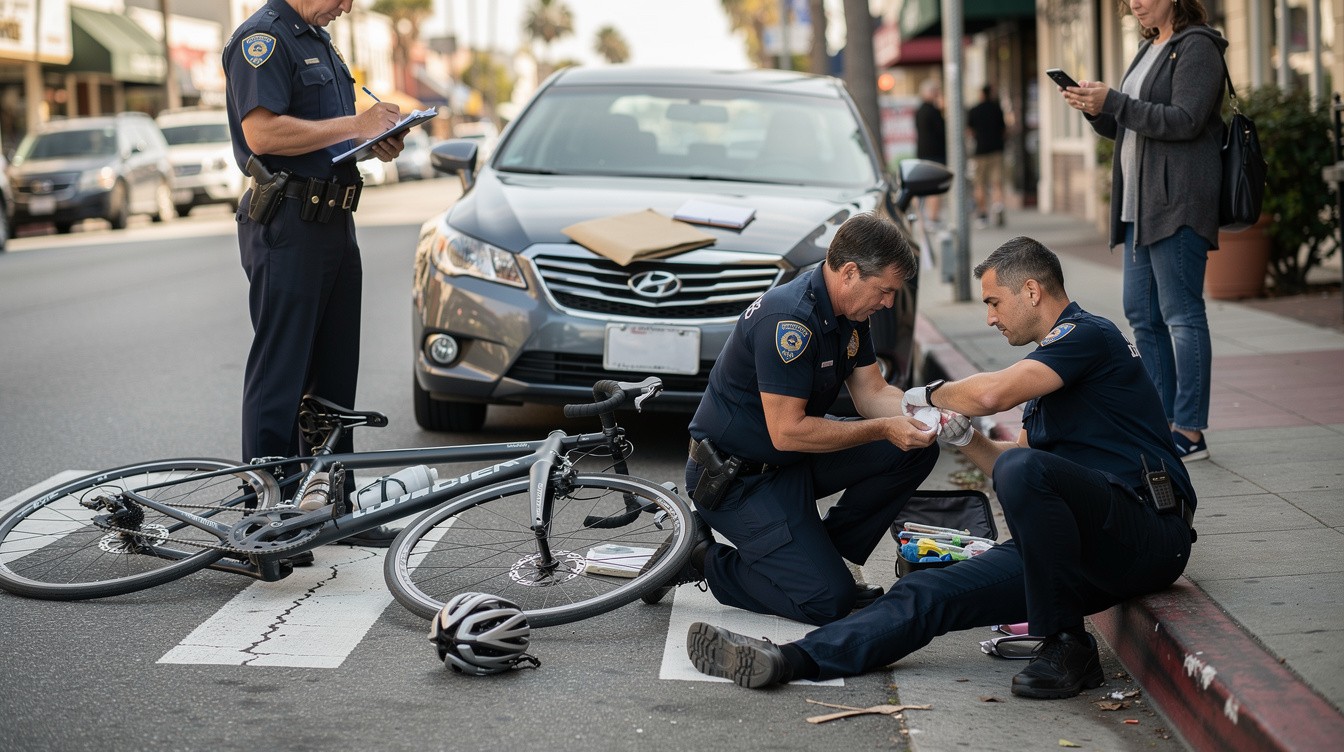
A bicycle collision in Santa Cruz can leave you injured, confused, and unsure about your rights. The path to fair compensation isn’t always straightforward, but understanding the process makes a real difference.
At Schaar & Silva LLP, we’ve helped many Santa Cruz County residents navigate these claims and recover what they deserve. This guide walks you through each step, from the accident scene to securing your settlement.
What to Do Right After Your Bicycle Collision
The first hours after a bicycle collision determine whether you’ll have the evidence needed to prove fault and secure fair compensation. Most people freeze or focus only on their injuries, missing critical steps that can cost them thousands in recovery. Act decisively during these moments, and you’ll have a much stronger foundation for your claim.
Photograph the Scene from Multiple Angles
Physical evidence at the accident scene disappears quickly. Debris gets swept away, vehicles move, and road conditions change within 24 to 48 hours. You must photograph the scene from multiple angles while you’re still there: the street intersection, vehicle positions, skid marks, debris, gouges in the pavement, traffic signals, and street signs. Document your bicycle damage in detail, showing impact points and broken components. Take photos of your injuries as well, even minor ones, because visual documentation strengthens claims later. Use your smartphone’s timestamp feature so photos are dated automatically.
Preserve Dashcam and Surveillance Footage
Dashcam and surveillance footage provides the most powerful evidence available. Ask nearby businesses, residents, or property owners whether they have cameras covering the collision location. Request that they preserve footage immediately using a spoliation letter, because retention windows can be as short as 72 hours to 30 days depending on the system. This step often makes the difference between a strong claim and a weak one.
Collect Witness Information While Memories Are Fresh
Independent eyewitnesses carry significant weight in fault determination. Gather contact details from anyone who saw the collision: names, phone numbers, addresses, and a brief statement about what they observed. Interview them within the first week while memories remain accurate. Written statements from these witnesses often prove invaluable later when insurance companies or courts evaluate your case.
Seek Immediate Medical Care and Document Everything
Do not delay seeking medical attention, even if injuries seem minor. Head to an urgent care clinic or emergency room immediately, because prompt treatment documents the timing and mechanism of injury. Keep every medical bill, receipt, prescription, and wage-loss document you receive. These organized records support settlement negotiations and insurance claims. Request a copy of the police report from the Santa Cruz Police Department (it helps identify witnesses and establishes the initial timeline and location facts, though it cannot be used to prove fault at trial under California Vehicle Code Section 20013). Avoid giving recorded statements to the other driver’s insurance company without legal guidance, as statements can be used against you later.
Contact an Attorney to Preserve Your Claim
An attorney within days can preserve evidence and guide your next moves. At Schaar & Silva LLP, we help Santa Cruz County residents navigate these claims and recover what they deserve. Understanding how fault is determined in your specific situation sets the stage for calculating the compensation you’re entitled to receive.
How Fault Gets Determined in Your Bicycle Collision
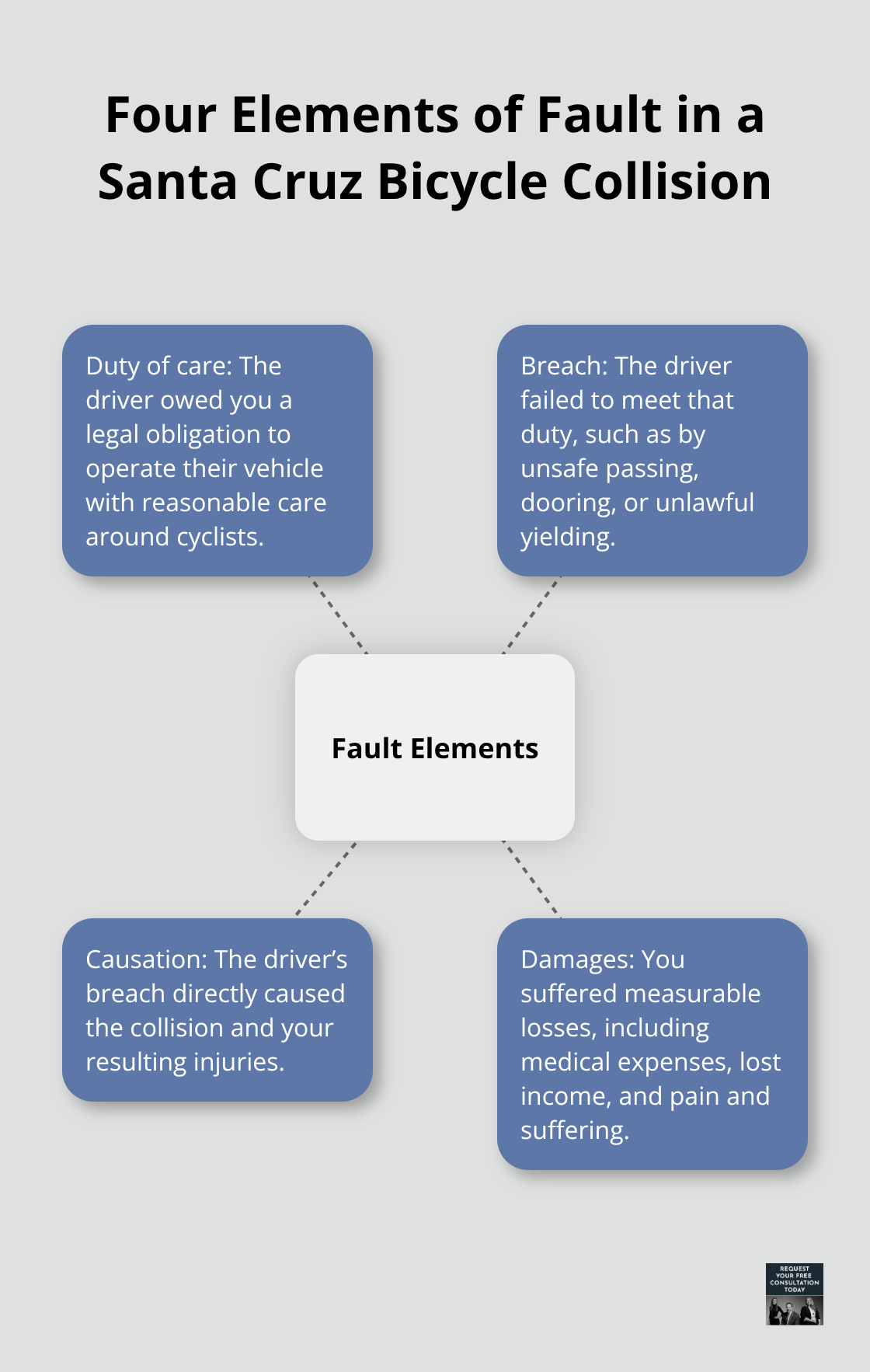
Fault in a Santa Cruz bicycle collision rests on four legal elements: the driver owed you a duty of care, they breached that duty, their breach caused your injuries, and you suffered measurable damages. California Vehicle Code Section 21200 establishes that cyclists have the same rights and responsibilities as motor vehicle operators, which means drivers must exercise reasonable care around you.
When the Law Presumes Driver Fault
When a driver violates specific Vehicle Code sections that protect cyclists, the law presumes fault without requiring you to prove negligence directly. These violations include failing to maintain a three-foot passing buffer under Section 21760, opening a car door into your path under Section 22517, failing to yield on left turns under Section 21801, and entering the roadway unsafely under Section 21804. If the collision happened at a crosswalk, Section 21950 requires drivers to yield to you. Speed violations under Section 22350 and impaired driving under Section 23152 also create presumptions of fault.
Evidence That Proves What Happened
The strength of your claim depends on the evidence you gathered at the scene: photographs of vehicle and bicycle positions, skid marks, debris patterns, and road conditions paint a clear picture of what occurred. Surveillance footage from nearby businesses or traffic cameras becomes the most powerful evidence available and resolves disputes instantly. Eyewitness statements from independent observers who have no stake in the outcome carry significant weight with insurance adjusters and courts alike. Your medical records tie your specific injuries directly to the collision’s impact and mechanism, establishing causation that insurers cannot dispute. Vehicle data from event data recorders shows the driver’s speed, braking patterns, and reaction times, providing objective proof of driver conduct. The bicycle itself tells a story through its damage pattern, revealing impact direction and force. Police reports cannot prove fault at trial under California Vehicle Code Section 20013, but they identify witnesses and establish the timeline and location.
How Comparative Negligence Affects Your Recovery
California’s pure comparative negligence rule under Civil Code Section 1714 allows you to recover even if you bear some responsibility for the collision, though your recovery gets reduced by your percentage of fault. If you were partially at fault-perhaps you were riding without lights at night or not in a designated bike lane when one existed-you can still recover damages. The law recognizes that driver negligence and cyclist conduct exist on a spectrum, and courts or juries apportion liability accordingly. This means a driver who failed to maintain a three-foot passing buffer cannot escape liability simply because you weren’t wearing a helmet or were riding after dark. Insurance companies often argue that you should have been in a bike lane, but lane-width photographs and accident reconstruction demonstrate that the lane was too narrow for safe sharing under Section 21202, which allows you to take the full lane when necessary. Helmet non-use in adults is not automatic negligence, and to reduce your damages the defense must prove a helmet would have prevented your specific head injuries and that your choice was unreasonable.
Navigating Insurance Settlement Offers
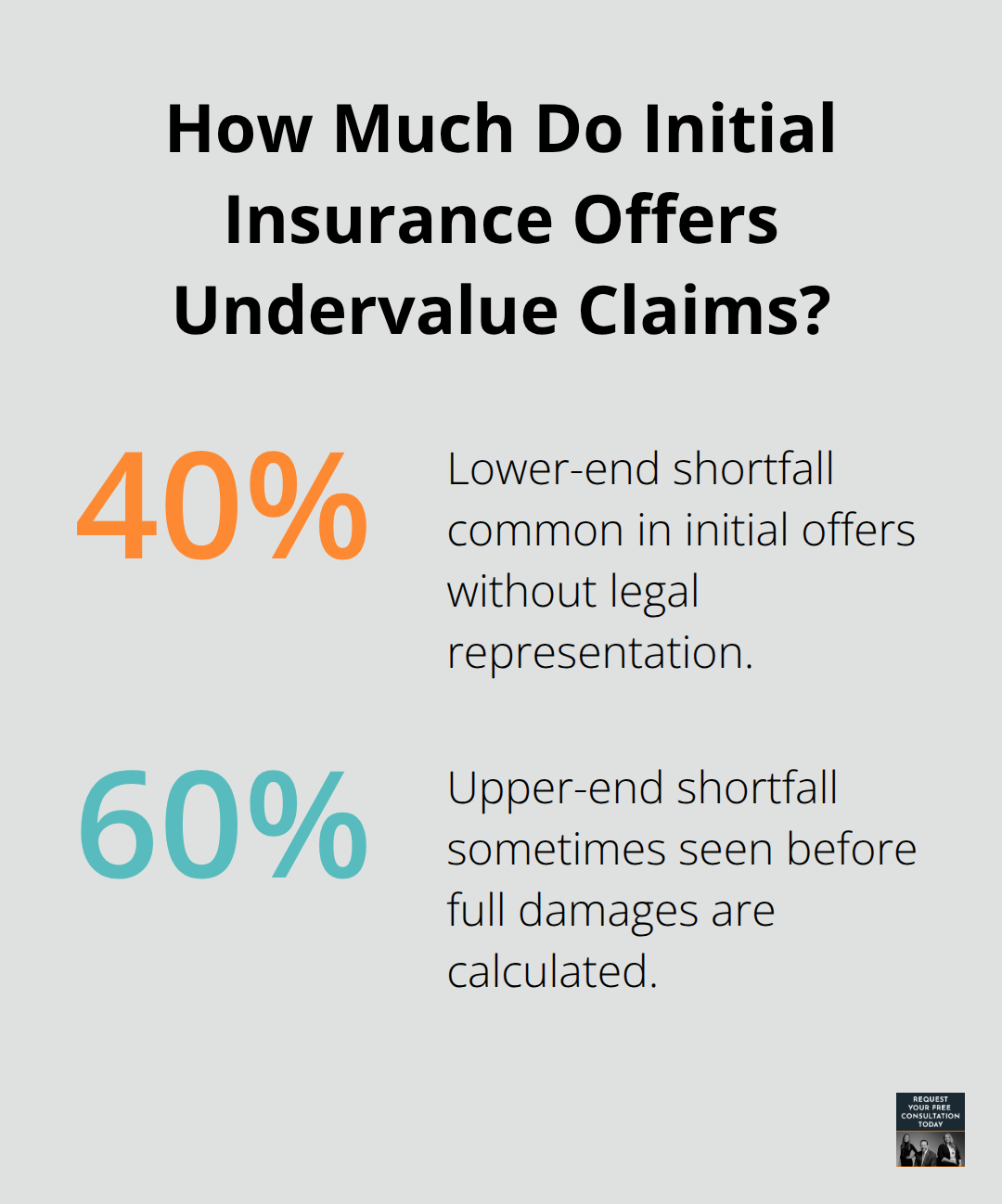
When filing a claim with the at-fault driver’s insurance company, provide your documentation systematically: the police report number, medical records with bills, photographs, witness statements, and a narrative describing the collision. Do not accept an initial settlement offer without understanding your full damages, because these offers typically fall 40 to 60 percent below what you could recover with legal representation. Insurance adjusters count on injured cyclists accepting quick payouts rather than pursuing full compensation for future medical treatment, lost earning capacity, and pain and suffering. Understanding how much your claim is truly worth requires calculating all categories of damages-a process that reveals why initial offers fall so short of fair compensation.
What Your Bicycle Collision Claim Is Actually Worth
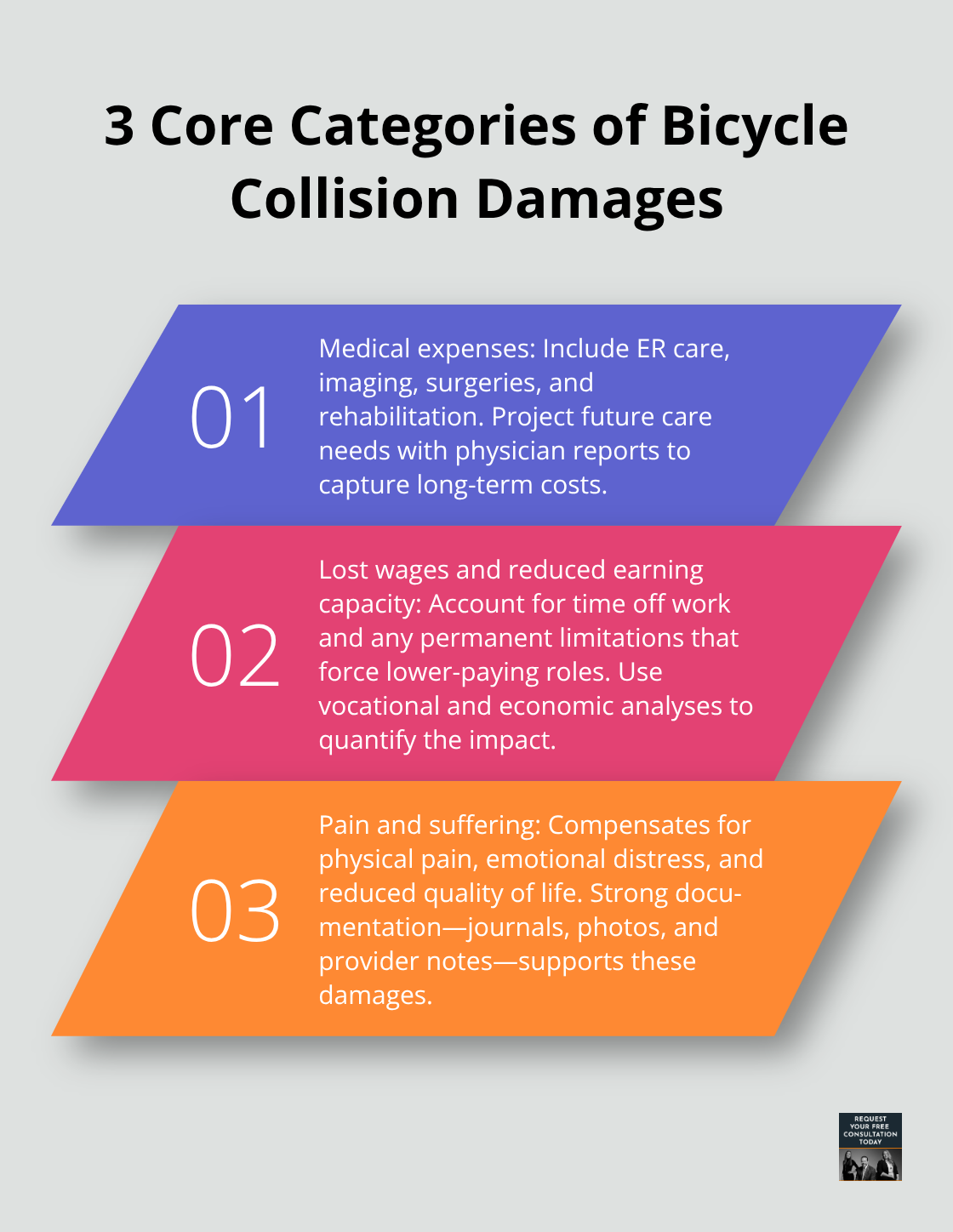
Most injured cyclists in Santa Cruz underestimate their damages by thousands of dollars because they focus only on immediate medical bills and miss the long-term financial impact of their injuries. Your compensation claim includes three distinct categories: medical expenses both current and future, lost wages and reduced earning capacity, and pain and suffering damages that account for your physical and emotional recovery. Calculating these amounts accurately proves essential because insurance adjusters rely on victims accepting lowball offers without understanding what their claims are truly worth.
Medical Expenses: Current and Future Costs
Medical expenses extend far beyond the emergency room visit. A broken collarbone might cost $15,000 to $25,000 for surgery, followed by physical therapy sessions at $150 to $300 per visit for six to twelve months, totaling $4,500 to $10,800 in rehabilitation alone. Neurological injuries like concussions require ongoing neuropsychological testing and monitoring, often costing $2,000 to $5,000 per evaluation. Dental work from facial impact can run $5,000 to $15,000 for crowns or implants.
Many cyclists develop chronic pain conditions after collisions, requiring pain management treatments, imaging studies, and consultations that accumulate over years. Document every medical expense meticulously: copays, deductibles, prescription medications, medical equipment like braces or crutches, and transportation costs to appointments. Insurance companies will scrutinize these bills, so keep itemized statements and receipts organized by date and provider.
Future medical treatment is where most victims lose significant recovery potential. Orthopedic surgery might cost $20,000 to $35,000, and post-surgical physical therapy could extend two to three years at ongoing expense. Request your treating physicians write reports projecting your future care needs and associated costs, because these projections become part of your damages calculation.
Lost Wages and Reduced Earning Capacity
Lost wages represent immediate financial harm that many cyclists overlook when focused on injuries. If you earn $60,000 annually and cannot work for three months during recovery, you’ve lost $15,000 in gross income. Your claim should also include reduced earning capacity if your injuries prevent you from returning to your previous job or force you into lower-paying work.
A cyclist who worked in construction and can no longer perform physical labor might transition to desk work at $40,000 annually instead of $65,000, representing a permanent $25,000 annual loss that compounds over your remaining working years. An economist or vocational rehabilitation professional can calculate this loss by analyzing your injury restrictions, job market data, and earning history.
If you’re self-employed, the calculation becomes more complex because you must document lost business income through tax returns, profit-and-loss statements, and client contracts that demonstrate the income you would have earned during recovery.
Pain and Suffering Damages
Pain and suffering damages compensate you for the physical pain, emotional distress, and reduced quality of life caused by the collision. These damages are not arbitrary; California courts and juries apply formulas that multiply your medical expenses by factors ranging from two to five depending on injury severity. A minor collision with $5,000 in medical expenses might support $10,000 to $25,000 in pain and suffering damages, while a serious fracture with $50,000 in medical treatment could justify $100,000 to $250,000 in pain and suffering.
Document your suffering through daily pain journals describing your physical symptoms, sleep disruption, inability to exercise or participate in activities you enjoyed, and emotional impacts like anxiety or depression. Photographs showing visible scars or physical limitations strengthen these claims. Insurance adjusters discount pain and suffering claims that lack documentation, so detailed records directly influence your settlement amount.
Initial insurance offers typically undervalue these categories by 40 to 60 percent, leaving injured cyclists far short of fair compensation for their long-term recovery and lost opportunity costs.
Final Thoughts
A bicycle collision in Santa Cruz leaves you facing medical bills, lost income, and physical pain that extends far beyond the initial impact. The steps you take immediately after your collision determine whether you’ll have the evidence needed to prove fault and secure fair compensation. Photographs from multiple angles, preserved surveillance footage, witness statements gathered within days, and prompt medical documentation create an unshakeable foundation for your claim.
We at Schaar & Silva LLP have seen countless Santa Cruz County residents accept settlement offers worth 40 to 60 percent less than their claims deserve because they focused on immediate medical costs and missed the long-term financial impact of their injuries. Legal representation changes this outcome fundamentally by helping you gather and preserve evidence that insurance adjusters cannot dispute, calculate your full damages across medical expenses and lost wages, and handle negotiations with insurance companies while you focus on healing. We connect you with medical lien services to manage bills until your case resolves and link you with psychological support specialists who understand trauma recovery.
Contact Schaar & Silva LLP within days of your bicycle collision in Santa Cruz to preserve evidence and begin calculating what your claim is truly worth. We serve Santa Cruz County and understand the specific roads, intersections, and traffic patterns where collisions happen, plus how local insurance companies operate and what settlement amounts reflect fair compensation for your injuries and losses. Your recovery depends on acting decisively now rather than waiting until evidence disappears and memories fade.
