

After a car accident in Santa Cruz, you face medical bills, vehicle repairs, and lost income. Insurance companies often offer settlements far below what you actually deserve.
We at Schaar & Silva LLP help accident victims understand their rights and fight for fair compensation. This guide shows you exactly what damages you can claim and how to avoid costly mistakes that reduce your settlement.
What Damages Can You Actually Claim
After an auto accident in Santa Cruz County, you can recover two distinct categories of damages: economic losses with hard dollar amounts and noneconomic losses tied to your physical and emotional suffering. Economic damages represent your actual out-of-pocket expenses and lost income, while noneconomic damages compensate for pain, mental anguish, and reduced quality of life. Insurance companies fight harder on noneconomic claims because they lack receipts or pay stubs to justify them.
Medical expenses and ongoing treatment costs
Your medical bills form the foundation of any auto accident claim. This includes emergency room visits, hospital stays, diagnostic imaging, surgery, physical therapy, and medications directly related to your crash injuries. If your injuries require future medical care, you can claim those anticipated expenses too. For instance, if you suffer a spinal injury requiring ongoing treatment, your settlement should cover not just today’s costs but estimated future medical expenses over your lifetime. Many accident victims underestimate this category because they focus only on immediate hospital bills and ignore long-term treatment. Gather every medical record, bill, and receipt, even minor ones. Insurance adjusters scrutinize medical expenses heavily, so documentation strength directly impacts your settlement amount.
Vehicle damage and transportation costs
Your vehicle repair or replacement value forms a clear, measurable damage component. Get multiple repair estimates from reputable shops in Santa Cruz County rather than accepting the insurance company’s valuation. If your vehicle is totaled, demand fair market value for your specific make, model, and condition. Beyond the vehicle itself, claim rental car costs while your vehicle is repaired or while you arrange replacement transportation. Some accident victims miss mileage reimbursement for trips to medical appointments or temporary transportation expenses. If the accident forces you to use rideshare services or taxis for medical visits, those costs belong in your claim.
Lost wages and reduced earning capacity
Document every hour you missed from work due to accident-related injuries or medical appointments. This includes wages lost during recovery and time spent attending medical visits, physical therapy, or legal consultations. If your injuries reduce your ability to earn in the future (whether through lower-wage work or part-time status), your settlement should reflect this reduced earning capacity. A construction worker with a permanent shoulder injury may never return to full capacity, meaning lost future earnings become a substantial damage component. Gather pay stubs, tax returns, and written statements from your employer confirming missed work days and any reduced hours or missed promotions tied to your injuries.
How insurance companies respond to damage claims
Insurance adjusters use specific tactics to minimize what they pay you. They question medical necessity, challenge treatment duration, and dispute wage loss calculations. They may argue that your injuries preexisted the accident or that you failed to mitigate damages through proper treatment. Understanding these tactics helps you prepare stronger documentation and avoid statements that weaken your position. When you present organized, detailed evidence of your damages (medical records, repair estimates, pay stubs), you make it harder for adjusters to dispute your numbers and push toward a fair settlement.
How Settlement Amounts Get Calculated
Insurance companies use predictable formulas to arrive at settlement offers, and understanding these formulas gives you leverage in negotiations. The first step involves determining who bears legal responsibility for the crash. In Santa Cruz County, fault assessment relies on police reports, witness statements, traffic camera footage, and accident reconstruction when necessary. California follows comparative negligence rules, meaning you can recover damages even if you’re partially at fault, though your recovery reduces by your percentage of responsibility. If you’re 20 percent at fault and your damages total $100,000, you recover $80,000. Insurance adjusters often exaggerate your percentage of fault to lower their payout, which is why detailed documentation of how the accident occurred matters enormously. Get the official police report immediately and photograph the accident scene from multiple angles if you’re physically able.
Determining Fault and Liability
Adjusters scrutinize every detail of the accident sequence to assign fault percentages. They review dashcam footage, witness statements, and police citations to establish who violated traffic laws or acted negligently. Traffic violations like running a red light or speeding create strong evidence of fault, but adjusters sometimes misinterpret witness accounts or ignore evidence that supports your position. Request all available evidence from the police department and any nearby businesses with security cameras. The more evidence you gather, the harder it becomes for adjusters to manipulate fault calculations in their favor.
Vehicle Valuation and Repair Estimates
Vehicle valuation comes next, and this is where adjusters frequently lowball you. They typically use National Automobile Dealers Association pricing guides or similar databases that don’t account for your vehicle’s actual condition or recent maintenance. If your 2019 Honda Civic had new tires, brakes, and a transmission service completed six months before the crash, that vehicle is worth more than the base NADA value. Get independent repair estimates from at least two reputable shops in the Monterey Bay area rather than accepting the insurance company’s preferred appraiser’s assessment. Multiple estimates create competition and pressure adjusters to offer fair valuations.
The Multiplier Method for Pain and Suffering
For pain and suffering damages, adjusters apply a multiplier to your economic damages, usually ranging from 1.5 to 5 times your medical expenses and lost wages combined. A minor soft tissue injury might use a 1.5 multiplier, while permanent scarring or chronic pain uses 4 or 5. The multiplier depends heavily on your medical documentation quality and treatment consistency. Gaps in treatment or casual doctor visits signal to adjusters that your pain wasn’t severe, triggering lower multipliers. If you stop physical therapy for three months then restart, adjusters argue your injury wasn’t serious enough to warrant ongoing care.
Building a Strong Medical Record
Maintain consistent medical treatment throughout your recovery and keep detailed records showing how your injuries impact daily activities, work performance, and relationships. Medical records that document your pain levels, functional limitations, and treatment progress support higher multipliers. Photographs of visible injuries, journal entries describing your daily struggles, and statements from family members about changes in your behavior all strengthen your noneconomic damages claim. Insurance adjusters scrutinize these records carefully because pain and suffering lacks objective measurement like medical bills do. The stronger your documentation, the less room adjusters have to dispute your multiplier calculation and reduce your settlement offer.
Costly Mistakes That Sabotage Your Settlement
Insurance adjusters count on accident victims making preventable errors that crater settlement values. The first and most damaging mistake is accepting the initial settlement offer without negotiation.
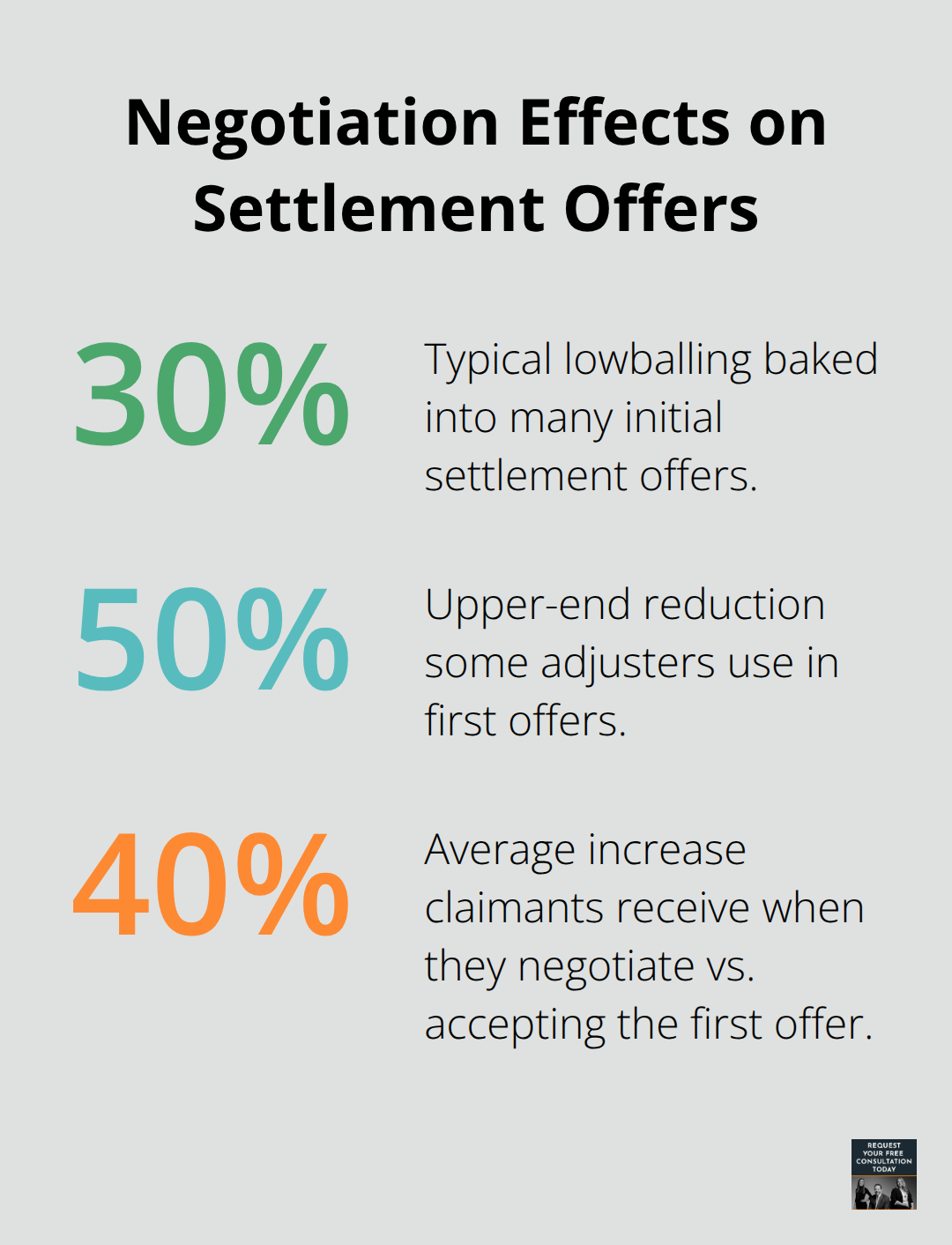
Adjusters deliberately lowball their opening offers by 30 to 50 percent because they know most people lack settlement experience and assume the first number is final. Research from the Insurance Information Institute shows that claimants who negotiate settlements receive 40 percent more compensation than those accepting initial offers. When an adjuster presents an offer, that number reflects their interests, not your actual damages.
Reject the First Offer and Demand Justification
Reject the initial offer immediately and request a detailed written explanation of how they calculated each damage component. Ask them to justify their vehicle valuation, their multiplier for pain and suffering, and their economic damage calculations. Most adjusters will increase their offer when pressed because their opening number contains negotiating room built in specifically for this back-and-forth. Accepting without pushback means leaving thousands of dollars on the table that rightfully belongs to your recovery.
Maintain Consistent Medical Records Throughout Recovery
The second critical mistake is maintaining incomplete or inconsistent medical records throughout your recovery. Insurance adjusters use treatment gaps as ammunition against you, arguing that missing weeks between appointments proves your injuries weren’t serious. If you stop physical therapy for two months then resume, adjusters claim you’ve recovered and use this gap to justify lower pain and suffering multipliers. Maintain consistent medical treatment and document every appointment, prescription, and specialist visit related to your accident injuries. Your medical records must tell a coherent story of injury, treatment, and recovery progress (one that adjusters cannot easily challenge with claims of exaggeration or malingering).
Keep Your Accident Private on Social Media
Third, never post about your accident, injuries, or settlement discussions on social media platforms. Insurance companies employ investigators who monitor accident victims’ social media activity, and a single post contradicting your injury claims can devastate your settlement. A Facebook photo showing you hiking or attending a party can be weaponized against you, even if the activity caused you significant pain afterward. Adjusters screenshot posts and use them in settlement negotiations to argue your injuries are less severe than you claim. Keep your accident completely private across all platforms until your case concludes (this includes private messages and group chats where information can spread).
Final Thoughts
Your auto accident damages in Santa Cruz depend on how thoroughly you document losses, how aggressively you negotiate, and whether professional representation fights for your rights. Insurance adjusters count on victims accepting initial proposals without pushback, which is why understanding settlement calculation methods gives you real negotiating power. The settlement amount reflects three critical factors: the strength of your liability evidence, the completeness of your medical and financial documentation, and your willingness to reject lowball offers.
We at Schaar & Silva LLP have spent over 35 years helping Santa Cruz residents recover full compensation for injuries caused by negligence. Our approach differs fundamentally from accepting quick settlements that leave money on the table-we pursue aggressive litigation strategies that pressure insurance companies to offer fair valuations rather than their standard lowball numbers. We handle medical bill assistance, evaluate property damage claims to protect your recovery, and address the emotional trauma that frequently gets underestimated in settlements.
Contact Schaar & Silva LLP at 831-443-1051 to schedule your free initial consultation where we review your accident details and outline a strategy tailored to your situation. We serve Santa Cruz County, Monterey County, San Benito County, and South Santa Clara County from our office in Salinas, with Spanish-speaking services available. You pay no upfront legal fees-you only pay if we recover damages for you.
