

After a vehicle accident, you’re facing medical bills, insurance paperwork, and decisions about your legal options. The right vehicle accident resources can make the difference between a weak claim and one that actually covers your losses.
We at Schaar & Silva LLP have helped accident victims in Santa Cruz County, Sacramento, and Oakland navigate this process. This guide walks you through the documentation, medical records, and legal tools you need to build a strong case.
What Evidence Matters Most After an Accident
The first 48 hours after a vehicle accident are critical for evidence collection. Police reports form the foundation of any strong claim, so obtain the crash report number and the officer’s name and badge number at the scene. Request a copy directly from the local police department or sheriff’s office in Santa Cruz County, Sacramento, or Oakland-these reports document the officer’s observations, contributing factors, and sometimes fault determinations that insurance companies and courts rely on. Without this official record, your claim loses credibility from the start.
Photograph Everything Before It Disappears
Take photos and video of the accident scene immediately, before vehicles are moved or debris is cleared. Capture the vehicle damage from multiple angles, road conditions, traffic signals, skid marks, and any visible hazards that contributed to the crash. Insurance companies scrutinize damage patterns to assess impact force and liability, so detailed photos prevent them from undervaluing your claim or shifting blame. Many victims wait days to photograph damage, only to find the scene altered or their memory faded. Your phone is sufficient-modern smartphone cameras record location data that strengthens your evidence. If you’re injured and unable to photograph, ask a bystander or request that police photographs be included in the accident report.
Witness Statements Preserve Accounts While They’re Fresh
Collect names, phone numbers, email addresses, and insurance information from anyone who saw the crash. Witness statements matter far more immediately after the accident than weeks later, when memories blur and people become harder to locate. Ask each witness to describe what they saw, and request permission to record their statement on your phone if they consent. Insurance adjusters often contact witnesses independently and may frame questions to support the at-fault driver, so having your own documented accounts prevents conflicting narratives. If witnesses are reluctant to provide contact information, at least note their vehicle descriptions or license plates so you can track them down later through police reports.
Once you’ve secured these foundational documents and statements, your next priority shifts to the medical side of your recovery.
How to Build Your Medical Records File and Track Treatment Costs
Start Collecting Medical Records Within 48 Hours
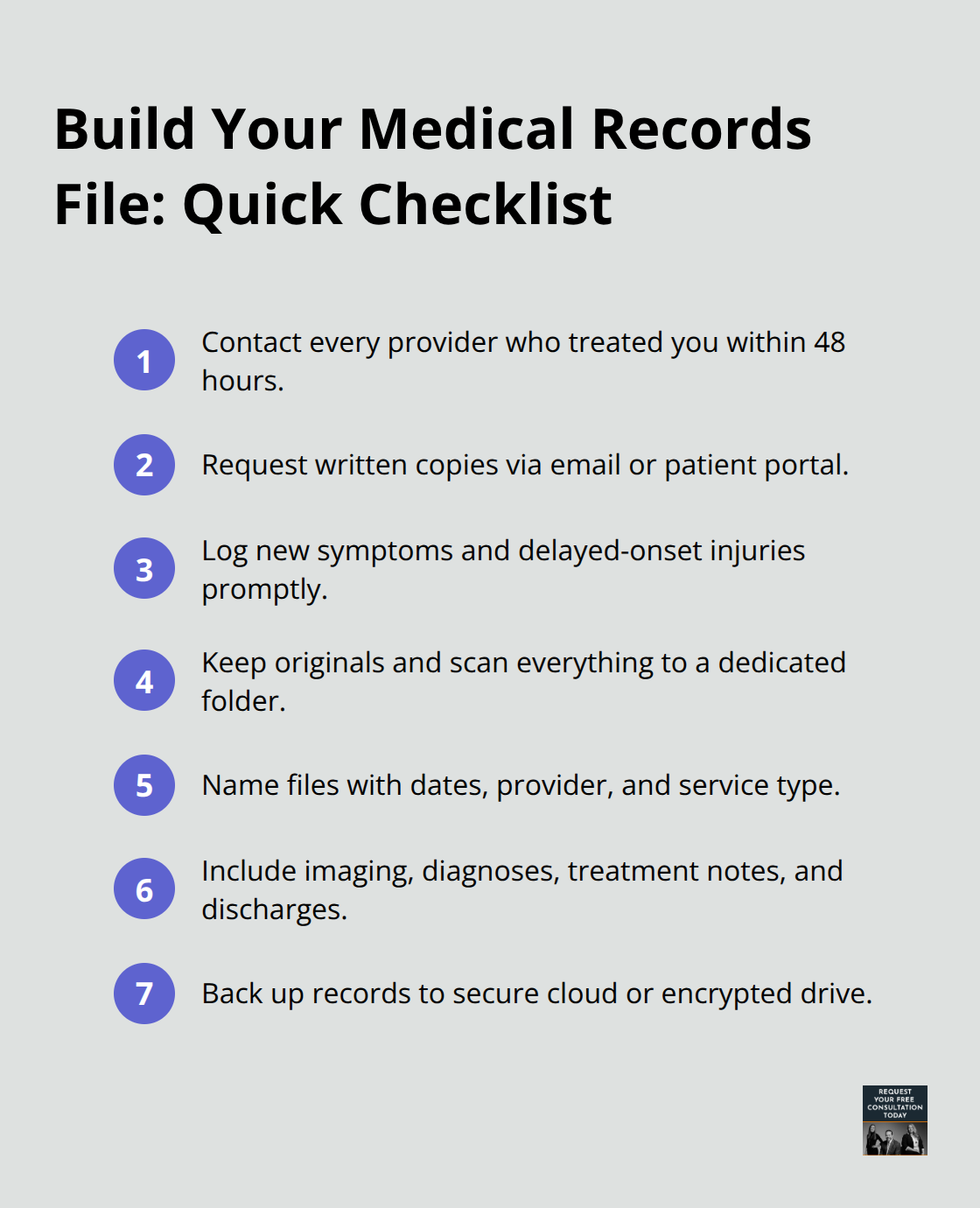
Contact every healthcare provider who treated you within 48 hours of your accident-emergency departments, urgent care clinics, primary care physicians, physical therapists, mental health counselors. Request copies of intake forms, diagnoses, treatment notes, imaging results, and discharge summaries in writing via email or patient portal when possible, as this creates a timestamped trail. Many injuries from vehicle collisions appear days or weeks later, so prompt documentation prevents gaps that insurance companies exploit to deny claims. Keep originals and scan everything into a dedicated folder on your phone or computer.
In Santa Cruz County, serious vehicle injuries cost about 59.8% more than the California average in medical expenses, with typical costs ranging from $57,000 to $123,000, so detailed documentation prevents undervaluation of your claim.
Access Medical Lien Services to Preserve Your Finances
Many families exhaust savings within three months after an accident without accessing medical lien services, which allow you to receive treatment now and pay later from settlement proceeds. Ask your healthcare providers about medical lien options immediately-this preserves your financial stability while your case develops. Medical lien services remove the pressure to accept inadequate insurance settlements just to cover mounting bills. Your focus should remain on recovery, not financial desperation.
Track Every Treatment Appointment and Cost
Create a spreadsheet or notebook and record the date, provider name, service type, time spent, cost, and whether insurance covered it for each appointment. This log becomes your proof of damages and ongoing need for care. Insurance settlements rarely account for long-term therapy costs or reduced earning capacity, so building a comprehensive evidence file strengthens your recovery amounts. Document each therapy session with notes about your symptoms, progress, and setbacks.
Document Mental Health Treatment With the Same Rigor as Physical Care
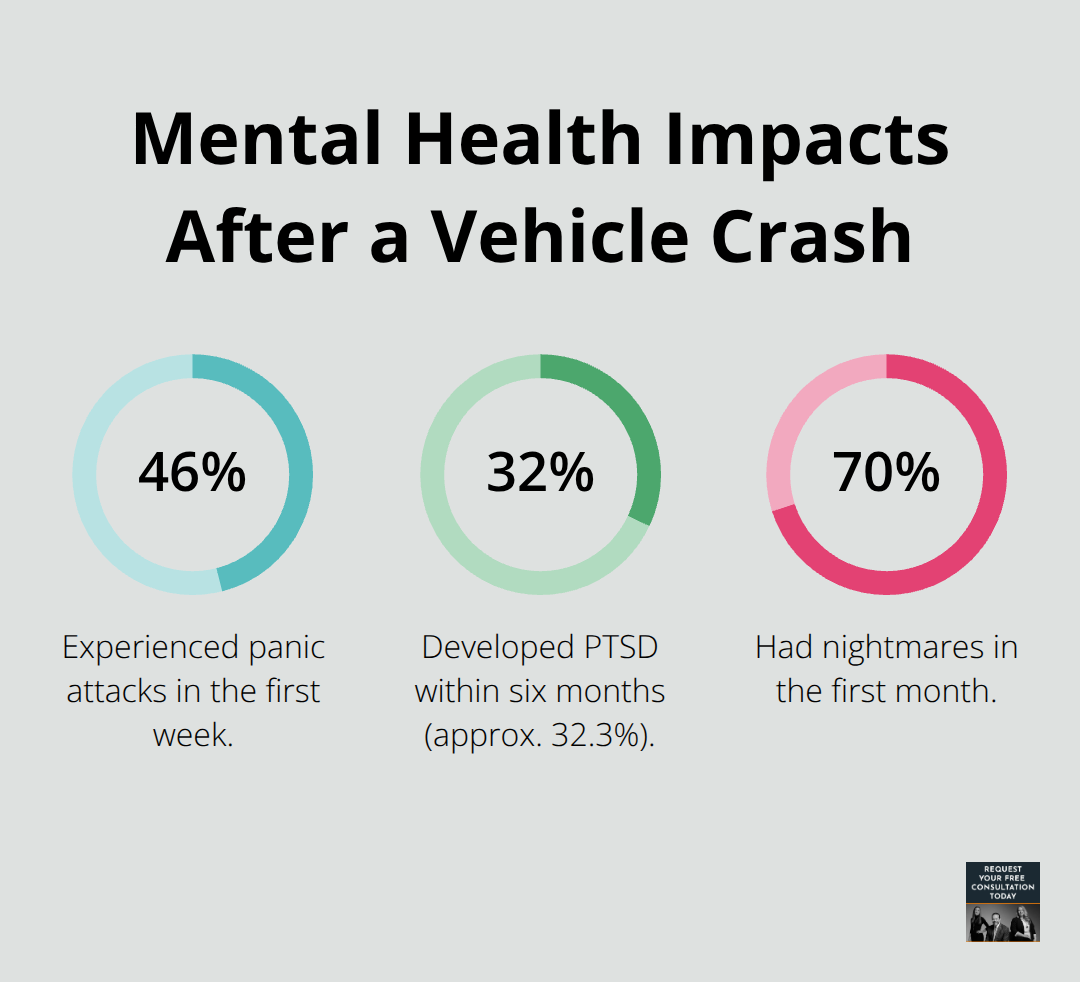
Mental health impacts are substantial after collisions: about 46 percent experience panic attacks in the first week, roughly 32.3 percent develop PTSD within six months, and about 70 percent have nightmares in the first month according to American Psychological Association and National Institute of Mental Health data. Women face roughly 2.5 times higher PTSD risk than men. These conditions require sustained therapy, and your treatment notes demonstrating ongoing sessions strengthen your claim for non-economic damages.
Cognitive-behavioral therapy with gradual exposure yields about 85 percent improvement for travel-related phobias over 12 to 16 sessions, and EMDR reduces PTSD symptoms by about 77 percent after 6 to 12 sessions. Persistent pain six to eight weeks after the crash strongly predicts depression at two months, justifying higher recovery amounts. Your medical notes prove that your injuries are real and ongoing, not exaggerated or temporary.
Connect With Local Mental Health Resources in Santa Cruz County
Group CBT has shown high effectiveness in PTSD outcomes, with roughly 88 percent PTSD-free in some clinical trials versus about 31 percent in control groups. Seek trauma-informed therapists through Psychology Today or local hospital-backed support groups (Kaiser Permanente, Sutter VNA Hospice, Dominican Hospital). Many therapists are in-network with major insurers (Aetna, Cigna, Anthem, UnitedHealthcare, Blue Shield, Medi-Cal) and may offer sliding-scale fees. If you need crisis support, the 988 Suicide & Crisis Lifeline is available 24/7. With your medical records organized and your treatment costs tracked, you’re ready to navigate the insurance and legal resources that will determine your final recovery.
Insurance and Legal Resources Available to You
Your insurance policy likely contains coverage limits and exclusions you don’t fully understand, and insurance companies count on this confusion to minimize what they pay you. Review your policy documents immediately and identify your liability limits, uninsured motorist coverage, underinsured motorist coverage, and medical payments coverage-these determine how much you can recover from your own insurer if the at-fault driver lacks sufficient coverage.
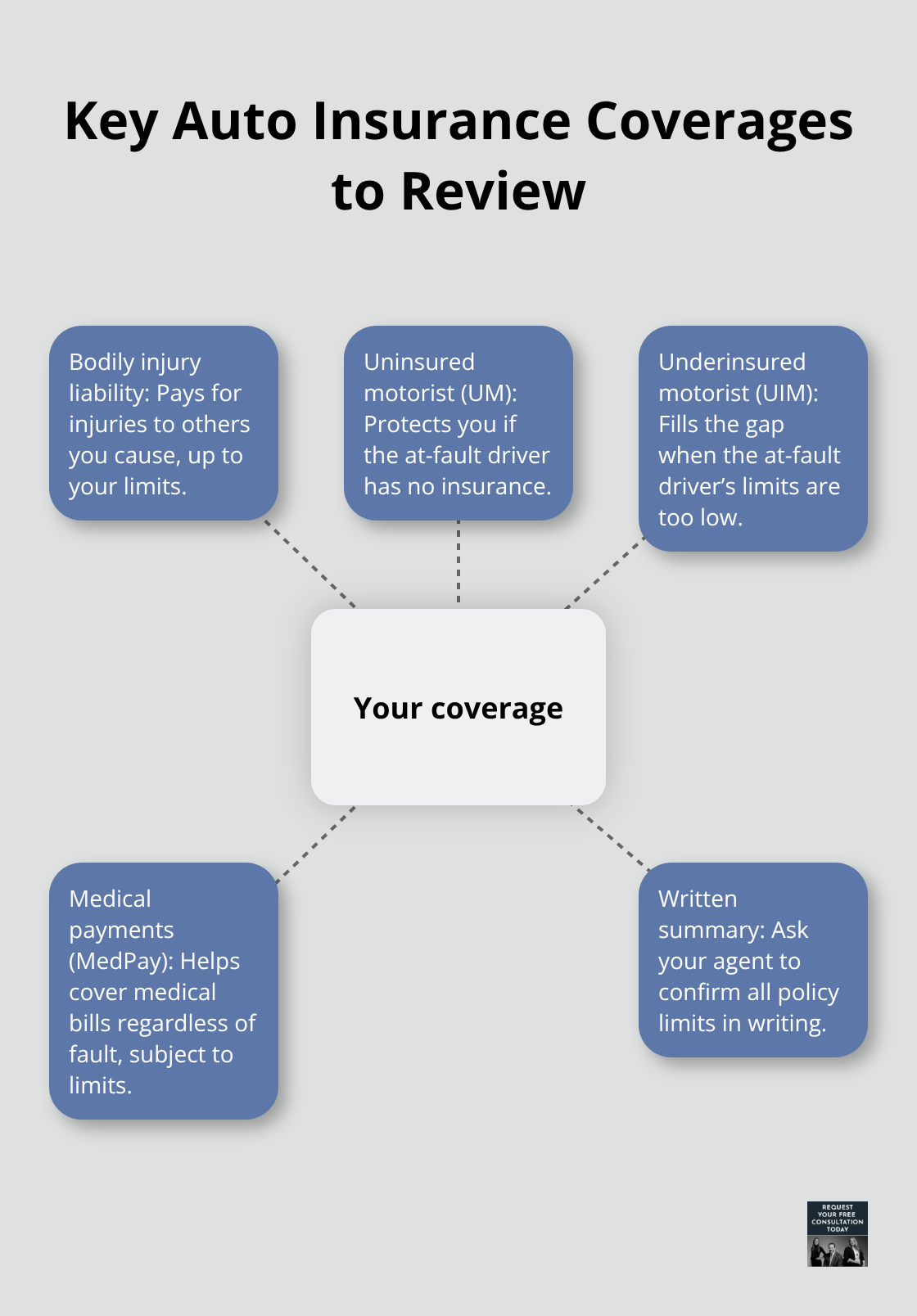
In California, the minimum liability requirement is $15,000 for injury to one person, but typical wrongful death settlements range from $800,000 to $5 million depending on case severity and available insurance, so your own underinsured motorist coverage becomes critical if the at-fault driver is underinsured. Contact your insurance agent and request a written summary of your coverage limits and what each covers.
Document Everything in Writing to Protect Your Claim
Insurance companies attempt to shift blame and undervalue claims from the moment you file, so document everything in writing via email rather than phone calls. Create a dedicated email folder for all correspondence with your insurer and the at-fault driver’s insurance company. Never accept a settlement offer without understanding what you’re signing away. Request that your insurer provide the at-fault driver’s policy limits in writing, as this determines whether you’ll need to pursue additional recovery through litigation. Many victims accept initial settlement offers within weeks, only to face mounting medical bills months later-insurance settlements rarely account for ongoing therapy costs, home modifications, or reduced earning capacity, so resist pressure to settle quickly.
Challenge Property Damage Valuations With Independent Appraisals
Property damage claims are valued through appraisal of your vehicle’s actual cash value, and you have the right to challenge valuations via two independent appraisers and an umpire. You can use OEM parts or alternatives and select your own auto body shop-compare valuations with Kelley Blue Book or NADA Guides to verify fairness. Insurance adjusters often undervalue damage to justify lower settlement amounts, so independent verification protects your recovery.
Assess All Potential Defendants Beyond the At-Fault Driver
A skilled attorney helps document evidence, counter settlement strategies, and assess all potential defendants-which can include other drivers, vehicle manufacturers, maintenance providers, or property owners if defective components or hazardous conditions contributed to the crash. If a defective component caused the accident, you may pursue product liability claims against the manufacturer in addition to driver liability claims. This expanded liability analysis often reveals additional sources of compensation that victims miss on their own.
Seek Legal Representation From Day One
Filing a claim with your insurance company puts you in an adversarial position despite paying premiums for years, which is why legal representation matters from the start. Early involvement of legal representation ensures deadlines are met, strengthens your case through expert input, and prevents you from inadvertently harming your claim through statements to adjusters. The legal team at Schaar & Silva LLP offers support with medical bill navigation, property damage evaluation, and connecting you with psychological support resources while handling the legal complexities of your case. We serve Santa Cruz County, California and can be reached at 408-721-1111 for a free case evaluation.
Final Thoughts
Strong vehicle accident claims require you to coordinate medical documentation, insurance navigation, and legal support simultaneously. You now understand how to collect police reports and photographs, preserve witness statements, organize medical records, track treatment costs, and challenge insurance valuations-these vehicle accident resources form your foundation for recovery. California’s wrongful death statute of limitations is two years from the date of the incident, and insurance adjusters know that victims under financial pressure accept inadequate settlements, which is why early legal involvement protects your financial stability during recovery.
Insurance companies use tactics designed to minimize what they pay you, and assembling documentation alone leaves you vulnerable to their strategies. Medical lien services remove the pressure to accept inadequate offers while your case develops, and a legal team that understands both the medical complexity of your injuries and the financial tactics insurers employ can challenge valuations and counter settlement strategies effectively. We at Schaar & Silva LLP have helped accident victims in Santa Cruz County, Sacramento, and Oakland recover substantial verdicts and settlements by coordinating medical bill assistance, property damage evaluation, and psychological support resources.
Contact Schaar & Silva LLP at 408-721-1111 for a free case evaluation and take action now rather than later. Your recovery depends on moving forward immediately with the right support in place.
