

A spinal injury from a car crash can change your life in seconds. The damage might not be obvious at first, but the medical bills, lost income, and pain often become overwhelming quickly.
We at Schaar & Silva LLP have helped many people in Santa Cruz County, Sacramento, and Oakland recover fair compensation for these injuries. This guide walks you through building a strong case and understanding what you’re entitled to receive.
How Spinal Injuries Develop in Car Crashes
Car crashes generate forces that your spine simply cannot absorb safely. When a vehicle impacts another object or gets hit, the sudden acceleration or deceleration causes your vertebrae, discs, and nerves to shift violently out of position. Rear-end collisions are particularly dangerous for spinal injury because your head and neck snap backward while your body moves forward, creating a whipping motion that strains the cervical spine. Side-impact crashes compress the thoracic and lumbar regions, while head-on collisions can cause the entire spine to hyperextend or hyperflex. The severity depends on vehicle speed, impact angle, and whether you saw the crash coming. Braced muscles provide some protection, but relaxed muscles offer none, which is why crashes you don’t anticipate cause worse damage.
Injury Types You Need to Know
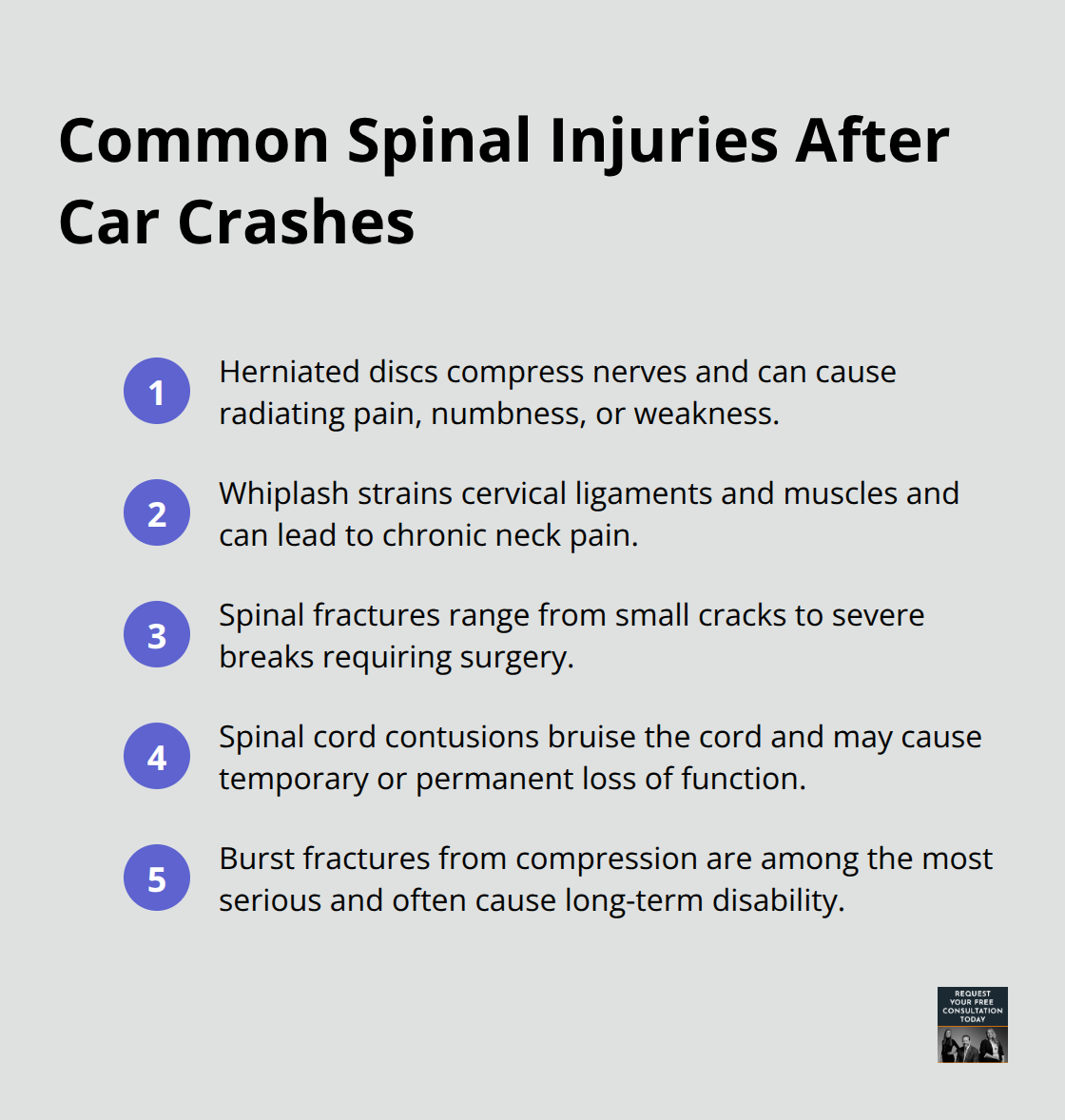
Herniated discs rank among the most common spinal injuries from car crashes. The impact ruptures the gel-like center of a disc, which then presses against nerves and causes pain, numbness, or weakness radiating down your arms or legs. Whiplash, though often dismissed as minor, involves ligament and muscle tears in the neck that can lead to chronic pain for years if left untreated. Spinal fractures range from small cracks that heal within months to severe breaks that require surgery and permanent hardware. Spinal cord contusions occur when the impact bruises the cord itself, potentially causing temporary or permanent loss of function below the injury site. Burst fractures, where vertebrae actually explode from compression, represent some of the most serious spinal injuries and often result in long-term disability.
What Happens After Impact
Pain and numbness typically appear within hours or days, though some spinal injuries develop symptoms weeks later. This delayed onset is why you must seek medical attention immediately after any crash, regardless of how you feel in the moment. Medical imaging like MRI or CT scans identifies disc herniations, fractures, and cord damage that X-rays miss. Long-term effects can include chronic pain, reduced range of motion, nerve damage causing permanent numbness or tingling, and in severe cases, partial or complete paralysis. Lost wages accumulate quickly because recovery from spinal surgery often requires three to six months away from work, sometimes longer. Lifetime medical costs for serious spinal injuries average between 1.1 million and 4.7 million dollars according to the National Spinal Cord Injury Statistical Center, accounting for ongoing physical therapy, medications, and ongoing specialist visits that never truly end.
Why Documentation Matters Now
The medical records you collect in the days and weeks after your crash form the foundation of your compensation case. Hospitals and imaging centers create detailed reports that link your injuries directly to the crash itself. These documents establish causation, which insurers will challenge if you lack solid evidence. Photographs of vehicle damage, road conditions, and visible injuries also strengthen your position when negotiations begin.
Building Your Case Step by Step
Collect Medical Records That Prove Your Injury
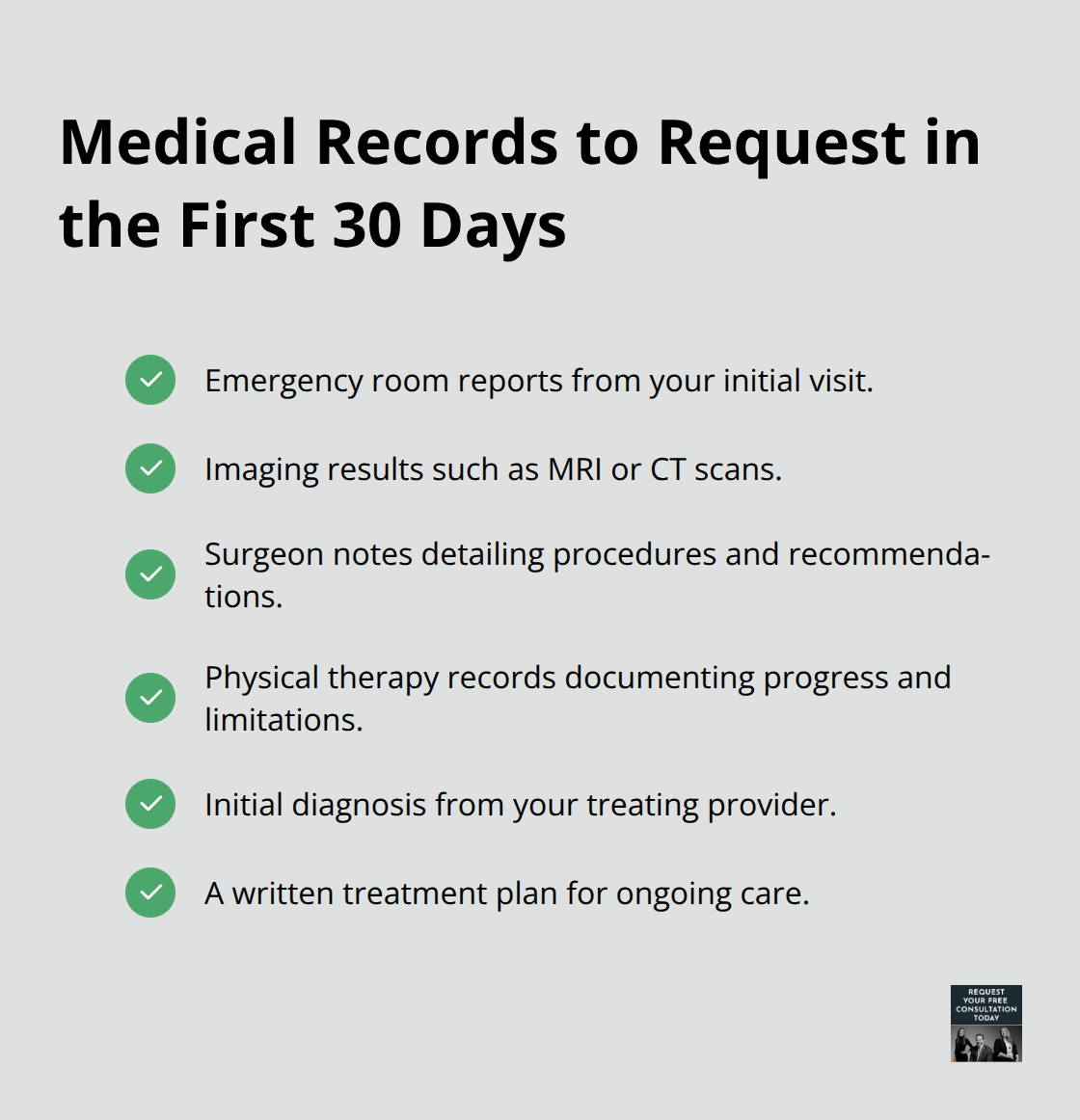
Medical records form your strongest weapon in securing fair compensation, and you must start collecting them immediately after your crash. Request copies of your emergency room reports, imaging results, surgeon notes, and physical therapy records from every provider who treats you. Insurance companies scrutinize these documents to verify that your injuries actually stem from the crash, not from a pre-existing condition or something unrelated. Within 30 days of your accident, your medical file should contain an initial diagnosis, imaging confirmation of spinal damage, and a treatment plan. The Insurance Research Council reports that represented claimants receive approximately 3.5 times higher settlements than unrepresented victims, and a major reason is that lawyers know exactly which medical documentation insurers demand.
Gather Evidence From the Crash Scene
Photographs taken at the crash scene showing vehicle damage, road conditions, and skid marks establish the force of impact. Dashcam footage, witness statements with contact information, and the police report all corroborate your account of what happened. Without this evidence, insurers will argue that your injuries resulted from minor impact forces that couldn’t possibly cause spinal damage. Store all documents in a secure folder, both physical and digital, because you’ll need them repeatedly throughout negotiations and potentially in court.
Understand How Insurers Calculate Settlement Value
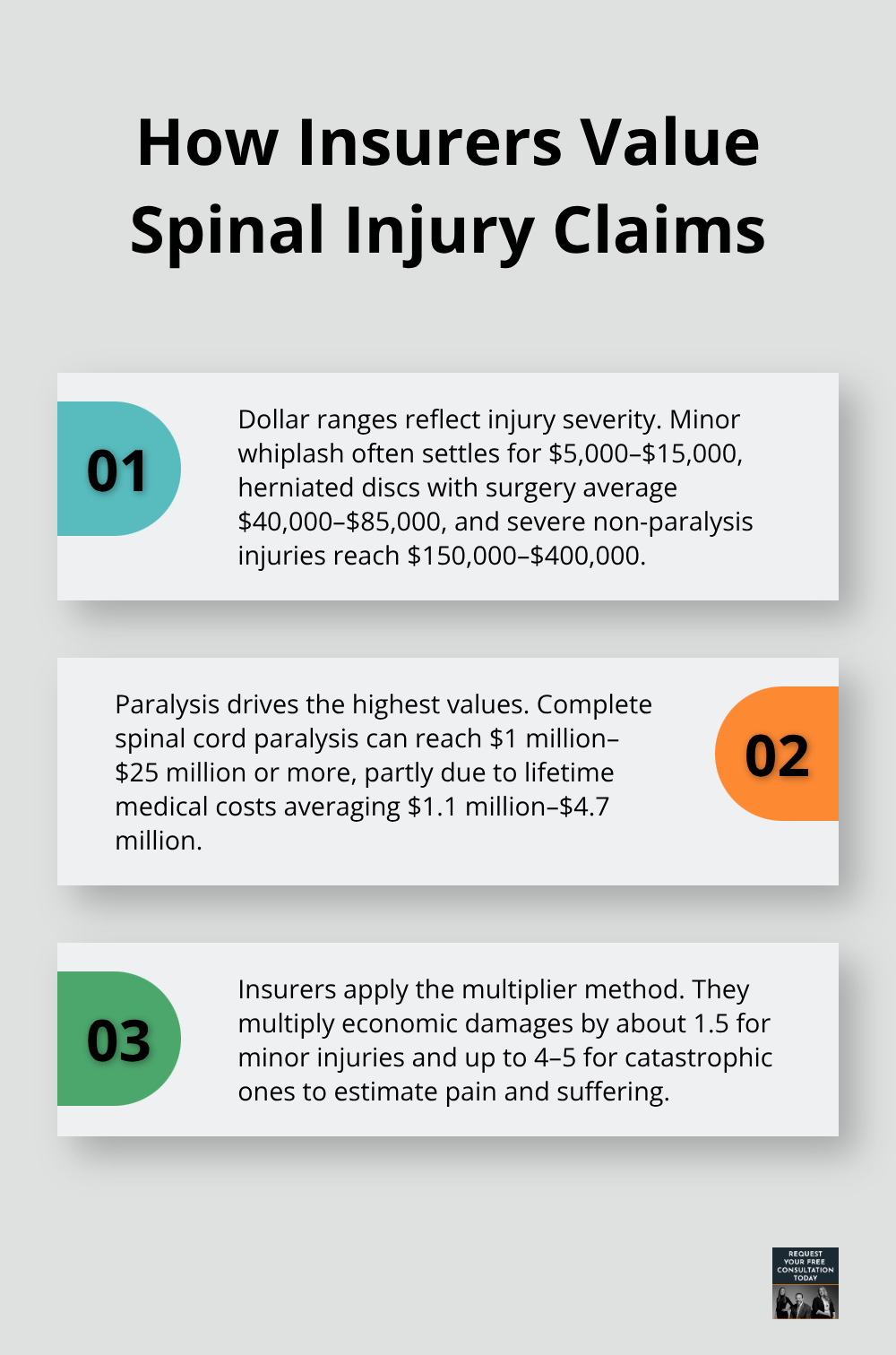
Calculating what your case is actually worth requires understanding how insurers value spinal injuries. Minor whiplash settlements typically range from $5,000 to $15,000, while herniated discs with surgery average $40,000 to $85,000 according to settlement data from personal injury cases nationwide. Severe spinal injuries without paralysis settle between $150,000 and $400,000, and complete spinal cord paralysis can reach $1 million to $25 million or higher when accounting for lifetime medical costs averaging $1.1 million to $4.7 million. Insurers use the multiplier method to calculate pain and suffering: they multiply your economic damages by a factor ranging from 1.5 for minor injuries to 4 or 5 for catastrophic ones.
Document Every Expense Related to Your Injury
Economic damages include medical bills, lost wages, transportation costs, and future care expenses. If you earned $60,000 annually and your spinal surgery requires six months of recovery, that’s $30,000 in lost wages alone before adding medical costs. You should document every expense: co-pays, prescription medications, medical equipment, home modifications for accessibility, and even travel costs to appointments. Many settlements fall between 60 and 70 percent of the gross amount after deducting attorney fees (around 33 to 40 percent) and case costs.
Avoid Settling Too Quickly
Never accept an initial settlement offer from an insurance company without understanding your full injury scope and long-term care needs, as early settlements frequently undervalue spinal injuries that worsen over time. Insurance companies count on victims accepting quick payouts before they understand the true cost of their recovery. The negotiation process ahead will test your patience, but the difference between a rushed settlement and a fair one can amount to hundreds of thousands of dollars over your lifetime. Understanding insurance company tactics and how to counter them becomes your next critical step.
What to Expect in Settlement Negotiations
Insurance companies approach spinal injury claims with a straightforward goal: pay as little as possible while closing the file quickly. Their initial offer typically represents 30 to 50 percent of what your case is actually worth, and they count on you accepting it before understanding your long-term medical needs. They request your medical records early, then argue that imaging shows only minor disc bulging or that your symptoms don’t match the injury severity. They cite pre-existing conditions from your medical history to suggest your pain stems from something other than the crash. They delay responses, hoping you’ll grow frustrated and settle. Most critically, they claim your lost earning capacity calculations are inflated or that future medical costs are speculative.
Counter Insurance Company Tactics
You must refuse their first offer outright and present a detailed demand letter that accounts for lifetime spinal care costs. Back every number with documentation from your medical team and economic professionals who can calculate your actual lost wages and future medical expenses. Adjusters expect counteroffers; they budget for negotiation and deliberately respond with lowball figures that insult your documented losses, so your paper trail becomes your strongest weapon in negotiations.
Structure Your Demand Letter for Maximum Impact
Your demand letter should itemize economic damages separately from pain and suffering, using the multiplier method insurers themselves employ. If your medical bills total $50,000 and you’ve lost $30,000 in wages, your economic damages equal $80,000. Applying a multiplier of 3.5 for a serious spinal injury yields $280,000 in pain and suffering, bringing your total demand to $360,000. Insurers will counter with a number substantially lower, perhaps $120,000 to $150,000, claiming your injury doesn’t warrant such a high multiplier. This is where evidence becomes your leverage.
Use Medical Evidence as Your Negotiating Power
Present your medical records showing ongoing treatment, imaging confirming structural spinal damage, and testimony from your healthcare provider about permanent effects. If you’ve undergone surgery, that fact alone justifies a higher multiplier because surgery indicates severity. Settlement negotiations typically last three to eight months for moderate spinal injuries and considerably longer for catastrophic cases (with some reaching 12 months or more). Most settlements fall between 60 and 70 percent of your demand after attorney fees and costs are deducted.
Know When to Stop Negotiating and Pursue Litigation
If the insurer’s offer remains below 50 percent of your demand after multiple rounds of negotiation, litigation becomes the better path forward because juries consistently award higher damages for spinal injuries than insurance companies voluntarily pay. The decision to litigate requires careful analysis of your case strength, but walking away from unfair settlement offers protects your financial future far better than accepting inadequate compensation.
Final Thoughts
Your spinal injury car crash case succeeds or fails based on the foundation you build immediately after impact. The medical records you collect, the evidence you preserve, and the documentation you maintain determine whether you receive fair compensation or accept an inadequate settlement. Start by gathering every medical report, imaging result, and treatment note from your healthcare providers, photograph vehicle damage and road conditions at the scene, collect witness contact information, obtain the police report, and document every expense related to your injury.
Refuse initial settlement offers that undervalue your long-term care needs and present a detailed demand letter backed by medical evidence and economic calculations. Insurance companies deliberately lowball their first offers, expecting negotiation, so understand that the difference between their opening position and a fair settlement often amounts to hundreds of thousands of dollars. If settlement discussions stall below 50 percent of your demand, litigation frequently yields better results because juries recognize the true cost of spinal injuries that insurance companies underestimate.
We at Schaar & Silva LLP support your recovery by handling the legal complexities while you focus on healing, and we’re ready to evaluate your spinal injury car crash claim at no cost to you. Contact us for a free case evaluation to assess your situation and understand your options in Santa Cruz County and surrounding areas. We fight for the compensation you deserve.
