

A back injury after a crash can range from mild soreness to severe pain that disrupts your daily life. Many people don’t realize how serious their injuries are until days or weeks pass and symptoms worsen.
At Schaar & Silva LLP, we help accident victims in Santa Cruz County understand their options and recover the compensation they deserve. This guide walks you through what to do immediately after a crash and how to protect your health and legal rights.
What To Do Right Now After Your Crash
Stop and assess your immediate safety. Move to a safe location if you can do so without worsening an injury, then call 911 immediately if anyone is hurt or if there’s significant vehicle damage.
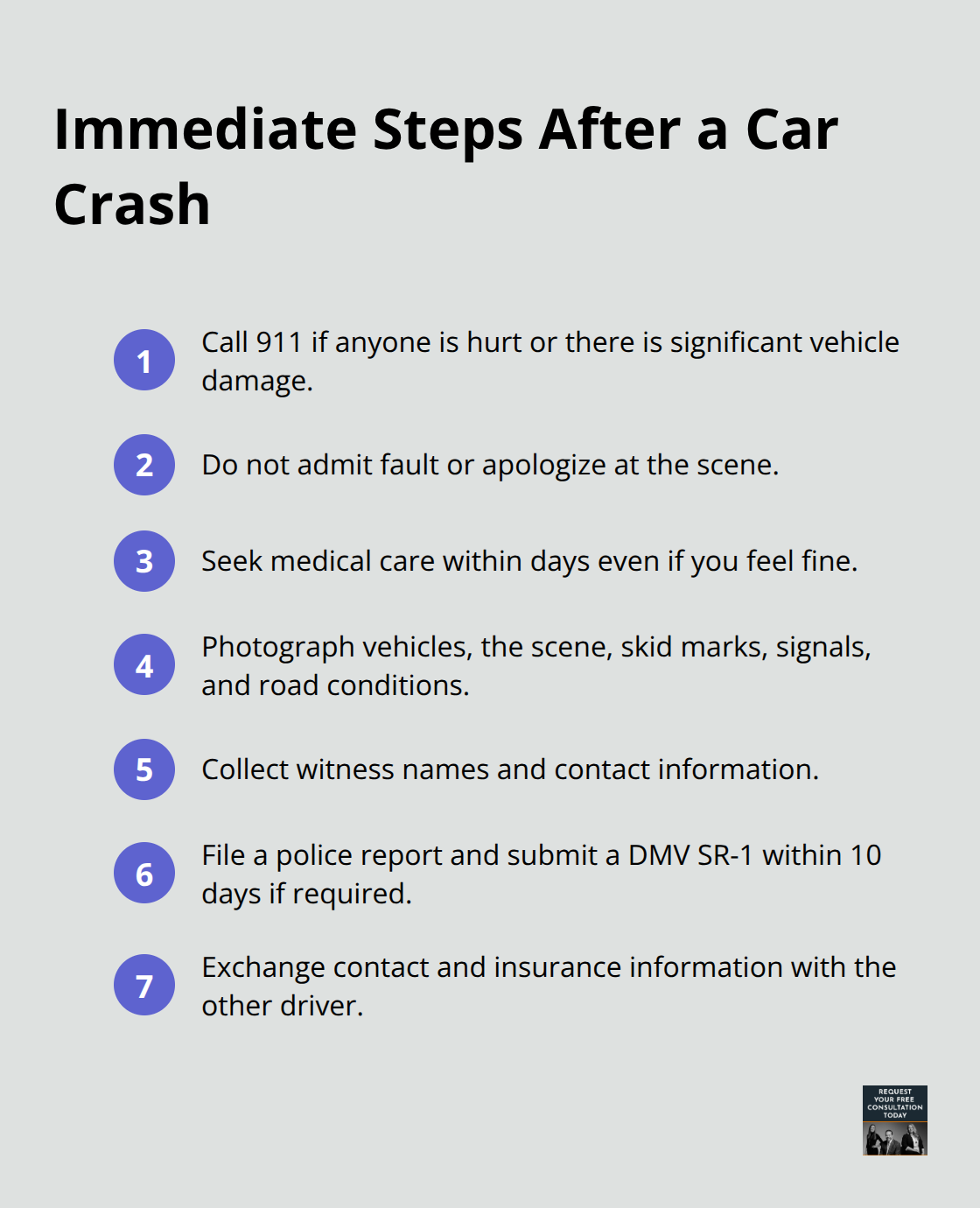
Do not admit fault or apologize at the scene-statements can be used against you later. California has timing requirements for preserving your rights, so seek medical care promptly. Even if you feel fine, adrenaline can mask serious injuries. Back pain often appears days or even a week after the accident due to inflammation, so get a medical evaluation as soon as possible.
Take photos and video of vehicle damage, the accident scene, skid marks, traffic signals, and road conditions. Collect witness names and contact information. File a police report if required and obtain a DMV SR-1 report if injuries or property damage meet the threshold-you have 10 days to file this report. Exchange information with the other driver, including name, phone, address, insurance company, and policy number.
Get Medical Help Within Days, Not Weeks
Call your doctor or visit an urgent care clinic within a few days of the crash, even if symptoms seem mild. An orthopedic professional can order imaging like X-rays or MRI scans to rule out fractures, herniated discs, or nerve damage that won’t show up on a simple exam. A 2018 study in the European Spine Journal found that people with a history of low back injury from a motor vehicle crash had a 2.76 times higher risk of developing troublesome back pain within 12 months. This means your injury now increases the odds of chronic pain later if left untreated.
Document Everything for Your Claim
Keep detailed records of all medical appointments, test results, and treatment plans. Report the accident to your insurance company promptly and provide them with the police report number and medical documentation. These records form the foundation of your claim and protect your rights moving forward. At Schaar & Silva LLP, we help accident victims in Santa Cruz County direct you to medical lien services so you’re not burdened by upfront costs while your case proceeds.
What Happens to Your Back in a Crash
Your back absorbs tremendous force during a car accident. The spine comprises 33 vertebrae, 31 nerve roots, and 32 muscles in the neck and back, giving you a sense of how many structures can be injured in a single collision. Most post-crash back injuries occur in the lumbar spine (lower back), where discs and soft tissues take the brunt of impact.
The specific injury depends on crash speed, your position in the vehicle, and how your body moves during the collision.
Types of Back Injuries That Occur in Crashes
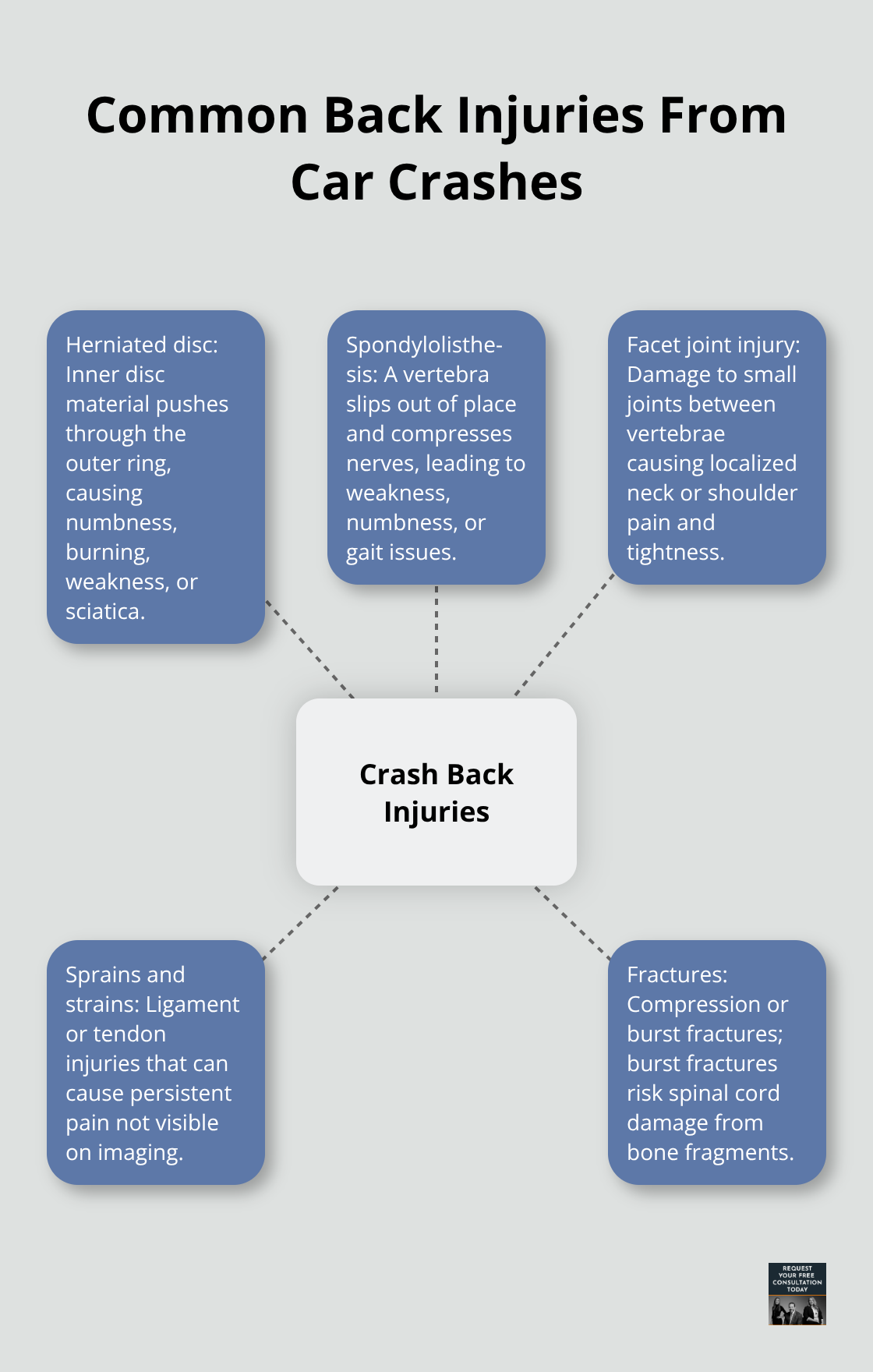
A herniated disc happens when the disc’s inner material pushes through the outer ring, potentially causing numbness, burning sensations, weakness, or sciatica radiating down your leg. Spondylolisthesis occurs when a vertebra slips out of place, compressing the spinal canal or nerves and leading to weakness, numbness, or difficulty walking. Facet joint injuries affect the small joints between vertebrae and typically cause neck or shoulder pain with muscle tightness. Sprains and strains involve ligaments and tendons respectively-both can cause persistent pain that won’t show up on imaging. Fractures range from compression fractures to burst fractures, with burst fractures being more serious because bone fragments can damage the spinal cord.
Pain Delayed by Days or Weeks
The reason you might feel fine immediately after a crash is adrenaline. Your body floods with hormones that mask pain, so you could have a serious disc injury and not know it for days. Inflammation builds gradually, and by day three or four you might wake up with sharp pain or stiffness you didn’t have the day before. Common symptoms include tingling or numbness in your legs, sharp pain that worsens with movement, burning pain radiating down your legs, or difficulty walking or standing.
A 2018 study in the European Spine Journal followed 789 Saskatchewan adults and found that people with a history of motor vehicle crash back injuries had a 2.76 times higher risk of developing troublesome back pain within 12 months compared to those without that history. This isn’t just about recovering from today’s injury-it’s about preventing chronic pain that could plague you for years. The longer you wait to get imaging and professional assessment, the harder it becomes to establish that your current pain connects to the crash.
Complications From Untreated Back Injuries
Untreated back injuries don’t stay static. Prolonged nerve irritation can develop into spinal stenosis, where the spinal canal narrows and compresses nerves. Radiculopathy causes shooting pain along nerve pathways, and nerve damage can become permanent if left alone. Chronic pain lasting more than three months disrupts sleep, which triggers depression and reduces your quality of life.
Degenerative spinal disorders can be accelerated by trauma, including bulging discs, stenosis, scoliosis, osteoarthritis, bone spurs, and degenerative disc disease. Once degeneration starts, it’s difficult to reverse. An orthopedic professional can order X-rays, MRI scans, or discography to identify exactly what’s damaged and assess mobility limitations. This diagnosis becomes your roadmap for treatment and your evidence for your claim. Waiting weeks or months to seek care weakens both your health outcome and your legal position, because insurance companies question whether your current pain truly stems from the crash or developed independently. Understanding what imaging reveals about your injury helps you make informed decisions about treatment options and strengthens your case when you work with a legal team that knows how to present medical evidence effectively.
Building Your Claim and Securing Fair Compensation
The evidence you collect in the first few days after your crash determines whether your claim succeeds or stalls. Medical imaging that ties your back injury directly to the collision forms your foundation-an X-ray or MRI report stating you have a herniated disc, vertebral fracture, or ligament damage proves the injury exists and links it to the crash. Without this connection, insurance companies argue your pain developed from something unrelated.
How Fault Affects Your Recovery
California’s pure comparative negligence rule allows you to recover damages even if you bear some fault, but your recovery amount gets reduced by your percentage of fault. If you’re 20 percent at fault and your claim is worth $100,000, you receive $80,000. Preserve crash-scene evidence immediately by photographing vehicle damage, positions, skid marks, and traffic controls. Collect witness names and contact information at the scene. These details support your liability argument and strengthen your position when negotiating with the insurance company.
Document Your Medical Treatment and Costs
Your medical records must show the full scope of your injury and its ongoing impact on your life. Keep receipts for every medical bill, imaging test, therapy session, and medication related to your back injury. Document how the injury affects your daily activities-pain levels, difficulty working, sleep disruption, and limitations on activities you previously enjoyed.
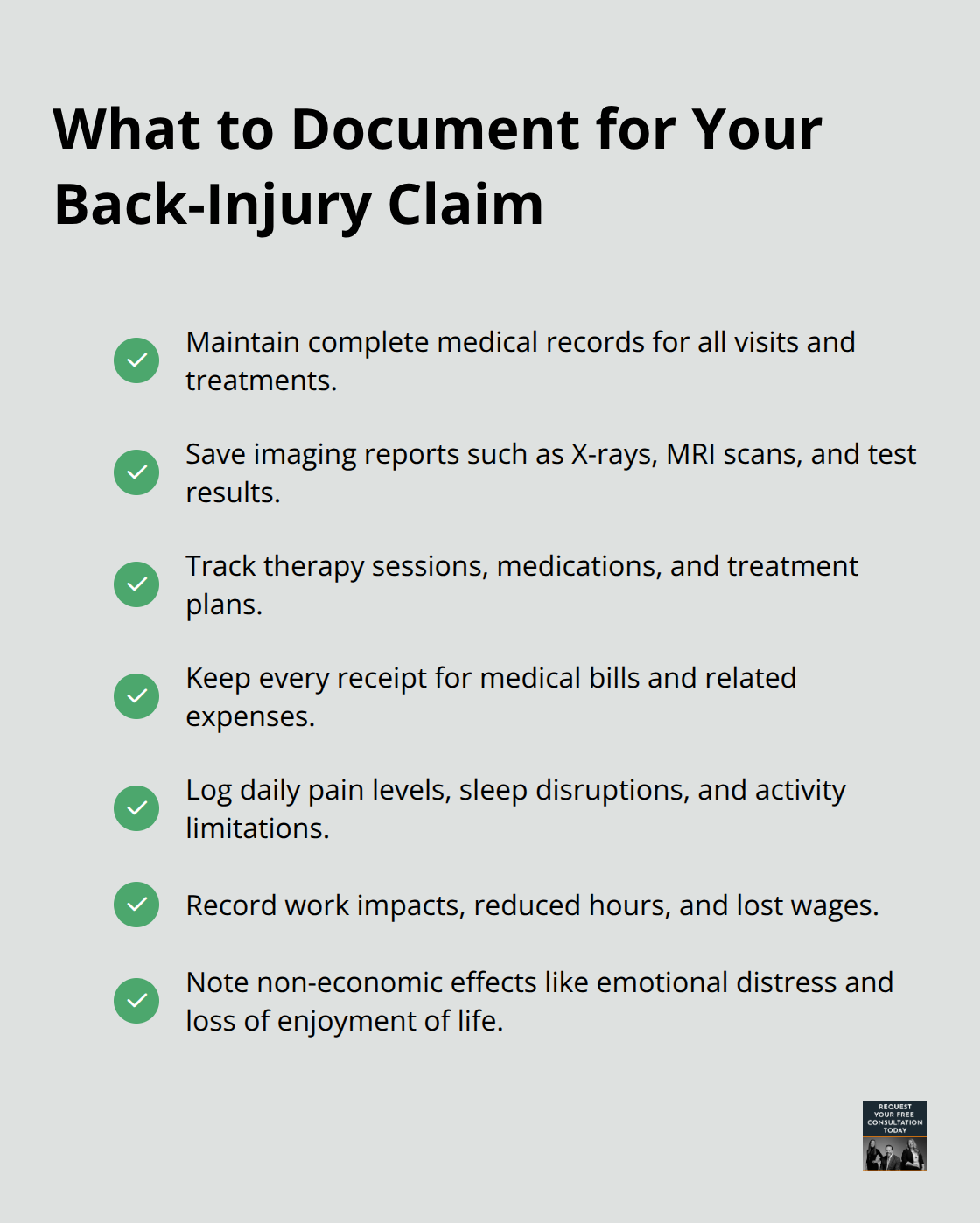
This information becomes non-economic damages, which include pain and suffering, emotional distress, and loss of enjoyment of life. California law recognizes these damages alongside economic damages like current and future medical expenses.
Quantify Your Pain and Suffering
Many people in Santa Cruz County underestimate their non-economic damages because pain is subjective and hard to quantify. Insurance companies count on this. A detailed log showing that your back injury prevents you from working full hours, sleeping through the night, or playing with your children demonstrates the real cost of your injury. These records carry weight when you present your claim to the insurance company or in court.
Understand Your Insurance Coverage Limits
California’s minimum liability coverage is 15/30/5, meaning $15,000 per person and $30,000 per accident for bodily injury. Back injuries often exceed these limits, so uninsured or underinsured motorist coverage becomes critical. If the at-fault driver has insufficient insurance, your UM/UIM coverage fills the gap. We at Schaar & Silva LLP can help you navigate these coverage questions and connect you with medical lien services so you access the treatment you need without paying upfront costs while your case proceeds. Our team evaluates property damage claims, ensures fair valuation for your vehicle loss, and connects you with psychological support specialists if emotional trauma accompanies your physical injury.
Final Thoughts
A back injury after a crash demands immediate action on two fronts: your health and your legal rights. The first days after your accident determine whether you prevent chronic pain and whether you build a strong claim. Seeking medical care within days, documenting everything, and preserving evidence at the scene protects both your recovery and your compensation.
In Santa Cruz County, you don’t have to navigate this process alone. We at Schaar & Silva LLP understand the physical and financial burden that comes with a back injury from a car accident, and our team has spent years helping accident victims recover fair compensation while they focus on healing. We handle the legal complexities so you can concentrate on your recovery.
Contact an orthopedic professional or your doctor within days of the crash, then reach out to us at Schaar & Silva LLP for a consultation about your claim. We can direct you to medical lien services that cover your treatment costs while your case proceeds, evaluate your property damage claim, and connect you with support services if emotional trauma accompanies your physical injury.
