

Back injuries from car accidents can sideline you for months or even years. The pain, medical bills, and lost income add up fast, and insurance companies often undervalue these claims.
We at Schaar & Silva LLP help people in Santa Cruz County, Sacramento, and Oakland build strong back injury cases that reflect the true cost of their recovery. This guide walks you through documenting your injury, calculating what you’re owed, and securing the compensation you deserve.
How Car Accidents Damage Your Back
Car crashes produce violent, sudden forces that your spine simply cannot handle. The impact throws your body forward, backward, or sideways at speeds your muscles and discs are not designed to resist. In a rear-end collision, your head whips backward while your torso stays anchored by the seat, creating shear forces across your cervical and lumbar spine. Front-end crashes slam your body forward, compressing discs and straining ligaments. Side-impact collisions twist your spine in unnatural directions. These aren’t theoretical injuries-they happen to real people in Santa Cruz County, Sacramento, and Oakland every single day. Motor vehicle crashes caused 40,901 deaths in the U.S. in 2023 according to the National Highway Traffic Safety Administration, and countless more people suffer non-fatal back injuries that alter their lives permanently.
Serious Injuries That Develop From Impact
Herniated discs rank among the most serious back injuries from car crashes. The impact ruptures the outer ring of a spinal disc, allowing the inner material to press against nerves. This causes radiating pain down your leg, numbness, and weakness-symptoms that can persist for months or years. Bulging discs occur when the disc material pushes outward without rupturing, still compressing nearby nerves and causing significant pain. Lumbar sprains and strains involve torn ligaments and muscle fibers in your lower back, producing stiffness and sharp pain that worsens with movement. Radiculopathy develops when nerve roots become irritated or compressed, causing burning sensations and tingling that travel from your back into your legs and feet.
These injuries carry vastly different settlement values. Minor soft tissue damage settles around $10,000 to $50,000, while herniated discs requiring surgery can justify settlements from $200,000 to $750,000 or more depending on severity and liability.
Why Pain Appears Days or Weeks Later
Many people walk away from a crash feeling fine, then wake up the next morning unable to move. Your body floods with adrenaline immediately after impact, masking pain signals that would normally alert you to injury. Swelling develops gradually over hours or days as inflammation builds around damaged tissues and nerves. Muscle guarding-your body’s protective response-keeps muscles tight and contracted, which temporarily reduces pain sensations but creates stiffness that becomes obvious only after the adrenaline wears off.
This delay creates a dangerous trap. Insurance companies exploit it aggressively, claiming that injuries appearing days or weeks later weren’t caused by the crash. Medical imaging breaks through this tactic. An MRI or CT scan showing a herniated disc or bulging disc carries far more weight in a claim than symptoms alone, substantially increasing settlement value. Imaging-confirmed injuries often justify settlements 2 to 3 times higher than those based purely on reported pain.
Taking Action Immediately Protects Your Claim
Seek medical attention immediately after any crash, even if you feel okay. Request imaging if your doctor recommends it, and keep all results in your records. This documentation becomes the foundation of your claim and prevents insurers from dismissing your injury as unrelated to the accident. The sooner you establish a medical record, the stronger your position when calculating what you’re owed.
Building Your Documentation From Day One
Seek Medical Care Immediately After Your Crash
Getting medical care within hours of your crash directly impacts settlement value. When you wait days or weeks, insurers claim your injuries weren’t serious enough to warrant immediate treatment, and they use that argument to slash your claim. The California Department of Insurance requires insurers to acknowledge claims within 15 days and begin investigation immediately, but your medical timeline starts the moment the crash happens.
Request imaging such as MRI or CT scans if your doctor recommends them. Imaging-confirmed injuries settle for substantially more than diagnoses based on symptoms alone. A herniated disc visible on an MRI might justify $200,000 to $750,000 in settlement value, while the same injury without imaging confirmation could settle for $30,000 to $100,000. Keep every medical record, bill, and receipt in one organized folder-digital and physical. Your treating physician’s notes become evidence that insurers cannot ignore, especially when they document progression of symptoms and functional limitations.
Photograph and Document the Accident Scene
At the crash scene, photograph everything before moving vehicles if it is safe to do so: vehicle damage from multiple angles, the accident location, road conditions, traffic signals, and any visible injuries. Obtain names, phone numbers, and addresses from the other driver, witnesses, and responding police officers. File a police report immediately and request a copy for your records.
This evidence establishes liability and prevents disputes about how the crash occurred. Photos showing severe vehicle damage strengthen your claim that the impact was forceful enough to cause serious injury. Police reports document the officer’s observations and any citations issued to the at-fault driver.
Track Your Pain and Functional Limitations Daily
Once home, start a pain journal documenting daily symptoms, what aggravates or relieves pain, and how injuries affect work and daily activities. Write specific entries: “Couldn’t sit at desk for more than 30 minutes Tuesday” carries more weight than vague statements like “back hurts.” Track every missed workday and request written confirmation from your employer showing dates and lost wages.
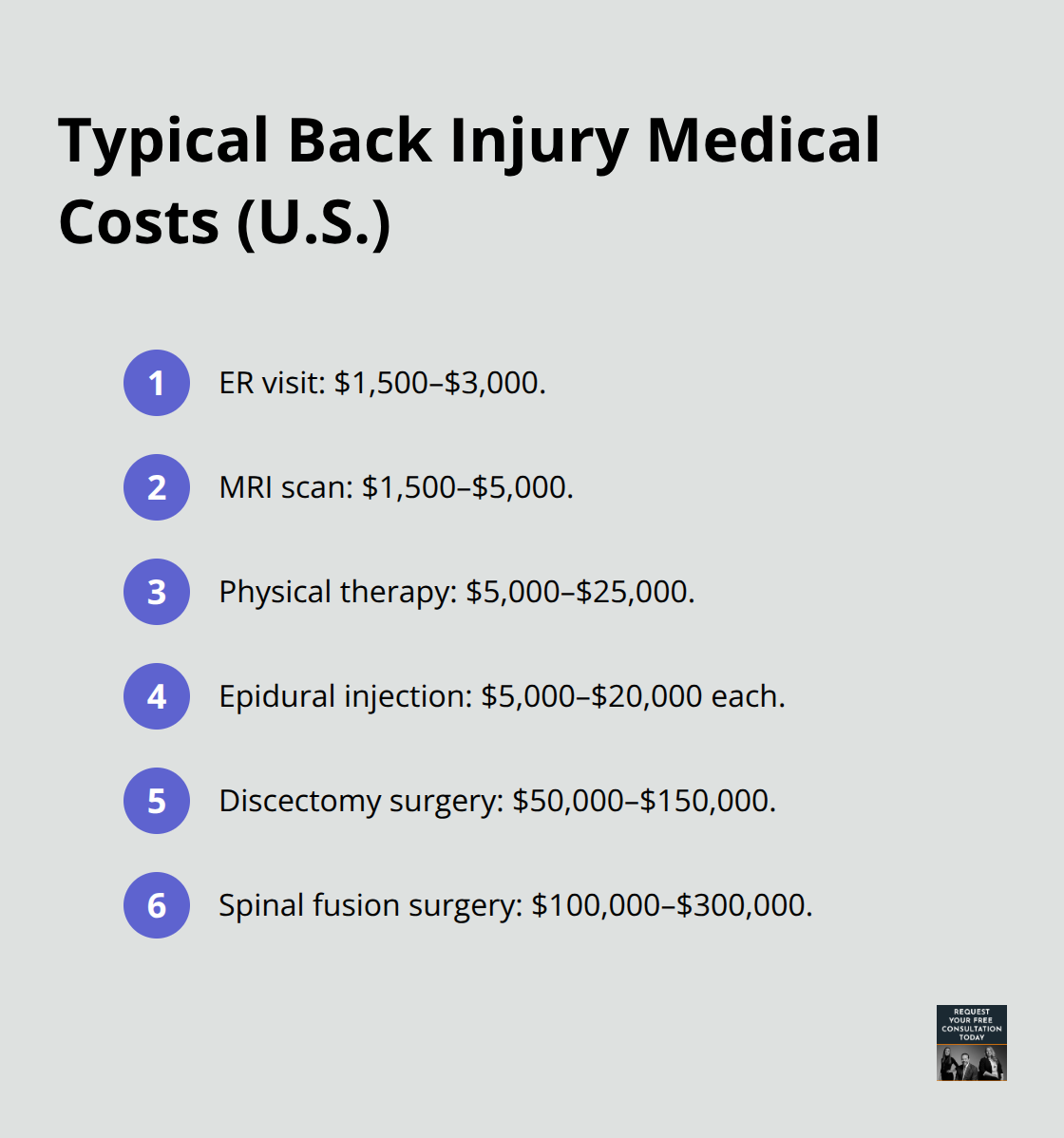
Medical expenses drive settlement calculations, so preserve all bills-emergency room visits typically cost $1,500 to $3,000, MRI scans range from $1,500 to $5,000, physical therapy runs $5,000 to $25,000, and epidural injections cost $5,000 to $20,000 each. The average personal injury claim takes 11.4 months to resolve according to NOLO, which means documentation you gather now becomes critical evidence months from now when you negotiate with insurers.
Protect Your Claim From Social Media and Recorded Statements
Do not post about your injury or accident on social media-insurers monitor social accounts and use posts to undermine claims. Do not give recorded statements to the other driver’s insurer without consulting a lawyer first; anything you say can be twisted and used against you. These mistakes hand insurers ammunition to reduce your settlement or deny your claim entirely.
Your documented medical records, scene photographs, pain journal, and wage loss statements form the foundation of a strong claim. With this evidence in place, you move into the next critical phase: calculating the actual damages you can recover and understanding how insurers value your specific injuries.
What Your Back Injury Is Actually Worth
Medical bills pile up fast after a back injury from a car crash, but the total damages you can recover extend far beyond what you paid to doctors and hospitals. Settlement value depends on three categories: medical expenses (both current and future), lost income and earning capacity, and pain and suffering compensation. Understanding how each category works prevents you from accepting lowball offers that ignore the full scope of your injury.
Medical Expenses: Current and Future Costs
Medical expenses form the foundation of your claim and are the easiest to document. Emergency room visits typically cost $1,500 to $3,000, MRI scans range from $1,500 to $5,000, physical therapy runs $5,000 to $25,000, and epidural injections cost $5,000 to $20,000 each. If your injury requires surgery, a discectomy ranges from $50,000 to $150,000 while spinal fusion surgery costs $100,000 to $300,000. Insurance companies use settlement software like Colossus that plugs your medical expenses into formulas to calculate initial settlement ranges.
Future treatment costs often exceed current bills, especially for chronic back injuries. A doctor’s statement projecting that you’ll need ongoing pain management at $5,000 to $30,000 annually for the next five years adds $25,000 to $150,000 to your claim value. Proving future damages requires current medical records showing your condition has stabilized and expert testimony about anticipated care needs, not speculation.
Lost Wages and Reduced Earning Capacity
Lost wages represent your second major damage category and should include every workday you missed plus reduced earning capacity if your injury prevents you from returning to your previous job. Request written documentation from your employer showing exact dates and wages lost during recovery. If you earn $60,000 annually and miss eight weeks of work, that’s roughly $9,200 in lost wages.
But if your back injury prevents you from performing physical labor and forces you into lower-paying work, the lifetime earning capacity loss could reach $200,000 or more. This calculation requires economic testimony about your reduced ability to earn over your remaining work years.
Pain and Suffering: Non-Economic Damages
Pain and suffering compensation addresses non-economic impacts that insurance companies want to ignore. California law allows uncapped pain and suffering awards in car accident cases, meaning there’s no legal maximum. Courts typically calculate this using either a multiplier method or per-diem approach.
The multiplier method applies a factor between 1.5 and 5 times your economic damages (medical bills plus lost wages), with higher multipliers for permanent injuries and lower ones for minor soft tissue damage. A herniated disc requiring surgery with $150,000 in medical expenses and $20,000 in lost wages might justify a 3 to 4 times multiplier, yielding $510,000 to $680,000 in pain and suffering alone. The per-diem approach assigns a daily dollar value to suffering and multiplies it by treatment duration or pain duration. If you assign yourself $200 per day of pain over 18 months, that reaches $109,000 in pain and suffering compensation.
Settlement Ranges by Injury Type
Settlement ranges vary dramatically by injury type and severity. Imaging-confirmed bulging discs typically settle between $30,000 and $100,000, while herniated discs without surgery settle from $75,000 to $350,000. Herniated discs requiring surgery jump to $200,000 to $750,000, and severe spinal or nerve damage involving permanent disability can exceed $2,000,000.
Pre-existing back conditions don’t eliminate your claim under California’s eggshell plaintiff doctrine, which holds that you can recover full compensation for aggravation caused by the crash even if you had prior problems. Medical records must clearly show the change from baseline to prove aggravation, so document your condition before and after the accident meticulously. Insurance companies exploit weak documentation by claiming injuries were pre-existing or unrelated to impact. Imaging confirmation changes this entirely-an MRI showing a new herniated disc or increased disc bulging after your crash proves causation in ways that pain complaints alone cannot.
Final Thoughts
Medical documentation transforms your back injury case from complaints into objective proof that insurers cannot dismiss. When your MRI shows a herniated disc, when your medical records document progressive treatment over months, and when your pain journal tracks specific functional losses, you shift from negotiating from weakness to negotiating from strength. Insurance companies know this reality, which is why they push back hardest against claimants with comprehensive medical records and imaging confirmation.
We at Schaar & Silva LLP evaluate back injury cases by examining the full picture of your recovery, reviewing medical records for consistency, assessing whether imaging confirms your diagnosis, and calculating both current and future medical costs with precision. We understand that your back injury case requires more than just medical bills-it demands proof of how your injury disrupted your work, your daily activities, and your quality of life. We connect you with medical lien services to manage bills while your case resolves and help you evaluate property damage claims.
Organize your medical records now, maintain your pain journal, and document every expense related to your recovery, since the statute of limitations gives you two years from your crash date to file a lawsuit. Insurance companies count on delay and fading documentation to reduce what they owe you. Contact Schaar & Silva LLP to discuss your back injury case and learn how we help people in Santa Cruz County, Sacramento, and Oakland secure the compensation they deserve.
