
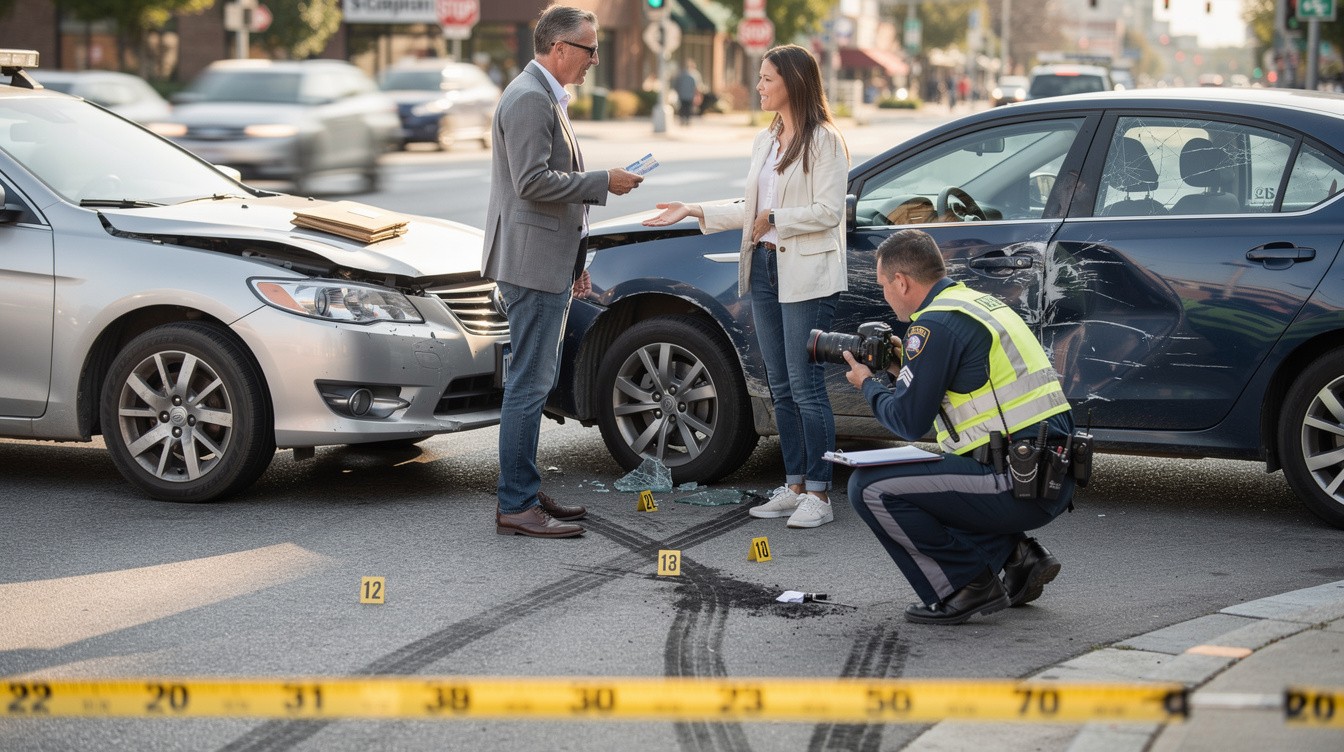
California’s pure comparative negligence rule means you can recover damages even if you’re partially responsible for your accident. However, the percentage of fault assigned to you directly reduces your compensation.
At Schaar & Silva LLP, we’ve seen how misunderstanding comparative negligence in California costs accident victims thousands of dollars. This guide explains how courts determine fault and what you can do to protect your claim.
How Fault Gets Calculated in California
California’s pure comparative negligence system, established by the landmark Li v. Yellow Cab Co. decision in 1975, operates on a straightforward principle: your recovery amount equals your total damages minus your percentage of fault. If you’re 30% at fault for a crash that caused $100,000 in damages, you recover $70,000. If you’re 60% at fault, you recover $40,000. There’s no threshold that bars recovery entirely-even if you’re 99% at fault, you still receive compensation for the remaining 1% of damages. This differs sharply from states using comparative negligence with a 50% bar, where any fault above 50% eliminates recovery.
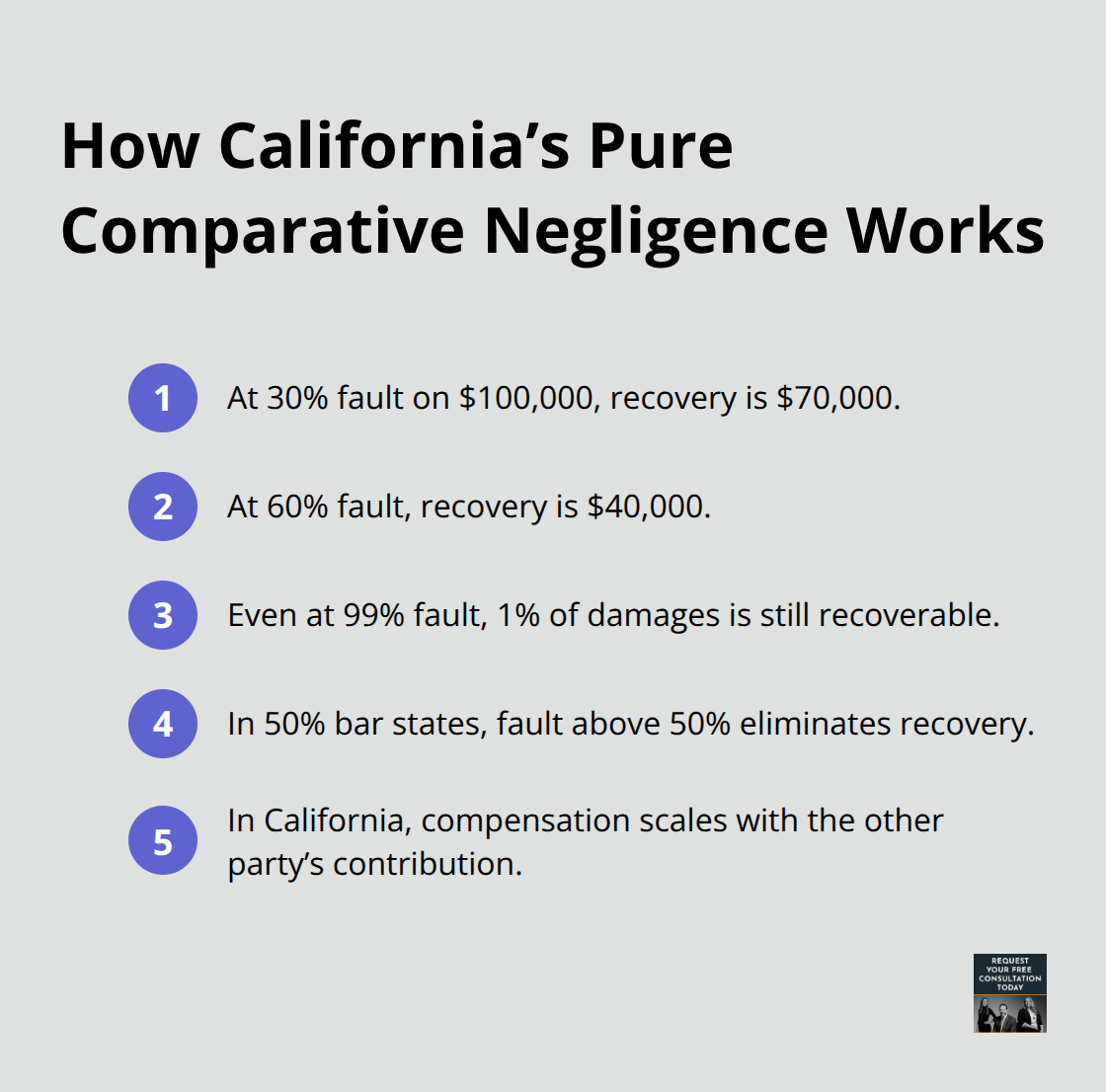
California’s approach means your compensation scales directly with how much the other party contributed to the accident.
Evidence That Courts Use to Assign Fault
Courts determine fault percentages by examining police reports, witness statements, physical evidence like skid marks and vehicle damage patterns, and sometimes accident reconstruction analysis. Police reports carry significant weight in fault determination, particularly when traffic violations are documented. However, police conclusions aren’t final determinations; they’re starting points that can be disputed with stronger evidence. Eyewitness credibility matters substantially-firsthand accounts from bystanders carry more weight than secondhand information.
How Physical Evidence Tells the Story
Physical evidence reveals what happened at the moment of impact. Vehicle damage patterns show impact angles, debris location indicates how vehicles moved after collision, and skid marks reveal braking and speed. When fault is hotly contested, accident reconstruction professionals analyze speeds, positions, and impact dynamics using physics and engineering principles. Their testimony carries significant weight in disputes.
Why Insurance Fault Assessments Aren’t Final
Insurance companies rely on the same evidence types but work to minimize payouts, so their initial fault assessments often favor their insured driver. You can challenge these assessments with additional evidence and professional analysis if needed. Accident victims who gather comprehensive evidence immediately-scene photographs, witness contact information, surveillance footage, and medical records-significantly improve their ability to counter unfair fault assignments.
How Damages Get Divided in Shared Fault Cases
Shared fault situations require proportional damage allocation: if you’re 25% at fault and total damages reach $80,000, you recover $60,000. This calculation applies to both economic damages like medical bills and lost wages, and non-economic damages like pain and suffering, though Proposition 51 (Civil Code Section 1431.2) modifies how non-economic damages are allocated among multiple defendants in certain situations. Understanding how courts apply these calculations to your specific accident helps you evaluate settlement offers and recognize when fault percentages have been inflated against your interests.
Where Comparative Negligence Plays Out
Rear-End Collisions and the Brake-Checking Problem
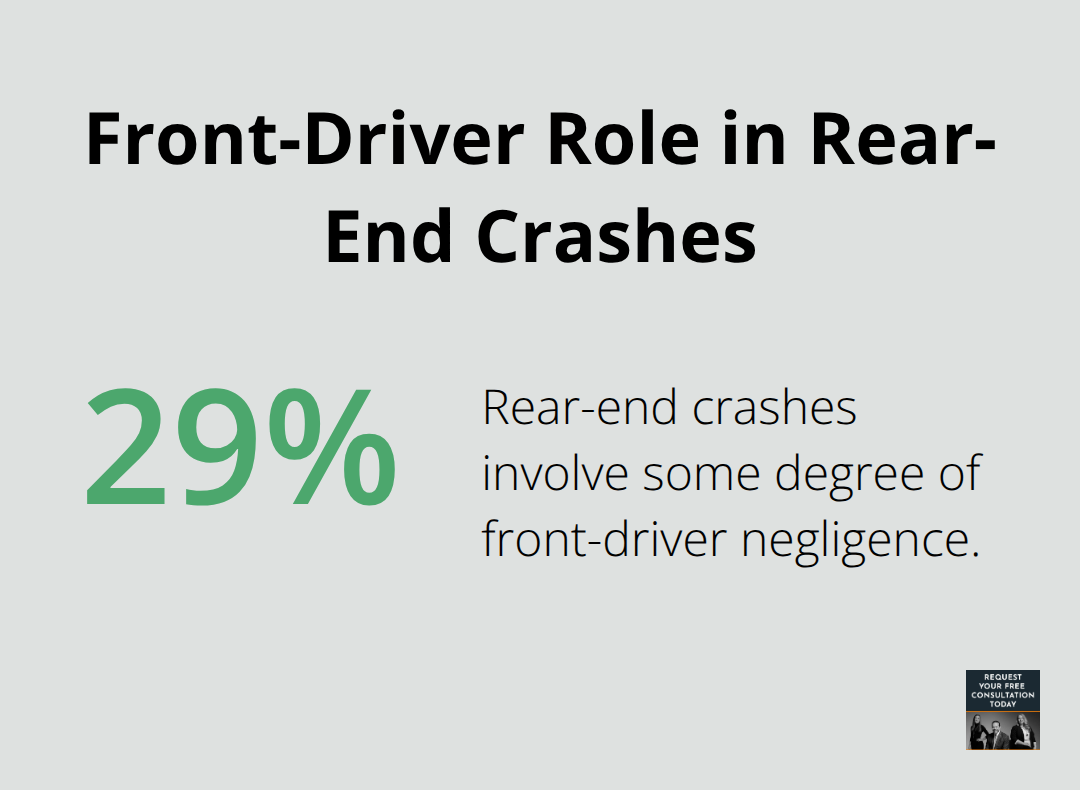
Rear-end collisions represent the most common scenario where comparative negligence complicates fault assignment. While many assume the rear driver bears full responsibility, California courts recognize that front drivers can share fault through brake checking, sudden lane changes, or malfunctioning brake lights. If you brake suddenly without cause or change lanes directly into traffic, you may face 10-40% fault assignment even though another vehicle hit you from behind. The insurance industry reports that approximately 29% of rear-end crashes involve some degree of front-driver negligence.
Documentation becomes critical here: dashcam footage showing whether you had legitimate reasons to brake, witness statements confirming sudden maneuvers, and traffic camera recordings all protect your claim. Insurance adjusters frequently cite brake checking to reduce payouts, so immediate evidence collection at the scene counters these arguments effectively.
Left-Turn Accidents at Intersections
Left-turn accidents at intersections generate intense fault disputes because both drivers often claim the other violated right-of-way rules. If you turned left in front of oncoming traffic, you’ll typically face 60-75% fault assignment, but if the other driver was speeding or ran a red light, courts reduce your percentage substantially. California courts examine vehicle speeds, traffic signal timing, and visibility conditions to determine whether the oncoming driver could have avoided the collision. Accident reconstruction analysis proves valuable here since speed calculations from skid marks and damage patterns establish whether the other driver exceeded posted limits.
Distracted Driving and Speed Violations
Distracted driving and speed violations shift fault allocation dramatically in accident cases. A driver texting while driving carries significantly heavier fault than one making a momentary glance, and speeding in a 35 mph zone increases fault assignment by 15-30% depending on how much the driver exceeded the limit. Insurance companies use minor speeding citations to inflate your fault percentage unfairly. If you were traveling 5 mph over the limit but the other driver was texting, California courts weight the distraction factor more heavily. Gathering phone records through discovery, obtaining witness statements about the other driver’s attention, and preserving any available surveillance footage strengthens your position significantly. The key distinction is that courts examine the actual negligent conduct, not technical violations alone, so your attorney’s ability to present comprehensive evidence determines whether inflated fault percentages get corrected.
How Evidence Protects You in Complex Scenarios
Each of these accident types requires specific evidence to counter inflated fault assignments. Scene photographs, witness contact information, surveillance footage, and medical records form the foundation of a strong response to unfair fault determinations. When insurance adjusters challenge your version of events, the evidence you collected immediately after the accident becomes your most powerful tool. The next section explains exactly how to document these details and work with witnesses to build an unshakeable record of what actually happened.
Building Your Evidence Foundation
Photograph the Scene Immediately
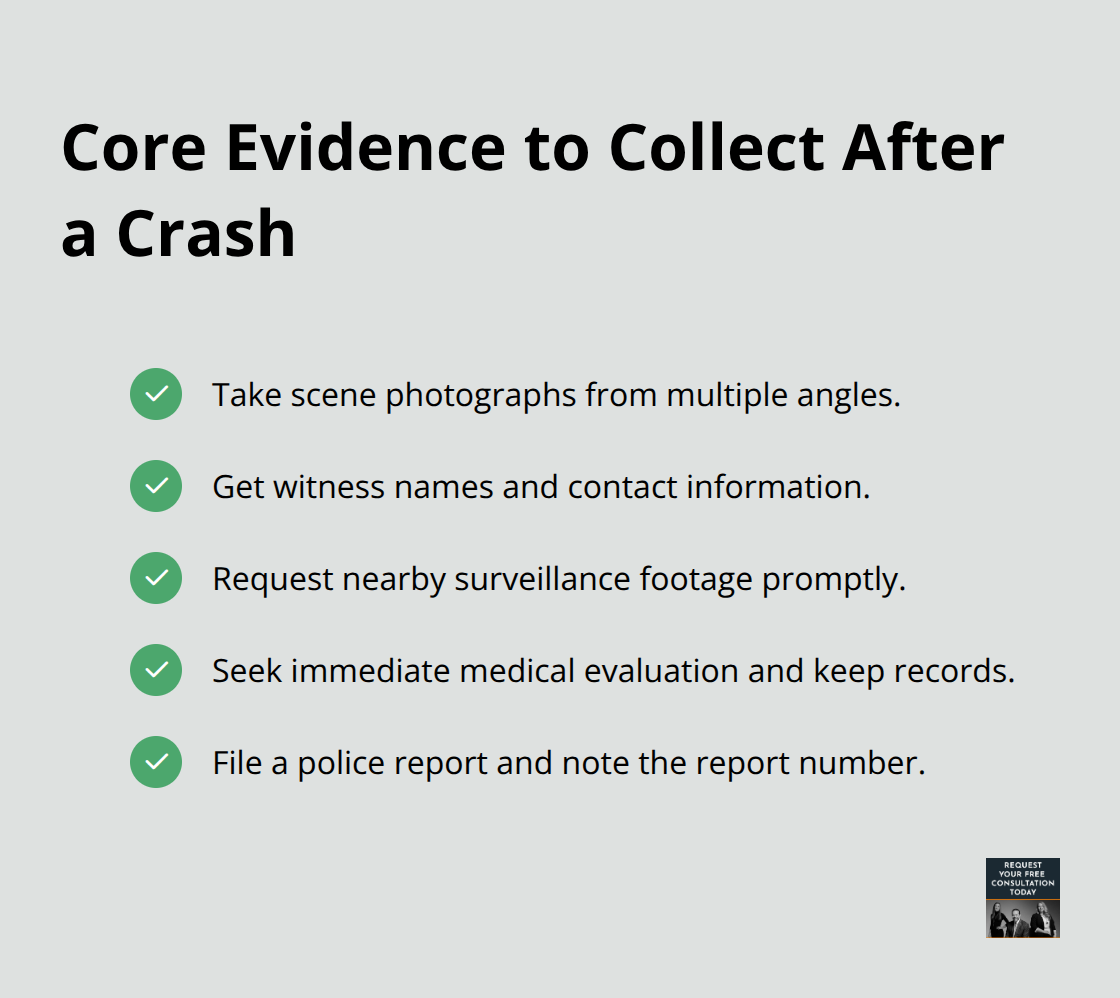
Immediately after an accident, the evidence you collect determines whether insurance adjusters can inflate your fault percentage unchallenged. Most accident victims wait days or weeks to document the scene, and by then crucial details vanish, witnesses disappear, and surveillance footage gets overwritten. You need to photograph everything at the accident scene immediately, including vehicle positions, damage patterns, road conditions, and traffic signals within the first hour if possible. Take wide shots showing the overall scene, then close-ups of each vehicle’s damage, the road surface for skid marks or debris, and any relevant traffic signs or signals. Photograph from multiple angles because damage patterns reveal impact direction and speed-something insurance adjusters use against you if the photos show evidence they can misinterpret.
Collect Witness Information While It’s Fresh
Collect witness contact information immediately by asking bystanders for their names, phone numbers, addresses, and what they saw. Most witnesses won’t return calls days later, so you need their information while adrenaline is high. If a business nearby has surveillance cameras, note the business name and contact the manager within 24 hours because footage retention policies typically allow only 7-14 days before automatic deletion. File a police report and obtain the report number; the officer’s observations about traffic violations, road conditions, and preliminary fault assessment create an official record that helps counter later insurance claims.
Secure Medical Records That Support Your Claim
If injuries occurred, you should seek medical attention immediately even for minor symptoms like neck pain or headaches, because medical records establish a timeline connecting the accident to your injuries-something insurance companies use to argue delayed treatment means injuries weren’t serious. Medical documentation becomes your strongest defense against fault inflation because insurers frequently argue that injuries were pre-existing or exaggerated. At your initial medical appointment, describe exactly how the accident happened and all symptoms you’re experiencing, no matter how minor. Request copies of all medical records, imaging reports, and treatment notes throughout your recovery.
Understand How Medical Records Affect Your Settlement
When you’re 30% at fault for a crash causing $150,000 in total damages, you recover $105,000-but if an insurer falsely argues your injuries were pre-existing and reduces your damages claim to $75,000, your recovery drops to $52,500 even though your fault percentage remains the same. The strategy here is straightforward: insurers attack both your fault percentage and your damages amount simultaneously. Medical records showing consistent treatment, progression of recovery, and a clear connection between the accident to your injuries make it harder for adjusters to manipulate your claim. Don’t accept the insurer’s initial fault assessment; it’s a negotiating position, not a legal determination. California’s pure comparative negligence system allows you to challenge fault percentages with evidence, and most accident victims never do. The difference between accepting 40% fault and successfully arguing for 20% fault on a $100,000 claim is $20,000 in your pocket.
Final Thoughts
California’s pure comparative negligence system allows you to recover damages even when you share fault for the accident, but insurance adjusters count on you accepting inflated fault percentages without challenge. The evidence you collect immediately after your crash-photographs, witness statements, medical records, and police reports-determines whether you settle fairly or leave thousands of dollars on the table. Understanding how comparative negligence California law works protects your claim because the difference between accepting 40% fault and successfully arguing for 20% fault on a $100,000 claim equals $20,000 in your pocket.
Professional legal representation counters the standard tactics insurance companies use to minimize payouts, including citing minor traffic violations to inflate your fault, questioning whether your injuries connect to the accident, and manufacturing 50/50 fault splits when evidence supports a lower percentage. An attorney familiar with comparative negligence law presents accident reconstruction analysis, independent investigations, and comprehensive evidence that challenges unfair fault assignments. This advocacy directly impacts your recovery because adjusters negotiate differently when they know you have professional representation.
We at Schaar & Silva LLP handle the legal complexities of comparative negligence cases while you focus on healing. Contact us for a free case review to understand how fault allocation impacts your specific accident and what compensation you can realistically expect in Santa Cruz County, Sacramento, or Oakland.
