

After a car accident, insurance companies often offer settlements that barely cover your medical bills. They systematically undervalue pain and suffering damages, leaving you with far less than you deserve.
At Schaar & Silva LLP, we’ve seen countless accident victims accept lowball offers simply because they didn’t understand how a pain and suffering settlement actually works. This guide shows you exactly how non-economic damages are calculated and what mistakes tank your claim.
What Pain and Suffering Actually Means After an Auto Accident
Physical and Emotional Pain Are Both Real
Pain and suffering in an auto accident claim covers two distinct categories: physical pain and emotional distress. Physical pain includes neck and back injuries, broken bones, burns, headaches, and in severe cases, paralysis. Emotional pain encompasses PTSD, insomnia, anxiety, grief, and cognitive issues that develop after the crash. California law treats both equally, yet insurance adjusters often dismiss emotional harm as secondary. The challenge is that emotional pain leaves no medical receipt, making it harder to prove than a fractured arm on an X-ray. Without proper documentation and testimony, adjusters will low-ball your claim by focusing only on what they can see in medical imaging.
Why Insurance Companies Undervalue Emotional Harm
This is where most accident victims lose thousands of dollars-they fail to document the psychological impact of their injuries and let insurers frame the narrative around economics alone. Adjusters rely on what they can measure, not what you actually experience. Your sleepless nights, your anxiety about driving, your inability to concentrate at work-these matter legally, but they require evidence to count in your settlement.
Economic Damages Have Receipts; Non-Economic Damages Don’t
Non-economic damages differ fundamentally from economic damages, which are straightforward to calculate. Economic damages include medical bills, lost wages, rehabilitation costs, and vehicle repair-anything with a receipt or invoice. Non-economic damages have no receipt; they represent the intangible harm: your pain, your lost enjoyment of life, your inability to play sports or care for your family, and the years of suffering ahead.
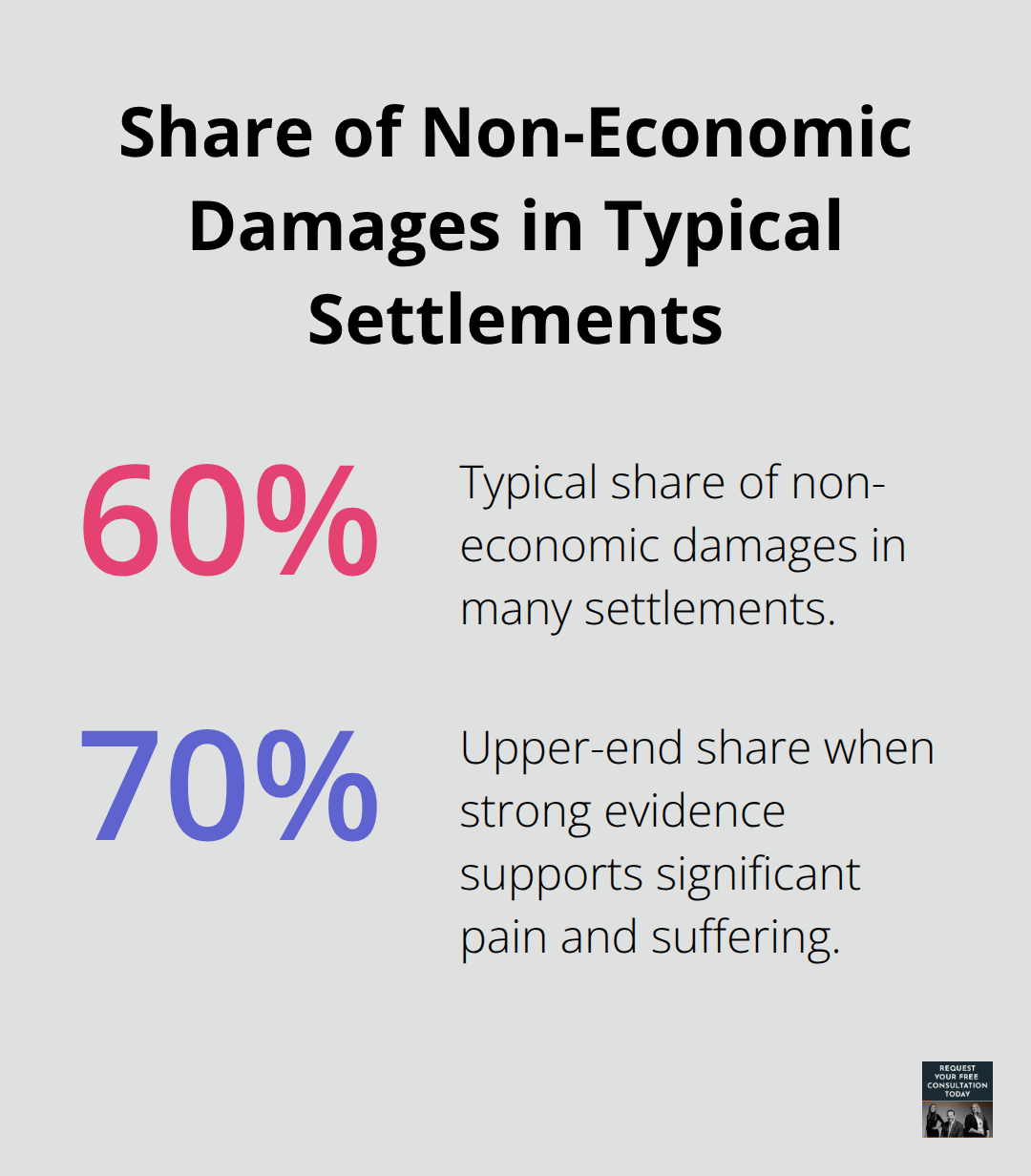
In many auto accident settlements, non-economic damages actually exceed economic losses. A soft tissue injury from whiplash that resolves in three to six months typically settles between $5,000 and $25,000, while a disc herniation requiring ongoing care can reach $75,000 to $150,000, with non-economic damages comprising 60 to 70 percent of that total.
How Settlement Software Shapes Your Offer
Insurance companies undervalue pain and suffering because they have no algorithm to prove you wrong-until you provide evidence. They rely on settlement software like Colossus, which analyzes thousands of claims to generate a settlement range, but that range is only as strong as the evidence supporting your injuries. Without medical records documenting your pain, testimony from neutral witnesses, or a detailed pain journal showing daily impact, adjusters will anchor their offer to the lowest end of the range. This is deliberate strategy, not oversight.
The evidence you gather-medical documentation, witness statements, and records of how your injuries affect your daily life-determines whether you land at the bottom or top of that range. Insurance companies count on you not building that case.
How Insurers Calculate Your Damage Award
Two Methods Shape Your Settlement
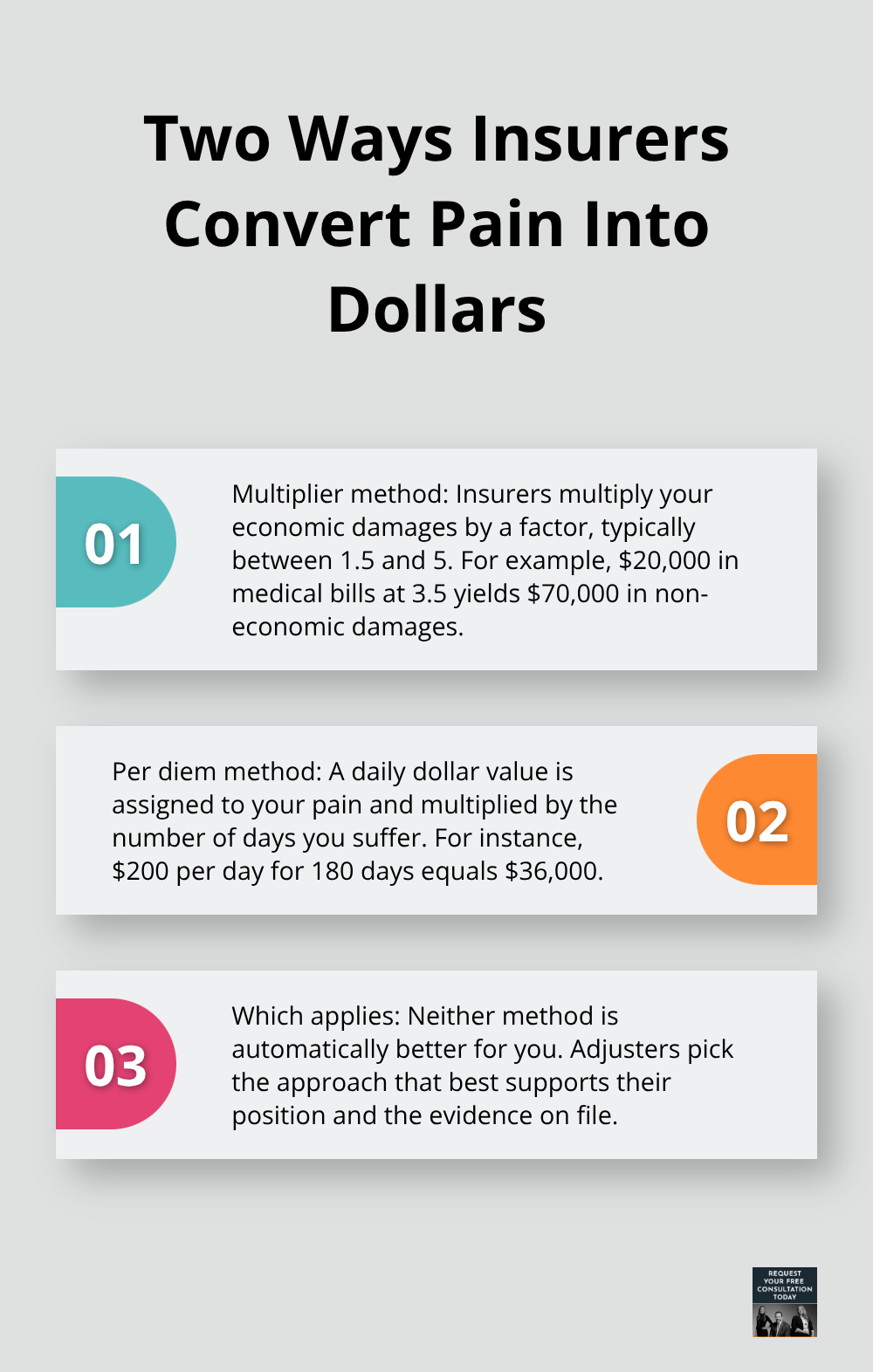
Insurance companies use two primary methods to convert your pain and suffering into a dollar amount, and understanding which one applies to your claim directly affects your settlement. The multiplier method takes your economic damages-medical bills, lost wages, vehicle repair-and multiplies them by a factor between 1.5 and 5. A $20,000 medical bill multiplied by 3.5 yields $70,000 in non-economic damages. The per diem method assigns a daily dollar value to your suffering and multiplies it by the number of days you experience pain. If you assign $200 per day for 180 days of recovery, that equals $36,000. Neither method is inherently superior; adjusters choose based on what benefits their position.
Which Method Works Against You
For soft tissue injuries that resolve quickly, the multiplier method favors insurers because your economic losses are modest. For chronic conditions like disc herniation, the per diem method works against you unless you can prove years of ongoing pain. Settlement software like Colossus generates a range based on thousands of comparable claims, but that range assumes you’ve built a credible case. Without documentation showing the severity and duration of your pain, the software’s output becomes irrelevant because adjusters ignore it and anchor their offer to the lowest possible figure.
Evidence Determines Your Final Amount
The strength of your evidence, not the calculation method, actually determines your settlement amount. A broken wrist with casting but no surgery typically settles between $15,000 and $40,000, while a disc herniation requiring ongoing physical therapy reaches $75,000 to $150,000, with non-economic damages making up 60 to 70 percent of the award. Traumatic brain injuries with lasting cognitive effects range from $150,000 to $1,000,000 depending on permanence. Spinal cord injuries command far higher amounts-paraplegia settlements typically fall between $3,000,000 and $8,000,000, while quadriplegia often exceeds $8,000,000.
What Pushes Your Settlement Higher
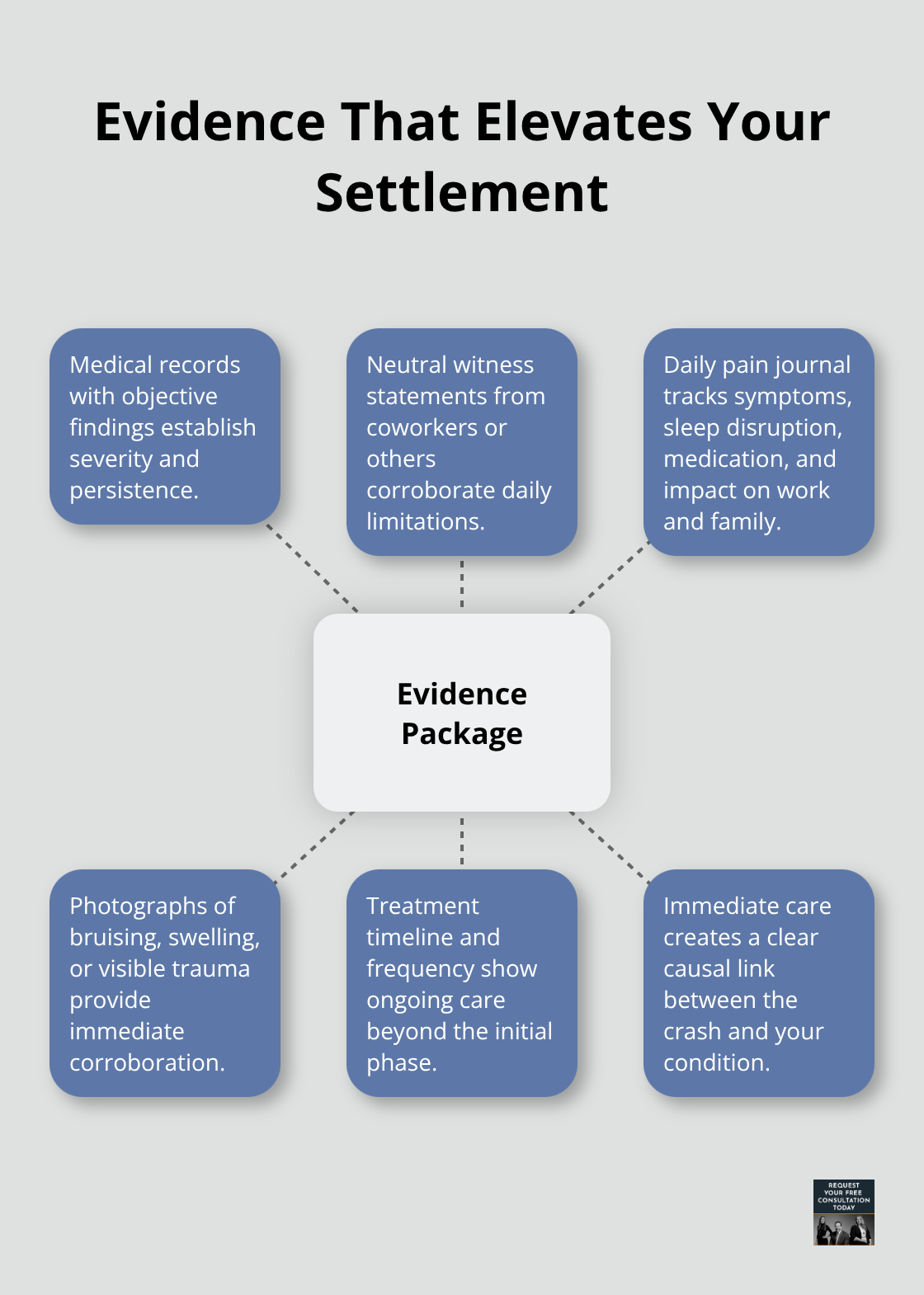
These figures matter only if you can prove your specific injuries match the severity level. Medical records documenting your condition, testimony from neutral third-party witnesses like coworkers who observed your limitations, and a daily pain journal showing how your injuries affected work and family life push your settlement toward the top of the range. Insurance adjusters count on you not gathering this evidence, leaving them free to lowball your claim. The documentation you build determines whether you land at the bottom or top of what the software suggests-and that difference often reaches tens of thousands of dollars.
The Three Mistakes That Tank Your Settlement
Rejecting the First Offer Changes Everything
The first offer from insurance arrives within days of your accident, and it feels like relief. The adjuster sounds professional, the number seems reasonable compared to your medical bills, and you want to move forward. Accepting that offer is the single biggest financial mistake you can make in an auto accident claim. Insurance companies deliberately lowball initial offers because they know most people will accept them without understanding how pain and suffering damages work.
A soft tissue injury that should settle for $15,000 gets offered at $6,000; you accept it, sign a release, and forfeit any right to renegotiate. That gap of $9,000 disappears forever. Adjusters count on this. They test your threshold with a low number knowing that many accident victims lack documentation of their injuries and therefore cannot argue for more. Your refusal to accept the first offer signals that you have evidence and are willing to fight for fair value. This changes the entire negotiation dynamic. The adjuster knows they will need to justify their position with data, not assumptions.
Build Your Case With Documentation
Documentation transforms a claim from guesswork into fact. Without a pain journal, medical records showing objective findings, and photographs of visible injuries, your claim rests entirely on your word against the insurance company’s skepticism. A pain journal that tracks your pain level, medication use, sleep disruption, and inability to work or care for family creates a timeline that contradicts any adjuster’s narrative that you recovered quickly.
Medical records that show ongoing physical therapy, specialist referrals, and treatment frequency prove your condition persisted beyond the initial injury phase. Photographs of bruising, swelling, or visible trauma taken immediately after the accident corroborate your account. Yet many accident victims skip this documentation because they assume the insurance company will accept their statement. They won’t. Adjusters regularly discount claims that lack supporting evidence, treating the claimant’s testimony as self-interested exaggeration. The absence of documentation becomes permission for the adjuster to anchor their offer to the lowest possible figure.
Seek Medical Treatment Immediately
Seeking immediate medical treatment after an accident serves two purposes: it protects your health and creates the medical record that proves your injuries. Delaying treatment gives adjusters ammunition to argue that your injuries were minor or that something else caused your pain weeks later. Emergency room visits, urgent care records, and follow-up appointments with specialists all establish a clear causal link between the accident and your condition.
Insurance companies use treatment gaps against you, claiming that if your injuries were serious, you would have sought care sooner. This argument carries weight with juries and settlement adjusters alike, even though delayed pain responses are medically common after trauma. The combination of immediate treatment, ongoing documentation, and a detailed pain journal creates an evidentiary foundation that adjusters cannot dismiss or undervalue.
Final Thoughts
Maximizing your pain and suffering settlement requires three concrete actions: refuse the first offer, build an evidence package that proves your injuries, and seek immediate medical treatment. The gap between what insurance companies initially offer and what your claim actually deserves often reaches tens of thousands of dollars. That difference exists because adjusters bet you won’t document your pain, won’t gather witness testimony, and won’t understand how non-economic damages work.
Working with legal support changes the entire dynamic of your claim. We at Schaar & Silva LLP handle the negotiation while you focus on recovery, connecting you with medical lien services to manage your bills, evaluating your property damage claim fairly, and linking you with psychological support for emotional trauma that insurance companies routinely undervalue. Our team understands how settlement software works, what evidence carries weight with adjusters, and when to push back against inadequate offers. We’ve recovered over $150 million for clients because we build cases that adjusters cannot dismiss or undervalue.
Contact Schaar & Silva LLP for a free case review to assess your eligibility for non-economic damages and outline a strategy to maximize your pain and suffering settlement. We serve Santa Cruz County, Sacramento, and the Oakland area, handling auto accidents, truck accidents, pedestrian injuries, and wrongful death cases. You pay nothing unless we recover money for you.
