

A car crash can leave you facing medical bills, lost income, and pain that disrupts your life. Understanding how an injury settlement from a car crash works is the first step toward getting fair compensation.
At Schaar & Silva LLP, we’ve helped countless accident victims in Santa Cruz County, Sacramento, and Oakland navigate the settlement process. This guide walks you through what compensation looks like, common pitfalls that hurt your claim, and how to protect your rights.
How Settlement Negotiations Actually Work
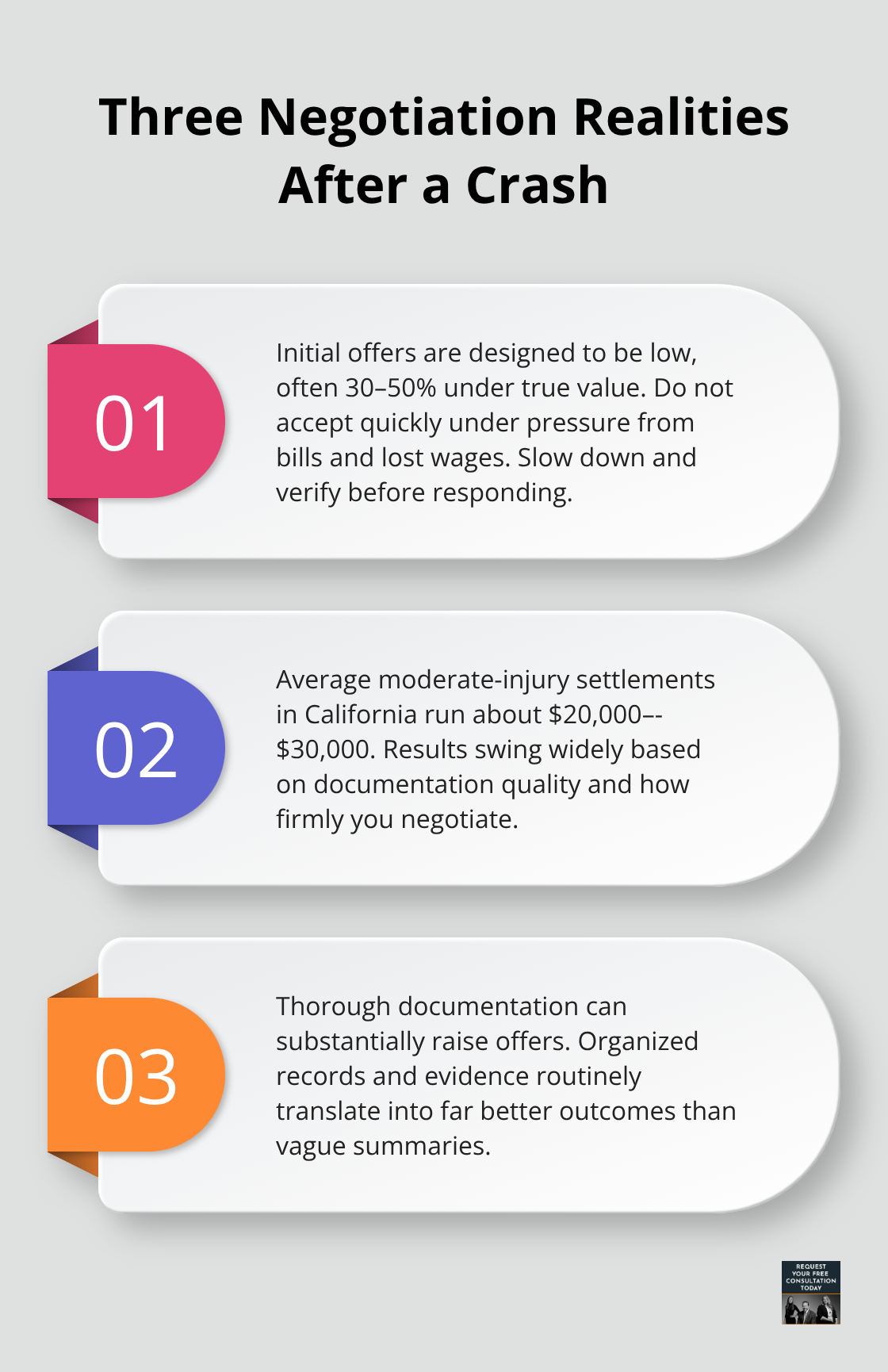
After a crash, the insurance company will contact you within days, and this is where most people make their first critical mistake. The adjuster’s opening offer is deliberately low-typically 30 to 50 percent below what your claim is actually worth. We see this pattern repeatedly with accident victims in Santa Cruz County, Sacramento, and Oakland. The adjuster counts on you to accept quickly because injured people face mounting medical bills and lost wages.
You must resist that pressure.
Settlement negotiations start the moment you report the accident, but they intensify once you have medical documentation that shows the full extent of your injuries. According to data from the California Office of Traffic Safety, the average settlement for moderate injury cases in California ranges from $20,000 to $30,000, but this figure masks enormous variation based on how well you document damages and how firmly you push back. Most people settle too early because they don’t understand that insurance companies have financial incentives to close claims fast.
Why Insurance Companies Push for Quick Settlements
The adjuster will ask for your medical records, wage loss documentation, and repair estimates-and they will use every piece of information to minimize what they owe you. Never hand over your complete medical file without legal guidance, because adjusters routinely cherry-pick records to argue your injuries are less severe than they actually are. Insurance companies profit when they pay less, so their entire system is built to pressure you into accepting inadequate offers before you fully understand your damages.
What Actually Determines Your Settlement Amount
Settlement value hinges on five concrete factors that you can measure and track. Medical expenses form the foundation: according to research published in JAMA Network Open, the median inpatient cost for motor-vehicle collision hospitalizations runs around $15,412, and this is just the starting point if you’ve had emergency care or surgery. Beyond immediate medical bills, you must account for ongoing treatment, rehabilitation, and any future care your injuries require.
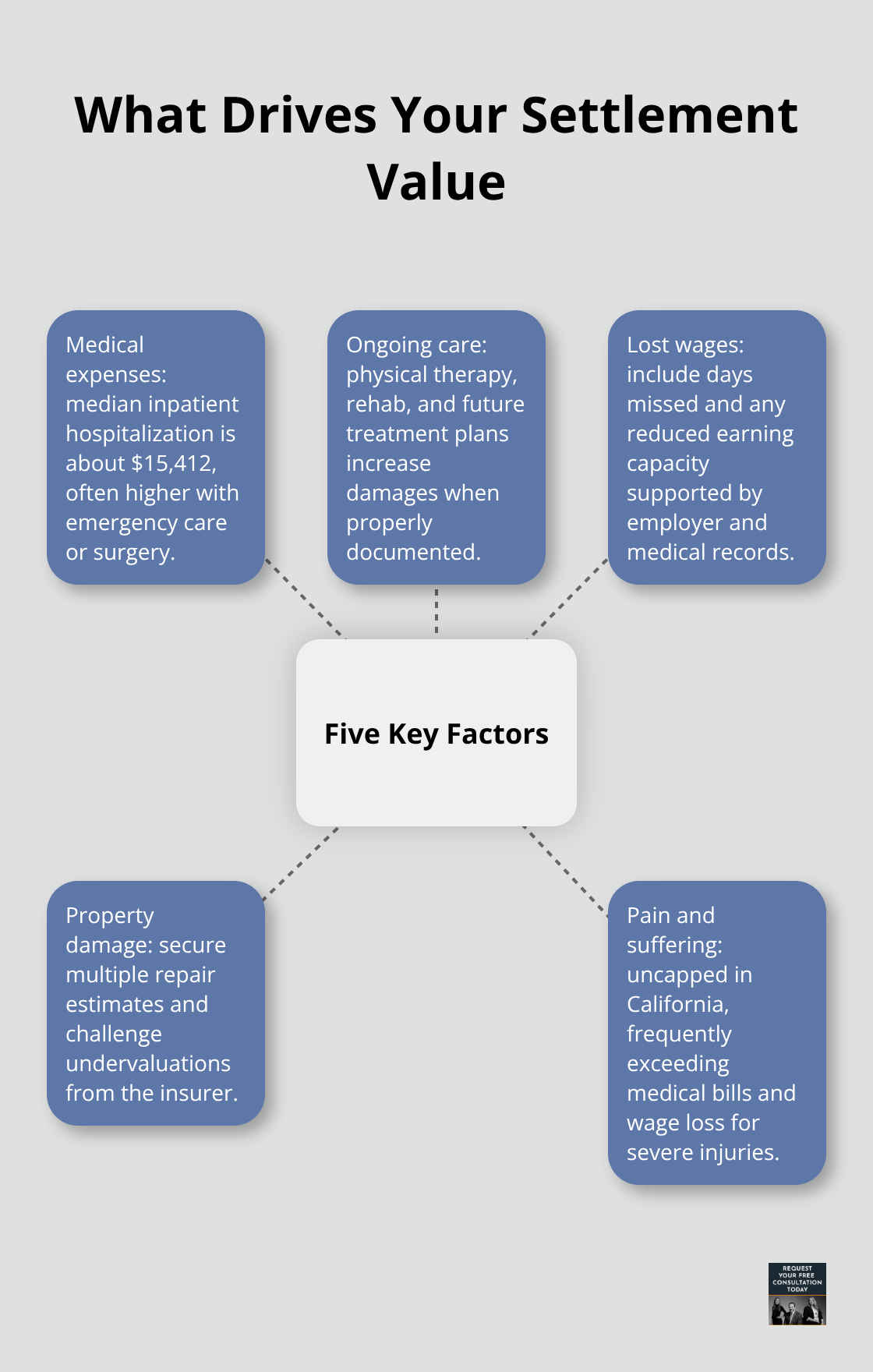
Lost wages matter significantly-if you’ve missed work or face reduced earning capacity, document every day and every dollar lost. Property damage to your vehicle is straightforward to calculate but often undervalued; obtain multiple repair estimates and push back if the insurer’s valuation is low.
The Often-Misunderstood Component: Pain and Suffering
The most misunderstood component is pain and suffering, which California law does not cap for car accident cases. This means your non-economic damages can substantially exceed your medical bills and lost wages combined, especially for severe injuries like spinal cord damage or traumatic brain injury. The injury category itself shapes the range: whiplash typically settles around $5,000 to $20,000, while broken bones or herniated discs settle in the $30,000 to $100,000 range, and spinal injuries can reach $500,000 to $1,000,000 or more depending on paralysis and long-term care needs (the adjuster will never volunteer this information).
You need documentation that proves the severity and duration of your condition. This is where the settlement process becomes critical-what you document now directly determines what you receive later.
What Compensation Can You Actually Recover
Medical Expenses Add Up Faster Than You Expect
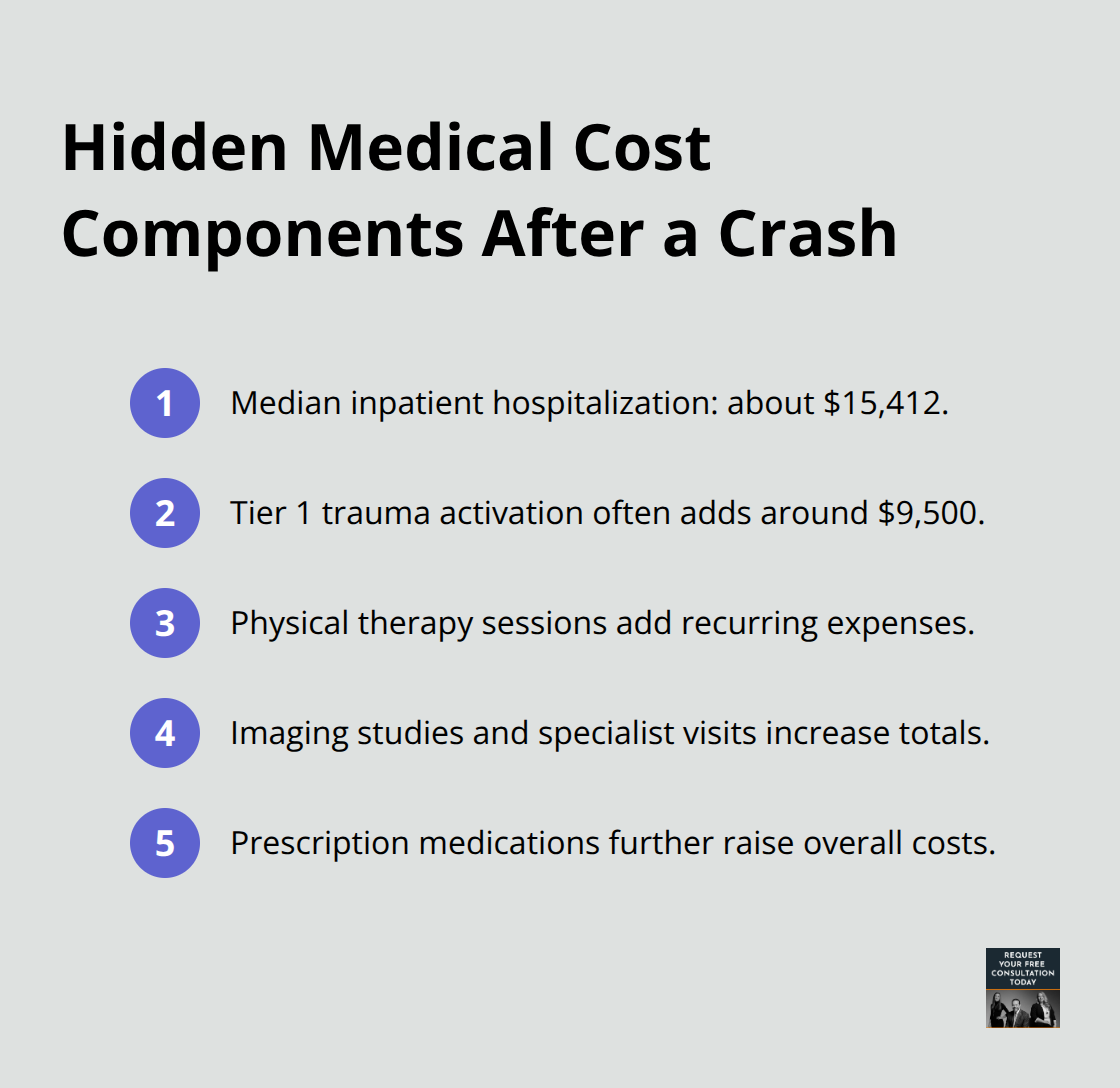
Medical expenses after a car crash extend far beyond what most people initially expect. The median inpatient cost for motor-vehicle collision hospitalizations sits around $15,412 according to research published in JAMA Network Open, and this covers only the hospital stay itself. If you required emergency transport, that tier 1 trauma activation typically adds another $9,500 in median costs. Once you leave the hospital, the bills continue: physical therapy, imaging studies, specialist consultations, and prescription medications accumulate quickly.
Accident victims often underestimate these ongoing costs because they focus only on what they’ve already paid rather than what lies ahead.
Future medical care matters enormously in your settlement calculation, especially for injuries like herniated discs or spinal cord damage that require long-term treatment or permanent assistive care. You must document every medical expense meticulously-obtain itemized bills from every provider, keep receipts for medications and medical equipment, and ask your doctor for a written estimate of future care needs. Insurance adjusters will scrutinize these costs, so precision matters; vague estimates weaken your negotiating position.
Lost Wages Include Both Past and Future Income
Lost wages represent income you’ve already lost plus earning capacity you may never recover. If you missed work during recovery, calculate your actual daily rate and multiply by days absent-don’t accept the adjuster’s estimate without verification. For severe injuries that reduce your long-term earning potential, the calculation becomes more complex; a 30-year-old facing permanent partial disability loses far more future income than someone near retirement.
California’s economic impact data shows the total burden of traffic crashes reached $5.83 billion in 2018, with lost productivity accounting for roughly $5.49 billion of that figure, underscoring how substantial wage loss becomes across injury cases. You must track every dollar lost to establish the full scope of your financial harm.
Pain and Suffering Has No Cap in California
Pain and suffering stands apart because it has no mathematical formula-California imposes no cap on non-economic damages in auto accident cases, meaning your compensation for physical pain, emotional distress, and life disruption can dwarf your medical bills and lost wages combined. Whiplash cases typically settle between $5,000 and $20,000 in pain and suffering alone, while spinal injuries routinely reach $500,000 to $1,000,000 or higher depending on paralysis and permanent disability.
The adjuster won’t volunteer this information, so you must build a compelling narrative through medical records, therapy notes, and detailed documentation of how your injuries have changed your daily life. This is where most accident victims fail to maximize their recovery-they treat pain and suffering as an afterthought rather than a substantial damage category that requires careful proof and presentation.
Mistakes That Tank Your Settlement
The adjuster’s first offer arrives within days of your accident, and this moment determines whether you walk away with fair compensation or accept pennies on the dollar. Most accident victims in Santa Cruz County, Sacramento, and Oakland make their biggest mistake right here by treating that initial number as a genuine starting point rather than what it actually is: a low-ball figure designed to close your case before you understand its real value. The adjuster knows you’re facing medical bills and lost wages, and they weaponize that financial pressure.
California accident data shows the average moderate injury settlement reaches $20,000 to $30,000, yet people routinely accept first offers at 30 to 50 percent below that range because they lack documentation and confidence in their claim’s value. Accepting that first offer locks you into permanent loss. You cannot reopen a settled claim, so the moment you sign, you forfeit any right to additional compensation if your injuries worsen or costs mount beyond what you initially knew.
The Documentation Trap
The second critical error is treating documentation as optional. Insurance adjusters live in a world of numbers and evidence; if you cannot prove an injury existed or a cost occurred, they treat it as if it didn’t. Every medical bill, receipt for medications, therapy invoice, and wage loss statement becomes ammunition in your negotiation.
Accident victims who maintain meticulous day-by-day records of their pain, limitations, and recovery progress generate settlement values 40 to 60 percent higher than those who rely on memory and general statements. Without itemized bills from every provider, without proof of every day missed from work, without documentation of future care needs your doctor has outlined, you hand the adjuster permission to minimize your damages.
Why Direct Negotiation With Adjusters Backfires
The third mistake undermines everything else: speaking directly with insurance adjusters without legal representation. Adjusters are trained professionals whose job is to extract maximum information while disclosing minimum liability, and they will use every casual comment you make against you. If you tell them your back feels better some days, they’ll cite that statement to argue your injury is minor.
If you accept a medical settlement without understanding your future care needs, you’ve eliminated your ability to recover those costs later. The law does not require you to represent yourself, and in fact, the data supports the opposite approach entirely. Accident victims with legal representation consistently recover significantly more than those negotiating alone because an attorney knows the local settlement ranges, understands which medical evidence matters most, and refuses low offers without hesitation.
What Insurance Companies Expect From You
In Santa Cruz County, Sacramento, and Oakland, insurance companies expect injured people to settle fast and cheap. They count on you to make these three mistakes. Each of these mistakes is entirely preventable, and the cost of preventing them is far lower than the cost of living with the consequences.
Final Thoughts
An injury settlement car crash claim succeeds or fails based on decisions you make in the first weeks after impact. The three mistakes outlined above-accepting low initial offers, failing to document thoroughly, and negotiating alone with adjusters-cost accident victims tens of thousands of dollars every year. You now understand that California’s average moderate injury settlement of $20,000 to $30,000 masks enormous variation, and that pain and suffering damages have no cap, meaning your actual recovery potential far exceeds what the adjuster’s first offer suggests.
The path forward requires two concrete actions: gather every piece of documentation immediately (medical records, wage loss statements, repair estimates, and daily injury logs), and stop communicating directly with insurance adjusters. Accident victims with legal representation consistently recover significantly more than those negotiating alone because attorneys understand local settlement ranges, know which medical evidence carries weight, and refuse inadequate offers without hesitation. We at Schaar & Silva LLP have guided countless accident victims in Santa Cruz County, Sacramento, and Oakland through this process.
Contact us to discuss your injury settlement car crash claim and learn what your case is actually worth. The difference between settling alone and having representation often exceeds the cost of legal fees many times over.
