
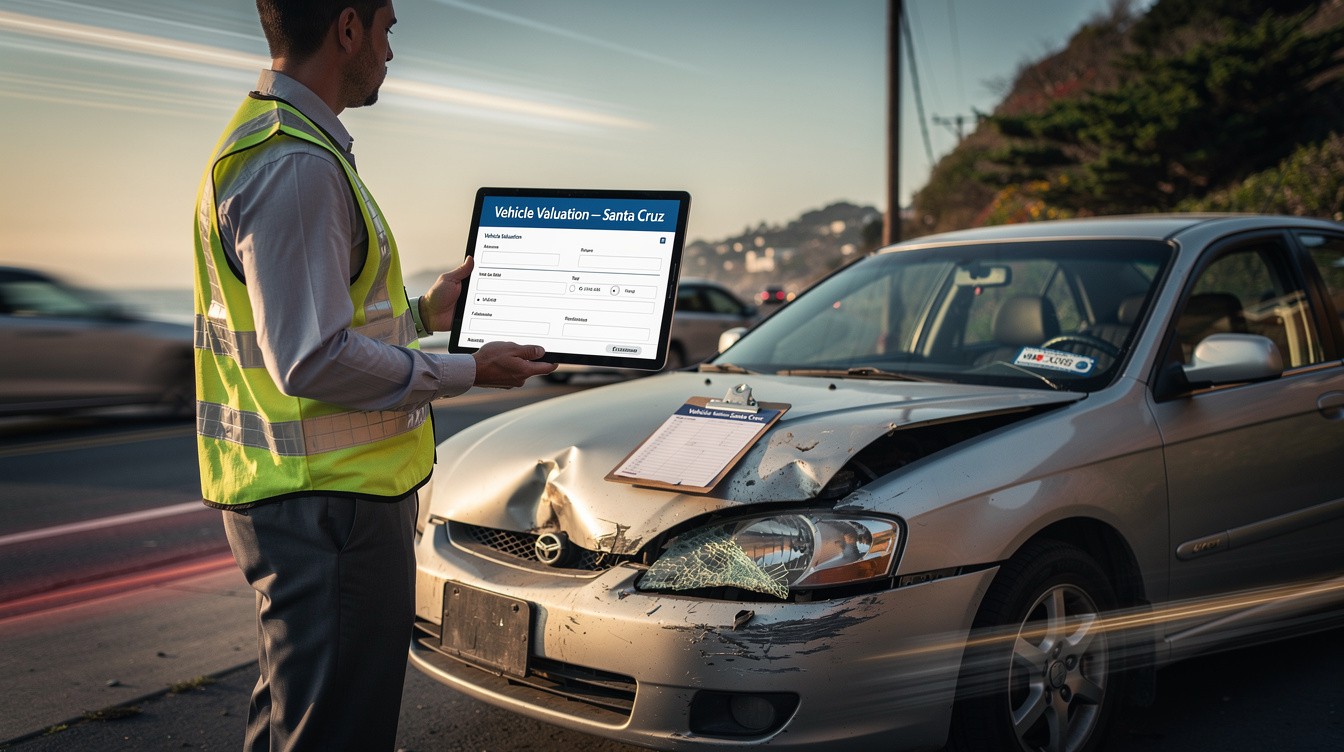
After a collision in Santa Cruz County, your insurance company will assign a value to your damaged vehicle. This valuation directly affects how much compensation you receive.
Vehicle valuation in Santa Cruz depends on several factors, from your car’s condition before the accident to current market prices. We at Schaar & Silva LLP have helped many accident victims understand and challenge valuations that don’t reflect their vehicle’s true worth.
How Your Vehicle Gets Valued After a Collision
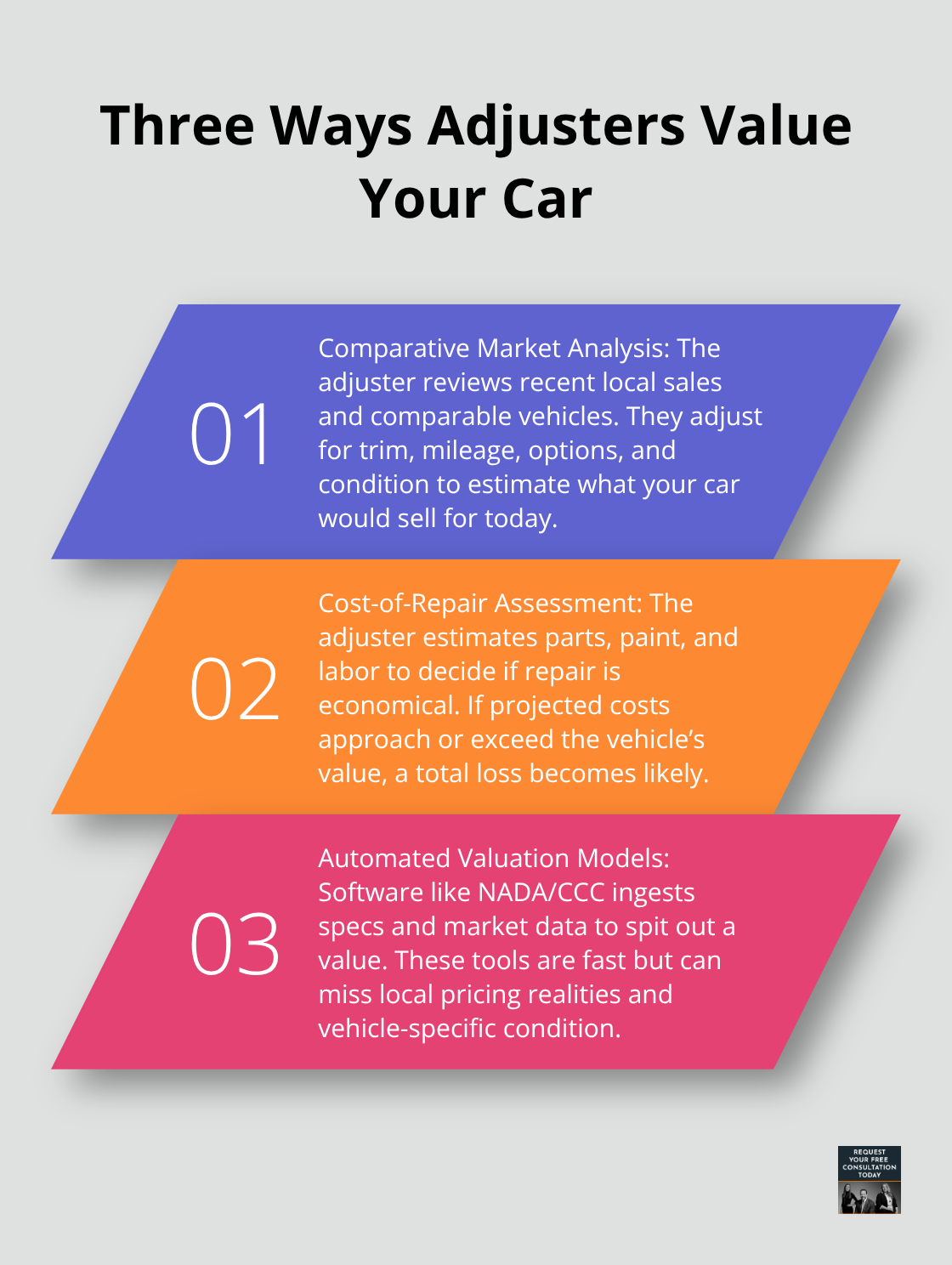
Three Valuation Methods Insurance Adjusters Use
Insurance adjusters in Santa Cruz County apply three primary methods to determine your vehicle’s value: comparative market analysis, cost-of-repair assessment, and automated valuation models. The adjuster typically conducts a one-hour inspection at the damage site, evaluating structural damage, paint condition, mechanical systems, and whether repair or replacement makes financial sense. During this inspection, the adjuster photographs your vehicle and notes damage patterns, but this brief window often misses hidden problems like frame misalignment, water intrusion, suspension issues, or electrical damage that can add $5,000 to $10,000 in repair costs later.
Why National Valuation Tools Underestimate Local Costs
The adjuster then inputs data into tools like NADA Guides, CCC reports, or similar automated systems to generate an estimated repair cost and actual cash value. Here’s the problem: NADA Guides and national valuation databases systematically understate Santa Cruz County labor and parts costs by approximately $2,000 to $5,000 compared to what local shops actually charge. A vehicle valued at $15,000 using national guides may require $18,000 or more in repairs locally, creating a significant gap between the initial offer and actual repair expenses.
The Adjuster’s Incentive Structure
The adjuster’s role is to settle claims efficiently, which creates an inherent bias toward lower valuations. Insurance companies are incentivized to close claims quickly at minimal cost, so the first offer typically reflects what the insurer believes it can get away with rather than what repairs actually cost. This is why the initial settlement offer is rarely final.
Building Your Counter-Offer with Local Evidence
Obtain three written repair estimates from independent Santa Cruz shops with no insurer ties within 48 hours of the accident, then present these estimates to the adjuster in writing along with pre-accident photos and your police report. This shifts negotiations from a generic national valuation to documented local costs. If your vehicle is declared a total loss, request a detailed written explanation of how actual cash value was calculated, including which comparable vehicles were used and what adjustments were made for mileage and condition.
Maintaining Documentation to Protect Your Timeline
California law requires insurers to acknowledge claims within 15 days and settle within 40 days after proof of loss, so maintaining a complete written record of all communications, estimates, photos, maintenance receipts, and police reports keeps negotiations timely and creates leverage when valuations fall short. The documentation you compile now becomes your foundation for the next critical step: challenging any valuation that doesn’t align with your vehicle’s actual repair costs and market value.
What Really Determines Your Settlement Amount
Age, Mileage, and Your Maintenance History
Your vehicle’s value after a collision in Santa Cruz County rests on concrete, measurable factors rather than what an adjuster’s initial report suggests. Age and mileage form the baseline for actual cash value and hit your valuation hardest. A 2022 Honda Civic with 45,000 miles carries substantially more value than a 2018 model with 95,000 miles, even if both sustained identical damage.
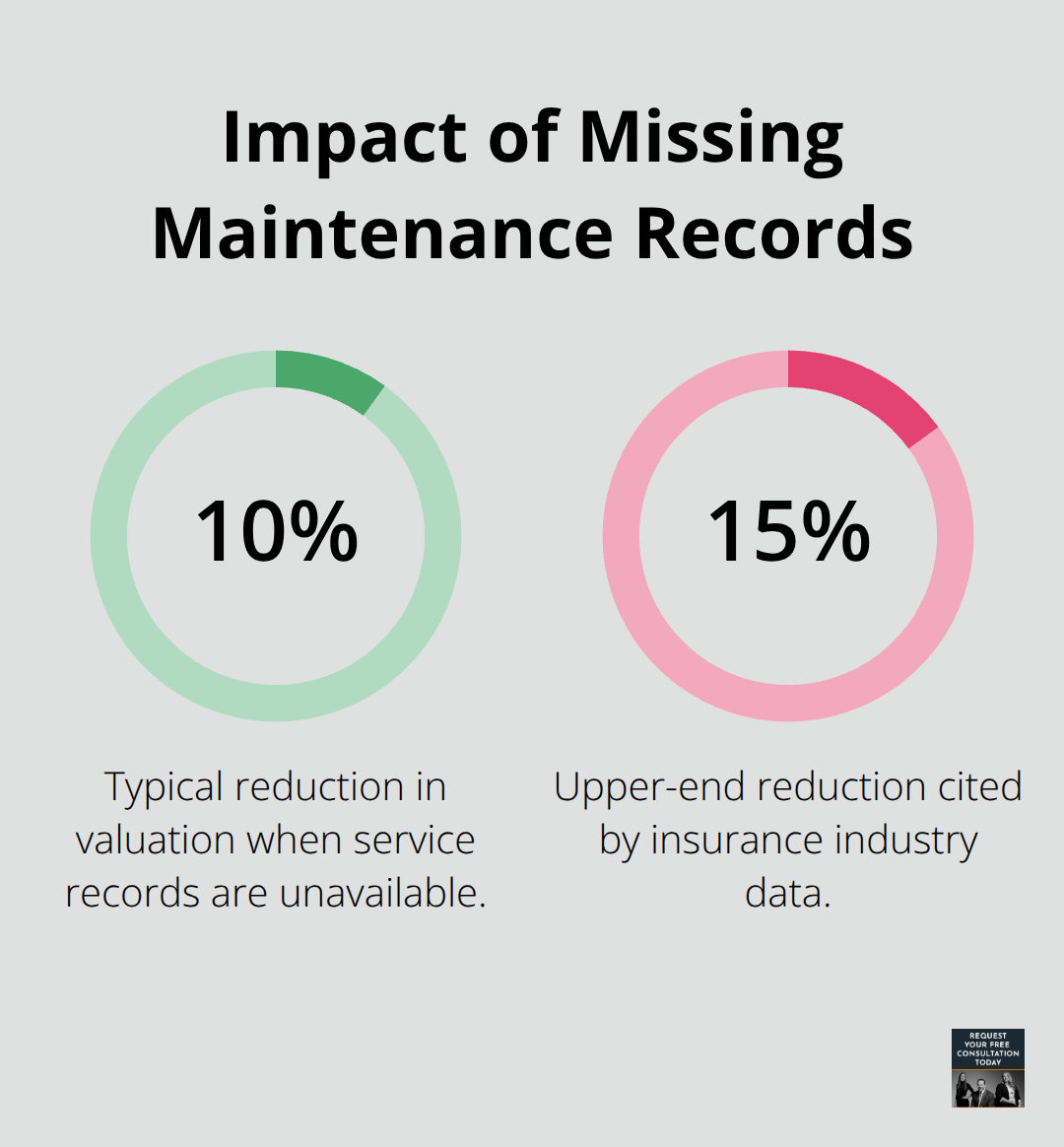
Your maintenance records become critical because a well-maintained older vehicle with documented service history commands higher valuations than a newer car with spotty or missing records. Missing maintenance records typically reduce valuations by 10 to 15 percent according to insurance industry data, so gather every receipt and service invoice immediately after your accident. Pre-accident photos showing your vehicle in good condition, presented during the adjuster’s inspection alongside your maintenance documentation, counter any claims of prior wear or mechanical issues.
Hidden Damage and What One-Hour Inspections Miss
The extent and type of damage you sustained determines whether repair or total loss applies and drives the actual cost gap between national estimates and Santa Cruz labor rates. Frame damage, water intrusion, and electrical problems add $5,000 to $10,000 in hidden costs that a one-hour inspection typically misses. A full pre-repair mechanical inspection costing $200 to $400 uncovers what the adjuster overlooked, and when hidden damage surfaces during repairs, you notify the adjuster immediately with updated estimates.
Insurers must stand behind repairs that meet accepted trade standards, and California’s three-year statute of limitations applies to property damage claims. This protection means you have time to identify problems and demand fair compensation for work that becomes necessary after the initial settlement.
Santa Cruz Labor Costs Versus National Benchmarks
Market conditions in Santa Cruz County create another valuation pressure because local labor costs exceed national benchmarks by $2,000 to $5,000 for typical collision repairs. When an adjuster uses NADA Guides or CCC reports calibrated to national averages, those tools systematically undervalue what Santa Cruz shops actually charge. A vehicle the adjuster values at $15,000 may legitimately cost $18,000 or more to repair locally, and that gap directly shrinks your settlement unless you present three independent repair estimates from Santa Cruz shops.
Obtain these estimates within 48 hours and present them in writing at the inspection alongside your police report and pre-accident photos. This combination of concrete local data, maintenance history, and damage documentation forces the adjuster to negotiate based on facts rather than generic formulas. The three elements-your vehicle’s age and mileage, the specific damage sustained, and current market conditions in Santa Cruz-interact in ways that directly affect your payout, and understanding how they work together gives you the ability to challenge low offers with real evidence.
Challenging a Low Settlement Offer
Why Independent Appraisals Shift Negotiations
When an adjuster’s valuation falls short of actual repair costs or your vehicle’s true worth, accepting the initial offer means leaving thousands on the table. An independent appraisal costs $300 to $600 upfront but routinely justifies $2,000 to $5,000 or more in additional compensation, making it one of the highest-return investments you can make after a collision in Santa Cruz County. A certified appraiser examines frame alignment, paint thickness, suspension condition, and electrical systems with precision that a one-hour adjuster inspection cannot match. Request the appraisal in writing before settlement, then present it alongside your three independent repair estimates. Watch the adjuster’s position shift when concrete evidence contradicts their initial offer. The appraiser’s report carries weight because insurers recognize it meets legal and industry standards, unlike generic national valuations that systematically undervalue Santa Cruz labor and parts.
Organizing Your Documentation Package
Your documentation package becomes your negotiating toolkit at this stage. Organize your police report, repair estimates, pre-accident photos, maintenance receipts, and communication log chronologically in a single file, then reference California Department of Insurance timelines to strengthen your position. If the adjuster pressures you toward quick settlement by framing the offer as fair and final, respond in writing with your appraisal and estimates rather than accepting verbally. California law requires insurers to acknowledge claims within 15 days and settle within 40 days after proof of loss, so use these deadlines to your advantage.
Invoking the California Appraisal Provision
If negotiations stall after you present your evidence, invoke the California Appraisal Provision, which establishes a binding process where you and the insurer each select an appraiser, those two appraisers select an umpire, and the agreed amount becomes final. This formal escalation often prompts insurers to negotiate more seriously rather than face binding arbitration. The appraisal provision exists specifically to resolve valuation disputes when standard negotiation reaches an impasse, and using it demonstrates that you will not accept an unfair settlement without a fight.
Seeking Legal Review When Negotiations Stall
When settlements reach an impasse despite your documentation and appraisal efforts, legal review becomes the next logical step to determine whether pursuing additional compensation makes financial sense for your specific situation. We at Schaar & Silva LLP can evaluate your case and help you understand your options across Santa Cruz County.
Final Thoughts
Vehicle valuation in Santa Cruz after a collision hinges on three concrete realities: national valuation tools systematically underestimate local labor costs by $2,000 to $5,000, insurance adjusters are incentivized to settle quickly at minimal amounts, and you have legal tools to challenge low offers. The gap between an adjuster’s initial offer and actual repair costs closes when you present three independent repair estimates from Santa Cruz shops, maintain complete documentation of your maintenance history and pre-accident condition, and obtain an independent appraisal that costs $300 to $600 but routinely justifies $2,000 to $5,000 or more in additional compensation.
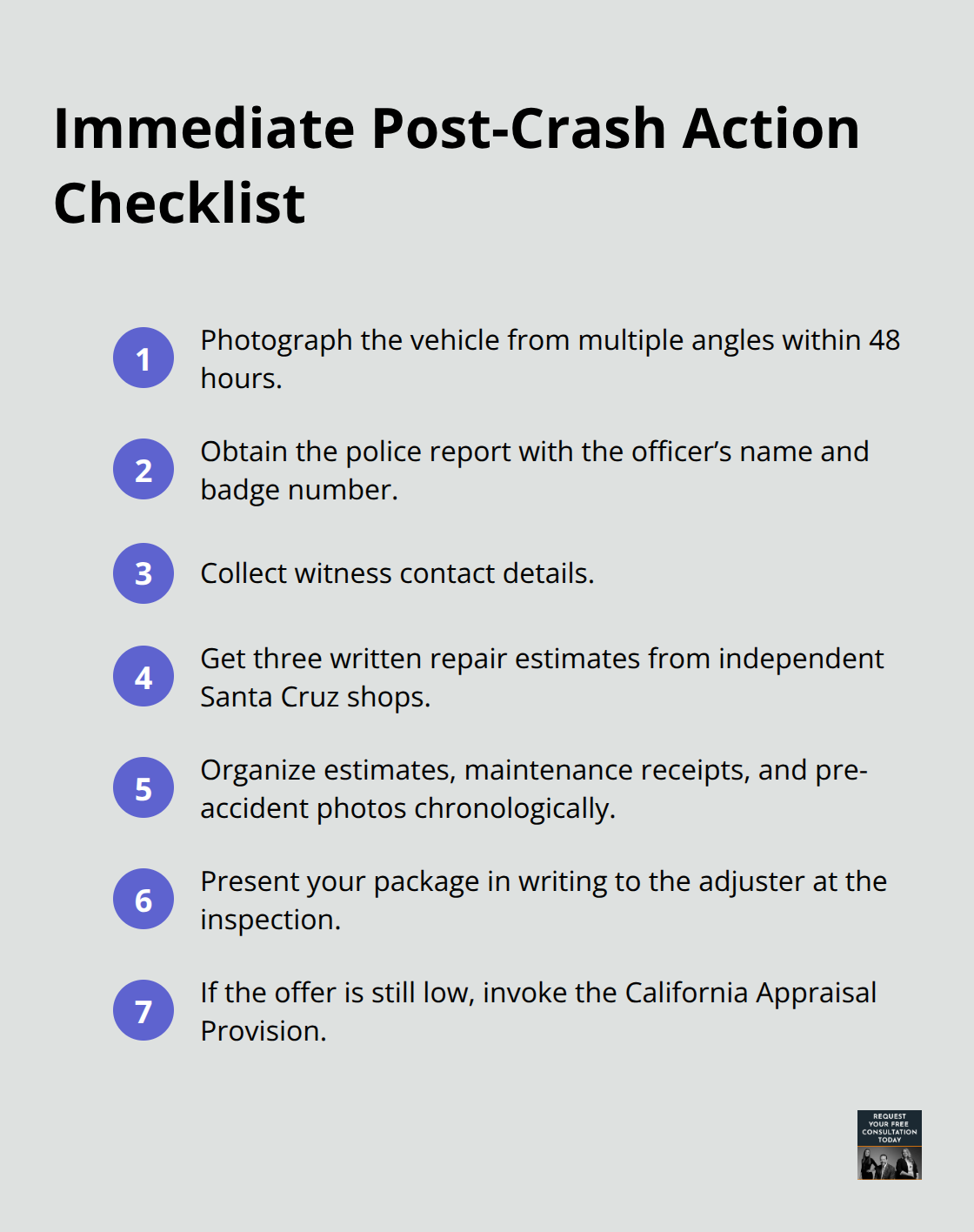
Your next step is immediate action: photograph your vehicle from multiple angles within 48 hours, obtain your police report with the officer’s name and badge number, collect witness contact details, and gather three written repair estimates from independent shops with no insurer ties. Organize these documents chronologically alongside your maintenance receipts and pre-accident photos, then present them in writing to the adjuster at inspection rather than accepting verbal settlement offers. If the adjuster’s valuation still falls short, invoke the California Appraisal Provision to escalate to binding arbitration, which often prompts serious negotiation rather than continued lowball offers.
When settlements stall despite your evidence and appraisal efforts, legal review helps determine whether pursuing additional compensation makes financial sense. We at Schaar & Silva LLP can evaluate your property damage claim and help you understand your options across Santa Cruz County.
