
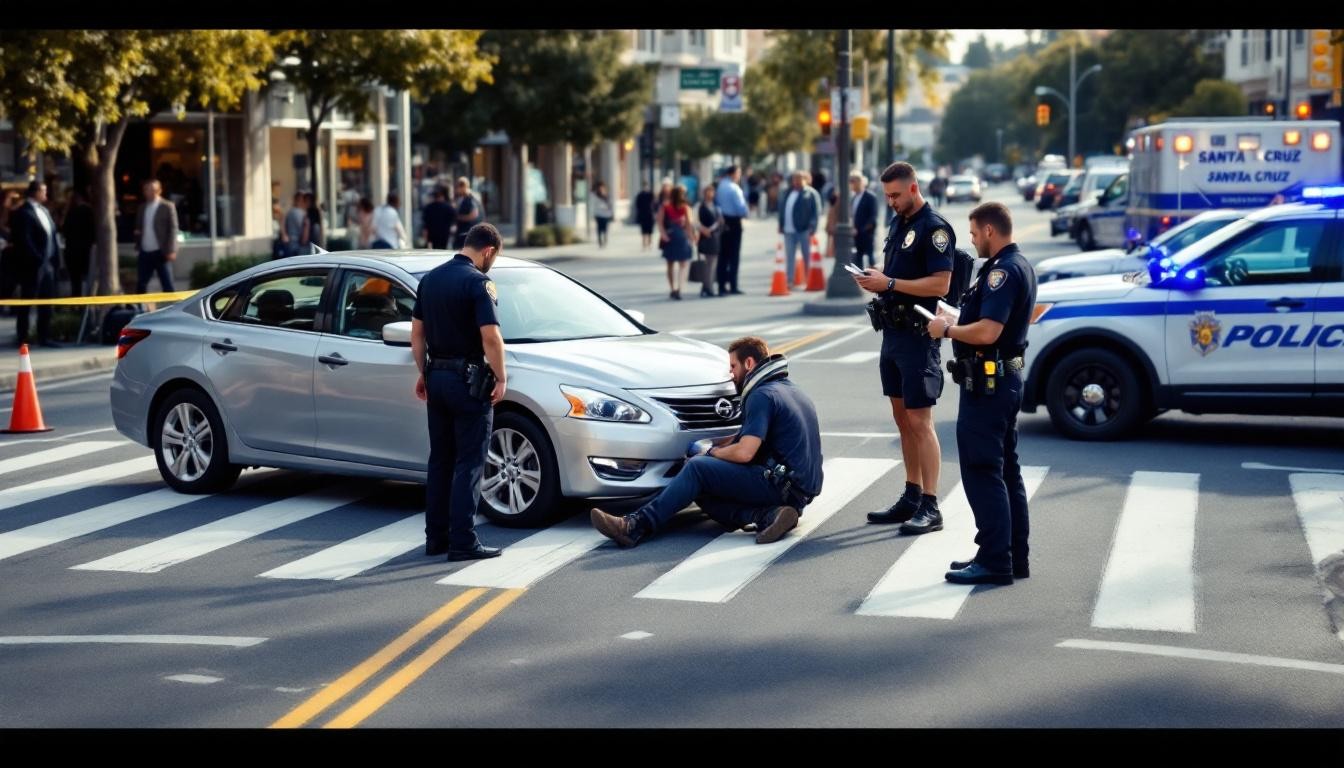
Santa Cruz’s busy streets, coastal roads, and high-traffic downtown areas create real dangers for pedestrians. A Santa Cruz pedestrian accident can happen in seconds, leaving victims with serious injuries and mounting medical bills.
At Schaar & Silva LLP, we’ve helped countless pedestrians navigate the legal process after being hit. This guide walks you through what causes these accidents, where hazards exist in our community, and exactly what steps to take if you’re injured.
Why Drivers Hit Pedestrians in Santa Cruz
Distracted Driving Takes Lives on Santa Cruz Streets
Distracted driving ranks as the leading cause of pedestrian accidents across Santa Cruz County. Drivers who check phones, eat, or adjust navigation systems remove their eyes from the road at moments when pedestrians depend on their attention. A driver looking at a phone for just five seconds at 55 mph travels the length of a football field without seeing the road. In Santa Cruz, downtown areas like Ocean Street see heavy foot traffic, and this inattention becomes deadly. Ocean Street alone has recorded two cyclist deaths and two pedestrian deaths since 2019. When a driver’s attention lapses near a crosswalk or intersection, pedestrians have almost no time to react. The problem worsens in areas where drivers expect fewer pedestrians, like residential neighborhoods near the beaches. Drivers often assume they can safely ignore the road momentarily because they believe their surroundings are predictable. This assumption kills people.
Speed Transforms Minor Collisions into Fatal Crashes
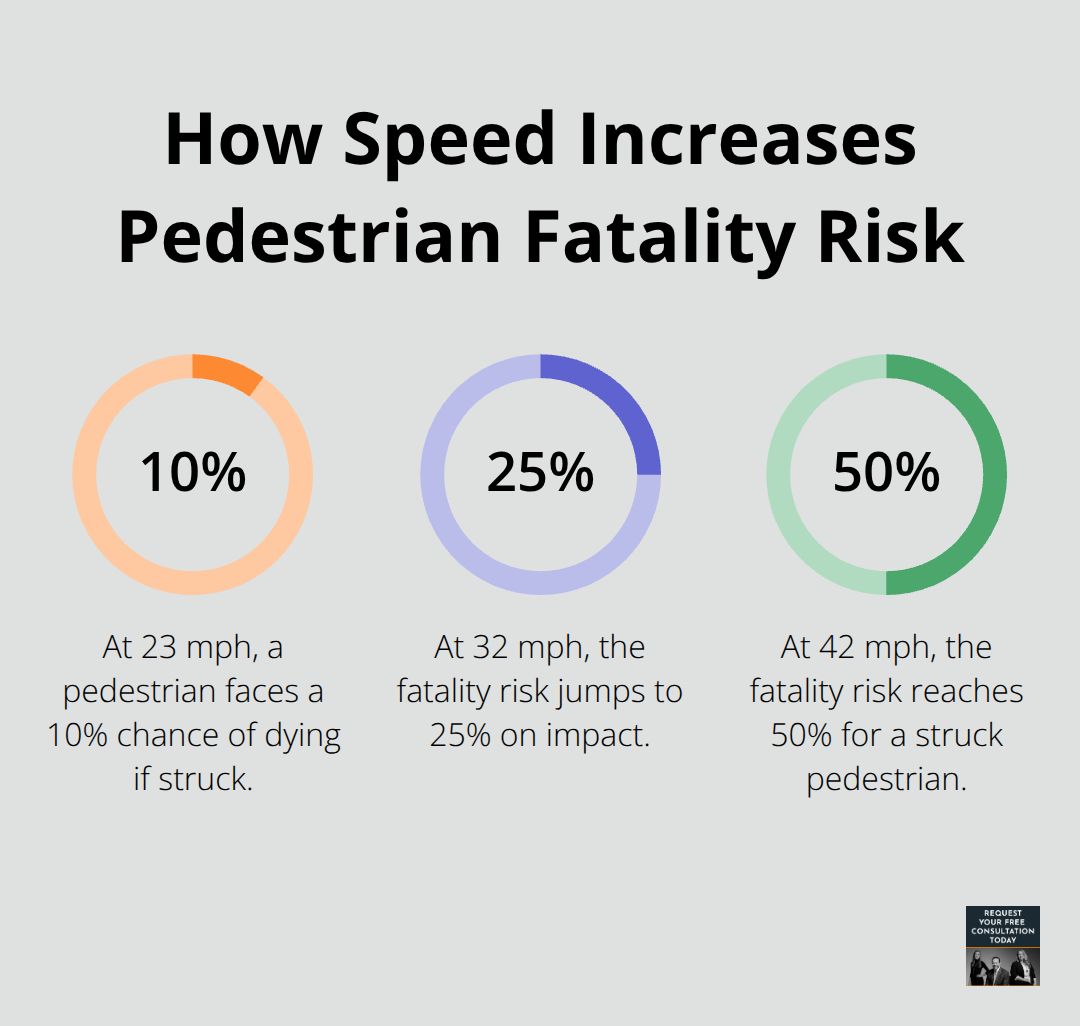
Speed is the second major factor, and it’s far more destructive than most drivers realize. A pedestrian hit by a vehicle at 23 mph has a 10% chance of dying, according to the U.S. Department of Transportation. At 32 mph, that risk jumps to 25%. At 42 mph, it reaches 50%. At 50 mph, it’s 75%.
Santa Cruz County ranks fifth statewide for speed-related crashes, meaning drivers routinely exceed safe limits in areas where pedestrians are present. Residential neighborhoods, downtown corridors, and the approach roads to beaches all experience speeding violations. Drivers treat these zones as straightforward stretches rather than spaces shared with vulnerable road users.
Drivers Ignore Crosswalks and Yield Laws
Failure to yield at crosswalks and intersections compounds the problem significantly. California law requires drivers to stop for pedestrians in marked and unmarked crosswalks, yet many drivers accelerate through intersections or roll through stops without checking for foot traffic. This negligence proves particularly dangerous at high-traffic zones near local crosswalks in Watsonville, Santa Cruz, and Capitola, where pedestrian volume peaks during rush hours. The combination of distraction, speed, and failure to yield creates a pattern of preventable collisions that victims and their families must address through legal action. These incidents are not accidents-they result from driver choices that can be changed through enforcement, street design, and accountability. Understanding these causes matters because it shapes how you approach your claim and what evidence you’ll need to prove liability. The next section examines where these collisions happen most frequently and what specific hazards make Santa Cruz’s pedestrian environment particularly dangerous.
Where Pedestrians Face the Greatest Risk in Santa Cruz
Beach Access Routes Create Multiple Hazard Points
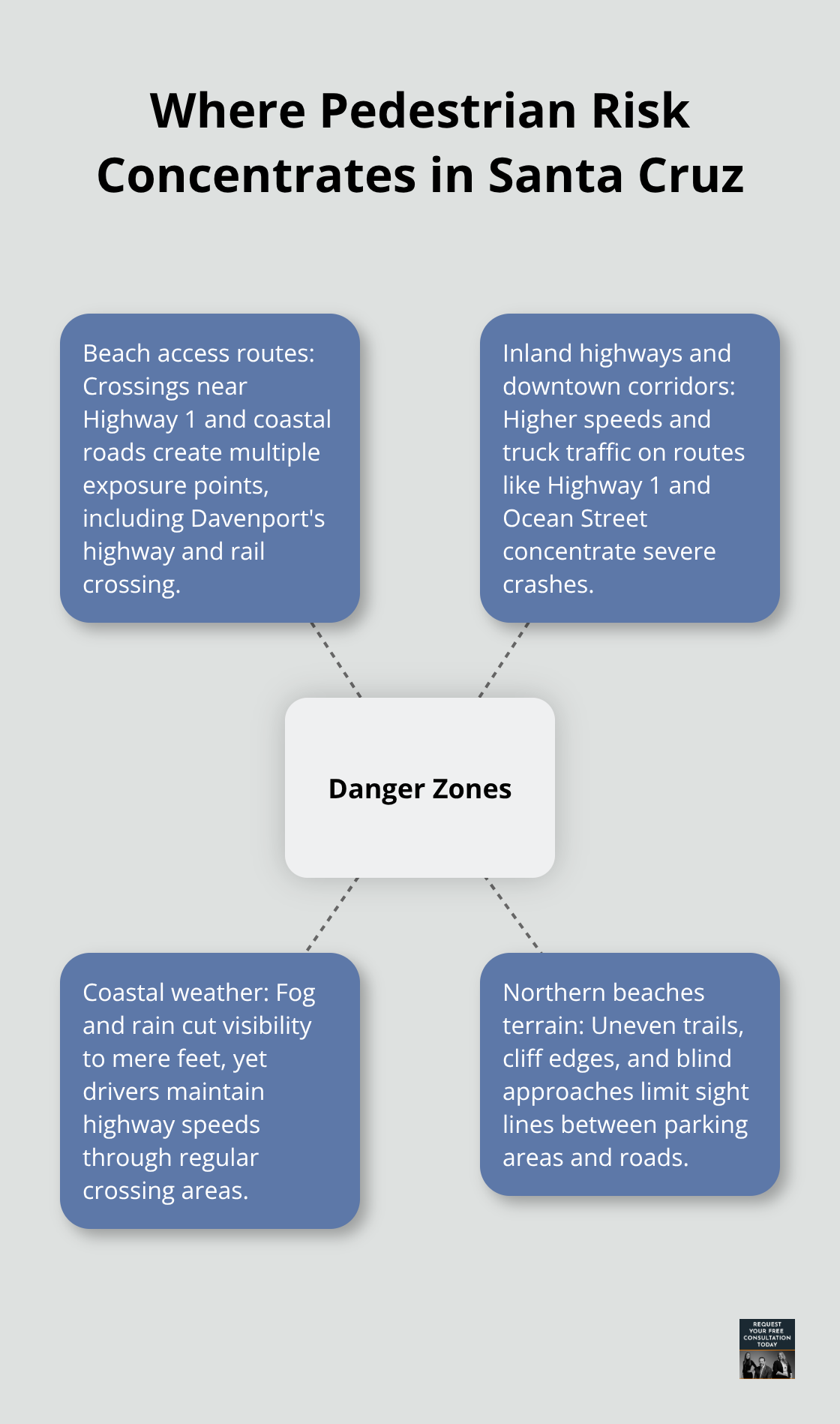
Santa Cruz’s 29 miles of beaches funnel pedestrians into dangerous intersections with vehicles and coastal roadways. Manresa Uplands State Beach and Palm State Beach require foot traffic to cross or approach Highway 1 via San Andreas Road, Sand Dollar Drive, Riverside Drive, and West Beach Street. Davenport Beach presents an unusual danger: pedestrians must cross Highway 1 and railroad tracks to reach the sand, creating multiple exposure points in quick succession. The northern beaches near Wilder Ranch State Park involve hiking from parking areas, but uneven terrain, cliff edges, and rocky headlands increase fall risk and limit visibility of approaching vehicles. Scott Creek Beach’s shallow creek and tide pools attract families, yet isolated access means fewer witnesses if a vehicle strikes a pedestrian in the adjacent lot. Fern Grotto Beach sits behind sandstone cliffs accessible only via the Old Cove Landing Trail, where hikers may emerge suddenly onto roadways. On busy summer weekends, popular beaches resemble human parking lots, intensifying congestion near vehicle entry points and crosswalks where drivers struggle to anticipate foot traffic patterns.
Inland Highways and Downtown Corridors Concentrate Fatalities
Watsonville has recorded 20 pedestrian fatalities between 2013 and 2024 despite its smaller population than Santa Cruz, which logged 14 fatalities in the same span. This disparity reflects Watsonville’s reliance on state highways-Highway 1, Highway 129 (East Lake Avenue), West Beach Street, Airport Boulevard, and Freedom Boulevard all carry higher speed limits and heavier truck traffic. Ocean Street in Santa Cruz, Soquel Avenue through Santa Cruz and Live Oak, and Bay Avenue in Capitola rank among the county’s worst crash corridors.
These high-traffic zones near local crosswalks experience peak pedestrian volume during rush hours, when drivers rush through intersections without checking for foot traffic.
Weather Obscures Pedestrians on Coastal Roads
Visibility deteriorates rapidly on coastal roads during fog and rain, conditions common from fall through spring. Drivers familiar with these stretches often underestimate speed and fail to adjust for pedestrians obscured by weather. The combination of reduced sight lines and driver overconfidence transforms routine commutes into collision zones. Coastal fog can reduce visibility to mere feet, yet drivers maintain highway speeds through areas where pedestrians cross regularly.
Immediate Medical Care and Evidence Documentation
Santa Cruz Health Center, located at 1080 Emeline Ave, offers immediate treatment after pedestrian accidents, with same-day appointments available for established patients on a limited basis and after-hours patient calls at 831-454-5146 for urgent guidance. Document accident details at local crosswalks by photographing signage, pavement markings, adjacent parking, and road conditions-this evidence proves essential for establishing liability in high-traffic zones where multiple factors may have contributed to the collision. Preserve all records and bills related to the accident; keep receipts, medical bills, and any related expenses. Collect and record the names, addresses, and phone numbers of all potential witnesses who saw the incident. Obtain traffic collision reports if possible to establish the facts and sequence of events surrounding the crash. These steps position your claim for success and protect your legal rights. Understanding where accidents occur most frequently in Santa Cruz helps you recognize danger zones and take precautions, but it also shapes the evidence you’ll need to prove negligence. The next section explains exactly what actions you must take immediately after a collision to protect your health and your legal claim.
Steps to Take Immediately After Being Hit
Act Fast at the Scene
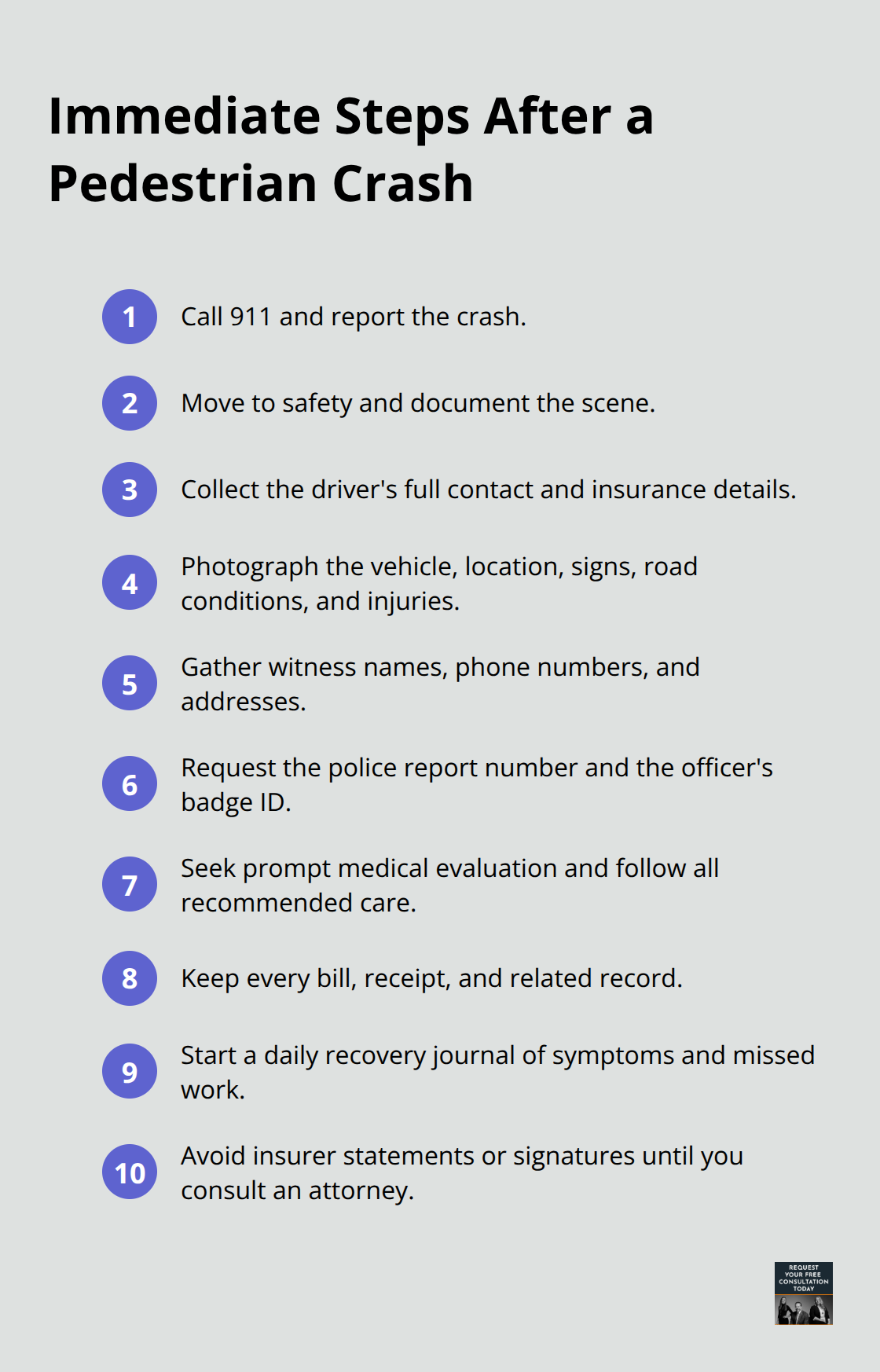
Call 911 immediately if you’re injured or if the vehicle didn’t stop. Obtain the driver’s name, phone number, address, insurance company, and policy number while at the scene-write these details down yourself rather than relying on memory. If you can safely move, step away from traffic and document what happened while details remain fresh. Take photographs of the vehicle involved, the crash location, nearby crosswalks and signage, road conditions, and any visible injuries using your phone or camera. If witnesses remain at the scene, collect their names, phone numbers, and addresses before they leave.
Secure Official Documentation
Police reports create official records that strengthen liability claims, so request a report number and the officer’s badge number. Contact law enforcement for a traffic collision report and obtain a copy for your records. These reports contain officer observations, driver statements, and preliminary findings that establish facts about the incident. Do not discuss the accident with the driver’s insurance company or sign any documents without consulting an attorney first-insurers will use your statements against you.
Seek Medical Evaluation Immediately
Seek medical evaluation immediately after a pedestrian accident, even if injuries seem minor at first. Medical documentation becomes your strongest evidence for damages and establishes a clear causal link between the crash and your condition. Delaying treatment weakens your claim and gives insurers grounds to dispute the severity of your injuries. Cost should never prevent you from seeking treatment-explore available coverage options and payment plans with your healthcare provider.
Build Your Evidence Package
Request itemized bills and all medical records related to your injuries; these documents prove the extent of harm and form the basis for compensation claims. Keep a daily journal of your symptoms, pain levels, medications, and any work you miss during recovery-this contemporaneous record demonstrates how the accident affected your life. Preserve all receipts for medical expenses, transportation to appointments, and any other accident-related costs. Do not alter, discard, or allow anyone to repair the vehicle involved in the collision; investigators need to inspect it before salvage to establish how the impact occurred. The combination of medical records, photographs, witness statements, and police documentation creates an evidence package that proves liability and quantifies your damages.
Final Thoughts
A Santa Cruz pedestrian accident leaves you facing medical bills, lost income, and physical pain that can last months or years. California law gives you the right to pursue compensation from the driver or property owner whose negligence caused your injuries. You recover medical expenses, lost wages, diminished earning capacity, and damages for pain and suffering.
We at Schaar & Silva LLP have spent years helping pedestrians in Santa Cruz County recover fair compensation after being hit. Our team handles the legal complexities while you focus on healing, and we connect you with medical lien services to manage bills until your case resolves. We also assist with gathering police reports, medical records, and witness statements that prove liability and quantify your damages.
California imposes a two-year statute of limitations for personal injury claims, but government-related incidents have shorter timelines. Personal injury lawyers typically work on contingency, meaning you pay nothing unless we recover compensation for you (fees generally range from one-third to forty percent of your recovery, plus costs for expert witnesses and investigation). Contact Schaar & Silva LLP today for a free case evaluation-we serve Santa Cruz County and nearby areas including Capitola, Soquel, and Scotts Valley, and we offer Spanish-language services.
