

A car accident can leave you injured, confused, and unsure about your next steps. At Schaar & Silva LLP, we help accident victims in Santa Cruz County understand their rights and recover the compensation they need.
This guide walks you through what to do immediately after a crash, how to document your injuries, and how to build a strong claim. Whether you’re dealing with insurance companies or considering legal action, we’re here to support you.
What to Do in the First Hours After Your Crash
Act Fast-Your Evidence Window Closes Quickly
The decisions you make in the first few hours after a car accident directly impact your legal claim. Police reports, witness statements, and scene evidence fade quickly, so acting fast matters. California law requires you to file an SR-1 report with the DMV within 10 days if there’s an injury, death, or property damage over $1,000; missing this deadline carries penalties that can hurt your case later.
Secure the Scene and Document Everything
Start by calling 911 if anyone is injured or if there’s significant damage. Once emergency responders arrive, get their names and badge numbers. Before you move your vehicle, take photos and videos of the crash scene from multiple angles, showing vehicle positions, road conditions, traffic signals, and damage to all vehicles involved. These images are irreplaceable-insurance companies and courts rely on them to establish what actually happened.
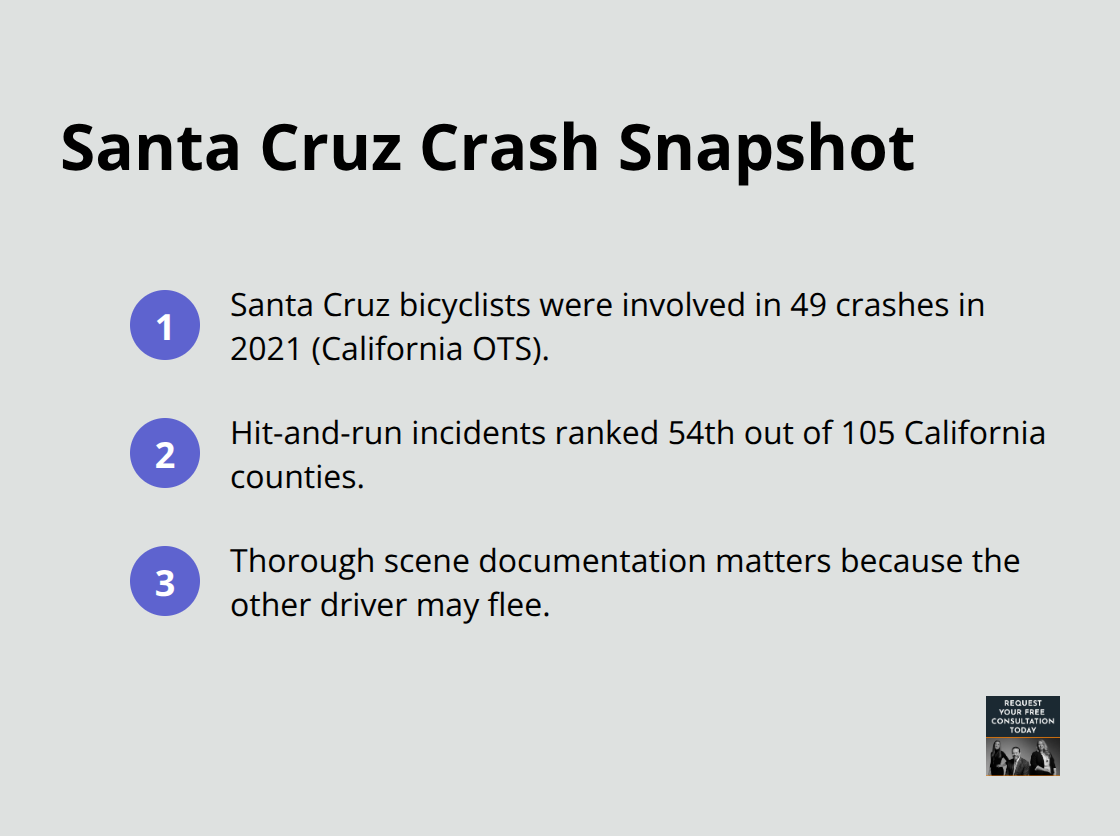
In Santa Cruz County, where bicyclists were involved in 49 crashes in 2021 according to the California Office of Traffic Safety, hit-and-run incidents ranked 54th out of 105 counties. This means scene documentation is critical since the other driver may flee.
Collect Information and Witness Statements
Collect the names, phone numbers, addresses, and insurance details of everyone involved. Get contact information from at least two independent witnesses who saw the crash; their statements often carry more weight than the at-fault driver’s account. Do not admit fault or apologize for the accident, even if you think you caused it-anything you say can be used against you in your claim.
Report to Insurance and Request the Police Report
Report the accident to your insurance company as soon as possible, but stick to the facts: when, where, and what happened. Provide only essential details and avoid speculation about injuries or liability. Request a copy of the police report once it’s filed; this document is foundational for your claim and typically becomes available within days.
California is an at-fault state, meaning the responsible driver’s liability insurance pays for damages, but establishing fault requires solid evidence. If you’ve suffered injuries, seek medical attention even if symptoms seem minor-some injuries like whiplash develop over hours or days. Keep all medical records, receipts, and bills organized in one place; these documents prove the financial impact of the crash and strengthen your claim for compensation.
Your next step involves understanding what injuries you’ve sustained and how to document them properly for your claim.
Common Injuries from Car Accidents and Medical Documentation
Whiplash and Neck Injuries Require Immediate Medical Attention
Whiplash ranks as the most common injury in car accident claims, and it’s far more serious than many people realize. Your neck contains delicate soft tissues and nerves that strain even in low-speed collisions. Symptoms often don’t appear immediately-you might feel fine at the scene but experience pain, stiffness, and reduced range of motion within hours or days. This delayed onset makes medical documentation critical. Visit a doctor within 48 hours of your crash, even if you feel okay, and get imaging done if your doctor recommends it. Keep detailed records of all visits, treatments, and any ongoing physical therapy. Insurance companies scrutinize whiplash claims heavily, so medical evidence from a licensed professional carries far more weight than your own account of pain.
Back and Spinal Cord Injuries Often Worsen Without Treatment
Back and spinal cord injuries create long-term consequences that aren’t immediately visible. A herniated disc or spinal compression might feel like general back pain initially, but without proper imaging and treatment, it can develop into chronic pain, loss of mobility, or permanent nerve damage. Request MRI or CT scans if you experience any back pain after a crash.
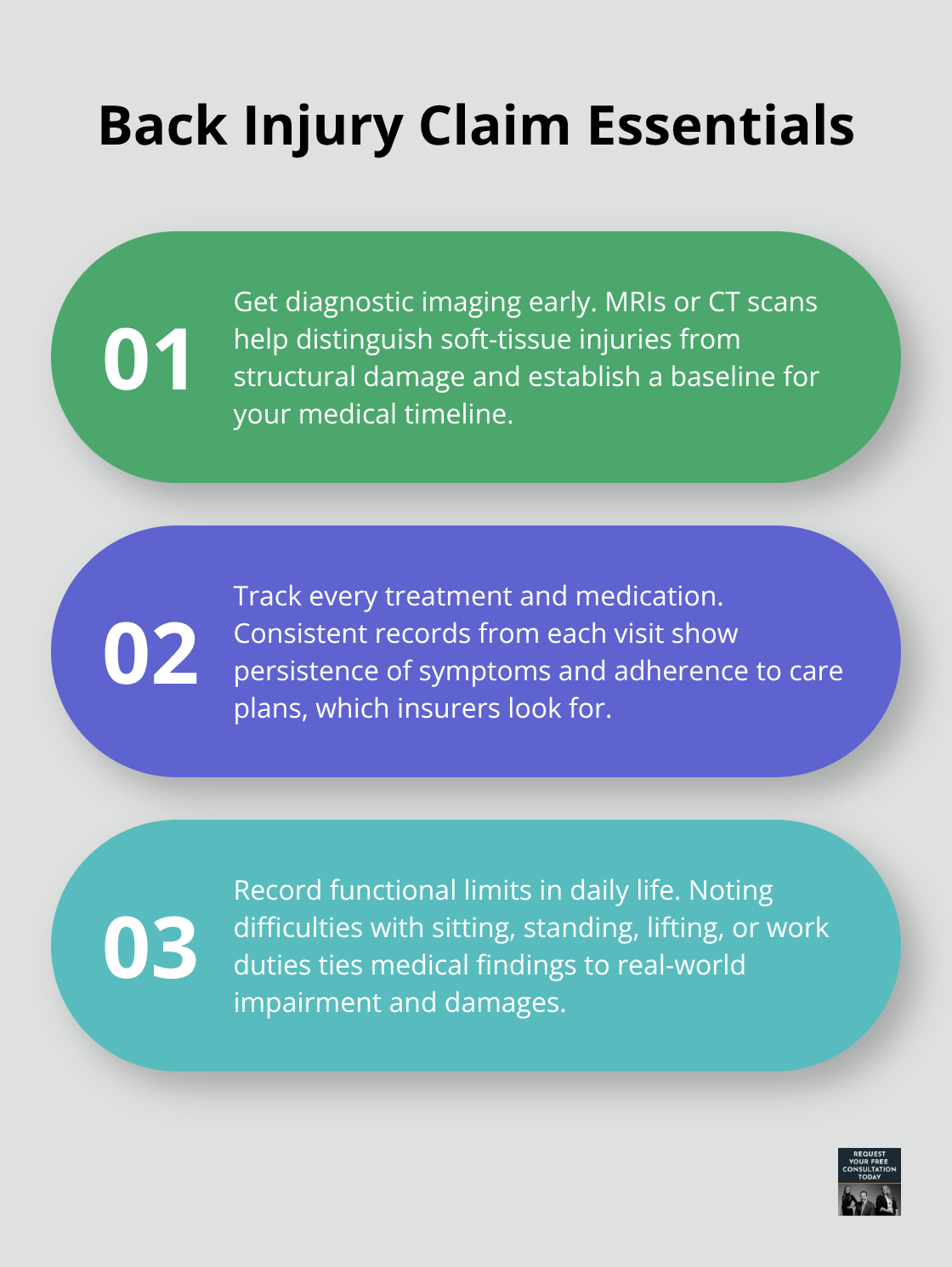
Document every treatment session, every medication prescribed, and every functional limitation you experience-whether that’s difficulty sitting, standing, or performing work duties. Courts and insurers want to see a clear medical timeline showing how your injury has progressed and what treatment you’ve received.
Head Trauma and Concussions Demand Immediate Evaluation
Head trauma and concussions require immediate medical attention and are frequently overlooked in accident claims. Even a mild concussion can cause headaches, dizziness, memory problems, and sensitivity to light that persists for weeks. If you hit your head during the crash or felt dazed afterward, get evaluated by an emergency room physician or neurologist right away. Concussions often require follow-up visits and sometimes cognitive testing to document the extent of the injury. The challenge with head injuries is that they’re invisible-there’s no cast or obvious wound-so medical records become your only proof that the injury occurred and affected your daily life. Insurance adjusters may dismiss head injury claims without solid medical documentation.
Building Your Medical Record Strengthens Your Claim
Start treatment immediately after your crash, keep every medical record organized, and be honest with your doctors about all symptoms you’re experiencing, no matter how minor they seem. Medical documentation you gather now directly determines the compensation you can recover later. The records you compile-from emergency room visits to physical therapy sessions to specialist consultations-form the foundation of your injury claim. Each document tells part of your story and proves the financial and physical impact of the accident.
With your medical records in place, the next step involves collecting additional evidence that strengthens your overall claim and demonstrates the full scope of damages you’ve suffered.
How to Build a Strong Accident Claim
Assess Property Damage With Precision
Medical records alone won’t win your case. Insurance companies demand a complete picture of damages, and that means assessing property damage, calculating both current and future expenses, and organizing everything in a way that proves the full financial impact of the crash. Obtain a detailed repair estimate from a certified mechanic or body shop-don’t rely on the insurance adjuster’s estimate alone, as they often undervalue repairs.
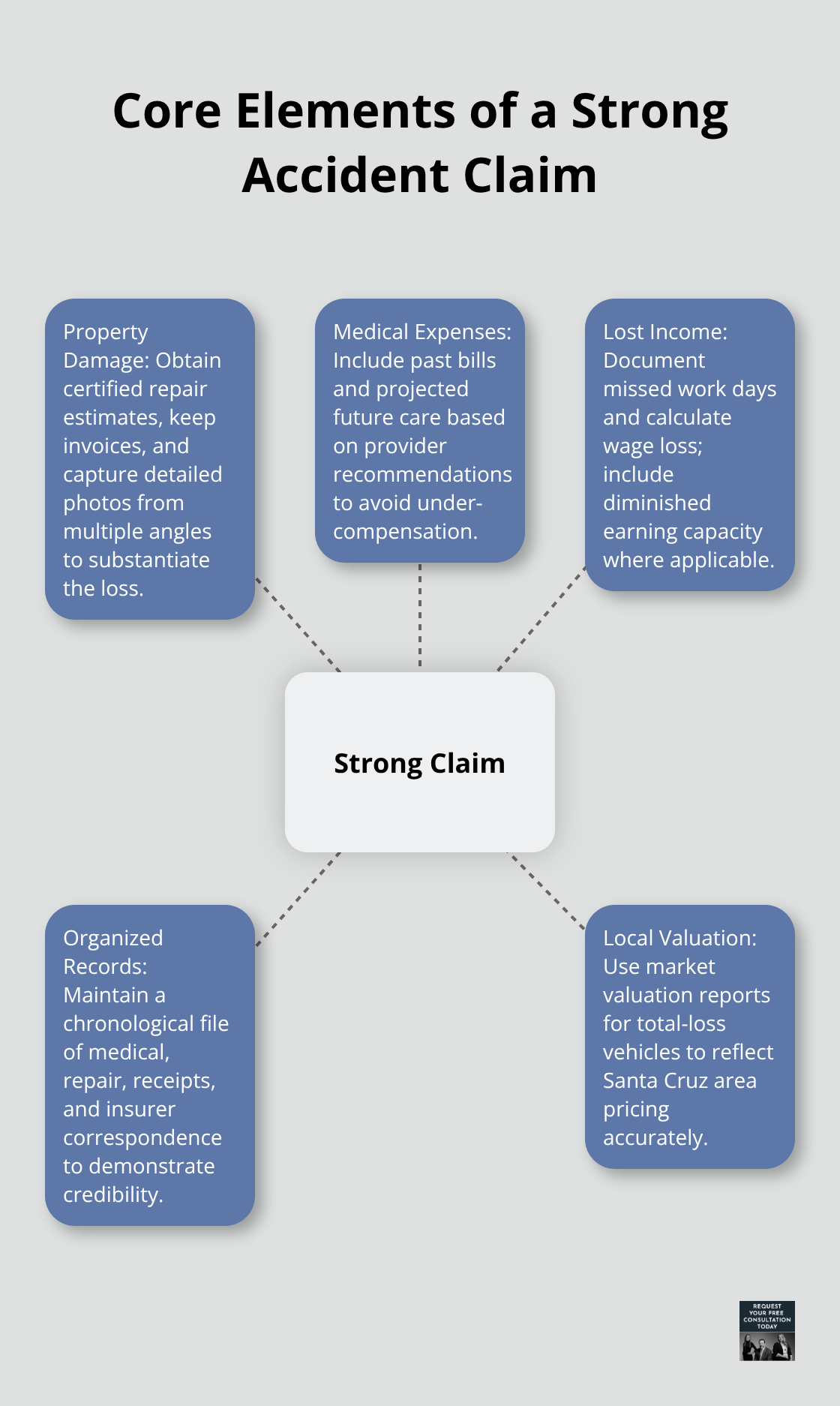
Take photos of the vehicle damage from multiple angles and keep the original repair invoice once work is completed. For total loss vehicles, request a market valuation report showing comparable vehicles in your area; Santa Cruz County’s used car market varies significantly by location, so a generic valuation misses local pricing realities. Preserve all receipts for rental cars, transportation costs, or other expenses directly caused by the accident.
Calculate Medical Expenses Past and Future
Medical expense calculations require precision and foresight. Collect every bill from the emergency room, doctor visits, physical therapy, imaging studies, and any medications prescribed specifically for crash-related injuries. Don’t stop at past expenses-calculate future medical costs based on your doctor’s recommendations. If your physician recommends ongoing physical therapy for six months but you’ve only completed two months, calculate the remaining treatment costs and include them in your claim. Insurance adjusters frequently offer settlements based only on treatment you’ve already received, leaving you to pay out-of-pocket for necessary future care.
Document Lost Income and Earning Capacity
Lost wages represent another critical component many people overlook. Document every day you missed work due to the accident or medical treatment, and calculate lost income using your pay stubs or employer verification. If the injury reduces your earning capacity long-term (such as a back injury that prevents you from returning to physical labor), that diminished earning potential must be calculated and included in your claim.
Organize Documentation Chronologically
Arrange all documentation chronologically in a single folder: medical records, repair estimates, receipts, pay stubs, and correspondence with insurers. This organized approach demonstrates professionalism to insurance adjusters and judges, making your claim harder to dismiss or undervalue. When you work with Schaar & Silva LLP, our team can help direct you to medical lien services that facilitate payment of your bills until your case is resolved, and we assist in evaluating the extent of property damage to ensure you receive fair valuation for your loss.
Final Thoughts
Establishing fault in a California car accident requires solid evidence. Police reports, scene photos, witness statements, and medical records all work together to prove who caused the crash. California’s at-fault system means the responsible driver’s insurance pays for your damages, but insurers won’t hand over fair compensation without pressure-they employ adjusters trained to minimize payouts and use any gap in your documentation to reduce what they owe you.
Insurance negotiations are where most accident victims lose money. Adjusters make lowball offers early, hoping you’ll accept before understanding the true value of your claim. A car crash injury firm like Schaar & Silva LLP changes this dynamic entirely by handling all communications with insurers, rejecting inadequate offers, and building comprehensive demand packages that account for past medical expenses, future treatment costs, lost wages, and pain and suffering.
Many victims settle too quickly and regret it later when medical problems persist or bills continue arriving. The statute of limitations in California gives you two years to file a personal injury claim, but waiting too long weakens your case as evidence disappears and memories fade. Contact us for a free consultation to discuss your options and understand what your claim is actually worth.
