

After a car accident in Santa Cruz, medical bills pile up fast. If you can’t pay upfront, medical lien services offer a way forward-your healthcare providers agree to wait for payment until your case settles.
At Schaar & Silva LLP, we help accident victims navigate this process without getting trapped by confusing terms or unfair agreements. This guide breaks down how medical liens work and what you need to know to protect yourself.
How Medical Liens Actually Work
Understanding the Lien Claim
A medical lien is a legal claim that healthcare providers place on your auto accident settlement to guarantee they get paid for treatment you received. When you’re injured in a car accident and can’t pay medical bills upfront, a provider agrees to treat you now and wait for payment from your settlement later. This arrangement protects both you and the provider, but it comes with real financial consequences you need to understand.
In Santa Cruz, medical providers routinely use liens because personal injury cases often take months or years to resolve, creating cash flow problems for both patients and clinics. Without liens, many accident victims would struggle to access immediate care while waiting for their case to settle.
What Happens When Your Settlement Arrives
Your healthcare provider files a lien notice with the court, creating a legal claim against any compensation you receive. When your settlement is finalized, the lien amount gets paid directly to the provider before you see any money. A $50,000 settlement with $15,000 in liens leaves you with $35,000 before attorney fees and costs are deducted, which significantly reduces your take-home amount.
This is where most accident victims run into trouble, because liens can be inflated or stacked from multiple providers without proper review. Many people accept lien amounts as fixed, but California law treats them as negotiable. Healthcare providers often accept reductions of 20% to 40% when you challenge charges with documentation and leverage, especially before a settlement is finalized.
The Critical Window for Negotiation
Once a settlement check clears, your negotiating power drops dramatically, so timing matters enormously. The key is requesting itemized billing statements from every provider and comparing charges to local fair market rates using tools like Healthcare Bluebook. If an MRI is billed at $2,500 when the Santa Cruz County average is $1,200, you have concrete leverage to push back.
Special Rules for Government Programs
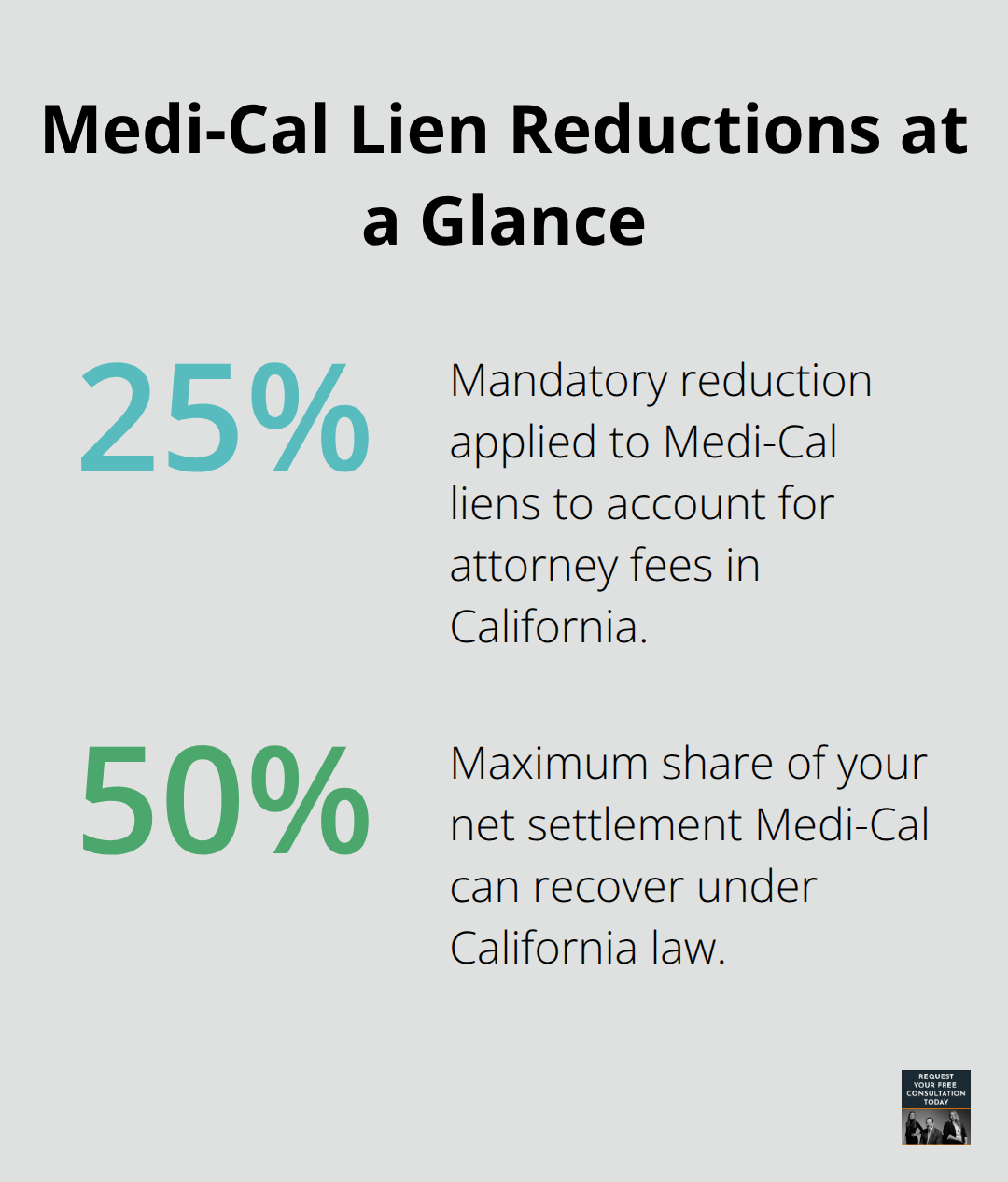
Medi-Cal liens follow different rules under California law, with mandatory 25% reductions to account for attorney fees, plus they cap recovery at 50% of your net settlement. Medicare liens are handled federally and also include pro-rata reductions based on your attorney’s contingency fee. Hospital liens must follow strict notice requirements, and failure to comply can render them invalid.
Getting Help with Lien Management
This complexity demands careful attention to detail. At Schaar & Silva LLP, we audit these claims, identify procedural defects, and negotiate aggressively on your behalf to protect what you actually keep from your settlement. Understanding how liens work is just the first step-knowing how to challenge them effectively is what separates a fair recovery from one that leaves you short.
How Liens Enable Treatment Access After an Accident
Medical lien services solve a timing problem that affects every accident victim in Santa Cruz. After a collision, you need immediate medical care, but your settlement may be months or years away. Without liens, you’d face a brutal choice: pay thousands upfront or delay treatment while your injuries worsen. Healthcare providers understand this reality and accept liens as a way to provide care now and collect later. This arrangement means you get the treatment you need without depleting savings or going into debt before your case resolves. Providers file lien paperwork with the court, creating a legal claim against your future settlement, and this security allows them to take the financial risk of treating you without guaranteed immediate payment.
How Providers Manage Their Role in the Process
When you choose a healthcare provider who accepts liens, the clinic handles most of the administrative burden. They file the lien notice, track your treatment costs, and prepare itemized billing statements for your attorney. Providers know that reasonable, well-documented bills are easier to defend than inflated ones, so many accept negotiations without resistance. The real issue emerges when multiple providers treat you for the same injury-physical therapy, orthopedic surgery, imaging, and pain management all stack liens on top of each other. A patient treated by four different providers can end up with $40,000 in combined liens against a $75,000 settlement, leaving only $35,000 before attorney fees.
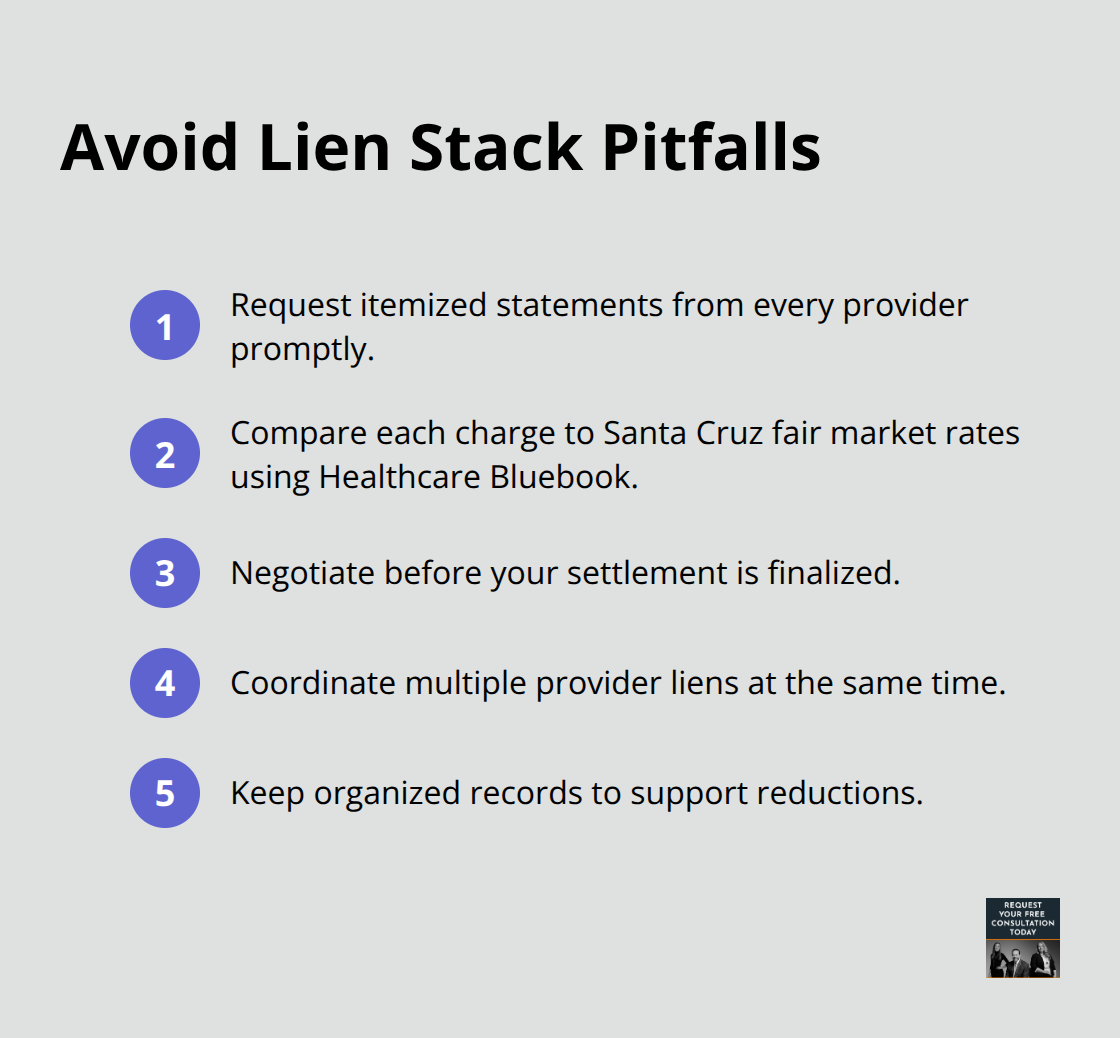
Request itemized statements from every provider immediately after treatment ends, not months later when memories fade and records become harder to access. Healthcare Bluebook provides free regional pricing data so you can verify whether your Santa Cruz providers charged fair market rates or inflated amounts compared to local averages.
Settlement Resolution and What You Actually Keep
When your case settles, liens get paid from the settlement proceeds in a specific order that protects certain claims first. Medi-Cal liens receive mandatory 25% reductions under California Welfare & Institutions Code 14124.70, plus they’re capped at 50% of your net recovery after attorney fees and costs. Medicare liens follow federal rules through the Benefits Coordination & Recovery Center and also include pro-rata reductions based on your attorney’s contingency fee. Hospital liens under California’s Hospital Lien Act must follow strict notice requirements, and providers who fail to comply lose their right to collect entirely. Private insurance subrogation claims can be negotiated using the Common Fund Doctrine, which requires insurers to share in the cost of creating the settlement fund proportional to attorney fees and expenses. The timing of settlement matters enormously-once your check clears, providers become far less willing to negotiate reductions. If total liens exceed your net recovery, California law requires pro-rata distribution, meaning available funds get divided proportionally among all claimants rather than allowing one provider to take everything.
Why Negotiation Timing Changes Everything
Lien negotiations before settlement finalization produce far better results than attempts after your check arrives. Providers still have incentive to work with you when the settlement remains unsigned, but that leverage vanishes once funds clear. Understanding these rules protects you from accepting a settlement that looks good on paper but leaves you with almost nothing after liens are satisfied. The next section covers how legal assistance transforms this complex process into a manageable one.
How Your Attorney Protects Your Settlement from Liens
Auditing Medical Bills Against Fair Market Rates
Your attorney’s role in managing liens separates a settlement that actually helps you from one that disappears before you see it. When you work with a firm like Schaar & Silva LLP, lien management becomes a core responsibility from day one. We audit every medical bill submitted by providers, comparing charges against Healthcare Bluebook regional pricing data to identify inflated amounts. If a provider billed $3,000 for physical therapy when Santa Cruz County averages run $1,800 for identical treatment, documented evidence supports negotiation downward. The window for this work is critical-we must challenge liens before settlement finalizes because providers lose negotiating incentive once your check clears.
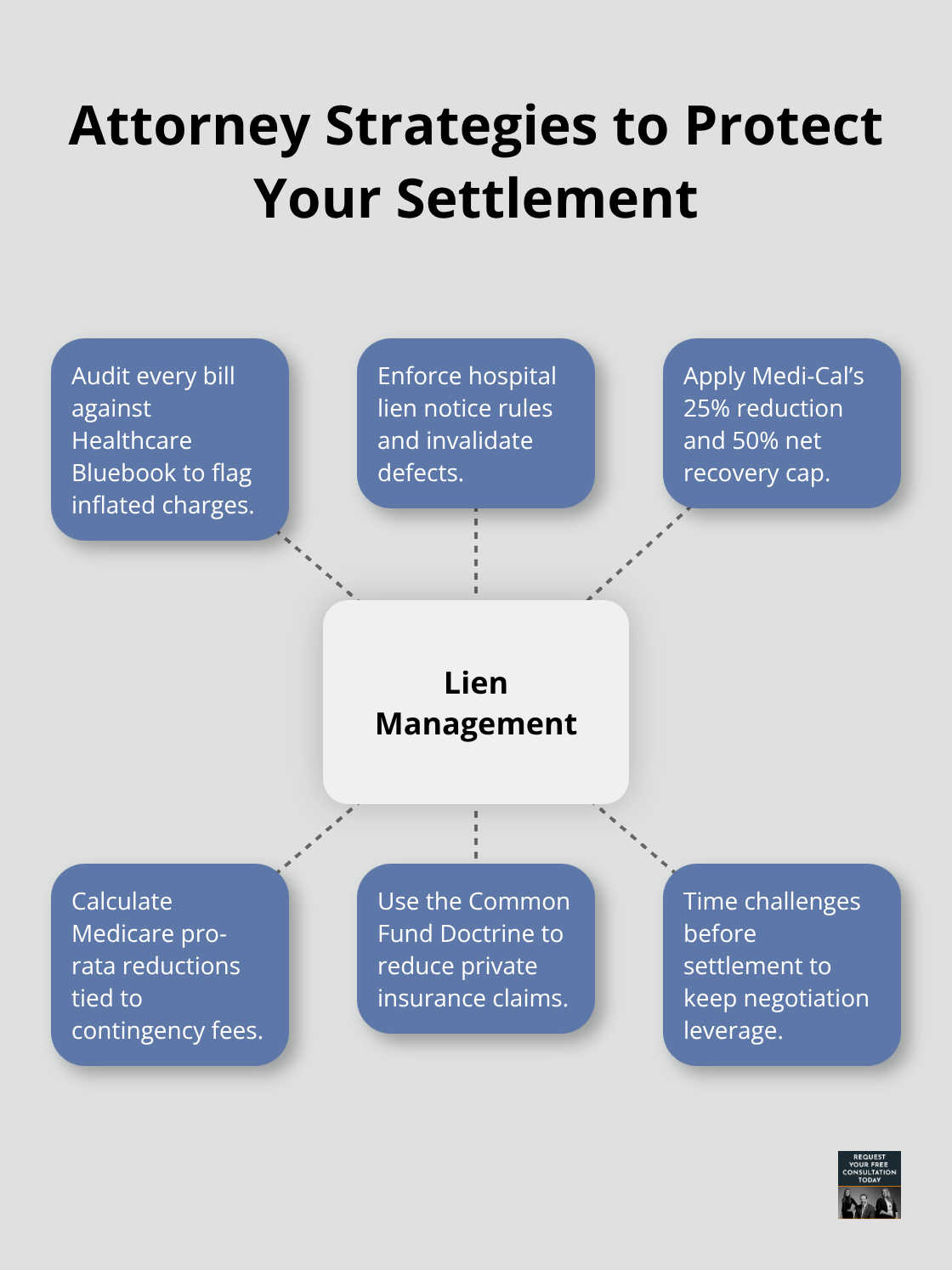
We also verify that providers followed California’s strict notice requirements for hospital liens under Civil Code 3045.1, since procedural failures can invalidate claims entirely. For Medi-Cal liens, we apply the mandatory 25% reduction required by Welfare & Institutions Code 14124.70 plus confirm the 50% net recovery cap is honored. Medicare liens receive pro-rata reductions through the Benefits Coordination & Recovery Center, and we calculate exactly what portion of attorney fees and costs should reduce the claim. Private insurance subrogation claims fall under the Common Fund Doctrine, meaning insurers must share proportionally in the cost of creating your settlement fund rather than recover their full amount.
Identifying Leverage Points in Negotiations
Providers accept 20% to 40% reductions regularly when you present itemized billing statements alongside fair market pricing data, but only before settlement concludes. We request comprehensive billing records from every provider immediately after treatment ends, not months later when documentation becomes scattered. If total liens exceed your net recovery after attorney fees and costs, California law requires pro-rata distribution, meaning we divide available funds proportionally among claimants rather than allow one provider to consume everything.
This protection prevents scenarios where a single aggressive lien holder takes 80% of your net recovery while others receive nothing. We also investigate whether treatment was medically necessary by reviewing medical records against your actual injuries-excessive physical therapy sessions or redundant imaging can be challenged if records don’t support their necessity.
Coordinating Simultaneous Negotiations
For Santa Cruz accident victims facing multiple providers, we coordinate negotiations simultaneously rather than sequentially, creating market pressure when providers realize they’re competing for funds from the same settlement. The timing of settlement negotiations matters enormously because once your check deposits, providers become immovable on their amounts. We structure settlement agreements to hold lien funds in escrow until negotiations conclude, preventing premature distribution that eliminates our negotiating leverage. This systematic approach to lien management often results in settlements where you retain substantially more than you would have without professional legal guidance managing the process.
Final Thoughts
Medical liens in Santa Cruz allow you to access immediate medical care without depleting savings, but they also reduce what you ultimately receive unless you challenge inflated charges and procedural errors. Providers routinely accept 20% to 40% reductions when you present itemized billing statements and fair market pricing data, but only before your settlement check clears. Once funds arrive, your negotiating power disappears entirely, making timing the single most important factor in protecting your recovery.
Government programs like Medi-Cal and Medicare include built-in protections that reduce lien amounts automatically, while hospital liens can be invalidated if providers fail to follow strict notice requirements. Private insurance subrogation claims fall under the Common Fund Doctrine, requiring insurers to share proportionally in the cost of creating your settlement fund. When multiple providers treat you for the same injury, pro-rata distribution ensures no single lien holder consumes your entire recovery.
We at Schaar & Silva LLP audit every medical bill against Healthcare Bluebook regional pricing data, verify that providers followed California’s strict procedural requirements, and negotiate aggressively before settlement concludes. Our team coordinates simultaneous negotiations with multiple providers, creating market pressure that individual victims cannot generate alone. Contact us for a free case evaluation to learn exactly how much you can realistically keep after medical lien services, attorney fees, and costs are satisfied.
