
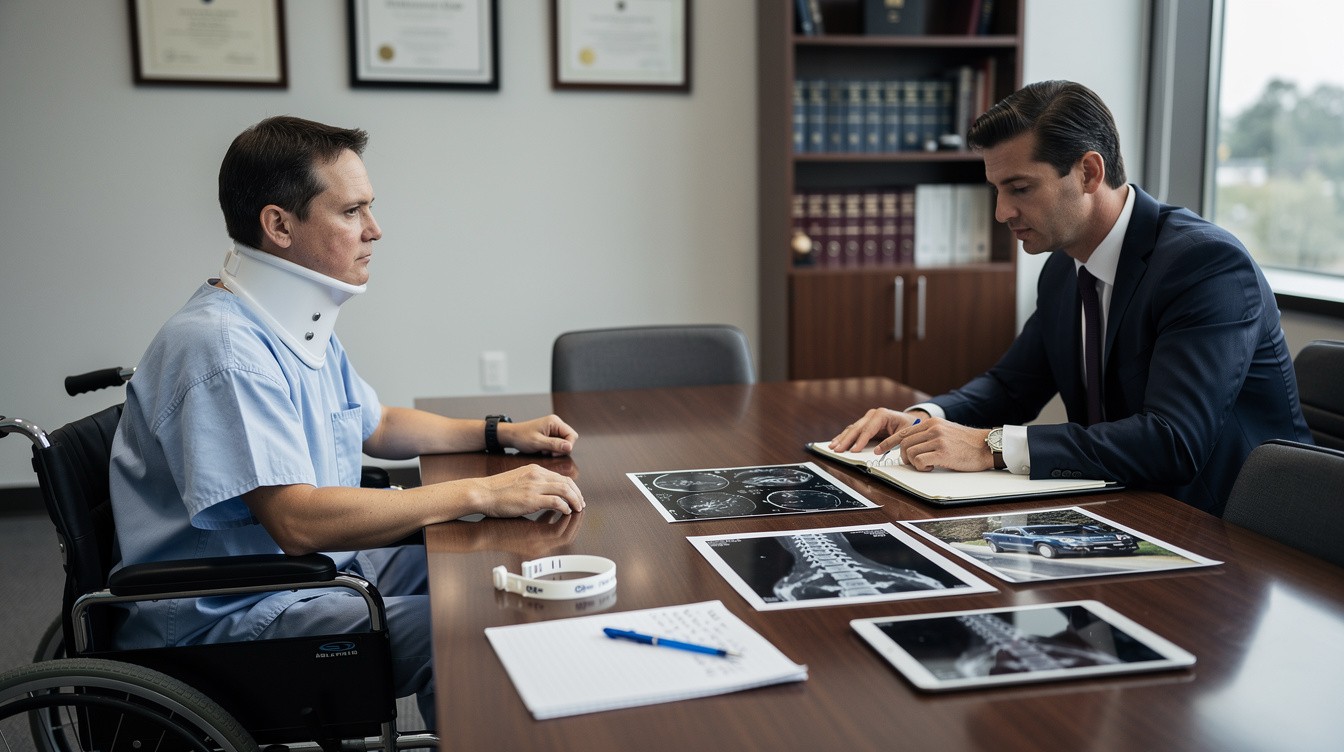
A spinal cord injury from a vehicle accident changes everything. Medical bills pile up, work becomes impossible, and pain becomes your constant companion.
We at Schaar & Silva LLP have helped people in Santa Cruz County, Sacramento, and Oakland recover the compensation they deserve after these devastating injuries. This guide walks you through calculating damages, gathering evidence, and fighting for full payment.
What Happens to Your Body After a Spinal Cord Injury from a Crash
Injury Severity Determines Your Lifetime Costs
A spinal cord injury doesn’t announce itself with a single threshold of damage. The injury severity depends on two critical factors: where on your spine the damage occurs and whether the injury is complete or incomplete. A complete spinal cord injury means total loss of function below the injury site, while an incomplete injury preserves some nerve signals. This distinction matters enormously because it determines your lifetime care costs, functional abilities, and compensation amount.
Cervical injuries at the neck level cause quadriplegia and typically generate the highest lifetime costs, ranging from $5 million to over $15 million for complete injuries. Thoracic injuries in the mid-back cause paraplegia with costs around $2 to $5 million over a lifetime. Lower lumbar and sacral injuries may allow some patients to regain walking ability with assistive devices, reducing but not eliminating long-term care expenses.
The Critical First Hours After Your Crash
The immediate aftermath of a crash involving spinal cord trauma is critical. Emergency stabilization within hours, transfer to a specialized SCI rehabilitation center like Rancho Los Amigos, and early involvement of a life-care planner substantially improve outcomes and protect your claim value. These steps establish the medical foundation for your entire recovery and compensation case.
Hospitalization and Rehabilitation Costs Add Up Fast
The financial reality hits fast and hard. Acute hospitalization alone costs between $150,000 and $1 million depending on injury severity and whether ventilation support is needed. Inpatient rehabilitation at specialized centers runs $1,500 to $3,000 per day, totaling $50,000 to $300,000 for initial recovery.
Lifetime Care Expenses Dominate Your Damages
Then comes the permanent part: 24-hour personal care attendants for high-level injuries cost $220,000 to $440,000 annually, adding $8 to $17 million in present value over 40 years. Power wheelchairs cost $20,000 to $50,000, accessible vehicles $50,000 to $100,000, and home modifications another $50,000 to $200,000. Annual ongoing medical care including specialist visits and devices typically runs $20,000 to $100,000.
Lost Earning Capacity Becomes Your Second-Largest Damage
The second-largest damage component is lost earning capacity. A younger professional facing permanent disability can lose multi-million dollars in future wages. Common crash causes in your region include speeding, distraction from cellphones, failure to yield at crosswalks, and poor nighttime visibility-all create clear liability paths. California Vehicle Code sections 21950 and 21453 establish that drivers must yield to pedestrians, making violations negligent per se.
You have two years from injury to file a claim under California Code of Civil Procedure section 335.1, though government entity claims require filing within six months. Understanding these liability rules and deadlines shapes how you build your case and what evidence matters most.
What Your Spinal Cord Injury Claim Is Actually Worth
Medical Costs Extend Far Beyond the Hospital
Calculating your true damages requires understanding that a spinal cord injury claim has multiple components, and most people significantly underestimate their value. Medical expenses form the foundation, but they represent only the beginning of your financial burden. Your hospitalization and initial rehabilitation already consumed $150,000 to $1 million depending on injury severity. The real financial impact emerges over decades of care and treatment.
If you have a complete cervical injury requiring 24-hour attendant care, you face $220,000 to $440,000 annually just for personal care assistance. Over a 40-year life expectancy, that totals $8 to $17 million in present value. A power wheelchair costs $20,000 to $50,000, vehicle modifications run $50,000 to $100,000, and home accessibility renovations add another $50,000 to $200,000. Ongoing medical care including specialist visits, medications, and devices typically runs $20,000 to $100,000 each year.
A Life-Care Plan Anchors Your Entire Claim
A certified life-care planner creates a detailed projection of your medical and daily living needs with realistic cost estimates. This document becomes your strongest tool when negotiating with insurance companies because it transforms abstract injury descriptions into concrete, itemized expenses. The life-care plan anchors your entire damages claim and forces insurers to confront the actual lifetime cost of your injury rather than dismissing your claim with a low offer.
Lost Earning Capacity Often Exceeds Medical Costs
Your lost earning capacity typically becomes the second-largest damage component, and it’s where many victims fail to capture their full value. A younger professional earning $75,000 annually who becomes unable to work faces decades of lost income plus the career advancement they’ll never achieve. Vocational experts and economists calculate this by analyzing your pre-injury earning trajectory, education, and job market conditions. If you were 35 years old at the time of injury with 30 years of potential work remaining, the loss compounds dramatically-potentially reaching millions of dollars.
Pain and Suffering Has No Cap in California
Pain and suffering compensation has no cap in California for spinal cord injury cases (unlike medical malpractice claims), which means you can receive full compensation for your physical pain, emotional distress, and loss of enjoyment of life. The challenge lies in proving these non-economic damages through medical records showing your functional limitations, testimony from family members about how your life changed, and documentation of activities you can no longer perform. Insurance companies will push back aggressively on pain and suffering claims, arguing the amounts are excessive.
Don’t Accept the First Settlement Offer
Insurance adjusters are trained to make low initial offers, knowing most people don’t understand the lifetime cost of their injuries and accept quickly. Organized medical documentation and a clear narrative about your daily struggles matter most when fighting back against these lowball proposals. The insurance company’s first number rarely reflects what your claim is actually worth, and accepting it means you forfeit compensation you rightfully deserve.
Understanding these damage components positions you to recognize when an insurance company undervalues your claim. The next step involves gathering the evidence and documentation that proves each damage category and forces insurers to negotiate fairly.
Building Your Case in Santa Cruz County
Preserve Evidence Immediately After the Crash
The moment a crash happens, evidence preservation becomes your priority. Photograph the crash scene from multiple angles, capturing vehicle damage, road conditions, weather, and traffic signals. Collect names and contact information from witnesses while they remain at the scene-memories fade quickly, and witness statements become exponentially harder to obtain later. Request the police report immediately and verify its accuracy; errors in the report can undermine your liability case. If surveillance cameras exist nearby, contact businesses within 100 feet of the crash location because footage typically overwrites every 7 to 30 days. For pedestrian crashes, doorbell cameras and traffic light cameras provide critical evidence that disappears if you don’t preserve it promptly.
Organize Your Medical Records Into a Single File
Medical documentation forms the foundation of your damages claim. Compile your records into one organized file containing discharge summaries, imaging results (MRI, CT scans), neurology notes, rehabilitation progress reports, and itemized medical bills. Create a simple daily log documenting your symptoms, functional limitations, and activities you can no longer perform-this becomes powerful evidence of pain and suffering when negotiating with insurers. Maintain detailed records of all out-of-pocket expenses including medications, equipment, home modifications, and transportation costs. This organized approach prevents critical information from scattering across multiple providers and insurers.
Protect Yourself During Insurance Communications
When insurance adjusters request recorded statements or broad medical releases, decline the recorded statement and limit releases to specific providers rather than blanket authorizations. Keep a written log of all communications with the insurance company, including dates, names, and what was discussed. Insurance companies deliberately make low initial offers knowing most injury victims don’t understand lifetime care costs and settle quickly. A complete life-care plan from a certified planner transforms abstract injury descriptions into concrete expenses that force insurers to negotiate seriously-this document typically becomes the largest single damages item in your claim.
Present a Comprehensive Damages Package to Insurers
Negotiating with insurance companies requires understanding that their first offer rarely reflects your claim’s actual value. Present your organized medical file, life-care plan, lost earning capacity calculations, and daily function logs together as a comprehensive damages package. Insurance adjusters attack individual numbers and create doubt about your injury severity; countering this requires documentation showing consistency across multiple providers and time periods.
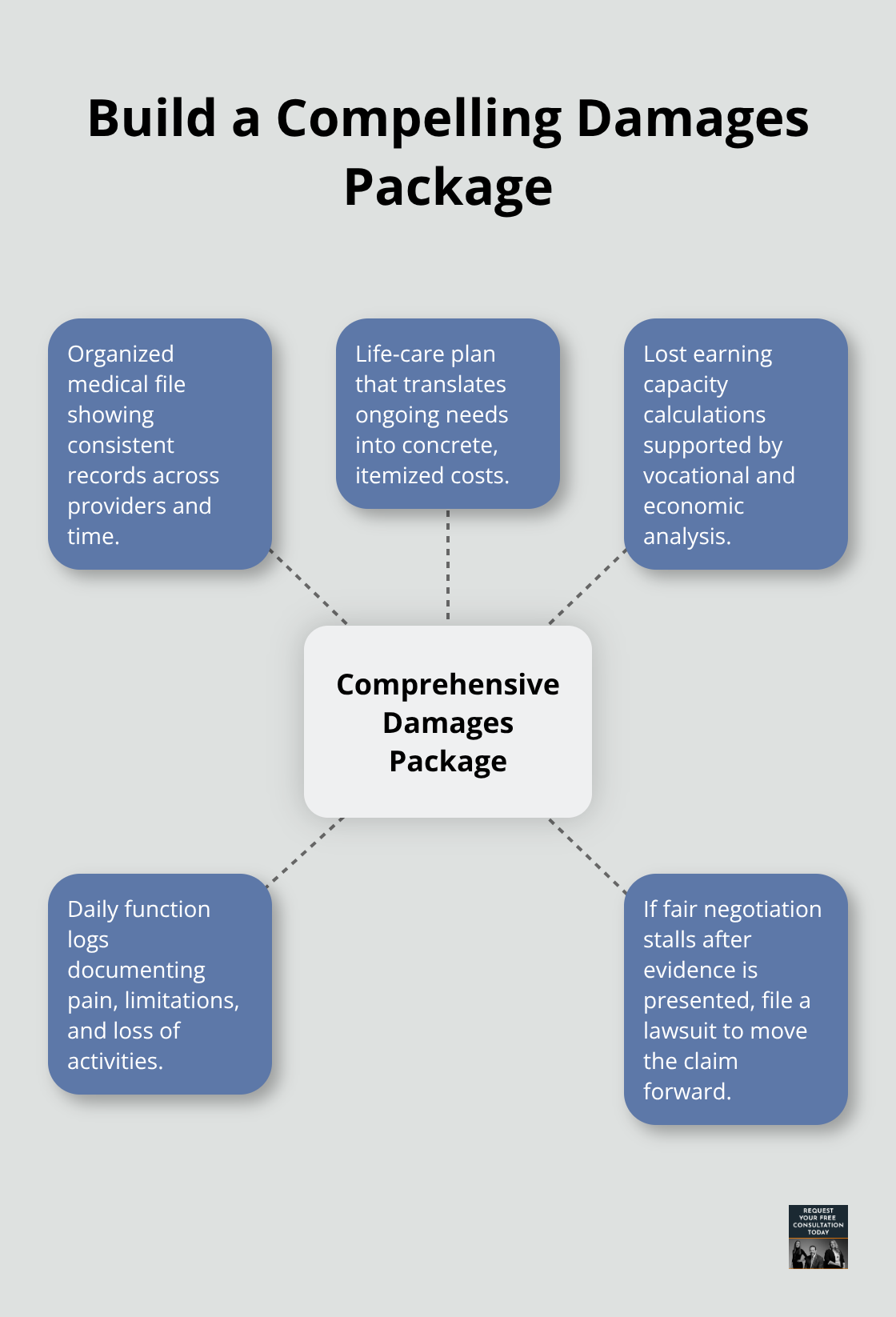
If the insurance company denies liability or refuses to increase their offer meaningfully after you’ve presented evidence, filing a lawsuit becomes necessary.
Know Your Deadlines and When to File
California’s two-year statute of limitations under Code of Civil Procedure section 335.1 provides time to file, but evidence degrades and witness memories fade as months pass. When government entities are involved, you must file a Government Tort Claim within six months. We at Schaar & Silva LLP handle the entire claims process for Santa Cruz County residents, including evidence preservation, medical lien coordination, and insurer negotiations so you focus on recovery rather than paperwork.
Final Thoughts
A spinal cord injury claim demands more than hope that insurance companies will do the right thing. You now understand that lifetime care costs reach millions, that lost earning capacity often exceeds medical expenses, and that California law allows you to recover full compensation for pain and suffering without caps. The evidence you gather in the first days after your crash determines whether you receive fair settlement or face lowball offers from adjusters trained to minimize payouts.
Your organized medical file, life-care plan, and documented daily struggles form the foundation of negotiating power. Insurance companies count on injured people accepting their first offer without understanding what their claim is truly worth. You have two years to file under California law, but evidence degrades and witnesses disappear as time passes, so acting quickly protects both your legal rights and your ability to prove damages.
Gather your incident reports, available medical records, insurance information, and photos, then contact Schaar & Silva LLP for a free case evaluation. We work on contingency, meaning you pay nothing unless we recover compensation for you, and your spinal cord injury claim deserves representation from people who understand both the medical complexity and the financial reality of your injury.
