

A shoulder injury from a car crash can sideline you for months or even years, affecting your ability to work and enjoy daily life. At Schaar & Silva LLP, we’ve helped countless clients in Santa Cruz County, Sacramento, and Oakland recover fair compensation for these injuries.
A shoulder injury settlement depends on several factors, including how severe your injury is and whether you’ll face long-term complications. This guide walks you through what affects your settlement amount and how to build a strong claim.
What Shoulder Injuries Look Like After a Car Crash
Rotator Cuff Tears: The Most Common Surgical Injury
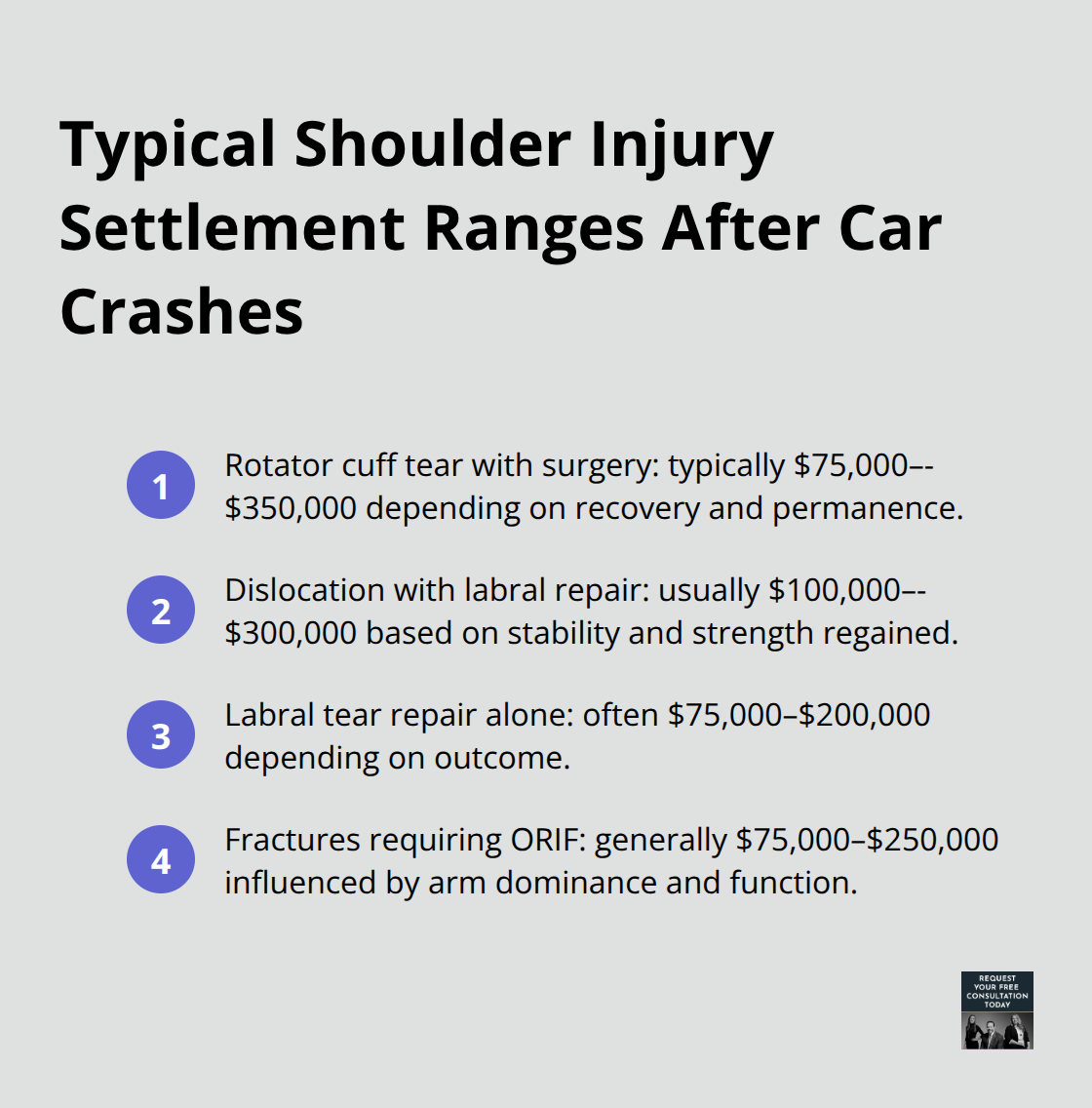
Car crashes cause predictable shoulder injuries, and knowing which ones you’re dealing with changes how your settlement gets valued. Rotator cuff tears are the most common surgical shoulder injury we see after vehicle collisions. These tears range from partial to complete, with full-thickness tears requiring arthroscopic repair that typically costs $15,000 to $40,000 in medical bills alone.
A full-thickness rotator cuff tear that heals well settles around $75,000 to $200,000, but if you develop permanent loss of motion or chronic pain, settlements climb to $150,000 to $350,000. The difference comes down to whether you regain normal shoulder function or live with lasting restrictions. MRI imaging proves the tear exists and establishes that the crash caused it-this structural evidence separates your claim from soft tissue injuries that settle for far less.
Dislocations, Labral Tears, and Fractures
Shoulder dislocations and labral tears (SLAP or Bankart tears) follow predictable settlement patterns. A shoulder dislocation with associated labral damage requiring surgical repair typically settles between $100,000 and $300,000, depending on whether you regain full strength or develop chronic instability. Labral tears alone, when repaired surgically, settle in the $75,000 to $200,000 range.
Fractures of the proximal humerus or collarbone requiring surgical fixation (ORIF) generally settle $75,000 to $250,000. The settlement value hinges on whether the injury affects your dominant arm-damage to your dominant shoulder increases settlement value substantially because it impairs your ability to work and perform daily tasks.
Why Your Dominant Arm Matters
A construction worker with a torn rotator cuff in their dominant shoulder will see a higher settlement than someone with the same injury in their non-dominant arm. Soft tissue damage without surgery settles much lower, typically $15,000 to $50,000, which is why early imaging matters. If you wait weeks to get an MRI and the tear has already started healing, some adjusters argue the injury wasn’t that severe.
Get imaging done within two weeks of the crash so your medical records show the injury’s true extent at the time of impact. This timing protects your claim and prevents adjusters from downplaying what actually happened to your shoulder. The next section covers how these injuries affect your ability to work and earn income-a major factor that drives settlement amounts higher.
What Drives Your Settlement Amount
Medical Bills Form Your Settlement Foundation
Medical bills create the baseline for your settlement, but they represent only the starting point. A full-thickness rotator cuff tear with surgery costs $15,000 to $40,000 in medical expenses alone. MRI imaging, orthopedic visits, anesthesia, and physical therapy extending 4 to 6 months add substantially to this total. Insurers use your medical bills as a reference point, so documenting every expense protects your claim. If you skip follow-up appointments or create gaps in your treatment plan, adjusters will argue your injury wasn’t serious enough to warrant a higher settlement.
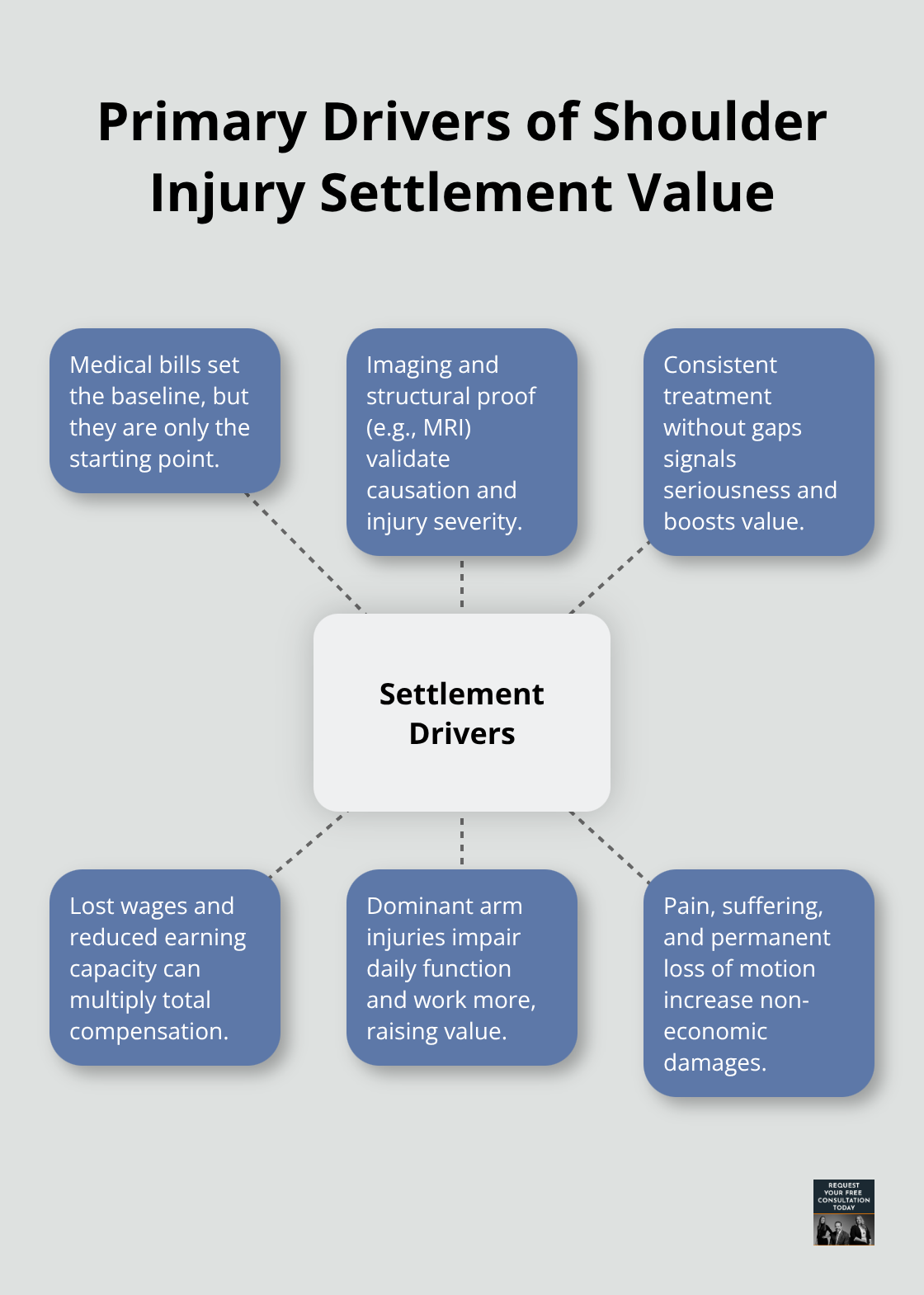
Consistent treatment with clear imaging showing structural damage pushes settlements significantly higher. A rotator cuff tear with 6 months of documented physical therapy and ongoing pain restrictions will settle for substantially more than the same tear with minimal follow-up care. Treatment gaps hurt your case far more than they help-they give adjusters ammunition to downplay your injury’s severity.
Lost Wages and Work Restrictions Drive Settlement Value Higher
Your ability to work determines whether your settlement stays at $75,000 or climbs to $300,000. Construction workers, electricians, and anyone whose job requires overhead lifting or reaching face decimated earning potential after a shoulder injury. You either cannot return to your previous job, or you return with permanent restrictions that cut your income significantly. Lost wages get added to your settlement, and for someone with 25 years of work ahead, the numbers become substantial.
A 45-year-old carpenter with a dominant-arm rotator cuff tear facing permanent lifting restrictions will see their settlement value increase by tens of thousands of dollars compared to a retired person with the same injury. The math is straightforward: lost earning capacity over decades of work life translates directly into higher settlement amounts. Your age, job type, and the permanence of your restrictions all factor into this calculation.
Pain, Suffering, and Permanent Functional Loss
Pain and suffering compounds your settlement value significantly. You cannot sleep normally, cannot exercise, cannot lift your children, and chronic pain affects your mental health. These functional limitations are real damages that get reflected in settlement amounts. Permanent loss of motion in your shoulder-where you cannot reach overhead or behind your back-justifies higher settlements because it’s permanent and affects your quality of life indefinitely.
Document your daily limitations in writing: what you cannot do at work, what you’ve given up at home, how your sleep is disrupted. This documentation transforms vague pain complaints into concrete evidence that justifies the settlement amount your case deserves. Adjusters respond to specificity-“I have shoulder pain” carries far less weight than “I cannot lift my arm above shoulder height, which prevents me from my job as an electrician and means I cannot play catch with my children.”
Dominant Arm Injuries Command Higher Settlements
Damage to your dominant shoulder increases settlement value substantially because it impairs your ability to work and perform daily tasks more severely than non-dominant arm injuries. A construction worker with a torn rotator cuff in their dominant shoulder will see a higher settlement than someone with the same injury in their non-dominant arm. This distinction matters because it directly affects your functional capacity and earning potential.
The settlement difference between dominant and non-dominant arm injuries can reach tens of thousands of dollars for the same underlying tear. Adjusters understand this distinction, and your medical records should clearly document which arm was injured and how that affects your specific job duties and daily activities. With these settlement drivers in mind, the next section covers how to build a claim strong enough to secure the compensation these factors justify.
Building a Claim That Proves Your Shoulder Injury
Photograph and Document the Crash Scene Immediately
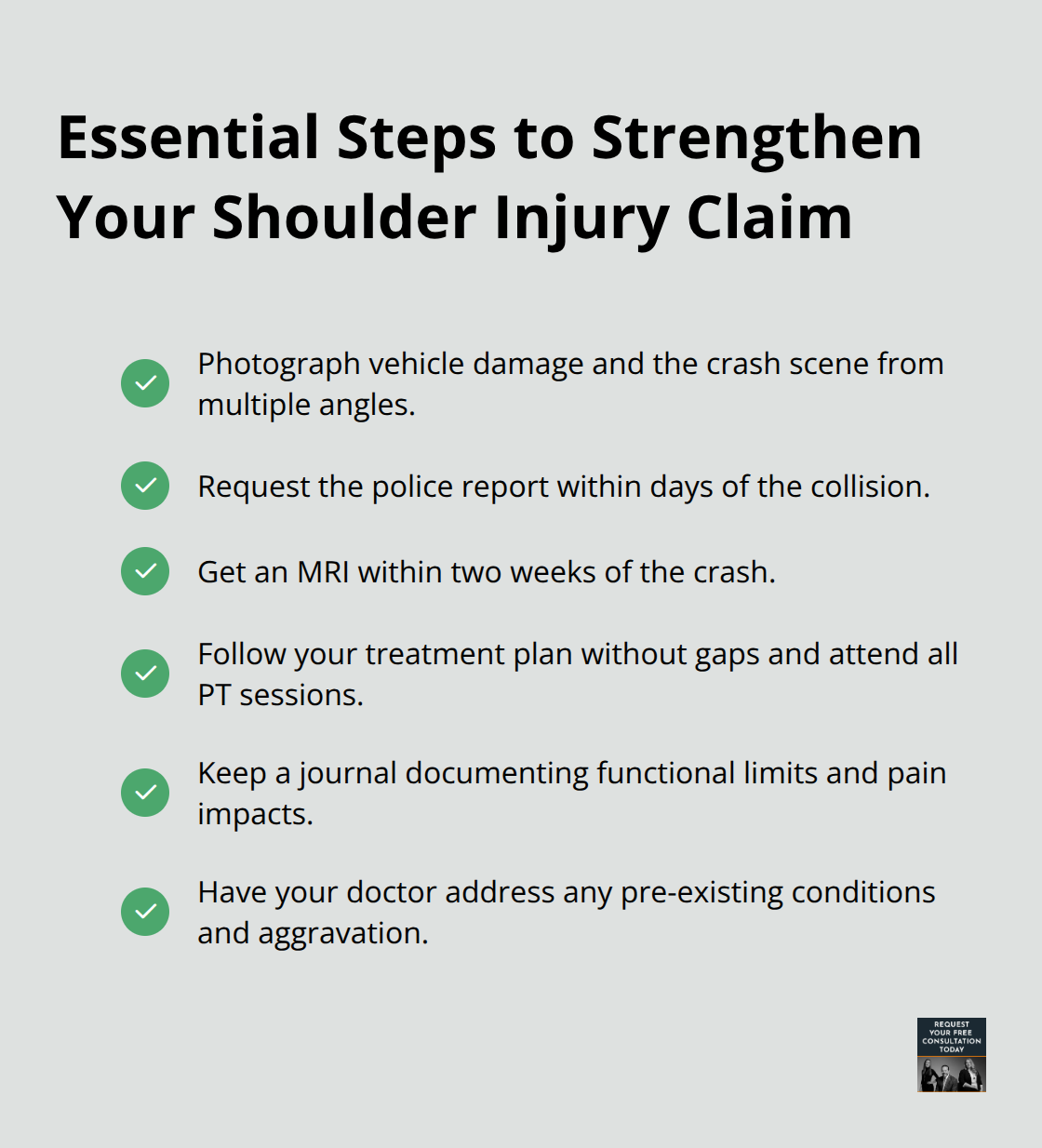
Start collecting evidence immediately after your crash, not weeks later when memory fades and details blur. Photograph your vehicle damage from multiple angles, capturing the point of impact and overall severity. Request the police report within days, not months, because it contains the officer’s observations about how the crash happened and who was at fault. Take photos of the accident scene if you’re able, showing road conditions, traffic signals, and vehicle positions. These photographs become critical when adjusters later claim the impact was minor and therefore your shoulder injury couldn’t be serious. Impact severity directly correlates to injury credibility in the adjuster’s mind, which means documenting the crash scene protects your entire claim.
Obtain Medical Imaging Within Two Weeks
Medical documentation separates legitimate claims from weak ones, and timing matters enormously. Get an MRI within two weeks of the crash, not two months later. Adjusters scrutinize the time gap between injury and imaging because they argue that delayed imaging suggests the injury wasn’t severe enough to notice immediately.
Your initial emergency room or urgent care visit establishes the injury occurred from the crash, not from some other activity. Request all medical records from your first visit forward, including imaging reports, physician notes, and physical therapy progress notes. These records show consistent treatment and functional decline, which justifies higher settlement amounts.
Follow Your Treatment Plan Without Gaps
Follow your treatment plan religiously and attend every physical therapy appointment. Treatment gaps create opportunities for adjusters to argue you weren’t seriously injured or that you contributed to your own poor recovery. Consistent treatment with clear imaging showing structural damage pushes settlements significantly higher. A rotator cuff tear with 6 months of documented physical therapy and ongoing pain restrictions will settle for substantially more than the same tear with minimal follow-up care. Treatment gaps hurt your case far more than they help-they give adjusters ammunition to downplay your injury’s severity.
Document Your Functional Limitations in Writing
Document your functional limitations in a journal, noting specific activities you cannot perform, sleep disruption, and how the injury affects your work. When you tell your doctor you cannot lift your arm above shoulder height, that note in your medical record becomes evidence supporting your settlement demand. Adjusters count pages of medical records and treatment duration as indicators of injury severity, so consistent documentation directly increases your settlement value. Medical professionals who provide detailed reports about your injury mechanism, imaging findings, and functional prognosis strengthen your claim substantially more than generic treatment notes.
Address Pre-Existing Conditions With Medical Evidence
Request that your physician document whether the crash aggravated any pre-existing shoulder conditions, because California uses the eggshell plaintiff doctrine (meaning the at-fault party remains responsible for worsening your pre-existing condition even if it was dormant before the crash). Pre-existing degenerative changes are common, but causation evidence showing the accident aggravated the injury protects your claim. Pre-accident imaging showing an intact shoulder is powerful evidence that the crash caused your current injury, not a condition that already existed.
Final Thoughts
Your shoulder injury settlement reflects how thoroughly you document your injury, follow treatment consistently, and prove the crash caused your damage. Medical imaging within two weeks, uninterrupted physical therapy, and detailed records of your functional limitations transform a weak claim into one that justifies substantial compensation. The settlement amounts throughout this guide reflect real cases where clients built strong evidence supporting their demands, and without that evidence, adjusters will lowball your claim and exploit any gaps in your medical records or treatment timeline.
We at Schaar & Silva LLP have helped countless clients in Santa Cruz County, Sacramento, and Oakland recover fair compensation for shoulder injuries from car crashes. Our team handles the legal complexities while you focus on recovery, and we connect you with medical lien services to manage your bills until your case resolves. We also assist with property damage claims and emotional support resources, recognizing that shoulder injuries affect your entire life (not just your physical health).
Contact Schaar & Silva LLP for a free case review where we evaluate your crash records, medical bills, surgery details, and insurance coverage to determine your shoulder injury settlement potential. The sooner you start building your claim with proper documentation and legal guidance, the stronger your position becomes when negotiating with adjusters or preparing for trial.
