

A car accident can leave you facing medical bills that stretch far into the future. From emergency room visits to years of physical therapy, the financial impact goes well beyond the initial crash.
We at Schaar & Silva LLP help people in Santa Cruz County, Sacramento, and Oakland understand what these future medical costs actually look like and how to plan for them. This guide walks you through the expenses you’ll likely face and the strategies that protect your financial recovery.
Understanding Medical Costs After an Auto Collision
What You’ll Pay Right After a Crash
An emergency room visit after a car accident typically costs between $1,500 and $3,000 just for initial assessment and stabilization. If you’re admitted to the hospital, costs climb rapidly-a week-long stay can exceed $50,000 depending on the severity of your injuries and the facility. These bills arrive within days of your accident, often before liability is even resolved, which creates immediate financial pressure that catches most people off guard. Your health insurance, if you have it, will cover these initial costs, but you’ll need to repay your insurer later from your settlement through a process called subrogation.
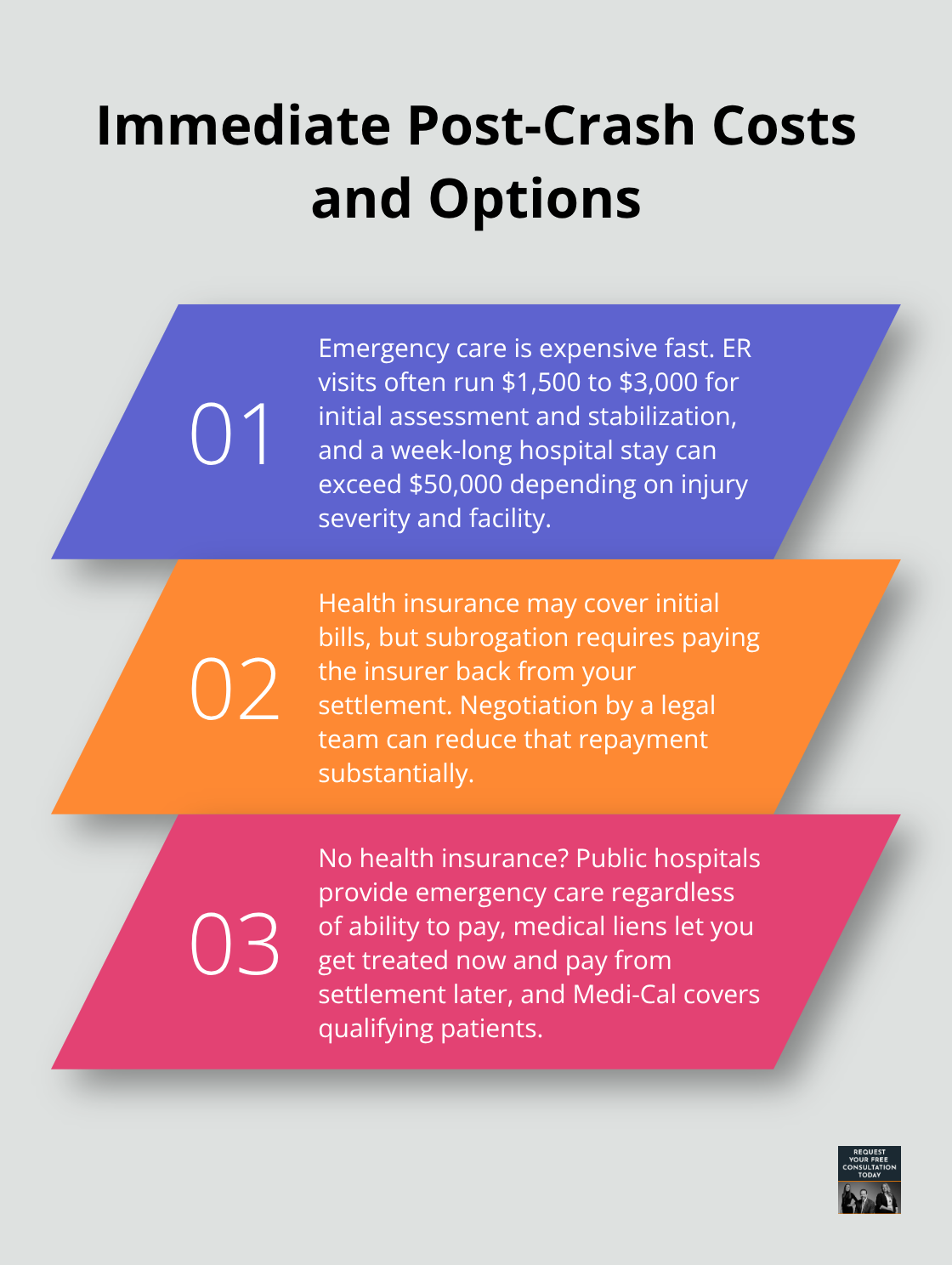
If you don’t have health insurance, you have options: Los Angeles County and other public hospitals offer emergency care regardless of ability to pay, medical liens allow doctors to treat you now and get paid from your settlement later, and Medi-Cal provides coverage for qualifying low-income patients. Seek medical attention immediately after a crash, even if you feel fine-early documentation directly links your injuries to the accident, which strengthens your ability to recover these costs later.
Physical Therapy and Ongoing Treatment
After the emergency phase, most accident victims face months of physical therapy and follow-up care. Physical therapy typically runs several thousand dollars over a treatment course lasting three to six months, with sessions costing $100 to $300 each depending on your location and the facility. Consistent documentation matters enormously-missing appointments or skipping follow-up care signals to insurers that your injuries weren’t serious, which they’ll use to lower settlement offers. Prescription medications for pain, inflammation, or other injury-related conditions add up quickly, and specialized imaging like MRI or CT scans cost $500 to $3,000 per scan. Mental health treatment is recoverable too if your accident caused psychological trauma, though many people skip this because they underestimate its financial value in settlements. The difference between settling your case at maximum medical improvement versus settling early can be tens of thousands of dollars, because early settlement offers don’t account for the full scope of treatment you’ll actually need.
Living With Long-Term Disability
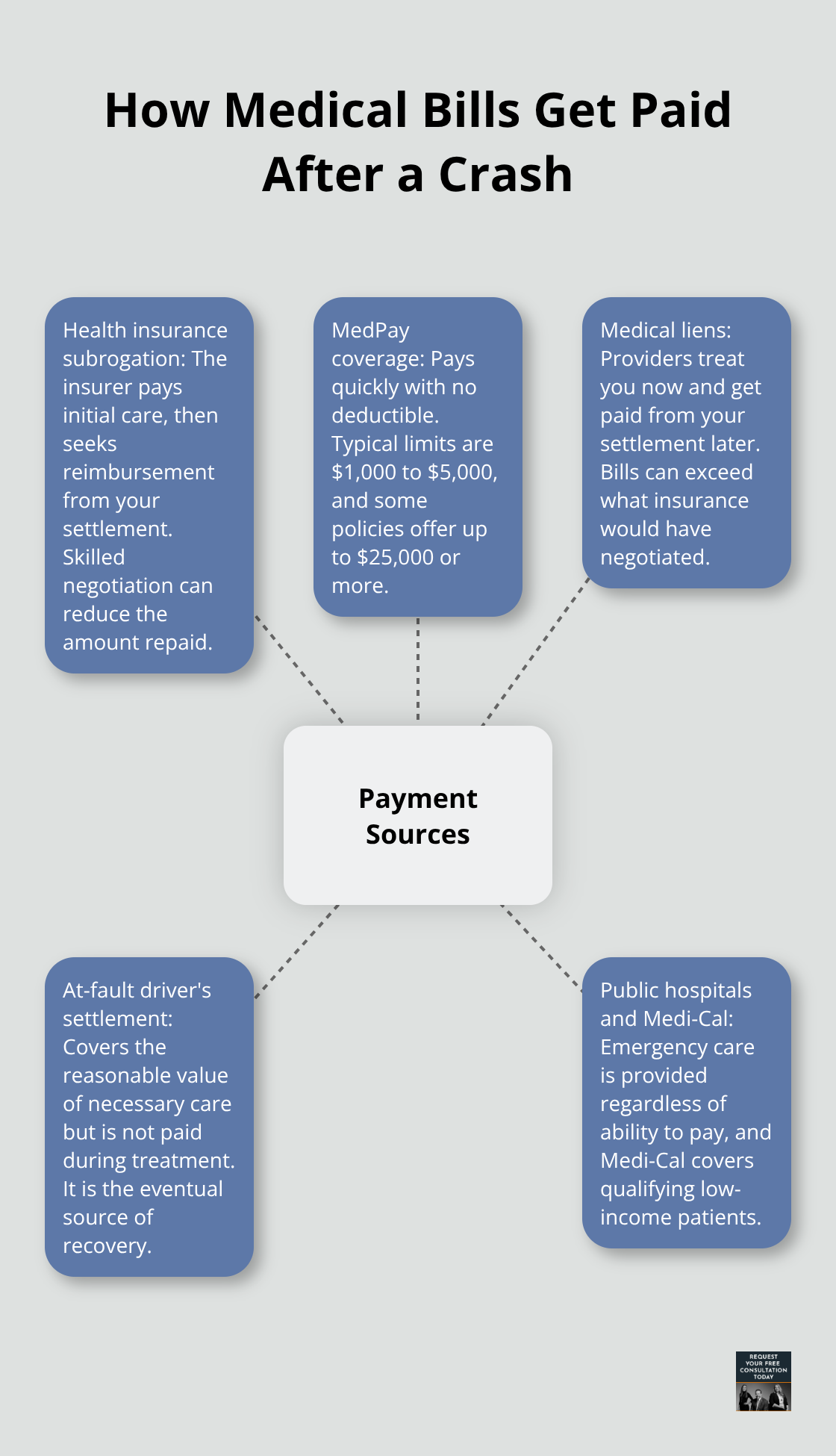
Brain and spinal cord injuries create costs that span decades or a lifetime. In-home nursing care, additional surgeries, ongoing rehabilitation, mobility equipment, and home modifications become permanent fixtures of your budget. The costs vary dramatically by location-24-hour in-home care in Oakland or Sacramento costs significantly more than in smaller communities. A life care plan is an itemized forecast of your future medical needs created by medical professionals and economists, and it transforms vague injury claims into concrete, defensible numbers. Without one, you’re essentially guessing at what you’ll need, and insurers will use that uncertainty to pay you far less than you actually deserve. The at-fault driver’s insurance won’t pay doctors upfront during your treatment-they wait until your claim settles because they want leverage to minimize what they owe. This means you need to understand all your payment options: health insurance subrogation, medical liens, MedPay coverage if you have it, and the eventual recovery from the at-fault driver’s settlement. Understanding these payment sources and how they interact with your long-term care needs sets the foundation for the financial planning strategies that protect your recovery.
How to Protect Your Medical Bills and Get Paid Back
Track Every Bill From Day One
Start tracking every medical bill the moment your accident happens. Create a single folder-physical or digital-and place every invoice, receipt, and explanation of benefits statement inside it. Hospitals and doctors bill aggressively after a crash, often within days, and bills arrive from multiple providers over weeks or months. Without centralized tracking, you’ll miss bills, forget amounts, and struggle to prove what you actually paid when settlement time comes.
Tax documents showing lost wages, receipts for over-the-counter medications, mileage logs for trips to treatment, and records of home modifications all count as recoverable expenses. Complete medical records strengthen your position when negotiating with insurers, and the more organized you are from day one, the stronger your case becomes.
Understand Your Coverage Options
Your health insurance company will demand repayment from your settlement through subrogation, which is their legal right, but a skilled legal team can negotiate those amounts down significantly. If you have Medical Payments coverage on your auto policy, it pays faster than health insurance and typically carries no deductible-common limits run $1,000 to $5,000 for basic coverage, though some policies offer enhanced coverage up to $25,000 or more.
Medical liens work differently: doctors treat you now, accept payment later from your settlement, and their bills can sometimes exceed what insurance would have negotiated. This is where having experienced counsel makes a tangible financial difference. An attorney familiar with California’s personal injury system can negotiate lien reductions that put thousands of dollars back in your pocket.
Navigate the At-Fault Driver’s Insurance
The at-fault driver’s insurance won’t pay your doctors during treatment because they’re using that leverage to minimize their final payout. This harsh reality means you must understand your coverage options and how they interact. If you lack health insurance, public hospitals in Sacramento and other counties provide emergency care regardless of ability to pay, medical liens give you access to ongoing care, and Medi-Cal covers qualifying patients.
California law allows you to recover the full value of reasonably necessary medical care, and a settlement structured correctly can cover past bills, reduce liens through negotiation, lower subrogation amounts, and still leave you with substantial net recovery.
Coordinate Your Recovery Strategy
Most people who try to handle these negotiations alone settle for far less than they deserve because they don’t understand how to reduce liens or challenge subrogation claims. The difference between settling without legal guidance and settling with it often exceeds the attorney’s fee, making representation financially beneficial rather than an added cost. When you work with a legal team experienced in personal injury cases, they connect you with lien-based providers, negotiate down amounts owed to insurers and lien holders, and ensure no bill falls through the cracks. This coordination transforms scattered medical expenses into a coherent financial strategy that protects your long-term recovery. Understanding how to structure your payment sources sets the stage for calculating the true value of your claim-a calculation that requires knowing not just what you’ve already paid, but what you’ll need to pay for years to come.
What Medical Expenses Will You Actually Face
Physical Therapy and Imaging Costs
Physical therapy dominates post-accident medical spending for most injury victims. Sessions typically cost $100 to $300 each, and a standard recovery course runs three to six months with two to three visits weekly, totaling $2,400 to $5,400 just for therapy. Imaging studies compound these costs immediately-an MRI runs $500 to $3,000, a CT scan $1,000 to $5,000, and X-rays $100 to $300 each.
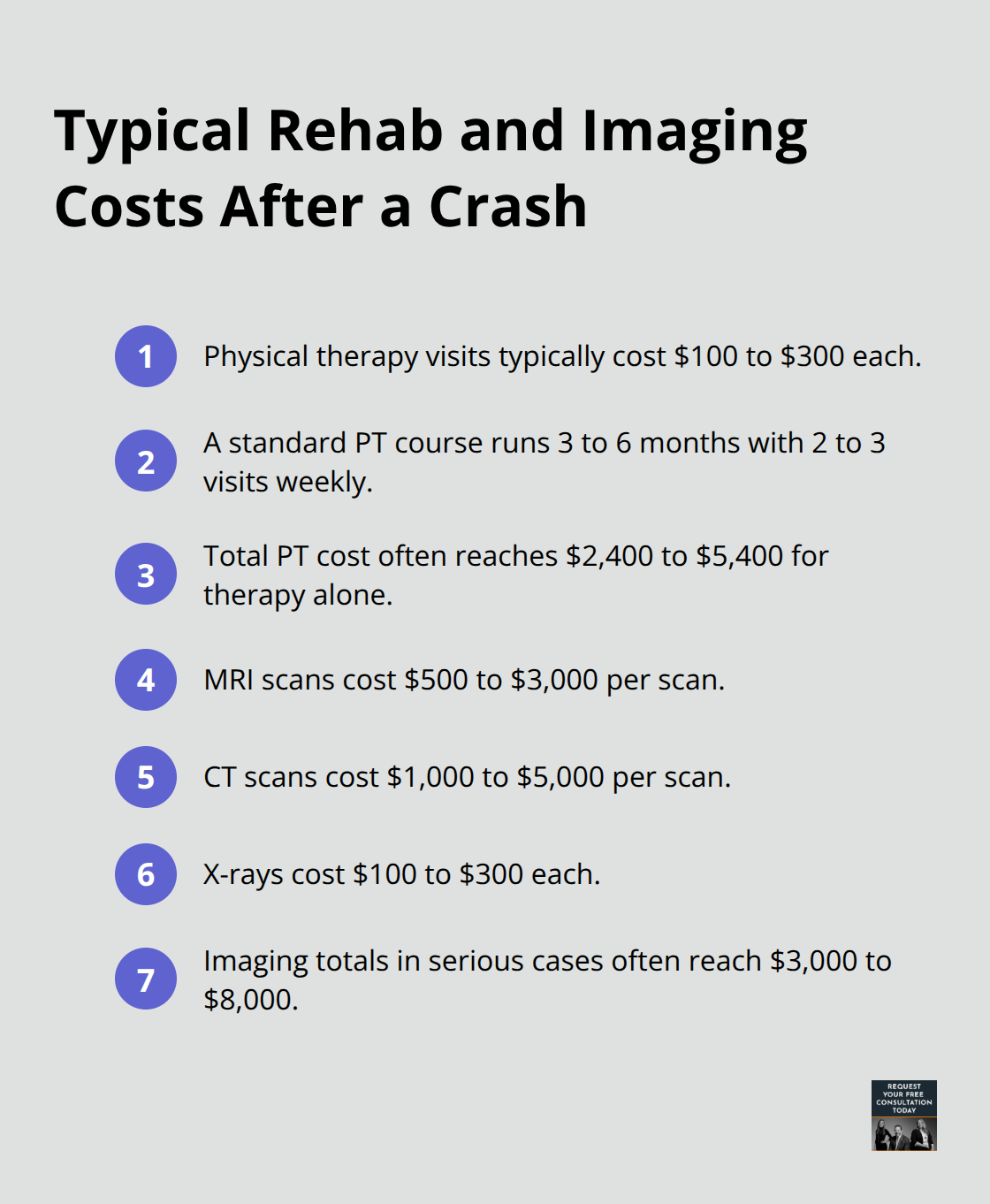
Many accident victims need multiple imaging rounds as injuries evolve, pushing imaging alone into the $3,000 to $8,000 range for serious injuries.
The critical mistake most people make is stopping physical therapy early to cut costs. Insurers scrutinize treatment consistency ruthlessly; gaps in your therapy schedule signal to adjusters that your injuries weren’t serious, giving them ammunition to slash settlement offers by thousands of dollars.
Medications and Pain Management
Prescription medications add another layer of expense-pain management, anti-inflammatory drugs, muscle relaxants, and medications for nerve damage can total $200 to $500 monthly over six months or longer, reaching $1,200 to $3,000 for a single injury claim. Many people underestimate medication costs because they focus only on the initial prescription without considering refills across multiple months of recovery.
Mental Health and Psychological Care
Mental health treatment remains the most undervalued component of accident claims, yet California law explicitly allows recovery for psychological trauma caused by collisions. Therapy sessions cost $100 to $250 each, and accident-related anxiety, PTSD, or depression often requires 20 to 40 sessions minimum, totaling $2,000 to $10,000 in legitimate mental health expenses. The problem is straightforward: people skip mental health treatment because they think it won’t affect their settlement, then they miss out on thousands in recoverable costs.
Home Modifications and Medical Equipment
Home modifications and medical equipment represent another substantial category that gets overlooked. Mobility aids like walkers or wheelchairs cost $500 to $3,000, grab bars and bathroom modifications run $1,000 to $5,000, and ramps or accessibility upgrades can exceed $10,000 for serious injuries. These aren’t optional luxuries-they’re medically necessary equipment that directly supports your recovery and long-term function.
Tracking All Expenses From Day One
When you coordinate your medical response to an accident, you must track every single expense from day one, including over-the-counter pain medication, compression sleeves, and transportation costs to appointments. The legal team at Schaar & Silva LLP helps clients in Santa Cruz County identify all recoverable medical categories, ensuring nothing slips through the cracks when settlement negotiations begin.
Final Thoughts
Your immediate medical bills arrive within days, but your future medical costs unfold over months or years. Physical therapy, imaging, medications, mental health treatment, and home modifications add up to thousands of dollars that most people underestimate. Without a clear plan, you’ll miss recoverable expenses, accept low settlement offers, and struggle to pay for care you actually need.
Start by tracking every medical bill, receipt, and explanation of benefits statement in one organized location. Understand how your health insurance, Medical Payments coverage, and medical liens interact with your settlement. Know that the at-fault driver’s insurance won’t pay your doctors upfront, so you need to navigate your own coverage options strategically.
The team at Schaar & Silva LLP helps accident victims in Santa Cruz County, Sacramento, and Oakland understand their true claim value and recover what they deserve. We direct you to medical lien services, evaluate your coverage options, and negotiate down amounts owed to insurers and lien holders. Contact us to discuss your specific situation and learn how much your claim is actually worth.
