
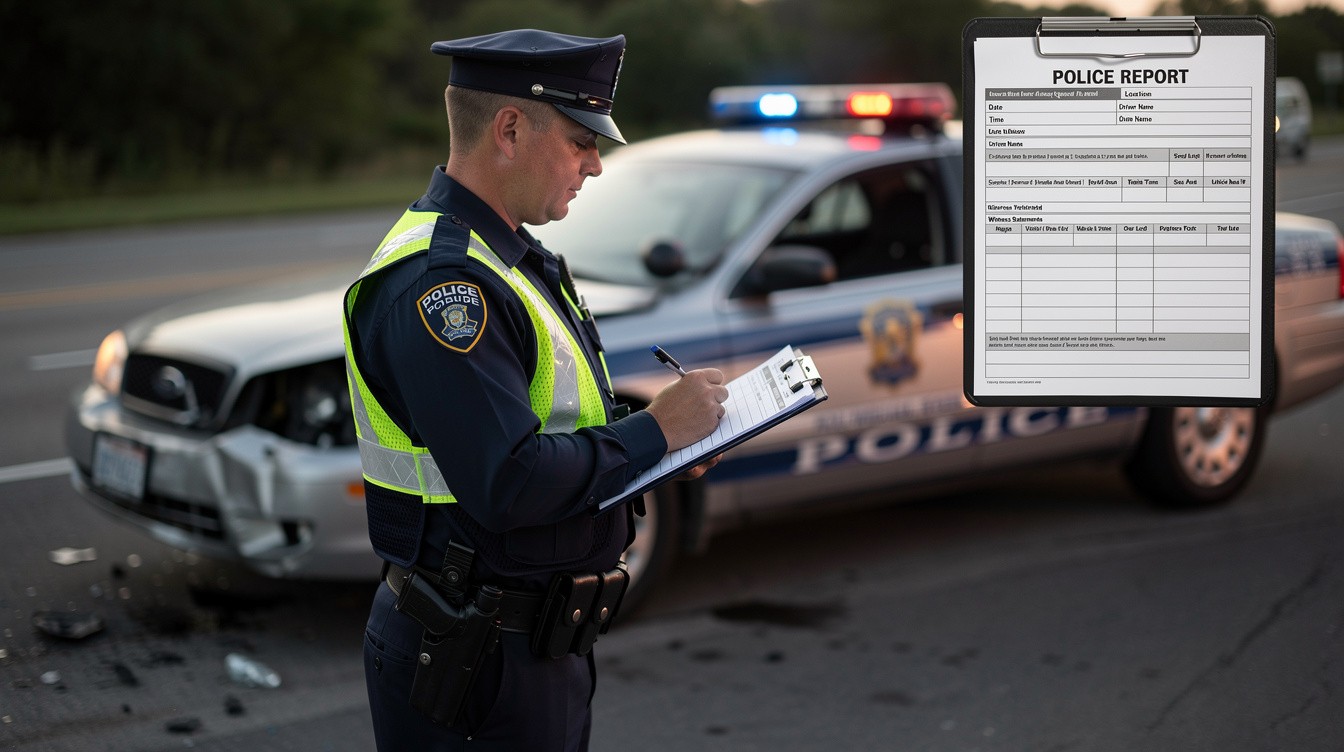
After a car accident, a police report becomes one of your most valuable documents. It contains the officer’s observations, witness statements, and details about what happened at the scene.
Understanding how to obtain this report and why it matters can make a real difference in your personal injury claim. We at Schaar & Silva LLP help accident victims in Santa Cruz County, Sacramento, and Oakland navigate this process and build stronger cases.
What a Police Report Actually Contains
The Officer’s Scene Documentation
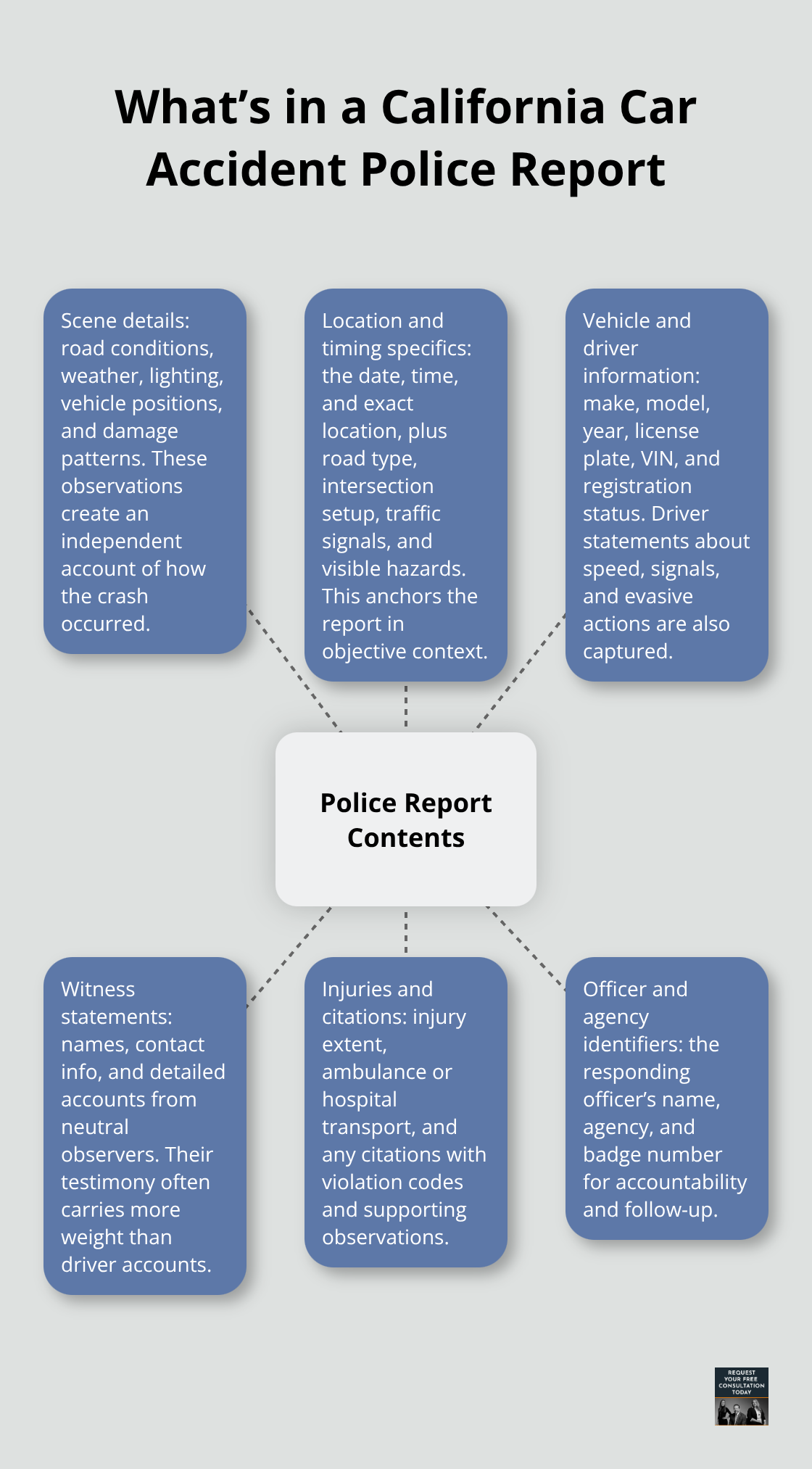
A police report documents the officer’s firsthand observations from the accident scene, including road conditions, weather, lighting, vehicle positions, and damage patterns. The officer records the date, time, and exact location of the crash, along with details about the road type, intersection configuration, traffic signals, and any visible hazards. This information becomes critical because it creates an independent account of how the accident occurred, separate from what either driver claims happened.
The officer assesses factors like suspected speeding, traffic violations, or impaired driving, which directly impact liability determinations. Vehicle details are logged systematically: make, model, year, license plate, VIN, and registration status. The officer also documents any citations issued at the scene, such as tickets for running a red light or unsafe speed for conditions.
Witness Statements and Driver Accounts
Witness statements form another essential component of the police report. The officer records names, contact information, and detailed accounts from anyone who saw the accident unfold. Witness testimony often carries more weight than driver statements because witnesses have no financial stake in the outcome.
The report captures statements from both drivers about how the collision occurred, their speeds, traffic signal compliance, and any evasive actions they took. Vehicle damage documentation includes descriptions of impact points, broken glass, skid marks, and the severity of structural damage to each vehicle involved.
Injury Documentation and Citations
Citations issued at the scene appear on the report with violation codes and officer observations supporting those citations. If injuries occurred, the report documents the extent of injuries, whether ambulance transport happened, and hospital transport details. For theft cases, the report notes whether the vehicle was broken into, what items were taken, the last-seen location, and owner details.
The responding officer’s name, agency, and badge number appear on the report for accountability purposes. This official documentation becomes the foundation for establishing fault because it represents an impartial investigation conducted immediately after the accident, before memories fade or stories shift. Understanding what information the officer captured at the scene helps you prepare for the next critical step: actually obtaining your copy of that report.
How to Obtain Your Police Report After a Car Accident
Timeline for Report Availability
In California, obtaining your police report follows a predictable timeline, though the exact window depends on your jurisdiction. If your crash occurred in Oakland, you’ll wait 60 to 90 days before the Oakland Police Department makes the report available for purchase through their Police Reports Portal. Other jurisdictions in Santa Cruz County or Sacramento typically follow similar timelines, though some departments process requests faster. Contact your local police department’s records division directly to confirm when your specific report will be ready, as availability windows vary by agency.
Purchasing Your Report Online and In Person
The Oakland Police Department charges $30 total for online purchases (including a $5 convenience fee) through their Police Reports Portal. You’ll need to specify the report number or provide the date, location, and names of involved parties. For in-person purchases at the Eastmont Substation Traffic Investigations Unit in Oakland (2651 73rd Avenue), the fee drops to $25, and staff assist Monday through Thursday from 8:00 a.m. to 2:30 p.m. Bring a valid government-issued photo ID and either the report number or the date and names of involved parties. Payment options include cash, Visa, Mastercard, money order, or check.
Other jurisdictions in Santa Cruz County or Sacramento typically charge under $10 to $30 for reports. Many departments maintain online incident report databases where you can search by VIN, case number, driver’s license, or involved parties’ names without visiting in person.
Additional Documentation and Materials
If you need body camera footage, surveillance video, or scene photos related to your accident, the Oakland Police Department charges $25 for each item. Third parties requesting a report must provide written authorization from an involved party or a death certificate if applicable. Fatal traffic collision reports cannot be purchased online; you must obtain them in person or by mail from the responding agency. For mail requests, include a self-addressed, stamped, trackable return envelope with your identifying information and payment according to the department’s instructions.
Securing and Using Your Report
Once you receive your report, download and store it in multiple secure locations immediately. The police report itself is not automatically a public record in California, so you may need to show identification to access your own report. Attach a copy to your insurance claim to speed up processing and prevent delays in your case.
Insurers treat police reports as objective evidence that clarifies fault at intersections, resolves disputes about traffic signal compliance or speeding, and substantiates the value of stolen items in theft claims. This document transforms your claim significantly because it provides an independent account of what happened. With your police report in hand, the next critical step involves understanding how this evidence strengthens your personal injury claim and what additional documentation you’ll need to build your case.
How a Police Report Strengthens Your Injury Claim
Your police report transforms how insurers and courts view your accident because it contains an independent officer’s assessment made within hours of the collision, before details blur or disputes harden. Insurance companies rely heavily on police reports to determine fault because the officer had no financial interest in the outcome and documented observations systematically at the scene.
How Officers Document Fault
When an officer notes that the other driver ran a red light or exceeded safe speed for conditions, that documentation shifts leverage in your favor during settlement negotiations. Insurers know that contradicting an official police report requires substantial counter-evidence, which is costly and time-consuming for them to develop. This reality means your police report often becomes the deciding factor in whether your claim settles quickly or stalls indefinitely. Without one, insurers frequently demand additional investigation, which delays payouts and forces you to provide alternative evidence that may be weaker than what an officer documented.
Brain and Spinal Injuries: Why the Report Matters
Crashes cause approximately 1.7 million traumatic brain injuries annually in the U.S., according to the CDC. In California personal injury cases, brain injuries from car accidents commonly settle between $250,000 and $750,000 for moderate cases, with severe cases reaching $1 million or higher depending on liability strength and medical documentation. Your police report establishes the foundation for these valuations because it clarifies whether the other driver’s negligence caused your injuries.
The report matters for brain and spinal injuries specifically because these conditions are often invisible on initial inspection, yet the police documentation of impact severity and vehicle damage helps medical professionals later establish the force involved and injury likelihood.
Comparative Fault and Your Recovery
Insurance companies use police reports to verify liability percentages under California’s pure comparative fault rule, which reduces your recovery only by your own percentage of fault. If the police report assigns primary fault to the other driver, your recovery remains largely intact even if you bear minor responsibility. Conversely, a report that identifies shared fault complicates settlement calculations significantly.
Wrongful Death and Police Documentation
For wrongful death cases in Santa Cruz County, Sacramento, and Oakland, the police report becomes even more critical because it establishes the circumstances that led to the fatality, which insurers use to evaluate both liability and damages. When you file your claim, attach your police report immediately to demonstrate that an official investigation supports your account of what happened. This documentation prevents insurers from dismissing your claim as one person’s word against another’s and signals that you have concrete evidence supporting your position. If you sustained serious injuries or lost a loved one in your accident, obtaining your police report quickly and presenting it strategically within your claim is non-negotiable for maximizing your recovery.
Final Thoughts
Your car accident police report transforms your claim from a dispute between two drivers into an official investigation backed by law enforcement authority. This document clarifies fault, documents injuries and damage, and provides the foundation that insurers need to settle your case fairly. Without it, you’re asking insurance companies to take your word against the other driver’s, which rarely leads to maximum recovery.
The practical steps are straightforward: wait for your report to become available through your local police department, obtain it within 60 to 90 days in most California jurisdictions, and attach it to your insurance claim immediately. The small fee you pay to access this document pays for itself many times over because it accelerates settlement timelines and prevents insurers from requesting additional investigation that delays your recovery. If you sustained a brain injury, spinal injury, or lost a loved one in your accident, your car accident police report becomes even more critical because it establishes the impact severity and negligence that led to those serious consequences.
California’s pure comparative fault rule means that a strong police report protecting your liability position directly increases your settlement value, whether your case involves moderate injuries settling in the $250,000 to $750,000 range or catastrophic injuries reaching into the millions. We at Schaar & Silva LLP help accident victims in Santa Cruz County, Sacramento, and Oakland navigate this entire process and maximize your recovery. Contact us today to discuss how we can guide you through every step of your claim.
