

Truck accidents in California leave victims facing overwhelming medical bills, lost income, and life-altering injuries. The path to fair compensation requires understanding California truck litigation and your legal rights.
At Schaar & Silva LLP, we guide accident victims through every step of the claims process. This guide covers what you need to know about liability, damages, and pursuing your case.
What Causes Truck Crashes and Who Bears Responsibility
Driver and Operational Failures
Truck crashes in California stem from preventable failures across multiple parties. Driver fatigue stands as the leading cause, with federal regulations limiting interstate drivers to 11 hours of driving within a 14-hour window, yet violations occur routinely on I-5 and Highway 99. California intrastate drivers face different rules-they can drive up to 12 hours after 10 consecutive hours off-duty within a 16-hour period-creating additional complexity in determining violations. Speeding dramatically amplifies crash severity due to the truck’s extended stopping distance. Distracted driving and substance use impair judgment and reaction times, compounding mechanical failures.
Mechanical and Cargo-Related Negligence
Maintenance failures including brake degradation, tire blowouts, and steering problems represent systemic negligence when carriers ignore basic safety protocols. Overloaded or improperly secured cargo increases rollover risk and reduces braking effectiveness, often reflecting loader negligence rather than driver error alone. Inadequate training leaves drivers unprepared for emergency handling and unsafe cargo management. The California Highway Patrol’s Basic Inspection of Terminals program identifies carriers with unsatisfactory safety ratings and missing maintenance records, signaling which companies operate recklessly.
Multiple Parties and Liability Exposure
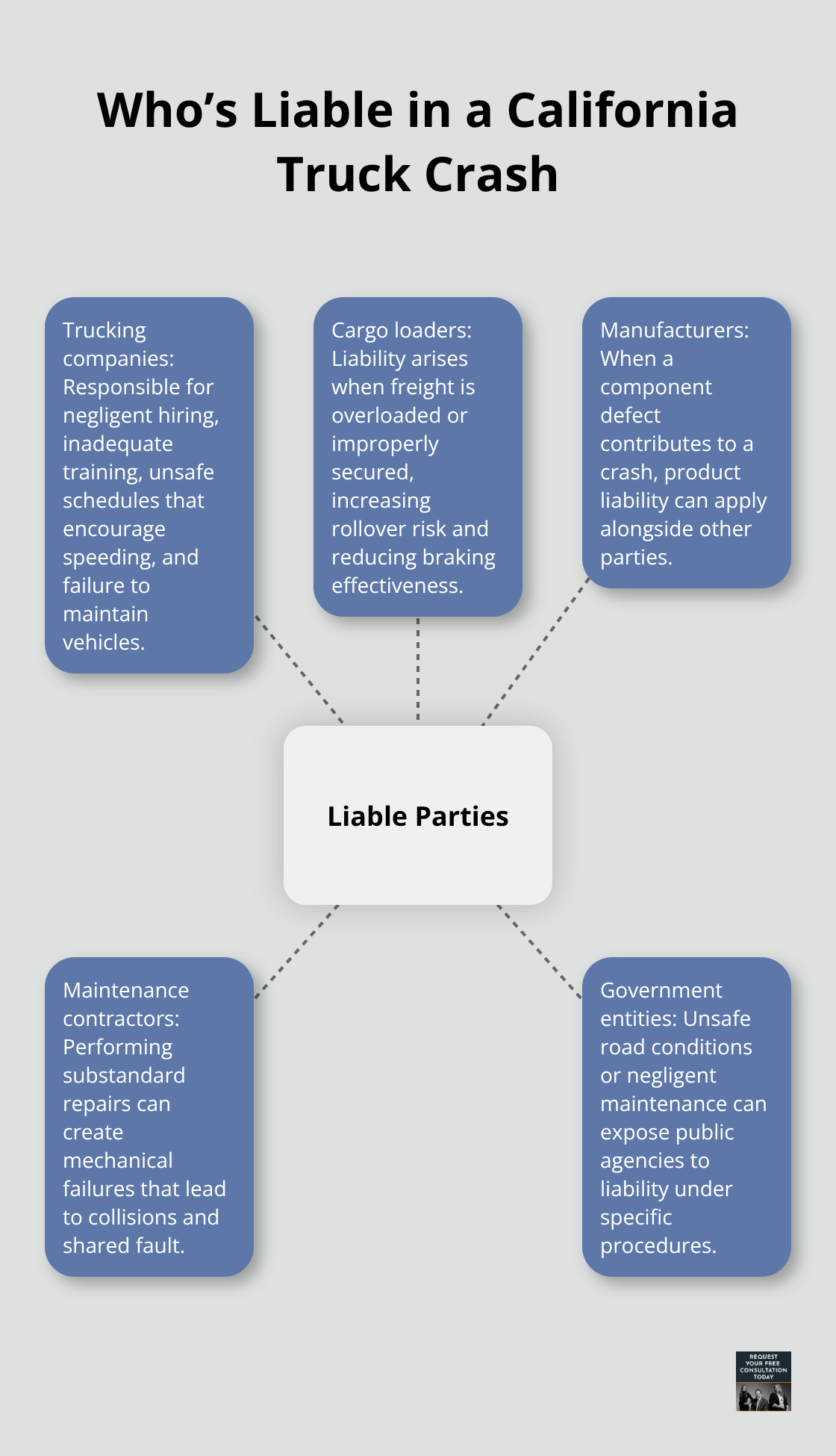
Liability extends far beyond the driver. Trucking companies face responsibility for negligent hiring, inadequate training, unrealistic delivery schedules that encourage speeding, and failure to maintain vehicles. Cargo loaders who improperly secure freight, vehicle manufacturers when defects contribute to crashes, maintenance contractors who perform substandard repairs, and even government entities responsible for road conditions can all be held liable. Federal law requires minimum financial responsibility of $750,000 for general freight and up to $5 million for hazardous materials carriers, establishing baseline coverage.
Evidence Preservation and Damages
California permits punitive damages when evidence shows conscious disregard for safety, meaning settlements often extend beyond medical costs when companies knowingly tolerate dangerous conditions. Electronic control module data and electronic logging device records reveal speed, braking patterns, and driver behavior, making evidence preservation critical within 30 days before data overwrites. Identifying every potentially liable party maximizes available insurance coverage and strengthens your claim significantly. Understanding which parties bear responsibility determines how much compensation you can recover and what evidence you need to gather.
What Compensation Can You Recover After a Truck Accident
Medical Expenses and Lifetime Care Costs
Truck accident victims in California face staggering costs that extend far beyond the initial medical visit. Medical treatment for severe injuries like spinal cord damage, traumatic brain injury, or amputation requires years of ongoing care, rehabilitation, and adaptive equipment. A victim with a spinal injury might need surgery costing $300,000 to $1 million, followed by lifetime physical therapy, home modifications, and specialized medical equipment. Life care planners project future treatment costs by analyzing your injuries and expected lifespan, while medical experts testify about causation and treatment necessity. These calculations transform your claim from a simple bill reimbursement into a comprehensive financial recovery plan.
Lost Wages and Earning Capacity
Lost wages compound the financial crisis immediately. If you earn $60,000 annually and miss six months of work, that represents $30,000 in lost income before your case settles. Courts in California recognize that your claim must account for future earning losses too. When a truck accident permanently reduces your work capacity, a forensic economist calculates what you would have earned over your remaining career. A 35-year-old earning $50,000 yearly who becomes unable to work faces potential lost earning capacity claims exceeding $1 million over 30 years.
Pain and Suffering and Punitive Damages
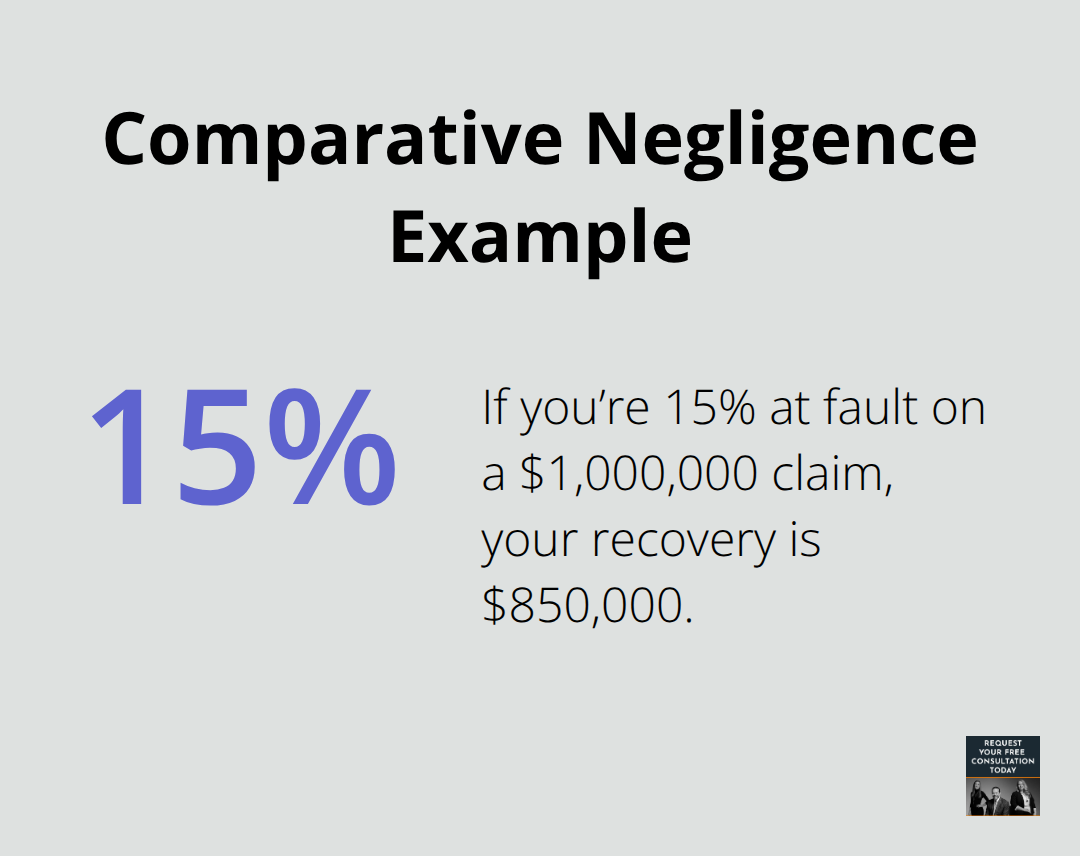
Pain and suffering damages compensate for physical pain, emotional trauma, and diminished quality of life-these are separate from medical bills and lost wages. California applies pure comparative negligence, meaning you can recover even if partially at fault; if you’re 15% responsible for a $1 million claim, you receive $850,000.
When trucking companies show conscious disregard for safety (such as knowingly violating federal hours-of-service rules or ignoring maintenance failures), California permits punitive damages on top of compensatory damages, potentially doubling or tripling your recovery.
Building Your Damages Documentation
Gathering evidence for damages claims demands immediate action. Obtain copies of all medical records, bills, and treatment plans from hospitals and clinics; these establish both past expenses and projected future costs. Document your lost wages through pay stubs, tax returns, and employer statements showing your typical earnings and time away from work. Photograph your injuries, mobility limitations, and any home modifications required for accessibility. Request detailed medical imaging reports, surgical records, and rehabilitation progress notes that quantify your condition’s severity. Insurance companies and defense attorneys scrutinize every damage category, so comprehensive documentation strengthens your position in settlement negotiations.
Settlement Strategy and Insurance Coverage
Settlement values in truck cases typically exceed those in standard auto accidents because federal law requires carriers to maintain $750,000 minimum insurance for general freight and up to $5 million for hazardous materials-these higher policy limits mean more funds available for your recovery. Delaying settlement until medical treatment concludes prevents undervaluing your claim; accepting a quick offer before completing rehabilitation often results in inadequate compensation for lifetime care needs. At Schaar & Silva LLP, we connect victims with medical lien services that facilitate bill payment until your case resolves, eliminating the pressure to settle prematurely before your full injury picture emerges. We also assist in evaluating property damage and ensuring fair valuation for vehicle loss.
Understanding how California courts calculate damages and what evidence strengthens your position sets the foundation for pursuing fair compensation. The legal process itself-from filing your claim to negotiating settlements-follows specific timelines and procedures that protect your rights.
How California’s Statute of Limitations Affects Your Truck Accident Claim
Understanding the Two-Year Filing Deadline
California’s two-year statute of limitations for personal injury claims starts on the accident date, not when you discover your injuries. This tight deadline means you must file your claim within 24 months for private-party truck crashes. The clock does not pause while you recover or gather evidence, making immediate action essential. If the truck belongs to a government entity like the California Highway Patrol, the timeline shrinks to six months for personal injury claims under California Government Code Section 911.2.
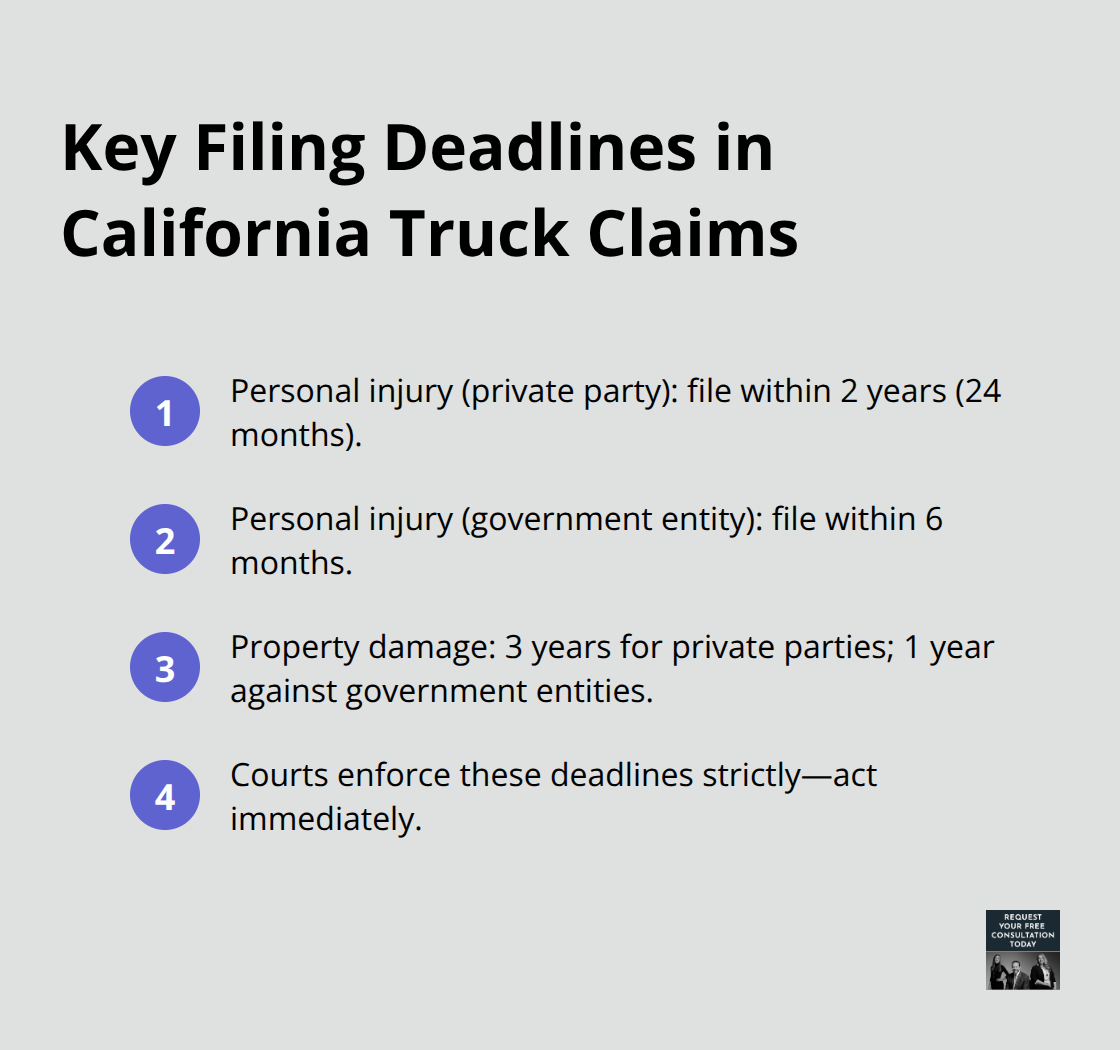
Property damage claims follow a three-year window for private parties but only one year against government entities. Courts interpret these deadlines strictly, so waiting to understand your injuries fully before filing creates substantial legal risk.
Tolling Rules and Limited Exceptions
Tolling rules can pause the clock in narrow situations. If you were a minor at the crash date, the deadline extends until you turn 18. If you lacked mental capacity to understand your rights, tolling may apply. If the defendant was imprisoned or out of state, the clock may pause. Courts apply these exceptions conservatively, so relying on them without legal guidance proves risky. We at Schaar & Silva LLP recommend filing your claim immediately rather than betting on tolling protections. Early filing protects your legal rights while you complete medical treatment and gather evidence.
Preserving Electronic and Physical Evidence
Electronic control module data overwrites after approximately 30 days unless you preserve it through a spoliation letter sent within 24 to 72 hours of the crash. You must preserve electronic logging device records, dashcam footage, GPS telemetry, and maintenance logs before they disappear. Request the police report from the California Highway Patrol within days of the crash; CHP reports document scene conditions, witness statements, and initial fault assessments. Obtain driver logs and vehicle maintenance records from the trucking company immediately, as carriers sometimes destroy records after standard retention periods.
Completing Medical Documentation Before Settlement
Medical records must be complete before settlement discussions begin. Finalize treatment plans before accepting any offer, as accepting early settlements often undervalues claims for lifetime care needs. Settlement negotiations typically take three to six months once evidence collection concludes, though complex cases with multiple liable parties extend timelines to 12 months or longer. If settlement stalls, trial preparation begins with depositions of the truck driver, company safety personnel, and maintenance contractors, followed by expert testimony on accident reconstruction and damages.
Managing Financial Pressure During the Claims Process
Medical lien services manage bill payments during your case, eliminating pressure to settle before your claim matures. These services allow hospitals and treatment providers to wait for payment until your case resolves, protecting you from debt collection while pursuing fair compensation. This financial flexibility proves critical in truck cases, where full injury assessment often requires months of ongoing treatment and rehabilitation before you understand your true damages.
Final Thoughts
Truck accidents in California demand immediate action because federal regulations govern driver hours, vehicle maintenance, and cargo handling, yet violations remain common on California roads. Electronic control module data overwrites within 30 days unless you preserve it through a spoliation letter, witness statements fade from memory, and maintenance records disappear-the first 72 hours after a crash determine whether you secure the evidence that proves fault. Understanding liability across multiple parties (drivers, trucking companies, cargo loaders, manufacturers, and maintenance contractors) determines how much compensation you recover, and California’s two-year statute of limitations creates urgency that waiting eliminates.
California truck litigation involves complex federal and state regulations that most accident victims cannot navigate alone, and insurance companies employ adjusters trained to minimize payouts while defense attorneys challenge every damage category. Medical expenses for severe injuries like spinal cord damage or traumatic brain injury often exceed $1 million when lifetime care is factored in, and punitive damages become available when companies show conscious disregard for safety, potentially doubling your recovery when negligence is egregious. Medical lien services manage your bills during the claims process, eliminating pressure to settle prematurely before your injuries fully manifest.
We at Schaar & Silva LLP guide victims through evidence preservation, liability investigation, and settlement negotiations while you focus on recovery. Contact us today for a free consultation and let our team handle the legal complexities of your case. We serve Santa Cruz County, Sacramento, and Oakland with 24/7 support and offices throughout Northern California.
