
After a car accident in California, you have a limited window to file a personal injury claim. Missing the deadline means losing your right to compensation entirely, no matter how strong your case is.
At Schaar & Silva LLP, we see people lose valid claims every year because they waited too long. The California statute of limitations for auto accidents is strict, and understanding these time limits can protect your rights.
How Much Time Do You Have to Sue After a Car Accident
In California, the statute of limitations for auto accidents creates a hard deadline that determines whether your claim lives or dies. According to the Judicial Council of California, you have exactly two years from the date of the accident to file a personal injury lawsuit. This is not a suggestion or a guideline-it is a firm legal boundary. If you miss this deadline, courts will reject your case, and you lose the right to recover compensation, regardless of how serious your injuries are or how clear the other driver’s fault may be.
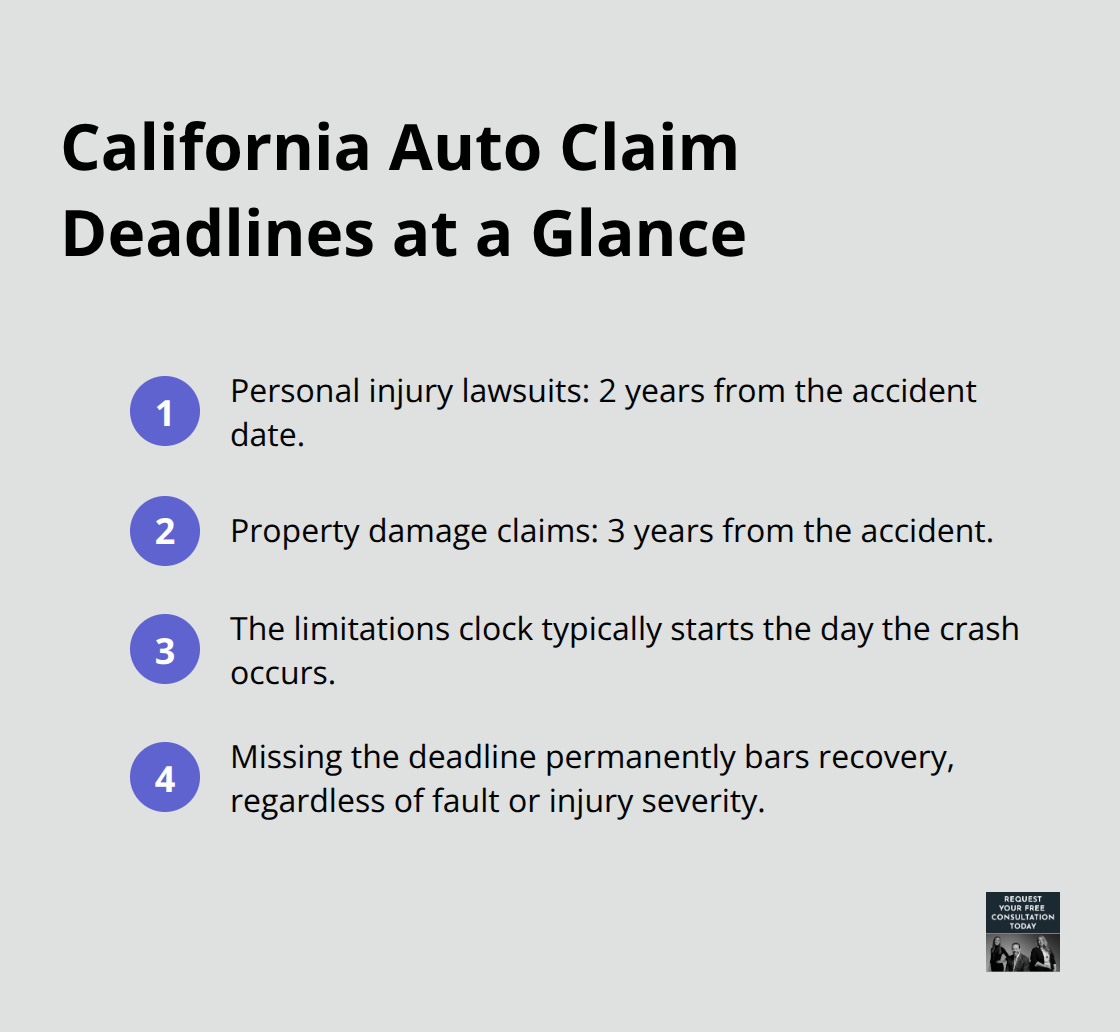
Property damage claims follow a different timeline. You have three years to file a claim for vehicle damage or other property losses resulting from the accident. This longer window exists because property damage is generally easier to document and evaluate than personal injury claims. However, the two-year limit for personal injuries is what matters most in serious accident cases, and that is where most people run into trouble.
When the Clock Actually Starts
The statute of limitations clock starts on the date the accident occurred, not when you discover your injuries or receive medical treatment. If a car hits you on March 15, your two-year countdown begins that same day. This matters tremendously because many people do not realize how quickly time passes after an accident. You may spend months recovering, dealing with insurance companies, or gathering medical records, and suddenly a year has gone by with no lawsuit filed.
Delayed Injuries and the Discovery Rule
Some injuries do not appear immediately. You might feel fine for weeks after an accident, then develop chronic pain, headaches, or neurological issues. Even in these delayed-discovery situations, California law generally does not extend the two-year deadline for personal injuries. The discovery rule-which pauses the clock when injuries are not immediately apparent-applies in narrow circumstances, primarily medical malpractice cases, not typical auto accidents.
Why Speed Matters for Your Case
The sooner you contact a lawyer and begin documenting your case, the more time you have to build a strong claim without racing against the calendar. Insurance companies know these deadlines exist, and they count on delays to weaken your position. Waiting too long can also result in insufficient documentation and other issues that undermine your claim. The next section examines what happens when you miss the deadline and how it affects your ability to recover damages.
When the Statute of Limitations Clock Pauses or Extends
The two-year deadline is firm, but California law recognizes specific situations where the clock stops running. These exceptions exist because fairness demands that people in certain circumstances should not lose their rights simply because time passed. Understanding when tolling applies can mean the difference between a valid claim and a permanently barred one.
Defendant Absence from California
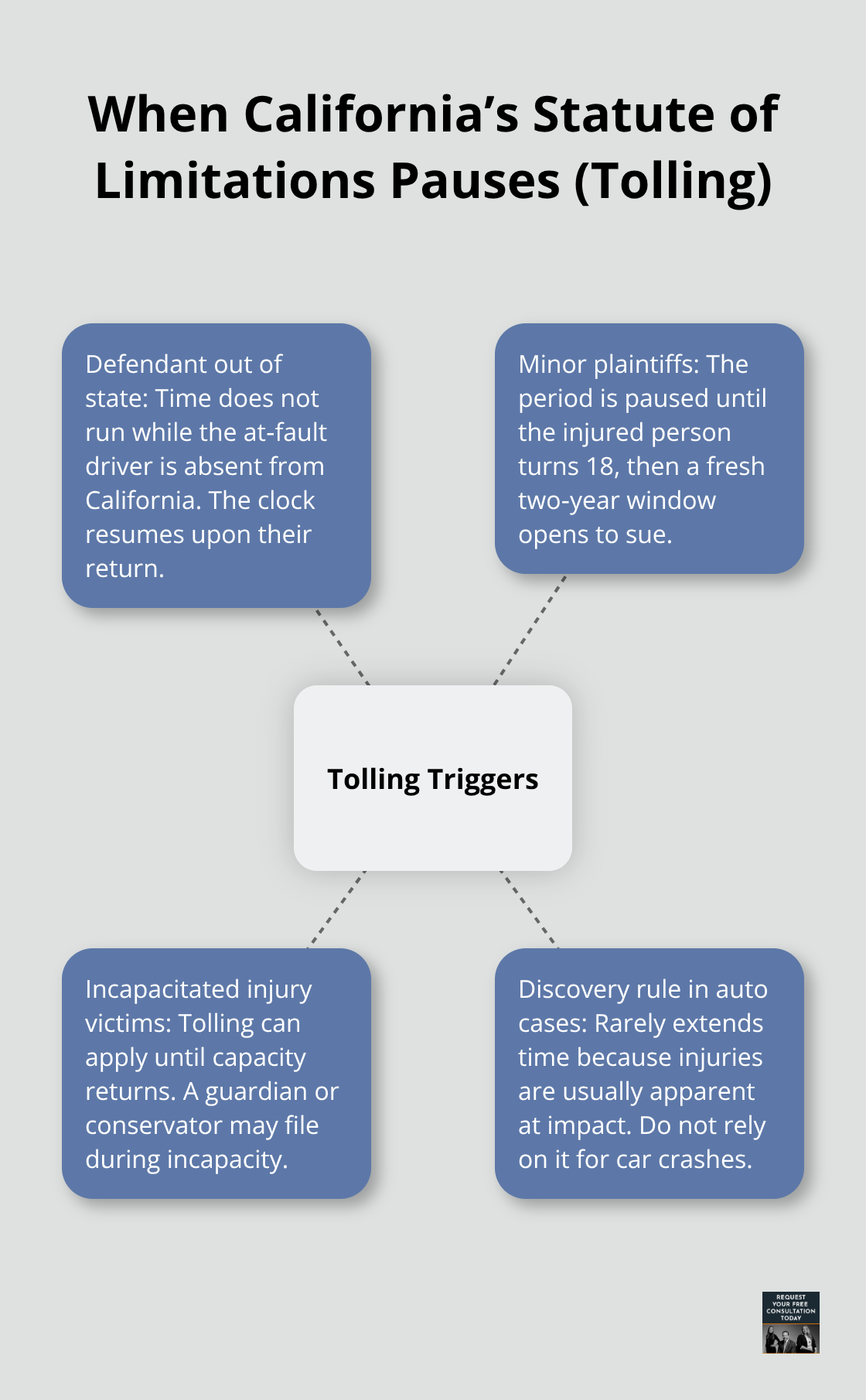
If the defendant leaves California, the statute of limitations pauses while they are out of state. According to California Code of Civil Procedure Section 351, time does not run against a defendant who is absent from the state. This tolling continues until the defendant returns to California. For example, if someone hits your car and then moves to Nevada six months after the accident, your two-year clock stops. Once they return to California, the clock resumes from where it left off. This rule protects your right to sue even when the at-fault party tries to avoid accountability by leaving the state.
Minors Receive Automatic Protection
If you were a minor when the accident occurred, the statute of limitations does not begin until you turn 18. California law pauses the entire countdown during your minority. Once you reach your 18th birthday, a fresh two-year window opens for you to file a lawsuit. This means a minor injured at age 16 in a car accident has until age 20 to file a personal injury claim. The Judicial Council of California recognizes this tolling because minors cannot legally represent themselves in court proceedings.
Incapacitated Persons and Legal Guardians
If you are incapacitated due to a serious brain or spinal injury, tolling may also apply until you regain the mental capacity to participate in litigation. A guardian or conservator can file suit on your behalf during the incapacity period, which helps preserve your right to recover damages. This protection ensures that catastrophic injuries do not strip away your ability to seek compensation simply because you cannot manage the legal process yourself.
The Discovery Rule Rarely Applies to Auto Accidents
The discovery rule, which allows the statute of limitations to start when an injury is discovered rather than when the accident occurred, rarely applies to car accidents. This rule primarily benefits medical malpractice victims where injuries are hidden or not reasonably discoverable. In auto accident cases, courts expect you to know you were injured at the moment of impact. Even if pain or symptoms develop later, the clock started on the accident date. This is why acting immediately after an accident matters so much-the sooner you document injuries and seek medical attention, the clearer your case becomes as time passes. Understanding these tolling rules helps you protect your claim, but the real challenge lies in gathering evidence and building a strong case before the deadline arrives.
Why Speed Matters for Your Case
Evidence Disappears Quickly After Accidents
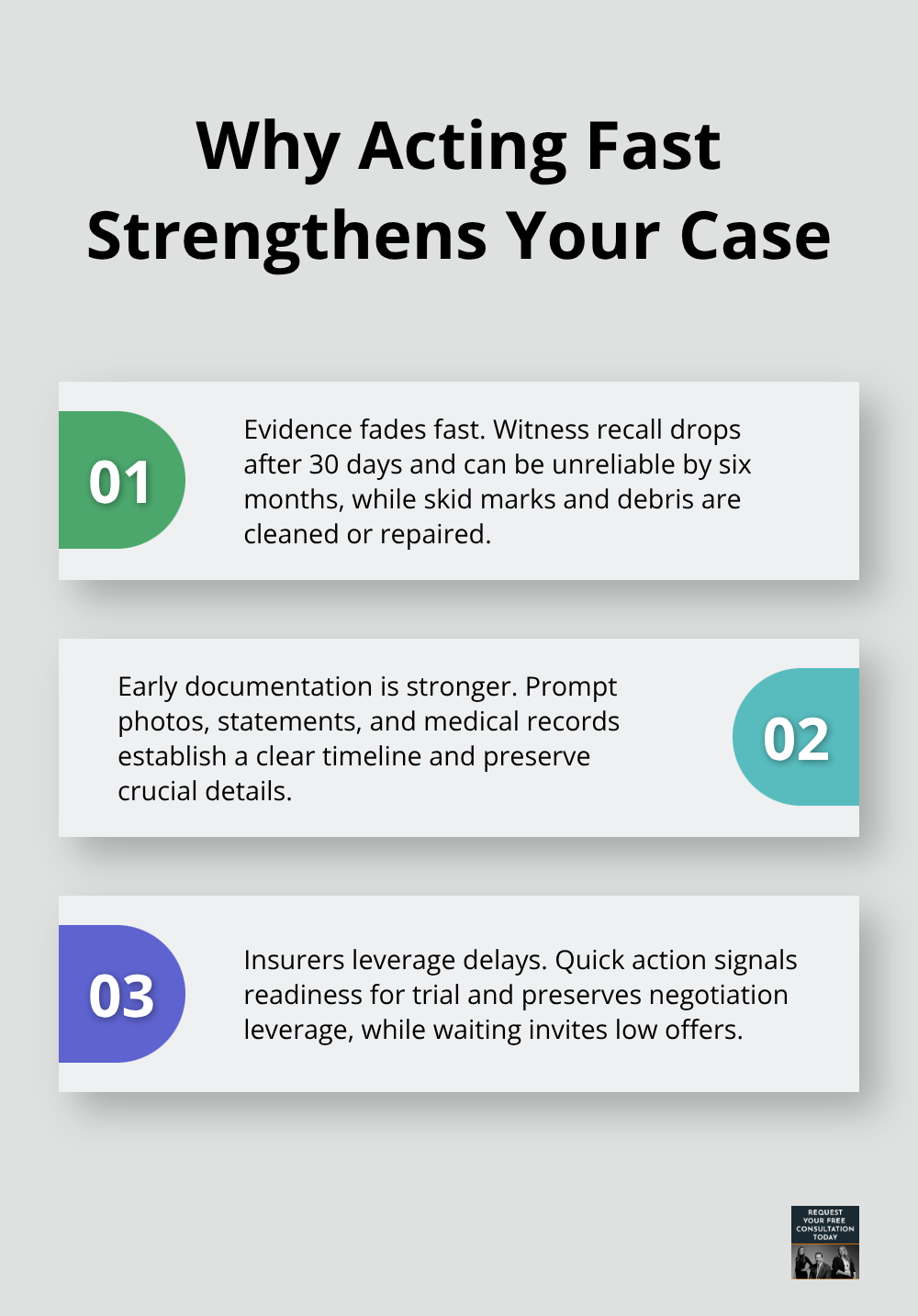
Evidence vanishes rapidly after car accidents. Witness memories fade within weeks, not months. Studies show that witness recall accuracy drops significantly after 30 days, and by six months, details become unreliable or forgotten entirely. Physical evidence like skid marks, debris, and vehicle damage gets cleaned up or repaired. Insurance companies document accident scenes immediately, but if you wait months to hire a lawyer, those photographs and measurements may no longer be available. Police reports contain critical details that officers recorded while facts were fresh, yet requesting these reports takes time. Medical records must be gathered from hospitals, clinics, and specialists, and delays make it harder to connect injuries directly to the accident. The longer you wait, the more evidence vanishes or becomes difficult to obtain.
How Delays Weaken Your Documentation
A case filed within months has substantially more documentation than one filed near the two-year deadline. Missing medical records, incomplete witness statements, and faded accident scene details all undermine your position. When you file a claim quickly and hire an attorney early, you preserve the strongest possible evidence. Photographs taken immediately after the accident show vehicle damage clearly. Witness statements recorded within days contain accurate details. Medical records from the first weeks after the accident establish the injury timeline. Each month that passes makes these documents harder to obtain and less reliable as proof.
Insurance Adjusters Exploit Delays in Settlement Talks
Insurance adjusters use delays as leverage in settlement negotiations. When you file a claim quickly and hire an attorney early, insurers know you are serious and prepared to go to trial if necessary. Waiting months signals weakness and desperation, which gives adjusters confidence they can lowball your settlement offer. Adjusters review your case file knowing that as time passes, your evidence deteriorates and your leverage decreases.
If you file within six months of the accident, you have solid medical records, clear witness statements, and documented property damage. If you file after 18 months, your witnesses have moved away, medical records are incomplete, and liability becomes harder to prove. Settlement amounts reflect case strength, and case strength depends on evidence quality and availability. The difference between settling quickly with strong evidence versus settling late with weak documentation can be tens of thousands of dollars.
Liability Becomes Harder to Establish Over Time
Liability becomes harder to establish without contemporaneous witness accounts and accident scene documentation. Insurance companies understand this dynamic, and they structure their offers accordingly. Filing early also prevents the risk of losing your case entirely if the statute of limitations window closes before you can file.
Final Thoughts
California statute of limitations auto accident rules demand immediate action. You have two years from the accident date to file a personal injury lawsuit, and missing this deadline permanently bars your claim. Tolling exceptions protect minors, incapacitated persons, and cases involving defendants who leave the state, but these narrow protections do not apply to most accident victims.
Evidence deteriorates rapidly after accidents, and insurance adjusters exploit delays to reduce settlement offers. Witness memories fade within weeks, medical records become harder to obtain, and accident scene documentation disappears. Filing within months of your accident-not years-preserves clear evidence, maintains accurate witness statements, and signals to insurers that you take your claim seriously.
Contact an attorney early to protect your rights and ensure your claim gets filed on time. We at Schaar & Silva LLP help accident victims in Santa Cruz County, Sacramento, and Oakland navigate these deadlines while building strong cases.
