

Car accidents in Santa Cruz can leave you facing medical bills, lost income, and vehicle repair costs. Understanding how auto compensation works is the first step toward getting the money you deserve.
We at Schaar & Silva LLP know that insurance companies often undervalue claims. This guide walks you through settlement calculations, common negotiation mistakes, and the timeline you can expect.
What Goes Into Your Settlement Amount
Medical Expenses Form Your Foundation
Settlement amounts in Santa Cruz car accidents break down into three concrete categories that adjusters calculate separately. Medical expenses form the foundation, and this is where documentation matters most. Every bill from emergency room visits, surgeries, physical therapy, imaging scans, and follow-up appointments gets tallied. If you received treatment from multiple providers, collect records from each one because gaps in your medical file give adjusters ammunition to argue your injuries weren’t serious.
The National Association of Insurance Commissioners reported an average bodily injury claim of about $51,635 in 2021, though Santa Cruz cases vary widely based on injury type. Your medical records must show the extent of impact on your daily life to justify higher settlement values.
Lost Wages and Income Documentation
Lost wages come next, and you need pay stubs, tax returns, and written statements from your employer showing exactly how much income you lost. If you’re self-employed, tax documentation becomes critical since adjusters scrutinize these claims more carefully. Insurance companies verify income through multiple sources, so incomplete paperwork weakens your position significantly.
Property Damage and Vehicle Costs
Property damage includes your vehicle repair or replacement cost, rental car expenses while repairs happen, towing fees, and storage charges if your vehicle sat in a lot. Get a detailed repair estimate from a reputable shop, not just a verbal quote. For total losses, the fair market value of your vehicle matters more than what you still owe on it.
How Adjusters Calculate Your Total Recovery
These three categories get added together, then adjusted based on your percentage of fault under California’s comparative negligence rule. If you were 20 percent at fault in a $100,000 claim, your recovery drops to $80,000.
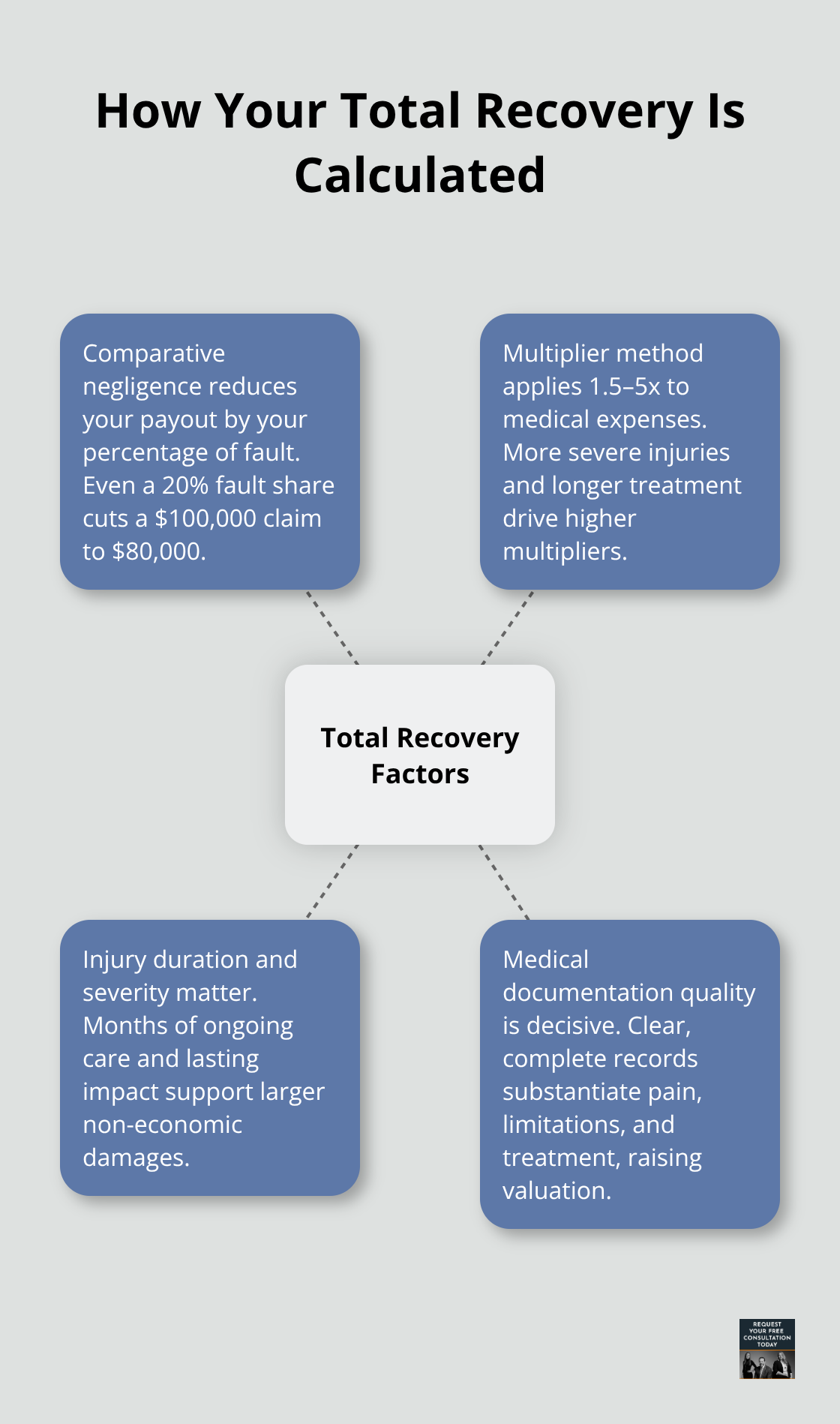
The multiplier method adjusters use typically ranges from 1.5 to 5 times your medical expenses, depending on injury severity and how long treatment lasted. Serious injuries that required months of ongoing care justify higher multipliers, but only if your medical records clearly show the lasting impact.
Insurance companies use software to standardize these calculations, which is exactly why your detailed documentation either strengthens or weakens your position significantly. The quality of your evidence directly determines whether you receive fair compensation or accept an artificially low offer. This reality makes your next steps-understanding what mistakes to avoid during negotiations-absolutely essential to protecting your recovery.
Negotiation Mistakes That Cost You Money
Insurance adjusters count on you making errors that reduce your settlement. The Insurance Information Institute found that people who negotiate their claims receive roughly 40 percent more than those accepting initial offers, yet most Santa Cruz accident victims never push back on lowball numbers. Your first offer is deliberately undervalued, designed to test whether you’ll accept pennies on the dollar without resistance. Adjusters know that many injured people need money fast and will take whatever gets handed to them. This advantage disappears when you refuse to accept their opening position, build an airtight documentation file before negotiations start, and avoid speaking with adjusters alone. The gap between initial offers and final settlements proves that negotiation works, but only if you understand what adjusters are doing and how they manipulate the process.
Why First Offers Fall Short
Insurers routinely open 30 to 50 percent below what your claim is actually worth. They’re testing your knowledge and your resolve. If you accept immediately, they save significant money. If you counter with solid documentation backing your position, they know you’re serious and will negotiate higher. A Santa Cruz victim with $50,000 in genuine damages who accepts a $25,000 opening offer just handed the insurance company $25,000 in pure profit. That money came directly from your recovery. The California Department of Insurance confirms that delayed responses and weak documentation are the two biggest reasons adjusters succeed in depressing settlements. Your response strategy matters enormously. Counter their first offer with a detailed demand letter showing your actual costs, medical timeline, and lost wages supported by receipts and records. Make them justify why their number is adequate.
Documentation Gaps Expose Your Weaknesses
Missing medical records, incomplete bill histories, or gaps between accident date and first treatment give adjusters legitimate reasons to question your injury claims. They’ll argue that injuries appearing weeks after the accident weren’t caused by the crash, or that treatment delays indicate less serious harm. Adjusters request full medical histories specifically to find pre-existing conditions they can blame instead of the accident. Start collecting everything that proves your damages immediately after the accident: police reports, photos from the scene, witness statements, and every single medical bill. Build a medical timeline showing when you first sought treatment and every subsequent visit. Maintain a daily journal documenting pain levels and activity restrictions. This evidence transforms your claim from a vague assertion into persuasive proof. Adjusters use claims-valuation software that standardizes pain calculations, but quality documentation forces them to adjust upward because your records are undeniably thorough and specific.
Unrepresented Conversations Weaken Your Position
Never give recorded statements to insurance adjusters without legal representation present. They’ll ask leading questions and use your own words against you later. You can decline recorded statements or request written questions instead, which preserves your control over responses. Adjusters are trained to identify hesitations, contradictions, or casual comments that weaken your position. A simple statement like “I’m doing okay” can be used to argue your injuries are minor. Adjusters work for the insurance company, not for you, regardless of how friendly they sound. If the at-fault driver carried only California’s minimum liability coverage of $30,000 per person, your recovery is capped there unless you have uninsured or underinsured motorist coverage. Having representation signals to insurers that you understand your rights and won’t accept manipulation.
What Happens When You Protect Your Rights
The settlement process moves differently once adjusters recognize you won’t accept lowball offers. They shift from testing tactics to genuine negotiation, which means higher final settlements. Your documentation file, combined with legal representation, eliminates the information advantage adjusters normally hold over unrepresented victims. This shift in power dynamics determines whether you recover fair compensation or settle for artificially depressed amounts. Understanding the timeline and phases of actual settlement negotiations reveals exactly what to expect next.
The Settlement Process: Timeline and What to Expect
Insurance Timelines Protect You From Silent Delays
The California Department of Insurance sets strict timelines that insurers must follow, and knowing these deadlines protects you from silent delays that weaken your position. Within 15 days of receiving your claim, the insurer must acknowledge it in writing. Within 15 days after that, they must begin their investigation. They then have 15 days to respond to your demand, and 40 days total from proof of loss to make a decision. Most Santa Cruz accident victims don’t realize these timelines exist, so they assume silence means progress when it actually means the insurer is stalling.
File your claim immediately after you receive medical care, not before, because treatment records strengthen your documentation package. Include the police report number, photos from the accident scene, witness contact information, and a detailed description of how the crash happened. Submit everything together rather than trickling documents over weeks, which signals you’re disorganized and gives adjusters reasons to request additional information they’ll use to delay negotiations.
The Adjuster Becomes Your Primary Contact
The at-fault driver’s insurance company will assign an adjuster within days, and this person becomes your primary contact throughout the process. This adjuster represents the insurance company’s interests, not yours, so treat all communications as formal and documented. Keep records of every phone call, email, and letter you exchange with the adjuster. Never agree to anything verbally-always request written confirmation of any statements or agreements the adjuster makes.
Negotiation Phases Narrow the Gap Between Offers
Settlement typically spans three to six months for straightforward cases, though moderate injuries can stretch to nine or twelve months depending on medical complexity. The initial settlement offer arrives weeks after you submit your demand letter, and it will be significantly lower than your actual damages. This opening position is not a negotiating point-it’s a test.
Counter with a detailed response showing every cost you’ve incurred, your medical timeline with supporting records, lost wages documentation, and a calculation of your pain and suffering using the multiplier method based on injury severity. Adjusters expect pushback and budget for it, so your refusal to accept lowball numbers doesn’t offend them-it simply moves the conversation into genuine negotiation territory. Most negotiations involve three to five rounds of offers and counteroffers before settlement, with each round narrowing the gap between your demand and their offer.
Coverage Limits May Cap Your Recovery
If the at-fault driver carried minimum liability coverage of $30,000 per person under California law, and your damages exceed that amount, your own uninsured or underinsured motorist coverage becomes critical to recovering the full value. Verify your UM/UIM limits immediately after the accident because these limits cap your additional recovery. About 20 percent of California drivers are uninsured, which means your own coverage protects you when the other driver lacks adequate insurance.
Settlement Agreement and Payment
Once you reach an agreement, the insurer drafts a settlement agreement releasing them from further liability in exchange for a lump sum payment. Review this document carefully before signing because it permanently closes your claim. Payment typically arrives within 10 to 21 business days after both parties sign, though some cases require longer if structured settlements are involved.
Final Thoughts
Settlement negotiations after a Santa Cruz car accident demand clarity about what you’re owed and confidence in your documentation. The three-part calculation method-medical expenses, lost wages, and property damage-gives you a concrete framework for evaluating any offer. Insurance companies count on confusion and urgency to push you toward accepting less than fair value, but you counter that pressure by building an airtight evidence file before negotiations start, refusing recorded statements without representation, and understanding that initial offers are deliberately low.
Auto compensation in Santa Cruz follows predictable patterns once you understand how adjusters operate. They use software to standardize calculations, request full medical histories to find pre-existing conditions, and deploy friendly tactics that mask their goal of minimizing your recovery. Your counter-strategy is equally straightforward: document everything, counter their opening position with detailed demands backed by receipts and records, and recognize that silence from the insurer often means stalling rather than progress.
We at Schaar & Silva LLP help Santa Cruz accident victims navigate this process by handling the legal complexities while you focus on recovery. Contact us to discuss your settlement strategy and maximize your recovery.
